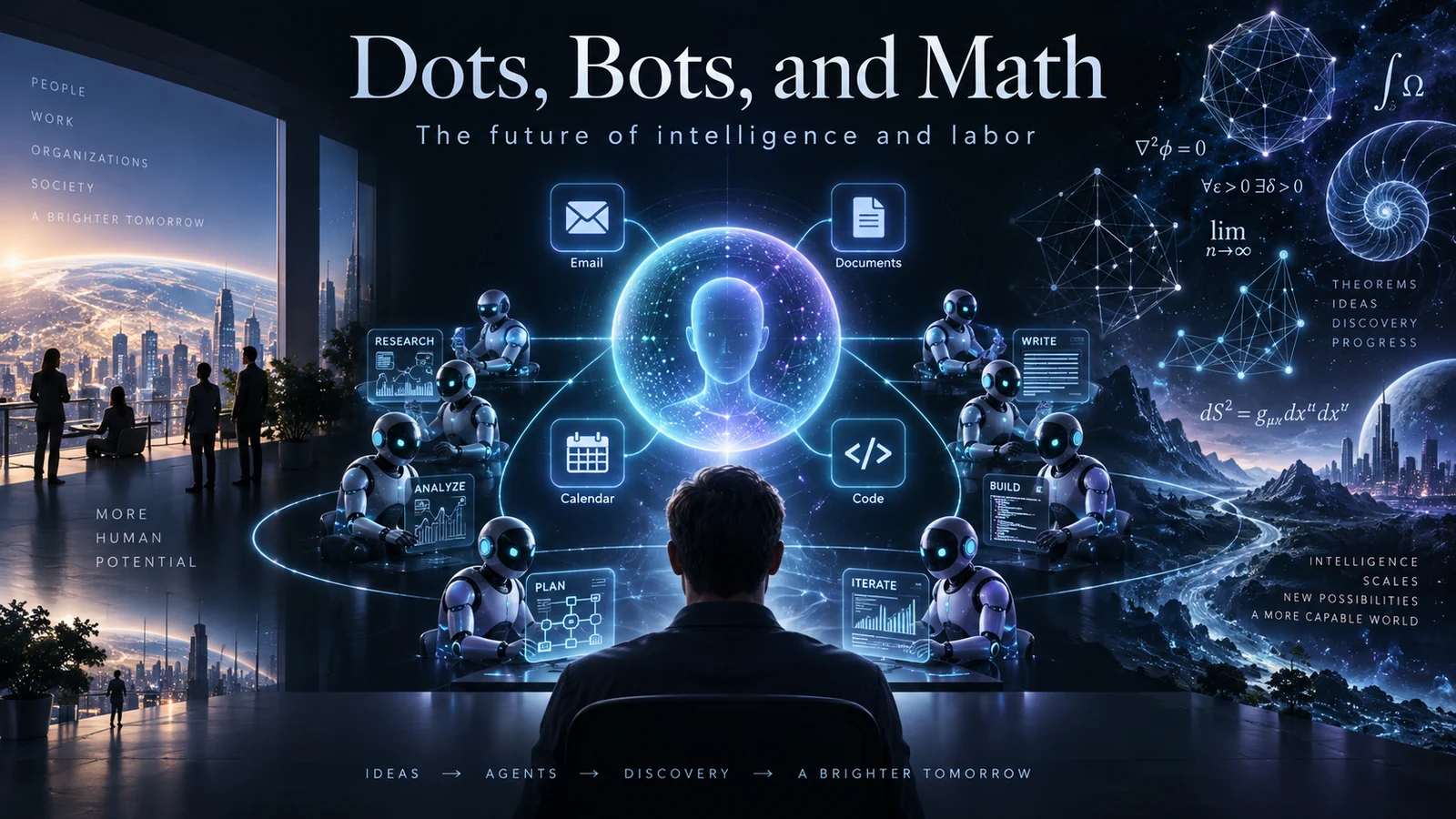

The important question is no longer whether AI can help us work faster. It is whether the way we organize work is becoming obsolete.

Get business pricing on tech for your team
- Business-only prices and quantity discounts
- Tax-exempt purchasing
- Multiple users, one account, clear invoices
For more than two centuries, our economic progress has depended on using technology to overcome scarcity. The steam engine multiplied muscle. Electricity reorganized factories. Computers accelerated calculations and connected information. But through all of those transformations, one constraint remained surprisingly stubborn: the availability of human intelligence to understand a problem, execute a plan, evaluate a result, and decide what should happen next.
We are now starting to challenge that constraint itself.
Three developments make the change unusually important. OpenAI’s Dots introduces the idea of a personal agent that can keep working across projects. Bots—autonomous software agents and coordinated agent systems—are beginning to perform sequences of actions instead of stopping at an answer. And Mathgives us a remarkable view of what happens when advanced reasoning and verification are applied to research at scale.
I do not see these as three unrelated product stories. Together, they suggest a different architecture for intellectual work. And once that architecture starts to function, the consequences extend well beyond IT departments. They reach expertise, management, software businesses, wages, and ultimately our understanding of the role work plays in society.
01 / Intelligence as an operating system
One intention. Many intelligences.
The change is not simply a better answer. It is an increasingly continuous path from a person’s goal to an executed, examined result.
Dots
The personal agent
Remembers the context of ongoing work, connects authorized tools and carries goals across projects.
Bots
Coordinated action
Specialist agents plan, run tools, exchange results, test, and revise within defined boundaries.
Math
Research and verification
Parallel search and formal methods can expand the capacity to discover and assess complex results.
Conceptual framework · Dots is OpenAI’s named product; Bots and Math describe broader technical capabilities. © Thorsten Meyer AI
My thesis is simple: the real disruption is not that AI can do our existing work faster. It is that AI may make the way we organize work itself obsolete.
Dots: The End of Starting Every Task from Zero

On September 29, 2026, OpenAI introduced Dots: always-on personal agents built to work across a person’s goals and projects. OpenAI describes dots as powered by GPT-6 Astra, equipped with their own cloud computer and able to connect to applications through plugins. Crucially, they are intended to retain continuity across tasks, learn from feedback, and do useful work while the user is occupied elsewhere.
This is not just a new chat interface.
In the conventional chatbot model, I must repeatedly reconstruct the situation. Here is my project. Here are the relevant files. Here are yesterday’s decisions. Here is the task. Even a brilliant answer is often a temporary event: one question, one response, one person responsible for carrying it forward.
A persistent agent changes that relationship. The unit of interaction becomes a goal that continues over time, not a prompt that ends when an answer appears.
That matters enormously in my own kind of work. I may be planning a software feature, reviewing the implementation of an agent-driven workflow, managing publishing operations, or analyzing a set of business results. The individual tasks are different, but the context, standards, and objectives are connected. If an agent can move between them with the right permissions, I spend less time rebuilding context and more time deciding what actually matters.
That does not justify granting agents unrestricted authority. Access must be scoped. Important financial and external actions need review. Results need inspection. A persistent agent becomes valuable precisely when it works within a dependable system of permissions, evidence, and accountability.
But the conceptual leap remains: we stop asking which application to open and begin asking which outcome to pursue.
As an affiliate, we earn on qualifying purchases.
Bots: From Answers to Work That Gets Done
A model can explain how to build an application. An agent can inspect a repository, edit files, run tests, diagnose a failure, revise code, and produce a result for review. A coordinated set of agents can divide that work across separate responsibilities.
The difference is not merely speed. It is the removal of human handoffs from parts of the process.
I increasingly think in terms of an agent production system: goals are defined, specialist tasks are assigned, environments are provided, tools are controlled, and results are checked. The system is not valuable because it has an impressive number of agents. It is valuable because it can turn a clear intention into a verifiable outcome.
In an older workflow, a person writes a requirement, another translates it into tickets, others implement and test it, somebody prepares a report, and another person sends the information back through the hierarchy. Some of those steps involve judgment and should remain human decisions. Others exist because organizations have historically needed people to move work from one place to another.
Once autonomous execution improves, we have a choice. We can put an AI assistant inside each existing step. Or we can redesign the entire value stream.
I believe the second choice is the more consequential one.
The engineering challenges are real: tool reliability, adversarial inputs, hallucinated assumptions, security boundaries, software tests, audit trails, and escalation of uncertain decisions. An agent that acts faster but produces untraceable errors is not an improvement. Autonomy without verification is simply risk at machine speed.
Still, when these controls are designed correctly, a small team can pursue work that previously required a much larger operation. The limiting factor shifts away from typing and coordination and toward choosing valuable problems, designing good systems, and validating their results.
As an affiliate, we earn on qualifying purchases.
Math: A New Scale for Intellectual Discovery
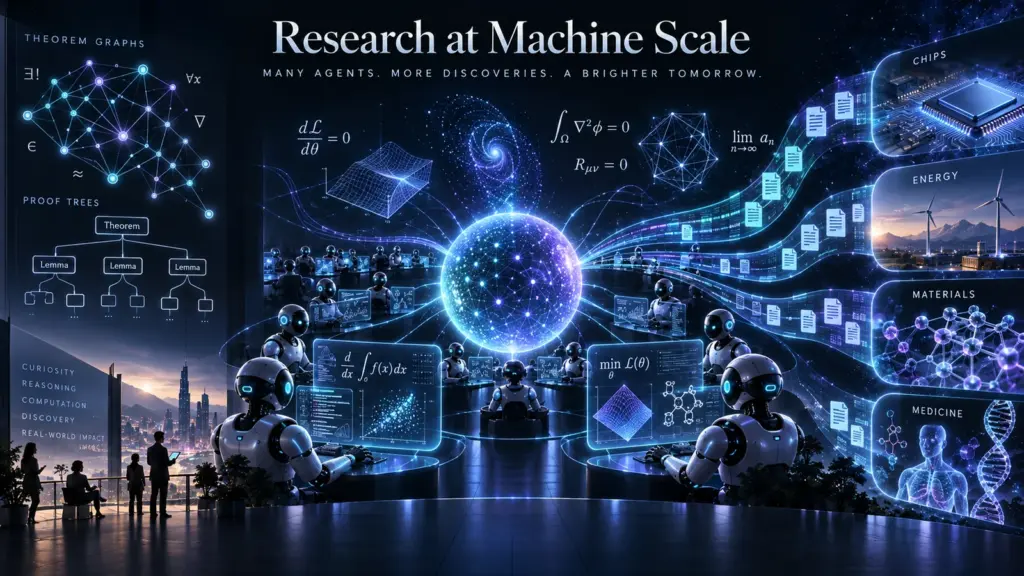
The clearest illustration of this change comes from mathematics, where some outputs can be checked against unusually strict formal rules.
On September 8, 2026, OpenAI announced a proposed solution to the Navier–Stokes existence and smoothness problem, one of the Clay Mathematics Institute’s Millennium Prize Problems. OpenAI reported using a coordinated research system with approximately 10,000 concurrent agents. According to its account, the agents reached their proposed result about 88 hours after the effort began; Lean formalization and verification took another 17 hours.
These are extraordinary engineering figures, regardless of how the eventual mathematical assessment unfolds. The Clay Mathematics Institute welcomed the apparent breakthrough while emphasizing that evaluating a Millennium Prize solution is a separate, deliberately careful process.
Then came a second development. On October 6, OpenAI released 722 mathematical manuscripts, organized into 372 related result families, produced through an internal, unreleased frontier model. The company reported that its evaluation covered approximately 4,000 posed problems and that the average retained result required compute equivalent to around three hours of ChatGPT Pro thinking with that model.
That three-hour figure matters, but so does its meaning. It is a compute-equivalent estimate per result, not a promise that every manuscript was finished in three wall-clock hours, and not evidence that today’s publicly available model can reproduce the same research. The releases also represent different workflows: the Navier–Stokes effort relied on a huge coordinated agent system; the broad manuscript collection was generated largely through a consistent procedure using the unreleased model.
The original release contained 722 manuscripts. After three withdrawals on October 7, the live repository listed 719 manuscripts. OpenAI’s revision historyalso documents corrections. Some results have formal Lean artifacts; others remain at different stages of checking. A released manuscript should not be treated as an independently certified theorem simply because it appears in a large collection.
These distinctions do not weaken the central point. They make it sharper.
02 / Research at machine scale · September–October 2026
Two research workflows. One emerging capability.
A coordinated agent swarm for one major problem versus a broad catalogue produced largely with a consistent procedure using an unreleased frontier model.
Navier–Stokes
Announcement of a proposed Millennium Problem solution; independent prize evaluation is a separate process.
Mathematics manuscripts
88 hours is reported elapsed time. The ~3-hour figure estimates equivalent compute per result—not elapsed wall time or the speed of a publicly available model.
After three withdrawals, the catalogue stood at 719 manuscripts. Formal proofs, revisions and independent scrutiny continue.
Sources: Navier–Stokes announcement · Mathematics release · Live repository · Revision history · Clay evaluation context. Figures checked October 12, 2026. © Thorsten Meyer AI
The important shift is from research as a limited sequence of human attempts toward research as a system of parallel exploration, selection, formal checking, correction, and publication. Science still needs interpretation, peer scrutiny, experiments, and consequences in the real world. But the capacity to generate candidate mathematical insights may become dramatically more abundant.
As an affiliate, we earn on qualifying purchases.
What Happens When Expertise Becomes Abundant?
Consider an intentionally extreme thought experiment: what if we could direct intellectual work equivalent to a billion Fields Medalists, around the clock? That is a provocative future scenario, not a measured population of mathematicians or AI systems. Its value is that it exposes the economic question behind the technical one.
We usually focus on whether one AI system can solve one hard problem. But organizations are constrained by how many good attempts they can pursue. A research institute may have more promising questions than people who can work on them. A software business may have more product ideas than engineering capacity. A hospital may have more data than experts can examine.
If the cost of intelligent attempts falls, the bottleneck moves. It may move to choosing meaningful research questions, obtaining good data, testing hypotheses, building hardware, securing energy, earning trust, or deploying a result safely.
Mathematics also sits beneath physics, semiconductor design, materials science, chemistry, and parts of modern medicine. Faster mathematical discovery could unlock progress across these fields. But no equation becomes a working reactor, a safe medicine, or a commercial chip automatically. Real-world validation is still expensive and sometimes slow.
This is why I resist both easy extremes: the claim that AI research changes nothing, and the claim that a remarkable demonstration means every scientific challenge has already been solved. The more useful question is: which constraint moves next?
Walkers vs. Rockets: Rethinking Expertise
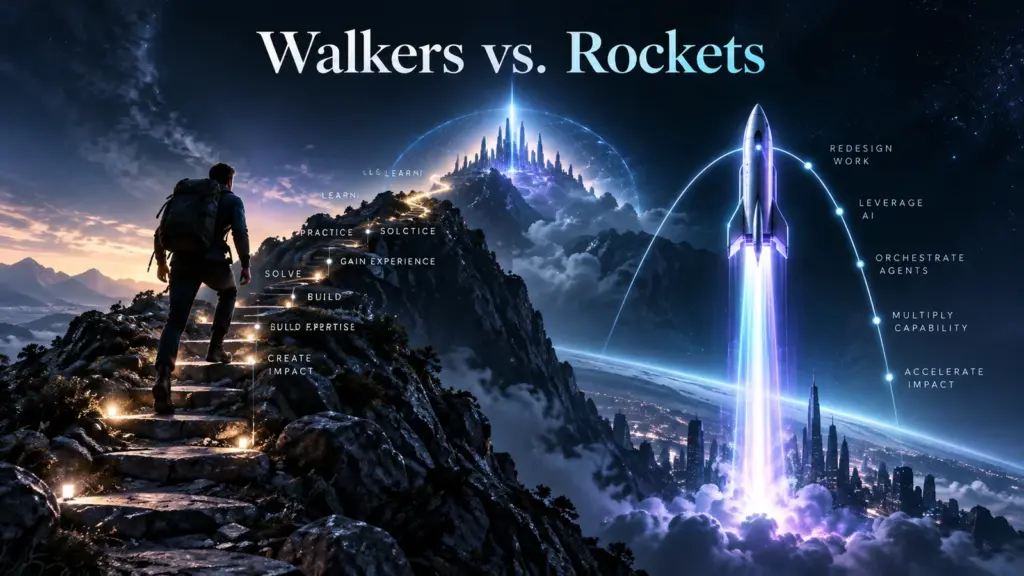
Imagine two people trying to reach the same mountain summit.
The first becomes a better climber. They study the route, practice, acquire equipment, and gain experience. That is how we have traditionally defined professional mastery: by developing the ability to perform a difficult process ourselves.
The second person asks whether climbing is the right way to reach the summit at all. They design a rocket.
The rocket does not eliminate the value of understanding the mountain. It changes the route, the economics, and the scale of what becomes possible.
I see the same tension in business technology. We often try to make an existing spreadsheet, reporting system, or software application do one more job. We add automation around the old interface. We optimize a task without challenging why the task exists.
For me, Excel is a good example. It can be a useful tool for inspecting information. But it is frequently treated as the workflow itself, when in reality it may be only a visibility layer over a process that could be redesigned. The important question is not whether an AI can fill a spreadsheet faster. It is whether anyone needs to fill that spreadsheet in the first place.
03 / A choice in organizational design
Walkers vs. Rockets
Both approaches can produce real work. Only one starts by questioning whether the existing route is still necessary.
The Walker
A person becomes better at the route already defined.
The Rocket
A person defines the destination and redesigns the route.
Illustrative operating-model comparison, not a measured company productivity result. Strong human judgment and safeguards remain essential. © Thorsten Meyer AI
This changes what expertise means. The most valuable person may not be the one who executes the largest number of tasks. They may be the one who identifies the correct outcome, assembles the system that produces it, and recognizes whether the result can be trusted.
Are we becoming better at moving the cart from A to B—or finally asking why the cart exists?
2027: The Organization Becomes the Competitive Battlefield
I see 2027 as a plausible inflection point for organizations, not because a calendar year guarantees disruption, but because the gap between two operating models could become difficult to ignore.
The first organization treats AI as a tool added to the existing structure. It keeps the same reporting layers, the same handoffs, and the same approach to roles. People work slightly faster inside the architecture they inherited.
The second organization asks what an AI-native company would look like if it were designed today. People own outcomes. Agents provide execution and coordination. Shared data and reusable capabilities replace unnecessary information relays. Human review is applied where expertise, accountability, or judgment genuinely matters.
That second company need not simply be a smaller version of the first. It may be a different kind of company: able to experiment more frequently, offer services that previously were uneconomic, and coordinate work without reproducing every old department boundary.
This is not an argument for declaring people obsolete. In many organizations, human relationships, local knowledge, responsibility, and complex judgment remain critical. A dangerous mistake would be to confuse fewer manual handoffs with less need for governance.
But another mistake is to treat every existing role and approval chain as permanent. If the process changes, the organizational chart should be allowed to change with it.
That raises a hard leadership question: if our competitor redesigns its value stream while we merely give every employee a chatbot, are we competing with the same production system anymore?
After Apps: Could the Agent Become the Interface?
Today’s enterprise software stacks often consist of separate systems for customers, finance, documents, projects, tickets, analytics, and reporting. A human moves between those systems, gathering context and triggering actions. The interfaces are designed around what a person needs to click, read, and reconcile.
My longer-term expectation is an architecture based on owned data, well-defined capabilities, policies, and agents. A person describes an objective. An agent retrieves authorized information, invokes appropriate tools, coordinates other agents, and returns an outcome with evidence. Conventional applications do not necessarily disappear: many continue to serve as systems of record, specialized workbenches, or essential review surfaces.
But the default interaction may change. Instead of entering six applications to complete one process, the user may have one agentic interface for the outcome and only open a specialist screen when necessary.
This is especially important for companies considering long-lived software investments. The question is not simply whether an application has AI features. It is whether the architecture allows a future agent to access the underlying data and capabilities safely, portably, and without trapping the organization inside one fixed interface.
The Labor Zero Horizon: What If Work Stops Being the Ticket to Prosperity?
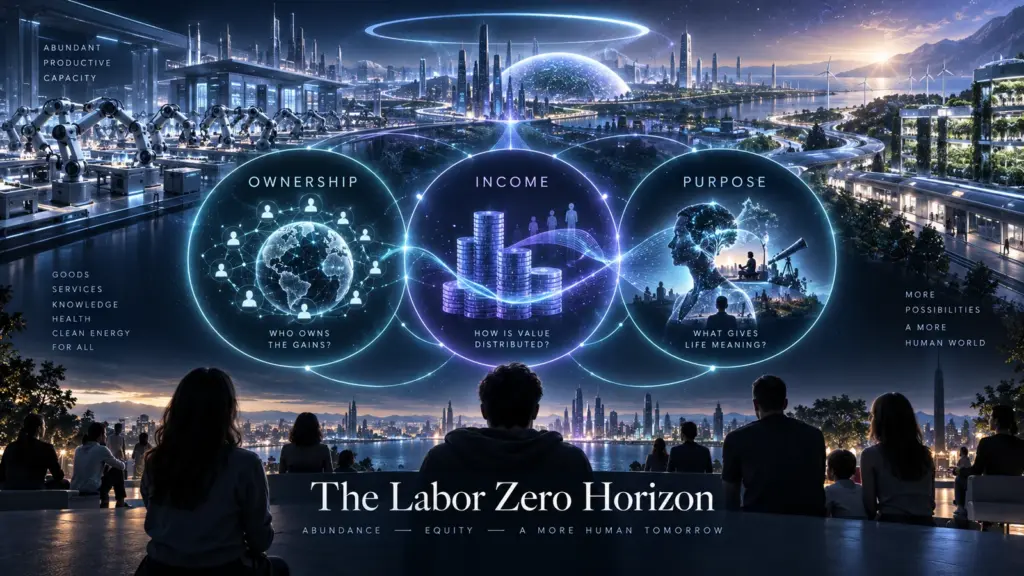
Now we reach the question I find most consequential.
Our economic and social institutions largely assume that human labor is scarce and that people must sell time and expertise to gain income. Even when machines produce enormous value, employment remains central to wages, social security, identity, and opportunity.
Suppose increasingly capable AI systems can produce more intellectual output without a proportional increase in human working hours. This does not imply that every job disappears. It does not mean energy, hardware, physical resources, regulation, trust, or genuine care become free. Labor Zero Horizon is a limit case: a way to think about what happens if human cognitive labor is no longer the central scarce input across a growing part of the economy.
Then three questions become unavoidable.
Ownership: Who controls the models, compute, intellectual property, data, distribution channels, and productive agent systems?
Income: If output expands while demand for some forms of work falls, how do the economic gains reach people who do not own those systems?
Purpose: If employment becomes less central to production, how do we preserve dignity, belonging, learning, contribution, and social status without demanding that every person remain economically indispensable?
The technology does not answer these questions. Markets, governments, institutions, employers, and citizens will.
There are optimistic possibilities. Cheaper research could improve medicine. More accessible intelligence could give small organizations capabilities once reserved for large firms. Better services could become affordable to many more people. There are also severe risks: concentrated ownership, weakened bargaining power, fragile dependence on a few infrastructure providers, and a pace of adaptation faster than existing institutions can handle.
04 / The economic thought experiment
The Labor Zero Horizon
What happens if cognitive output keeps expanding without a matching increase in human labor? Greater productive capacity is not, by itself, a distribution policy.
Ownership
Who controls models, compute, data, the agent infrastructure—and the gains?
Income
How do people benefit when productive capacity no longer tracks working hours?
Purpose
Where do dignity, contribution, learning, and belonging come from beyond a job?
Lower-cost services, wider opportunity, access to tools and shared prosperity.
Ownership concentration, weaker bargaining power and unequal access.
Scenario, not prediction that all jobs or costs disappear. Physical resources, care, governance and accountability remain real constraints. © Thorsten Meyer AI
The difference between those outcomes is not merely how intelligent the models become. It is how we choose to organize the resulting abundance.
The Question Is Not Whether We Can Stop This Conversation
I am not arguing that the future is predetermined, that every announcement is an independently established theorem, or that the next generation of AI will make human beings unnecessary. Those are poor substitutes for serious thinking.
I am arguing that our planning assumptions deserve to be challenged.
For years, we have discussed AI as a way to help people do more work. We now have to consider systems that can carry intentions across time, execute work across applications, and participate in sophisticated research processes. That combination may change the underlying economics of many professions and organizations.
The next question is therefore not, How do we get everyone to use AI?
It is, What would we build if we did not assume that human labor had to perform every step between an idea and an outcome?
And beyond the organization itself: if work eventually becomes a less reliable ticket to prosperity, what takes its place?
That is not a question for the technology industry alone. It is a question about the kind of society we want to create.
Sources and further reading
- OpenAI — Introducing dots (September 29, 2026)
- OpenAI — On the Navier–Stokes Millennium Prize Problem (September 8, 2026)
- Clay Mathematics Institute — Navier–Stokes Announcement (September 11, 2026)
- OpenAI — Sharing AI progress in mathematics (October 6, 2026)
- OpenAI math repository: publications, formalizations and revision history
- OpenAI math release revision history
Research facts and product descriptions reflect public sources available on October 12, 2026. Organizational timelines and socioeconomic outcomes are the author’s analysis and scenarios.
Halloween Picks
halloween
As an affiliate, we earn on qualifying purchases.