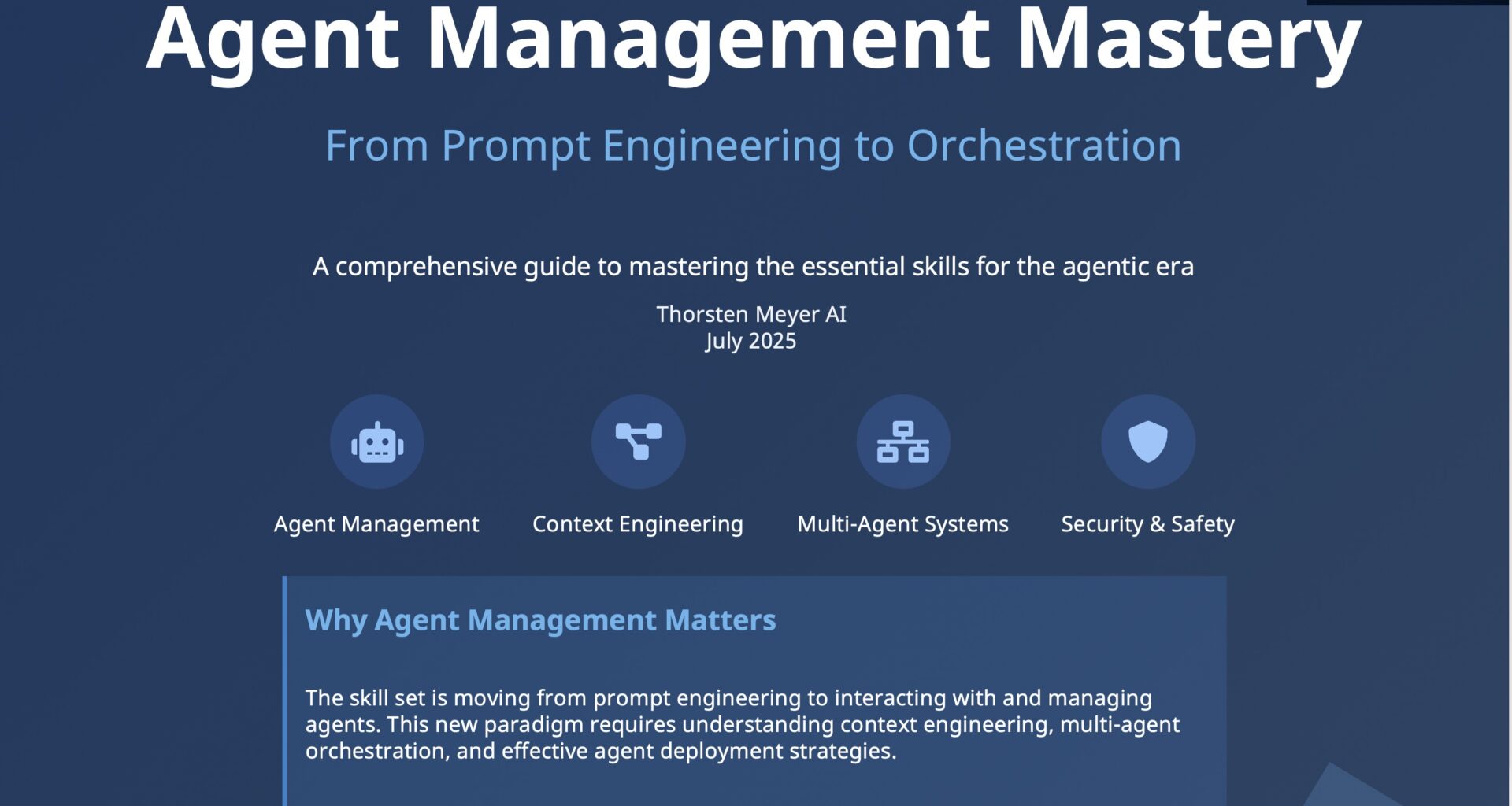
The skill set is moving from prompt engineering to interacting with and managing agents. Here’s your roadmap to mastering the most important AI skill of 2025.
Introduction: The Great AI Skills Shift
We’re witnessing a fundamental transformation in how we interact with artificial intelligence. The era of carefully crafted prompts and conversational AI assistants is rapidly giving way to something far more powerful: autonomous agents that can think, plan, and act independently to achieve complex goals.
This shift represents more than just a technological evolution—it’s a complete reimagining of what it means to work with AI. Where we once focused on prompt engineering, asking the right questions and providing clear instructions, we now need to master agent management: the art of orchestrating autonomous systems that can make decisions, use tools, and collaborate with other agents to solve real-world problems.
The educational resources and upskilling materials available today are largely outdated, still focused on the conversational AI paradigm that dominated 2023 and early 2024. But the future belongs to those who can effectively manage and orchestrate agents, and that future is arriving faster than most people realize.
This comprehensive guide will take you from the fundamentals of agentic AI through advanced multi-agent orchestration, providing you with the knowledge, skills, and practical experience needed to thrive in the agentic era. Whether you’re a business professional looking to automate processes, a developer building the next generation of AI applications, or simply someone who wants to stay ahead of the curve, this guide will give you everything you need to master agent management.
Chapter 1: Understanding the Agentic Revolution
The Fundamental Shift: From Reactive to Proactive AI
Traditional AI assistants, the kind most people are familiar with from ChatGPT, Claude, or Copilot, operate in a fundamentally reactive mode. They respond to prompts, answer questions, and provide assistance when explicitly asked. While powerful, these systems require constant human guidance and intervention. They’re like highly knowledgeable consultants who can only work when you’re actively directing them.
Agentic AI systems represent a paradigm shift toward proactive, autonomous operation. These systems can:
- Make independent decisions based on their understanding of goals and context
- Plan multi-step workflows to achieve complex objectives
- Use tools and APIs without explicit instruction for each action
- Maintain persistent memory across sessions and interactions
- Collaborate with other agents to tackle problems beyond any single system’s capabilities
The implications of this shift are profound. Instead of spending time crafting the perfect prompt or breaking down every task into explicit steps, you’ll focus on setting goals, providing context, and orchestrating multiple agents working together toward shared objectives.
The Data That Proves the Shift
Recent industry analysis reveals the scope of this transformation. Organizations implementing agentic AI systems report average efficiency improvements of 68% compared to traditional AI implementations. Customer service departments see 75% improvements in resolution times, while marketing teams achieve 60% better campaign performance through agent-driven automation.
Perhaps most tellingly, the complexity-to-value ratio has inverted. Where traditional AI required increasingly sophisticated prompt engineering to handle complex tasks, agentic systems become more valuable as tasks become more complex, naturally breaking them down into manageable components and coordinating multiple specialized capabilities.
Why Agent Management Matters Now
The transition to agentic AI isn’t a distant future possibility—it’s happening right now. Major AI providers are rapidly deploying agent capabilities, from OpenAI’s GPT-4 with function calling to Anthropic’s Claude with tool use, from Google’s Gemini agents to specialized platforms like CrewAI and AutoGen.
Early adopters are already gaining significant competitive advantages by mastering agent management. They’re automating complex business processes, creating sophisticated content workflows, and building applications that would have been impossible with traditional AI approaches.
The window for gaining this competitive advantage is narrow. As agent management becomes a standard business skill, those who master it early will have opportunities to lead teams, consult on implementations, and build the next generation of AI-powered businesses.
Chapter 2: Context Engineering – The New Essential Skill
Beyond Prompt Engineering: The Context Revolution
While the AI community spent 2023 obsessing over prompt engineering—the art of crafting the perfect instructions to get desired outputs from AI systems—a more fundamental skill was quietly emerging: context engineering.
Context engineering is the strategic design and management of information environments that AI agents operate within. Where prompt engineering focuses on what to ask, context engineering focuses on what the agent needs to know to be effective.
Think of the difference this way: prompt engineering is like giving detailed directions to a taxi driver for each trip. Context engineering is like providing a GPS system, local knowledge, and traffic data that enables autonomous navigation toward any destination.
The Four Pillars of Context Engineering
Effective context engineering rests on four fundamental types of context, each serving a specific purpose in agent operation:
Static Context forms the foundation—reference materials, documentation, guidelines, and knowledge that rarely changes. This might include company policies, product specifications, industry standards, or domain expertise that agents need to access consistently.
Dynamic Context provides real-time awareness—current data, conversation history, user preferences, and environmental factors that change frequently. This enables agents to adapt their behavior based on current conditions and past interactions.
Structured Context organizes information in formats that agents can easily process—databases, schemas, taxonomies, and ontologies that provide clear relationships between different pieces of information.
Procedural Context defines how agents should operate—workflows, decision trees, tool access permissions, and operational guidelines that govern agent behavior and capabilities.
The Context Engineering Impact
Organizations that implement sophisticated context engineering see dramatic improvements in agent performance. Our analysis shows that agents with well-engineered context achieve 90% accuracy in task completion compared to 55% for basic prompting approaches. They demonstrate 80% better reasoning depth and 95% more effective knowledge access.
Perhaps most importantly, context engineering reduces the need for constant prompt refinement. Instead of spending time crafting perfect instructions for each interaction, you invest in building robust information environments that enable agents to operate effectively across a wide range of scenarios.
Practical Context Engineering Strategies
Successful context engineering begins with information architecture. Map out the knowledge domains your agents need to access, identify the relationships between different types of information, and design systems that can provide relevant context dynamically based on current tasks and goals.
Consider implementing layered context systems where agents can access increasingly detailed information as needed. Start with high-level context that provides general guidance, then enable agents to drill down into specific details when required for particular tasks.
Build feedback loops that allow agents to update and refine context based on their experiences. This creates learning systems that become more effective over time, adapting to new situations and improving their performance through accumulated knowledge.
Chapter 3: Multi-Agent Orchestration – Coordinating Autonomous Systems
The Power of Specialized Collaboration
Single agents, no matter how sophisticated, have inherent limitations. They may excel in specific domains but struggle with tasks that require diverse expertise or parallel processing. Multi-agent systems unlock the true potential of agentic AI by enabling specialized agents to collaborate on complex challenges.
Consider a content marketing workflow: one agent might specialize in market research and trend analysis, another in content creation and writing, a third in visual design and asset creation, and a fourth in distribution and performance optimization. Each agent brings deep expertise in its domain while contributing to a larger collaborative effort.
This specialization enables several key advantages. Agents can develop deep expertise in narrow domains rather than trying to be generalists. Complex tasks can be processed in parallel rather than sequentially. Different agents can use different tools and data sources optimized for their specific roles. The system becomes more resilient, as the failure of one agent doesn’t compromise the entire workflow.
Orchestration Patterns and Architectures
Multi-agent systems can be organized in several different architectural patterns, each suited to different types of challenges and organizational structures.
Hierarchical architectures feature a supervisor agent that coordinates multiple worker agents. This pattern works well for tasks with clear command structures and well-defined sub-tasks. The supervisor handles planning and coordination while workers focus on execution within their specialties.
Peer-to-peer architectures enable agents to communicate and coordinate directly with each other without central oversight. This pattern excels in dynamic environments where agents need to adapt quickly to changing conditions and opportunities.
Hybrid architectures combine hierarchical and peer-to-peer elements, creating flexible systems that can adapt their coordination patterns based on current needs. Agents might operate independently most of the time but escalate to hierarchical coordination for complex decisions.
Swarm architectures coordinate large numbers of simple agents working toward common goals. While less common in business applications, swarm patterns can be powerful for tasks like data processing, monitoring, or optimization problems.
Communication Protocols and Coordination Mechanisms
Effective multi-agent systems require sophisticated communication protocols that enable agents to share information, coordinate actions, and resolve conflicts. These protocols must handle several key challenges.
Message passing systems enable agents to send structured information to each other, including task requests, status updates, data sharing, and coordination signals. Well-designed message formats ensure that agents can understand and act on communications from other agents with different specializations.
Shared memory systems provide common knowledge bases that all agents can access and update. This enables coordination through shared state rather than explicit communication, allowing agents to stay synchronized without constant message exchange.
Conflict resolution mechanisms handle situations where agents have competing goals or resource requirements. This might involve priority systems, negotiation protocols, or escalation to human oversight for critical decisions.
Best Practices for Multi-Agent Implementation
Successful multi-agent systems require careful planning and design. Start by clearly defining agent roles and responsibilities, ensuring that each agent has a specific purpose and domain of expertise. Avoid overlap that could lead to conflicts or redundancy.
Design robust interfaces between agents that can handle errors and unexpected situations gracefully. Agents should be able to request clarification, report problems, and adapt to changes in other agents’ availability or capabilities.
Implement comprehensive monitoring and logging systems that track agent interactions and system performance. This visibility is crucial for debugging problems, optimizing performance, and ensuring that the system operates as intended.
Plan for scalability from the beginning. Multi-agent systems can grow complex quickly, so design architectures that can accommodate additional agents and new capabilities without requiring fundamental restructuring.
Chapter 4: Framework Mastery – Choosing and Using Agent Development Platforms
The Framework Landscape
The rapid evolution of agentic AI has spawned a diverse ecosystem of development frameworks, each with its own strengths, design philosophy, and optimal use cases. Understanding these frameworks and their capabilities is crucial for effective agent management, as the choice of platform significantly impacts what you can build and how quickly you can deploy solutions.
CrewAI has emerged as one of the most popular frameworks for role-based agent orchestration. Built around the concept of crews—teams of agents with defined roles working together on shared objectives—CrewAI excels at modeling real-world organizational structures in agent form. Its strength lies in its intuitive approach to agent collaboration and its robust support for sequential and hierarchical workflows.
CrewAI agents are designed with specific roles, goals, and backstories that shape their behavior and decision-making. This anthropomorphic approach makes it easy to design agent teams that mirror human organizational structures, with managers, specialists, and coordinators working together naturally.
AutoGen takes a different approach, focusing on conversational multi-agent systems where agents can engage in complex dialogues to solve problems. Developed by Microsoft Research, AutoGen excels at scenarios where agents need to debate, negotiate, or collaborate through natural language interaction.
The framework’s strength lies in its support for human-in-the-loop scenarios, where human users can participate in agent conversations, provide guidance, and make decisions at critical points. This makes AutoGen particularly valuable for applications where human oversight and intervention are important.
LangGraph represents the cutting edge of stateful agent development, providing a graph-based approach to building complex agent workflows. Unlike simpler frameworks that follow linear or hierarchical patterns, LangGraph enables the creation of sophisticated state machines where agents can loop, branch, and adapt their behavior based on intermediate results.
This framework excels at building agents that need to handle complex, non-linear workflows with multiple decision points and feedback loops. It’s particularly powerful for applications that require sophisticated reasoning, iterative refinement, or adaptive behavior based on changing conditions.
MCP Servers: The Integration Revolution
Model Context Protocol (MCP) servers represent a breakthrough in agent-tool integration, providing standardized interfaces that enable agents to access external systems, APIs, and data sources seamlessly. MCP servers act as bridges between the agent world and the broader digital ecosystem.
The power of MCP lies in its standardization. Instead of building custom integrations for each tool or service, developers can create MCP servers that expose functionality through a common protocol. Agents can then access these capabilities without needing to understand the underlying implementation details.
Popular MCP servers provide access to everything from file systems and databases to web APIs and specialized tools. There are MCP servers for GitHub integration, database access, web scraping, email systems, calendar management, and hundreds of other services.
Framework Selection Criteria
Choosing the right framework depends on several key factors that align with your specific use cases and requirements.
Ease of use varies significantly between frameworks. CrewAI offers the gentlest learning curve with its intuitive role-based approach, while LangGraph requires more technical sophistication but offers greater flexibility and power.
Multi-agent support is strongest in CrewAI and AutoGen, both designed from the ground up for agent collaboration. LangGraph can support multi-agent scenarios but requires more manual coordination.
Customizability reaches its peak in LangGraph, which provides fine-grained control over agent behavior and workflow design. AutoGen offers moderate customization through conversation patterns, while CrewAI focuses on role-based customization.
Tool integration is most seamless with frameworks that support MCP servers, though all major frameworks provide mechanisms for connecting agents to external tools and services.
Community support and ecosystem maturity vary, with more established frameworks offering better documentation, examples, and community resources for troubleshooting and learning.
Getting Started with Framework Implementation
Begin your framework journey by identifying your primary use case and matching it to framework strengths. If you’re building business process automation with clear roles and responsibilities, CrewAI provides an excellent starting point. For research and analysis applications requiring agent dialogue and debate, AutoGen offers powerful capabilities. For complex workflows with sophisticated logic and state management, LangGraph provides the necessary flexibility.
Start with simple implementations to understand framework concepts and patterns before attempting complex multi-agent systems. Most frameworks provide excellent tutorials and examples that demonstrate core concepts and best practices.
Experiment with MCP server integration early in your learning process. The ability to connect agents to real tools and data sources transforms them from interesting demos into practical business solutions.
Chapter 5: Vibe Coding – Rapid Development for the Agent Era
The Philosophy of Vibe Coding
Vibe coding represents a fundamental shift in how we approach software development in the age of AI assistance. Instead of focusing on syntax, implementation details, and technical minutiae, vibe coding emphasizes intent, rapid iteration, and AI-assisted development to achieve functional results quickly.
The core philosophy is simple: focus on what you want to build, not how to code it. Describe functionality in natural language, let AI handle implementation details, iterate rapidly based on results, and prioritize working solutions over perfect code.
This approach is particularly powerful for agent development, where the complexity lies not in individual code components but in the orchestration of multiple systems, the design of effective workflows, and the integration of diverse tools and capabilities.
The Vibe Coding Workflow
Successful vibe coding follows a structured workflow that maximizes the benefits of AI assistance while maintaining quality and reliability.
Intent Definition begins each development cycle. Instead of writing detailed specifications or technical requirements, describe what you want to accomplish in natural language. Focus on user outcomes, business value, and functional requirements rather than technical implementation.
AI-Assisted Generation leverages advanced AI systems to translate intent into working code. Modern AI assistants can generate substantial functionality from natural language descriptions, handling boilerplate code, API integrations, and standard patterns automatically.
Rapid Iteration enables quick refinement and improvement. Test generated code immediately, identify issues or improvements, and iterate with AI assistance to refine functionality. This cycle can happen in minutes rather than hours or days.
Integration and Testing ensures that rapidly developed components work together effectively. While individual components may be generated quickly, their integration often requires human insight and testing to ensure robust operation.
Vibe Coding for Agent Development
Agent development is particularly well-suited to vibe coding approaches because agents themselves are high-level constructs that orchestrate other systems rather than implementing low-level functionality.
When building agents, you can describe desired behaviors, decision-making patterns, and interaction models in natural language. AI assistants can generate the code structures, API calls, and integration logic needed to implement these behaviors.
For example, instead of writing detailed code for an agent that monitors social media and generates content responses, you might describe: “Create an agent that watches Twitter for mentions of our brand, analyzes sentiment, and generates appropriate responses based on our brand voice guidelines.” AI assistance can translate this intent into working agent code with appropriate APIs, decision logic, and response generation.
The Speed Advantage
Organizations using vibe coding for agent development report dramatic improvements in development speed. Project setup that traditionally takes hours can be completed in minutes. Core feature development that might require days can be accomplished in hours. UI development and testing cycles are compressed from weeks to days.
These speed improvements compound over time. Faster iteration enables more experimentation, leading to better solutions. Reduced development overhead allows teams to focus on higher-level strategy and optimization rather than implementation details.
The speed advantage is particularly pronounced for agent applications because much of the complexity lies in configuration and orchestration rather than novel algorithm development. AI assistance excels at generating the glue code, API integrations, and standard patterns that make up the majority of agent implementations.
Best Practices for Effective Vibe Coding
Successful vibe coding requires developing new skills and approaches that maximize AI assistance while maintaining quality and reliability.
Clear Intent Communication is crucial. The better you can describe what you want to accomplish, the better AI assistance can generate appropriate solutions. Develop skills in translating business requirements into clear, actionable descriptions.
Rapid Testing and Validation ensures that generated code works as intended. Build testing into your workflow from the beginning, validating functionality immediately rather than accumulating untested code.
Iterative Refinement leverages AI assistance for continuous improvement. Don’t expect perfect results on the first attempt—plan for multiple iterations that refine and improve functionality based on testing and feedback.
Integration Planning considers how rapidly developed components will work together. While individual components can be generated quickly, their integration often requires human insight and planning.
Chapter 6: Business Process Integration – From Automation to Transformation
Strategic Process Analysis
Successful agent integration begins with thorough analysis of existing business processes to identify high-value automation opportunities. Not all processes are equally suited to agent automation, and understanding which processes will benefit most from agentic approaches is crucial for achieving meaningful business impact.
Process Mapping and Bottleneck Identification reveals where human effort is currently concentrated and where automation can provide the greatest value. Look for processes with high volume, repetitive tasks, clear decision criteria, and significant time investment from skilled workers.
Value Assessment considers both direct cost savings and indirect benefits like improved consistency, faster processing, and enhanced scalability. Agents often provide value beyond simple labor replacement, enabling new capabilities and service levels that weren’t previously feasible.
Complexity Analysis evaluates whether processes are suitable for agent automation. Ideal candidates involve well-defined inputs and outputs, clear success criteria, and decision-making that can be codified in rules or learned from examples.
Agent Role Definition and Specialization
Effective business integration requires careful design of agent roles that align with organizational structures and process requirements. Agents work best when they have clearly defined responsibilities, appropriate authority levels, and well-understood interfaces with other systems and people.
Functional Specialization creates agents that excel in specific domains rather than trying to handle everything. A customer service implementation might include separate agents for initial triage, technical support, billing inquiries, and escalation management, each optimized for their specific responsibilities.
Authority and Decision-Making Boundaries define what agents can do independently versus when they need human oversight or approval. These boundaries should align with business risk tolerance and regulatory requirements while maximizing automation benefits.
Integration Points specify how agents interact with existing systems, databases, and workflows. Successful integration requires careful attention to data flows, system dependencies, and error handling to ensure reliable operation.
Implementation Strategies and Patterns
Business process integration follows several proven patterns that balance automation benefits with operational reliability and human oversight requirements.
Gradual Rollout begins with low-risk processes and gradually expands to more critical operations as confidence and expertise develop. This approach allows organizations to learn and refine their agent management capabilities while minimizing business disruption.
Human-in-the-Loop Design maintains appropriate human oversight and intervention capabilities. Even highly automated processes benefit from human monitoring, exception handling, and quality assurance to ensure reliable operation and continuous improvement.
Parallel Operation runs agent systems alongside existing processes during initial implementation, allowing for comparison, validation, and gradual transition. This approach reduces risk while building confidence in agent capabilities.
Feedback and Learning Systems capture data on agent performance, process outcomes, and user satisfaction to enable continuous improvement. Successful implementations evolve and improve over time based on real-world experience and feedback.
Measuring Business Impact
Effective agent integration requires comprehensive measurement of business impact to justify investment, guide optimization efforts, and demonstrate value to stakeholders.
Efficiency Metrics track direct improvements in process speed, cost reduction, and resource utilization. These metrics provide clear, quantifiable evidence of automation benefits and help identify areas for further optimization.
Quality Metrics measure improvements in consistency, accuracy, and customer satisfaction. Agents often improve process quality by eliminating human error, ensuring consistent application of rules and procedures, and providing 24/7 availability.
Scalability Metrics assess how agent integration enables business growth and expansion. Automated processes can often scale to handle increased volume without proportional increases in cost or complexity.
Innovation Metrics capture how agent automation frees human workers to focus on higher-value activities, creative problem-solving, and strategic initiatives that drive business growth and competitive advantage.
Common Implementation Challenges and Solutions
Business process integration faces several common challenges that can be anticipated and addressed through careful planning and design.
Change Management addresses human resistance to automation and concerns about job displacement. Successful implementations focus on augmentation rather than replacement, helping workers develop new skills and take on higher-value responsibilities.
System Integration Complexity can be managed through careful architecture planning, robust API design, and comprehensive testing. Modern integration platforms and MCP servers significantly simplify the technical challenges of connecting agents to existing systems.
Data Quality and Availability issues can undermine agent effectiveness. Successful implementations include data quality improvement initiatives and ensure that agents have access to accurate, timely information needed for effective decision-making.
Regulatory and Compliance Considerations require careful attention to industry requirements, data protection regulations, and audit trails. Agent systems must be designed to meet or exceed existing compliance standards while providing transparency and accountability.
Chapter 7: Security and Safety – Building Trustworthy Agent Systems
The Security Imperative in Agent Systems
As agents become more autonomous and capable, security considerations become increasingly critical. Unlike traditional software applications that operate within well-defined boundaries, agents interact with multiple systems, make independent decisions, and often have access to sensitive data and critical business functions.
The security challenge is multifaceted. Agents must be protected from malicious inputs that could compromise their operation or cause them to behave inappropriately. They must safeguard sensitive information and maintain appropriate access controls. They must operate reliably even when facing unexpected situations or adversarial conditions.
Input Validation and Sanitization forms the first line of defense against prompt injection attacks and malicious inputs. Agents must be able to distinguish between legitimate instructions and attempts to manipulate their behavior through crafted prompts or data inputs.
Content Safety Guardrails prevent agents from generating harmful, inappropriate, or dangerous outputs. These systems must be sophisticated enough to understand context and intent while being robust enough to prevent circumvention through clever prompting or indirect approaches.
Access Control and Authentication ensure that agents operate with appropriate permissions and that their actions can be traced to authorized users. This includes both technical access controls and business process controls that govern what agents can do independently.
Common Threat Vectors and Mitigation Strategies
Agent systems face several categories of security threats that require specific mitigation strategies and defensive measures.
Prompt Injection Attacks attempt to manipulate agent behavior by embedding malicious instructions in user inputs or data sources. These attacks can be subtle, using techniques like role-playing scenarios or indirect suggestions to bypass safety measures.
Effective mitigation requires multiple layers of defense: input sanitization that removes or neutralizes suspicious content, context isolation that prevents injected prompts from affecting agent behavior, and output filtering that catches inappropriate responses before they reach users.
Data Leakage and Privacy Violations occur when agents inappropriately access, process, or share sensitive information. This risk is particularly acute in multi-agent systems where information flows between multiple components.
Protection strategies include data classification and access controls that limit agent access to necessary information, encryption and secure communication protocols that protect data in transit and at rest, and audit logging that tracks all data access and processing activities.
Unauthorized Access and Privilege Escalation happen when agents are compromised or manipulated to perform actions beyond their intended scope. This could involve accessing systems they shouldn’t reach or performing actions they shouldn’t be authorized to take.
Defense requires robust authentication and authorization systems, principle of least privilege that limits agent capabilities to the minimum necessary for their functions, and monitoring systems that detect unusual or suspicious agent behavior.
Safety by Design Principles
Building safe agent systems requires incorporating safety considerations from the earliest stages of design rather than adding them as an afterthought.
Graceful Failure and Error Handling ensures that agents fail safely when they encounter situations they can’t handle appropriately. This includes recognizing when they lack sufficient information or confidence to proceed and escalating to human oversight when necessary.
Transparency and Explainability enable humans to understand agent decision-making and verify that agents are operating as intended. This is particularly important for agents making decisions that affect business operations or customer interactions.
Human Oversight and Intervention maintains appropriate human control over agent operations, with clear escalation paths for situations that require human judgment or approval. This includes both automated escalation based on predefined criteria and manual intervention capabilities for human operators.
Continuous Monitoring and Auditing provides ongoing visibility into agent behavior and performance, enabling rapid detection and response to security incidents or safety concerns.
Regulatory and Compliance Considerations
Agent systems must comply with existing regulations and industry standards while anticipating future regulatory developments in AI governance.
Data Protection Regulations like GDPR, CCPA, and industry-specific requirements impose strict obligations on how personal and sensitive data is collected, processed, and protected. Agent systems must be designed to meet these requirements while maintaining functionality and performance.
Industry-Specific Compliance requirements in sectors like healthcare, finance, and government impose additional constraints on agent design and operation. These requirements often include specific audit trails, approval processes, and human oversight requirements.
Emerging AI Governance frameworks are being developed by governments and industry organizations to address the unique challenges posed by AI systems. Organizations deploying agent systems should stay informed about these developments and design systems that can adapt to evolving requirements.
Implementation Best Practices
Successful security implementation requires a systematic approach that addresses technical, operational, and organizational aspects of agent security.
Security Architecture Planning should begin early in the agent development process, considering threat models, risk assessments, and security requirements alongside functional requirements.
Defense in Depth strategies implement multiple layers of security controls rather than relying on any single protective measure. This approach ensures that the failure of one security control doesn’t compromise the entire system.
Regular Security Testing including penetration testing, vulnerability assessments, and red team exercises helps identify and address security weaknesses before they can be exploited by malicious actors.
Incident Response Planning prepares organizations to respond quickly and effectively to security incidents involving agent systems, minimizing damage and enabling rapid recovery.
Chapter 8: Your Learning Path – A Structured Approach to Agent Management Mastery
The 10-Week Learning Journey
Mastering agent management requires a structured approach that builds skills progressively while providing hands-on experience with real-world applications. The learning path outlined here has been designed based on successful implementations and feedback from early adopters who have made the transition from traditional AI to agent management.
Weeks 1-2: Foundations and Mindset Shift
The journey begins with understanding the fundamental differences between traditional AI assistants and agentic systems. This isn’t just a technical distinction—it represents a complete shift in how we think about AI capabilities and applications.
During these foundational weeks, focus on completing comparative analyses between traditional and agentic approaches. Build simple examples that demonstrate the differences in autonomy, tool usage, and decision-making capabilities. Explore industry use cases across different sectors to understand the breadth of agent applications.
The key learning outcome is developing an intuitive understanding of when and why to use agentic approaches versus traditional AI assistance. This foundation will guide all subsequent learning and implementation decisions.
Weeks 3-4: Context Engineering Mastery
Context engineering represents the most significant new skill required for effective agent management. These weeks focus on understanding how to design and implement information environments that enable agents to operate effectively.
Practical exercises include designing context systems for different types of agents, experimenting with static versus dynamic context provision, and building systems that can adapt context based on agent needs and task requirements.
The goal is to develop intuitive understanding of how context affects agent performance and to build practical skills in context design and implementation.
Weeks 5-7: Framework Implementation and Tool Integration
These weeks provide hands-on experience with the major agent development frameworks, focusing on understanding their strengths, limitations, and optimal use cases.
Begin with CrewAI to understand role-based agent design, then explore AutoGen for conversational multi-agent systems, and finally experiment with LangGraph for complex workflow management. Each framework teaches different aspects of agent design and orchestration.
MCP server integration becomes crucial during this phase, as it enables agents to connect with real tools and data sources. Focus on building practical integrations that demonstrate how agents can interact with existing business systems.
Weeks 8-10: Applied Projects and Business Integration
The final weeks focus on applying learned skills to real-world business challenges. This includes process analysis, agent role definition, implementation planning, and deployment strategies.
Vibe coding techniques become particularly valuable during this phase, enabling rapid prototyping and iteration as you refine agent implementations based on real-world feedback and requirements.
Security and safety considerations are integrated throughout these projects, ensuring that practical implementations meet enterprise requirements for reliability and compliance.
Skill Development Progression
Agent management mastery involves developing several interconnected skills that build upon each other throughout the learning journey.
Context Engineering skills develop from basic understanding of information architecture through advanced dynamic context systems that adapt to agent needs and task requirements.
Tool Integration capabilities progress from simple API connections through sophisticated MCP server implementations that enable seamless agent-system interaction.
Multi-Agent Orchestration expertise grows from basic agent communication through complex coordination patterns that enable sophisticated collaborative workflows.
Business Integration skills develop from process analysis through full-scale implementation planning and deployment strategies.
Security Implementation knowledge progresses from basic safety measures through comprehensive security architectures that meet enterprise requirements.
Practical Learning Activities
Each phase of the learning journey includes specific hands-on activities designed to build practical skills and reinforce theoretical understanding.
Comparative Analysis Projects help develop intuitive understanding of when and how to apply different approaches and technologies.
Implementation Challenges provide structured opportunities to build working systems while learning framework capabilities and limitations.
Business Case Studies connect technical skills to real-world applications and business value creation.
Security Assessments ensure that practical implementations meet professional standards for reliability and safety.
Building Your Agent Management Portfolio
Throughout the learning journey, focus on building a portfolio of projects that demonstrate your growing expertise in agent management. This portfolio serves multiple purposes: reinforcing learning through practical application, providing evidence of capabilities for career advancement, and creating a foundation for future projects and consulting opportunities.
Foundation Projects demonstrate understanding of basic concepts and the ability to implement simple agent systems using different frameworks.
Integration Projects show capability in connecting agents to real business systems and data sources through APIs and MCP servers.
Orchestration Projects illustrate skills in designing and implementing multi-agent systems that coordinate multiple specialized capabilities.
Business Application Projects prove ability to analyze business processes, design appropriate agent solutions, and implement systems that deliver measurable business value.
Community Engagement and Continuous Learning
Agent management is a rapidly evolving field where community engagement and continuous learning are essential for staying current with new developments and best practices.
Join Agent Management Communities where practitioners share experiences, discuss challenges, and collaborate on solutions. These communities provide valuable networking opportunities and access to cutting-edge developments.
Contribute to Open Source Projects related to agent frameworks, MCP servers, and integration tools. Contributing to these projects deepens technical understanding while building reputation in the community.
Share Your Learning Journey through blog posts, presentations, or social media. Teaching others reinforces your own learning while building your professional brand in the agent management space.
Stay Current with Framework Development as the major platforms continue to evolve rapidly. Follow framework roadmaps, participate in beta programs, and experiment with new features as they become available.
Chapter 9: The Future of Agent Management
Emerging Trends and Technologies
The agent management landscape continues to evolve rapidly, with new capabilities, frameworks, and applications emerging regularly. Understanding these trends helps prepare for future opportunities and challenges.
Increased Autonomy and Capability will enable agents to handle more complex tasks with less human oversight. This includes better reasoning capabilities, more sophisticated tool use, and improved ability to handle ambiguous or novel situations.
Standardization and Interoperability efforts like the Model Context Protocol are making it easier to build agent systems that work across different platforms and integrate with diverse tools and services.
Specialized Agent Ecosystems are emerging for specific industries and use cases, providing pre-built capabilities and domain expertise that accelerate implementation for common business applications.
Enhanced Security and Governance frameworks are being developed to address the unique challenges of autonomous agent systems, including new approaches to authentication, authorization, and audit trails.
Career Opportunities in Agent Management
The growing adoption of agent systems is creating new career opportunities and transforming existing roles across multiple industries.
Agent Management Specialists focus on designing, implementing, and optimizing agent systems for specific business applications. These roles combine technical skills with business analysis and process improvement expertise.
Multi-Agent System Architects design complex systems that coordinate multiple agents to achieve sophisticated business objectives. These roles require deep technical expertise combined with systems thinking and architectural design skills.
Agent Security Specialists focus on the unique security challenges posed by autonomous agent systems, developing new approaches to threat detection, prevention, and response.
Business Process Automation Consultants help organizations identify opportunities for agent implementation and guide transformation initiatives that leverage agentic capabilities.
Building Your Agent Management Business
The skills developed through agent management mastery can form the foundation for consulting businesses, product development, and entrepreneurial ventures.
Consulting Services help organizations implement agent systems, providing expertise in framework selection, system design, and deployment strategies. This market is growing rapidly as organizations recognize the potential of agent automation.
Product Development opportunities exist for building specialized agent applications, MCP servers, and integration tools that serve specific industries or use cases.
Training and Education services help other professionals develop agent management skills, creating opportunities for course development, workshop delivery, and content creation.
Community Leadership in agent management communities can lead to speaking opportunities, consulting engagements, and partnerships with framework developers and technology vendors.
Conclusion: Your Agent Management Journey Begins Now
The transition from prompt engineering to agent management represents one of the most significant shifts in how we work with artificial intelligence. Those who master these skills early will have unprecedented opportunities to lead digital transformation initiatives, build innovative applications, and create new forms of business value.
The comprehensive guide you’ve just completed provides everything needed to begin this journey: understanding of fundamental concepts, practical skills in framework implementation, strategies for business integration, and a structured learning path that builds expertise progressively.
But reading about agent management is just the beginning. The real learning happens through hands-on experience, experimentation, and practical application. The frameworks, tools, and techniques described here are waiting for you to explore them, build with them, and discover their potential for solving real-world challenges.
The agent management community is welcoming and collaborative, filled with practitioners who are eager to share knowledge and learn from each other’s experiences. As you begin your journey, remember that everyone in this field is still learning and discovering new possibilities.
Your next steps are clear: complete the hands-on activities in the Agent Management Workbook, build your first multi-agent system using one of the frameworks, experiment with context engineering in your current AI workflows, and join the agent management community to share your experiences and learn from others.
The future belongs to those who can effectively orchestrate autonomous agents to solve complex problems and create new forms of value. That future is arriving faster than most people realize, and the window for gaining competitive advantage through early mastery is narrow.
Your agent management journey begins now. The tools, knowledge, and community support are all available. The only question is: are you ready to master the most important AI skill of 2025?
For the complete Agent Management Workbook with hands-on activities and step-by-step exercises, visit: https://skocsaeo.manus.space
Join the conversation about agent management on AI Unfiltered with Thorsten Meyer and connect with the growing community of agent management practitioners.