

Get business pricing on tech for your team
- Business-only prices and quantity discounts
- Tax-exempt purchasing
- Multiple users, one account, clear invoices
The power bottleneck behind artificial intelligence
Artificial‑intelligence models consume enormous amounts of electricity. A single hyperscale data‑centre can devour as much energy as 1,000 Walmart stores, while an AI‑driven web search can use ten times more energy than a normal Google searchportagewi.com. The U.S. Department of Energy estimates that the electricity needed by data‑centres could triple within three years, forcing them to use as much as 12 % of all U.S. powercpr.org. Analysts warn that by 2030 data‑centres could account for 14 % of U.S. electricity demand and that the world may need more electricity than the U.S. currently producestheguardian.com. Globally, data‑centre electricity use may more than double to roughly 945 TWh by 2030, with AI workloads quadrupling requirementsnucnet.org.
This growth strains electric grids. Utilities face multi‑year interconnection queues and regulatory bottlenecks. Developers report waiting years to secure new high‑voltage lines, while thousands of projects remain stuck in approval backlogstexastribune.org. In Texas, for example, a developer building a 1.2‑GW AI datacentre is constructing its own gas plant because the grid connection is oversubscribedtexastribune.org. Similar queue congestion has led other companies to seek their own power supplies, even if it means delaying renewable‑energy goalstexastribune.org.
natural gas generator for data center
As an affiliate, we earn on qualifying purchases.
As an affiliate, we earn on qualifying purchases.
Building private gas and engine plants
To bypass grid bottlenecks, many AI‑datacentre operators are becoming small power utilities. Behind‑the‑meter natural‑gas plants and modular reciprocating engines are the most common solution:
- Texas mega‑plant: Developers near New Braunfels, Texas, are constructing a 1.2‑GW gas‑fired plant fueled by shale gas to run an AI data‑centre. The entire capacity is dedicated to the facility rather than the public gridtexastribune.org.
- Meta’s Socrates South (Ohio): The Williams Companies are building a 200‑MW on‑site plant with a mix of gas turbines and 15 large reciprocating engines (piston engines that burn natural gas or diesel). The output is solely for Meta’s data‑centre and is not connected to the gridpower-eng.compower-eng.com. Modular reciprocating engines allow power to scale quickly and have long been used for backup but are now being adopted as primary generationcoresite.com.
- xAI’s Colossus (Memphis): Elon Musk’s xAI plans to import a 2‑GW combined‑cycle plant and install 40–90 methane‑gas turbines at its Memphis facilities, enough to generate 1.56 GW—more than a regional utility plantselc.org. Community groups complain that dozens of trailer‑sized turbines have been installed without permits, increasing smog and placing a predominantly Black neighborhood at riskpropublica.orgtennesseelookout.com.
- Horizon AI (Texas Permian Basin): Startup Poolside and GPU provider CoreWeave are building an AI campus called Horizon that taps an existing gas plant in the Permian Basin. Abundant shale gas and limited transmission capacity make on‑site generation economical. However, a global shortage of gas turbines is forcing developers to use older, less efficient modelsenergynewsbeat.co.
How gas and engine solutions work
Gas turbines and reciprocating engines convert natural gas into electricity quickly and at relatively low capital cost. Reciprocating engines—the scale‑up version of car engines—typically deliver under 20 MW each, but multiple units can be installed in blocks to reach hundreds of megawattscoresite.com. Turbines have higher efficiencies at scale and shorter construction times. Companies often install them behind the meter, meaning the equipment connects directly to the datacentre rather than to the grid; this avoids interconnection delays and provides control over generation. These plants can run 24/7 and ramp up rapidly to handle fluctuations.
Drawbacks and environmental concerns
Although natural‑gas generation offers reliability and fast deployment, it entrenches dependence on fossil fuels. The Guardian notes that if datacentres continue relying on gas, greenhouse‑gas emissions from datacentre power plants could double by 2035theguardian.com. Local communities also suffer; residents near xAI’s Memphis site report smog levels increasing by 30–60 % and worry about pollution in a neighborhood already burdened by asthmatennesseelookout.com. Some developers argue gas plants are a “bridge” until renewable or nuclear options are available, but critics worry about long‑term lock‑in.
As an affiliate, we earn on qualifying purchases.
Fuel cells: A cleaner but costly alternative
Another emerging option is solid‑oxide fuel cells, which generate electricity through electrochemical reactions rather than combustion. They can run on hydrogen or reformed natural gas and produce no on‑site emissions. Fuel cells are attractive because they are modular, deployable within datacentres, and scalable: operators can add capacity in small increments. Microsoft, Equinix, Google and Amazon have all piloted or deployed fuel cells at data‑centresdatacenterknowledge.comdatacenterknowledge.com. Equinix has installed fuel cells at more than a dozen U.S. sitesdatacenterknowledge.com and signed a multi‑site agreement with Bloom Energy for additional unitsnai500.com.
However, fuel cells remain expensive—about US$ 7 per watt of capacity—and require a steady supply of hydrogen or natural gasdatacenterknowledge.com. Producing hydrogen can generate emissions elsewhere, and the technology’s long‑term durability is still being proven. For now, fuel cells are often deployed as supplementary power or to smooth peaks rather than as sole sources.
on-site power generator for data center
As an affiliate, we earn on qualifying purchases.
As an affiliate, we earn on qualifying purchases.
Nuclear revival: small modular reactors and new mega‑projects
To achieve round‑the‑clock, low‑carbon power at scale, some datacentre operators are turning to nuclear energy. While the U.S. nuclear fleet is aging, new designs—small modular reactors (SMRs)—promise safer, more flexible deployment. SMRs have capacities up to 300 MW, can be factory‑built and assembled on site, and provide continuous baseload power with near‑zero operational emissionsstantec.comstantec.com. They are smaller than conventional reactors and can be installed close to datacentres, reducing transmission losses and enabling incremental scalingstantec.com.
Amazon’s Cascade Advanced Energy Facility
In October 2025 Amazon announced that it will partner with X‑energy to build the Cascade Advanced Energy Facility in Washington State. The project will deploy up to twelve 320‑MW SMRs (≈960 MW total) to power Amazon Web Services’ AI and cloud data‑centres. Amazon invested US$ 334 million to secure half of the output from the first four reactors and expects the units to be operational in the 2030saboutamazon.comaboutamazon.com. The facility will create more than 1,000 construction jobs and over 100 permanent positionsaboutamazon.com. Amazon has a long‑term goal of adding 5 GW of nuclear power by 2039geekwire.com.
Oklo and Vertiv: heat‑integrated micro‑reactors
Startup Oklo is developing advanced reactors that produce 5–10 % as much power as today’s large reactors. In partnership with cooling specialist Vertiv, Oklo plans to use waste heat from its reactors to drive datacentre cooling systems, potentially cutting cooling energy use by 10–20 %utilitydive.com. A demonstration is planned for 2027/2028 at the Idaho National Laboratoryutilitydive.com. Oklo has non‑binding agreements to supply Switch (up to 12 GW), Equinix (500 MW) and Prometheus Hyperscale (100 MW), giving it a customer pipeline exceeding 14 GWdatacenterdynamics.com.
Fermi America’s HyperGrid AI campus
Another ambitious project is Fermi America’s HyperGrid AI campus in Amarillo, Texas. In August 2025 it signed a memorandum with Hyundai Engineering to build four 1‑GW AP1000 reactors—forming what could become the largest nuclear power complex in the U.S. The 11‑GW campus will also integrate natural‑gas turbines, solar arrays and battery storage to deliver power behind the meter. Construction could start as early as 2026, with completion by 2032datacenterdynamics.com.
Why nuclear?
SMRs offer several benefits over gas and fuel cells:
- Baseload reliability: Nuclear reactors produce steady power regardless of weather, eliminating the intermittency issues that plague wind and solarstantec.com.
- Scalability and factory fabrication: Modular designs can be assembled off‑site and transported to datacentre campuses, reducing construction time and enabling phased expansionstantec.com.
- Near‑zero carbon emissions: Nuclear fission emits minimal greenhouse gases during operation. The International Energy Agency projects that nuclear’s share of datacentre electricity could rise to 16–18 % by 2030‑35, and widespread SMR deployment could allow low‑emission sources to supply more than 55 % of U.S. datacentre power by 2035nucnet.org.
- Cost stability: Although upfront costs are high, nuclear plants offer long lifetimes and stable fuel costs compared with volatile gas prices.
However, nuclear projects face regulatory hurdles, long development timelines and public scepticism. Amazon’s reactors are unlikely to be operational before the early 2030s, while Fermi America’s 11‑GW campus may take most of the decade to build. Additionally, nuclear waste management and safety remain political challenges.
As an affiliate, we earn on qualifying purchases.
The road ahead: diversification and demand management
No single technology will solve the AI power bottleneck. The most pragmatic approach appears to be diversification—using a mix of gas turbines, reciprocating engines, fuel cells, renewables, batteries and SMRs to balance reliability, cost and sustainability. Developers are exploring hybrid campuses that combine natural‑gas generation for immediate needs with solar or wind to offset daytime loads, batteries to handle peaks, and nuclear or fuel cells for baseload stability. Policy incentives and streamlined interconnection rules will be crucial; the sector’s power appetite is forcing regulators to reconsider permitting processes and grid‑planning assumptions.
Community and environmental justice
As datacentres evolve into power plants, they must address environmental justice concerns. Projects like xAI’s Colossus show how communities can be adversely affected by on‑site generation. Engaging local stakeholders early, investing in emissions controls and prioritizing cleaner fuels can help mitigate conflicts. Regulators may also require environmental assessments and community benefits agreements for behind‑the‑meter plants.
Final thoughts
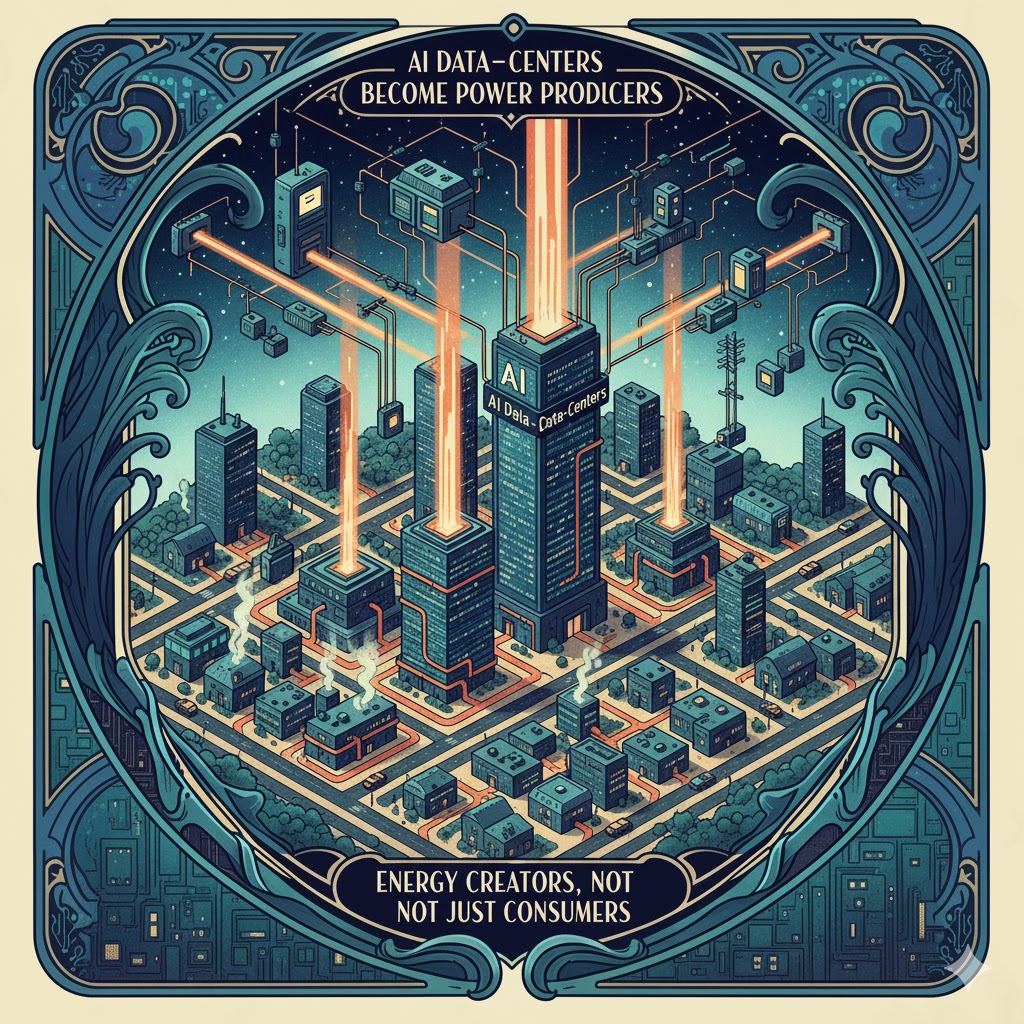
AI’s insatiable appetite for electricity is reshaping not only the computing industry but also the energy landscape. Data‑centre operators are becoming power producers, building turbines and engines, experimenting with fuel cells and championing small modular reactors. This shift offers opportunities for innovation in generation technology and grid management, but it also raises pressing questions about emissions, equity and long‑term sustainability. Balancing these competing priorities will define the next decade of both the AI and energy sectors.
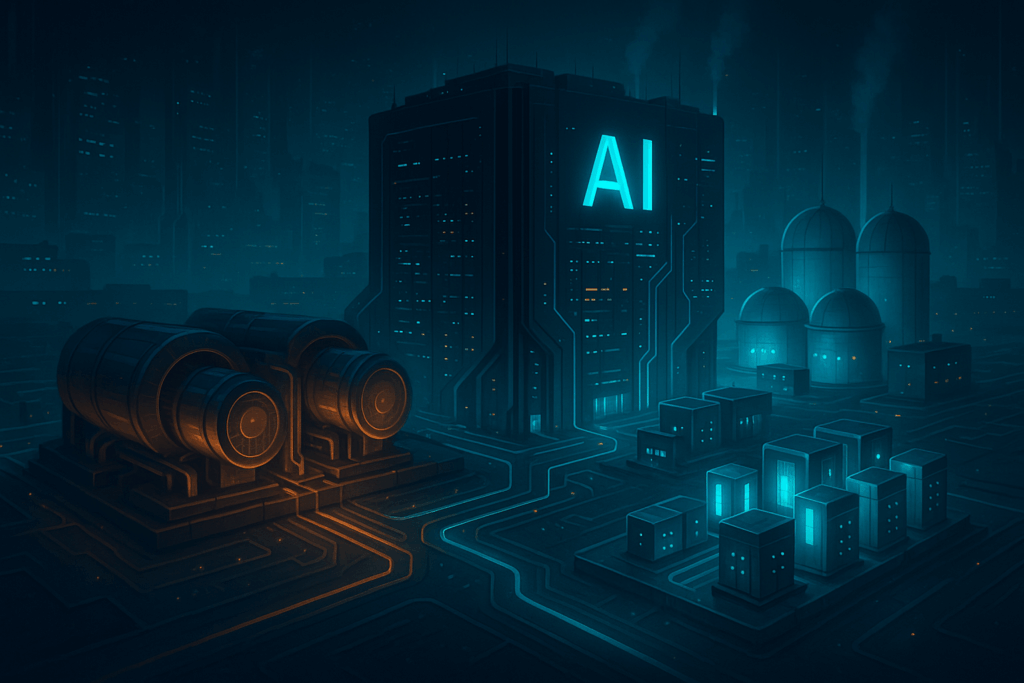
The following illustration provides a conceptual view of a future AI‑datacentre campus with integrated power sources. It depicts an AI‑centric skyscraper connected to modular power blocks representing natural‑gas turbines, fuel‑cell units and small modular reactors. The blue and orange lighting underscores the mix of fossil and nuclear technologies while the piping hints at behind‑the‑meter integration. The image does not depict any real facility or individual.
Fall Picks
fall essentials
As an affiliate, we earn on qualifying purchases.