
Executive Summary
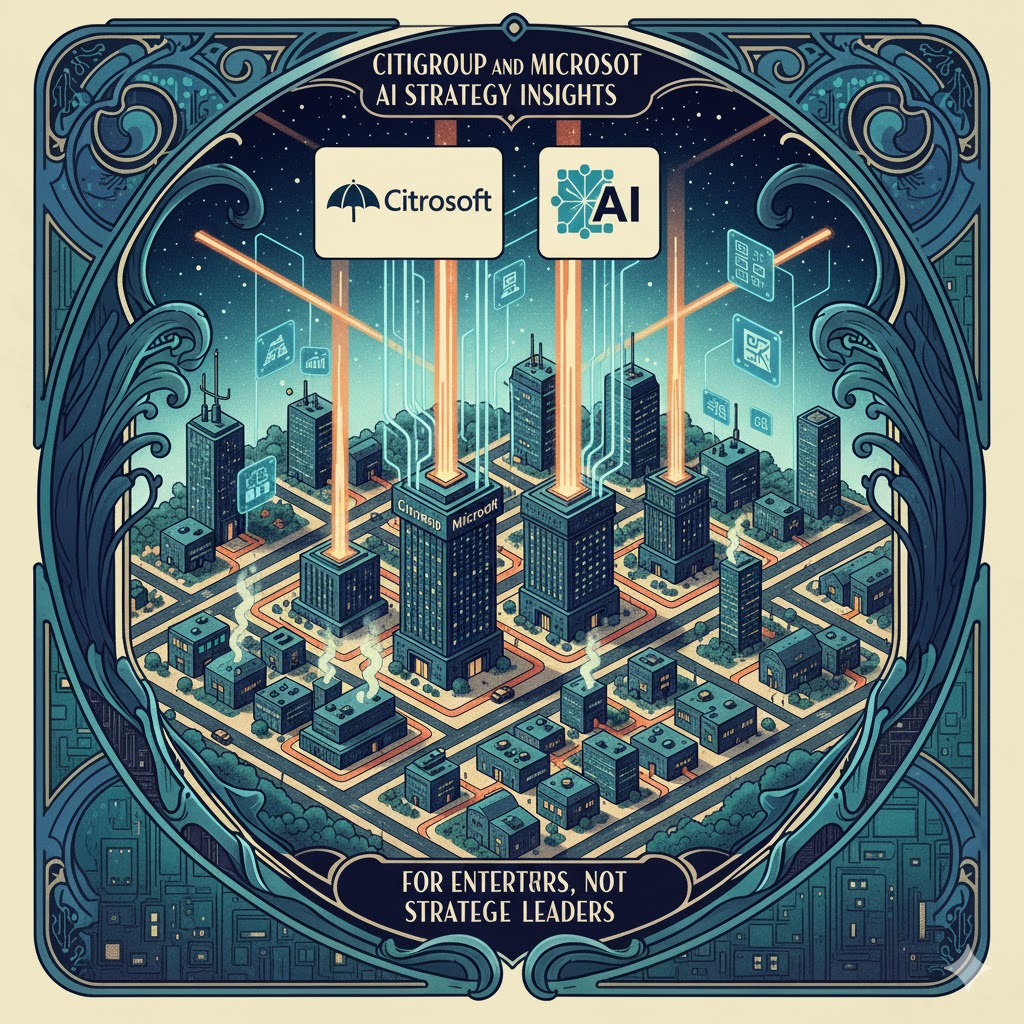
Artificial Intelligence (AI) adoption in large enterprises is accelerating, delivering tangible productivity gains and transforming how organizations operate. This white paper examines two recent case studies – Citigroup and Microsoft – to illustrate different but complementary approaches to enterprise AI integration. Citigroup’s internal AI initiatives have dramatically improved developer productivity and operational efficiency by embedding AI across its global workforceconstellationr.com. Microsoft, meanwhile, is infusing AI at the operating system level with the Windows 11 “Copilot” update, introducing voice-activated assistants, screen-aware AI, and autonomous task execution capabilitieswindowscentral.com. Both cases underline strategic imperatives for C-level leaders: harness AI to augment the workforce, design “agentic” AI capabilities with robust permission and trust frameworksgeekwire.com, and establish governance and training programs to ensure responsible rollout. In summary, AI offers unprecedented productivity and innovation opportunities, but realizing these benefits requires thoughtful strategy – from internal AI platforms (as in Citigroup’s case) to leveraging platform-level AI tools (as in Microsoft’s case) – along with careful risk management and employee enablement. The following sections provide an in-depth analysis and strategic takeaways for executives.
Citigroup’s Internal AI Initiatives
Citigroup has embarked on a comprehensive internal AI transformation, embedding AI tools and automation across its global operations. Scale and Usage: Nearly 180,000 Citi employees in 83 countries now have access to the bank’s proprietary AI tools, which they have used over 7 million times in 2025constellationr.com. These tools range from generative AI assistants for content and data analysis to coding copilots for software development. Employees leverage AI to automate routine work, analyze large data sets, and generate materials in minutes rather than hoursconstellationr.com, freeing them to focus on higher-value tasks. As a result, AI adoption is pervasive across the enterprise rather than siloed in one team, reflecting Citigroup’s strategy to democratize AI usage at scale.
Productivity Gains: The impact on productivity has been significant. Citigroup’s developers have performed over 1 million AI-driven code reviews in 2025 alone, using AI to automatically check and improve code qualityconstellationr.com. This has created an estimated 100,000 hours of additional developer capacity per week – effectively freeing up that much time which can be reinvested in innovation and complex problem-solvingconstellationr.com. These gains are trackable and tangible: code that once required manual review and debugging is now accelerated by AI, speeding up software release cycles and reducing human error. Beyond IT, other business units are also seeing efficiency boosts; for example, in Citigroup’s wealth management division, advisors receive AI-generated insights that help them deliver personalized client advice fasterconstellationr.com. By automating responses to common customer queries and drafting research, AI shortens response times and improves service quality.
AI Agent Pilots: Citigroup is now pushing into the next frontier of enterprise AI – agentic AI. In September 2025, the bank launched a pilot program deploying AI agents for ~5,000 employeesconstellationr.com. These AI agents are designed to handle multi-step tasks via natural language prompts, effectively acting as digital assistants that can execute sequences of actions across Citigroup’s internal systems. Integrated into the firm’s proprietary platform (dubbed Citi Stylus Workspaces), these agents leverage advanced models from Citigroup’s cloud partners (including Google Cloud’s Gemini and Anthropic’s Claude) to understand intent and perform tasks autonomouslyconstellationr.com. For example, an employee can ask the AI agent to generate a financial report from multiple internal databases – a process that would typically require navigating several applications – and the agent will coordinate the steps automatically. Early results from this pilot are “very promising,” according to CEO Jane Fraser, and there are plans to expand access in the coming monthsconstellationr.com. This illustrates Citigroup’s commitment to end-to-end AI integration: not just isolated use cases, but a systematic embedding of AI agents into workflows to drive further efficiency, reduce operational risk, and enhance client experiencesconstellationr.com.
Workforce Enablement and Training: A critical element of Citigroup’s AI strategy is preparing its workforce to effectively and safely use these AI tools. The bank has mandated AI prompt training for the majority of its staff as part of the rolloutbankingdive.com. All ~180,000 employees with access to AI must complete training modules on how to write effective prompts and interpret AI outputsbankingdive.com. This ensures that employees—from developers to business analysts—understand how to collaborate with AI and are aware of its limitations. Notably, Citigroup does not force employees to use AI for daily tasks, but it strongly encourages adoption by highlighting productivity benefitsbankingdive.com. By investing in training and change management, Citigroup addresses the human factor of AI integration: building trust in AI tools, improving user proficiency, and mitigating risks like misuse or overreliance. The bank’s approach exemplifies a balanced rollout strategy, combining aggressive scaling of technology with education and policy to ensure responsible use.
Transformation Progress: These AI initiatives are part of Citigroup’s broader technology transformation journey. The firm reports that over two-thirds of its transformation programs are at or near target state, with AI as a key catalystconstellationr.com. In addition to deploying AI, Citigroup has been simplifying and modernizing its tech stack (e.g. retiring or replacing hundreds of legacy applications) to optimize for AI-enabled workflowsconstellationr.com. Importantly, leadership views the AI transformation as ongoing – there is “still so much upside left to capture,” Fraser notesconstellationr.com. This mindset underscores that AI adoption isn’t a one-off project but a continuous evolution. Citigroup’s internal playbook thus far highlights a few key principles for enterprise AI success: scale the technology pervasively, focus on measurable productivity gains, pilot advanced capabilities like agents in controlled environments, upskill the workforce, and continuously iterate on processes and infrastructure.

Coding with AI For Dummies (For Dummies: Learning Made Easy)
As an affiliate, we earn on qualifying purchases.
As an affiliate, we earn on qualifying purchases.
Microsoft’s Windows 11 Copilot Update (October 2025)
While Citigroup exemplifies internal AI deployment, Microsoft illustrates another path: building AI capabilities directly into products at massive scale. In October 2025, Microsoft released a significant update to Windows 11 that effectively turns the operating system into an AI-powered collaborator. This update introduces Windows Copilot enhancements that embed generative AI across the user experience, marking a shift toward an agentic operating system. Key features of the update include:
- “Hey Copilot” Voice Activation: Users can now simply speak to their PC with the wake phrase “Hey Copilot” to invoke Microsoft’s AI assistantwindowscentral.com. This hands-free activation allows for truly natural interaction; for example, an executive could just say “Hey Copilot, summarize this document and email it to the team,” without touching the keyboard. Voice commands move Windows beyond the traditional mouse/keyboard paradigm, with Microsoft positioning voice as a “third input mechanism” on par with those earlier innovationsgeekwire.com. The goal is to make interacting with a computer more human-like and conversational.
- Copilot Vision (Screen Awareness): The updated Copilot can “see” the user’s screen content and context when summoned. Invoking “Hey Copilot” automatically launches Copilot Vision mode, which means the AI can analyze whatever is displayed – an email, a webpage, a spreadsheet – and provide assistance relevant to that contextwindowscentral.com. For instance, a user reviewing a PowerPoint slide can ask, “Hey Copilot, draft speaker notes for this slide,” and the AI will understand the on-screen content to generate an appropriate response. This screen awareness allows the AI to offer contextual help inside apps, effectively acting as an intelligent co-worker that is always observing (only with permission) what the user is working on and ready to help.
- Copilot Actions (Agentic Capabilities): Perhaps the most transformative feature is the expansion of Copilot Actions, which gives the AI the ability to perform multi-step tasks on the PC autonomously. Previously, Copilot’s functionalities were mostly assistive (e.g. answering questions, rewriting text), but with Copilot Actions, the assistant can take action on the user’s behalf in Windows. Microsoft describes this as the first general-purpose agentic AI experience on Windows – the AI can control or interact with apps, files, and settings to complete tasks for the userwindowscentral.com. For example, a user can ask Copilot to organize files into folders, adjust system settings, or even draft and send an email, and the AI will carry out those commands step-by-step. This is done either visibly (in front of the user) or in the background, allowing the user to multitaskwindowscentral.com. Essentially, Windows 11 is evolving from a static operating system into an autonomous agent platform where routine digital tasks can be delegated to an AI assistant.
- Deeper OS Integration: Microsoft has tightly integrated Copilot into core Windows 11 interfaces. The Windows taskbar now prominently features Copilot – including adding Copilot into the Search box – making the AI only one click (or voice command) away at all timeswindowscentral.com. The design intent is to make the taskbar a “dynamic hub” for accomplishing work with minimal effortwindowscentral.com. By weaving Copilot into the fabric of the OS (as opposed to a separate app), Microsoft ensures AI assistance is ubiquitous and seamlessly available, whether the user is managing files, browsing the web, or working in Office apps. Notably, these AI features are being rolled out to all Windows 11 PCs, not just newer models with AI chips, showing Microsoft’s commitment to broad accessibilitywindowscentral.com.
Strategic Shift to an Agentic OS: Microsoft’s updates signal a strategic shift: the personal computer is being redefined around AI collaboration. Company executives liken this moment to the advent of the graphical user interface – suggesting voice and AI-driven autonomy could be as revolutionary as the mouse and keyboard were decades agogeekwire.com. Users are encouraged to treat their PC “less as a tool and more as a collaborator”geekwire.com. By building AI “co-pilots” into Windows itself, Microsoft is moving AI from being an optional add-on to a core part of the computing experience. This agentic OS approach means every Windows user potentially has a digital assistant at their disposal, changing how work gets done on a fundamental level (e.g., quicker searches, automated file organization, intelligent help in every application). It also reflects Microsoft’s competitive positioning – by making Windows the home of everyday AI usage, Microsoft aims to anchor the next generation of computing on its platformgeekwire.com. With the end-of-life of Windows 10 and a push to entice upgrades, these AI features provide a compelling reason for enterprises and consumers to move onto Windows 11geekwire.com.
Permissioning and Trust by Design: Recognizing the significant risks of an autonomous assistant, Microsoft has implemented robust permission and security frameworks for Copilot’s agentic features. The Copilot Actions feature is opt-in and disabled by default, meaning users (or IT administrators in enterprise settings) must explicitly enable it before the AI can act on their behalfgeekwire.com. Even once enabled, Copilot runs in a contained environment: it operates under a separate, limited system user account and within a secure sandbox with restricted access to user datageekwire.com. This design ensures the AI agent cannot roam freely through a user’s files or execute high-privilege operations unless permitted. Moreover, the system requires user approval for sensitive actions – the assistant will pause and prompt the user if a task involves accessing protected content or making a potentially impactful changewindowscentral.com. For example, if Copilot is asked to delete files or send an email on behalf of the user, it will likely request confirmation before proceeding. These safeguards address trust and safety: users (and organizations) retain control and oversight, mitigating fears of the AI “running wild” or breaching privacy. Microsoft has also developed a new security framework specifically for Copilot Actions to contain any security risks introduced by this autonomygeekwire.com. By building in these guardrails – default-off, least-privilege access, and human-in-the-loop checkpoints – Microsoft is foregrounding trust in the design of its agentic OS. This approach will be crucial for enterprise adoption of such features, as C-level leaders will demand assurances that AI agents on employee devices follow corporate security policies and cannot compromise data integrity or compliance.

Generative AI Essentials For Beginners: Boost Your Artificial Intelligence Skills With Innovative Tools To Write, Create, And Edit Content With Ease
As an affiliate, we earn on qualifying purchases.
As an affiliate, we earn on qualifying purchases.
Strategic Takeaways for Enterprise AI Adoption
The experiences of Citigroup and Microsoft yield several strategic insights for C-level executives looking to drive AI adoption in their organizations:
- Prioritize Productivity and Measurable Impact: Both case studies show AI delivering concrete efficiency gains. Citigroup’s 100,000 developer hours freed per week is a clear, quantifiable benefitconstellationr.com, as is the faster client service enabled by AI insights. Microsoft’s OS-level Copilot aims to save users time on everyday tasks (from file search to email drafting). Leaders should focus AI initiatives on high-impact productivity opportunities – automate repetitive workloads, accelerate data analysis, and assist in content generation. Establish metrics (e.g. hours saved, cycle time reduced, error rates improved) to track AI’s contribution to productivity. Early wins will build momentum and executive buy-in for broader AI investments.
- Design for Agentic Capabilities with Control: The move toward agentic AI – where AI doesn’t just advise, but acts – holds huge promise for automation. However, it must be designed with rigorous control. Microsoft’s implementation provides a blueprint: keep autonomous actions opt-in, operate them in sandboxed environments, and require user approval for critical stepsgeekwire.comwindowscentral.com. Enterprises experimenting with AI agents (like Citigroup’s pilot) should similarly constrain what tasks agents can perform, start with narrow use cases, and build escalation/override mechanisms. The guiding principle is trust through transparency and permission – users (or IT admins) need visibility into what the AI is doing and final say over irreversible actions. By carefully architecting agent permissions and logging agent decisions, organizations can unlock automation benefits without losing governance.
- Augment, Don’t Replace – Focus on Workforce Empowerment: AI in these case studies is deployed as a copilot to human workers, not a replacement. Citigroup’s AI tools take over routine chores (code review, data gathering), enabling developers and advisors to concentrate on creative and strategic work. Microsoft’s Copilot is positioned as a personal assistant to help users “accomplish more with less effort”windowscentral.com. C-level leaders should frame AI initiatives as augmentation of the workforce. This involves identifying tasks that AI can do faster or better, and redesigning workflows so employees collaborate with the AI. It’s equally important to communicate this clearly to employees to alleviate job displacement fears and gain their support. When workers see AI offloading drudgery (while they retain oversight), they become more receptive to adoption and even advocate for it.
- Phased Rollouts and Pilot Programs: A common theme is starting small, then scaling. Citigroup tested AI agents with 5,000 employees before firm-wide deploymentconstellationr.com, allowing them to gather feedback and fine-tune usage policies. Microsoft is rolling out Windows Copilot features in stages (Insider previews, gradual regional releases)windowscentral.com, which helps identify bugs and gauge user reactions to the new paradigm. Enterprises should similarly adopt a pilot and iterate approach: begin with a contained pilot for a specific department or process, evaluate results and risk factors, then expand in waves. Phased rollouts enable learning and adaptation – for example, adjusting an AI model that is prone to errors, or improving the user interface for easier adoption – before broad enterprise-wide implementation.
- Invest in Training and Change Management: Both cases underscore the importance of user education. Citigroup’s mandatory AI prompt training for employees is a proactive step to build an AI-ready workforcebankingdive.com. Even the best AI tools will underdeliver if employees don’t know how to use them effectively or distrust them. Executive leadership should champion comprehensive training programs, covering not just how to use AI tools, but also responsible use guidelines (e.g., verifying AI outputs, understanding data privacy). In addition, change management efforts – such as internal evangelism, success stories, and accessible support – can accelerate cultural adoption of AI. Align these programs with HR and IT so that AI proficiency becomes a core competency across the organization.
- Develop Governance and Ethical Frameworks: As AI becomes ingrained in processes, robust governance frameworks are non-negotiable. This includes establishing clear policies on acceptable AI use cases (and prohibited ones), data governance rules (especially for sensitive data passing through AI models), and compliance with regulations (for instance, ensuring AI in finance complies with audit and security requirements). Risk committees or AI governance boards should oversee model performance, monitor for bias or hallucinations, and update policies as the technology evolves. Both Microsoft and Citigroup recognized risks – from hallucinations to security – and responded with structured approaches (Microsoft built a security framework into its productgeekwire.com; Citigroup set up training and limited initial agent use to controlled scenarios). Enterprises should similarly anticipate risks and put guardrails in place before scaling AI widely. This might involve IT creating sandboxes for AI experimentation, compliance teams reviewing AI outputs in regulated contexts, and legal teams crafting guidelines on intellectual property and AI-generated content.

Plaud Note Pro AI Voice Recorder, Transcribe & Summarize with AI, App Control, Note Taker for Meetings & Calls, Supports 112 Languages, Ultra-Slim w/InstantView Display, Case Included, Black
AI-POWERED TRANSCRIPTION & MULTI-DIMENSIONAL SUMMARIES: Plaud Note Pro is your professional voice transcriber, delivering high-accuracy transcription in 112…
As an affiliate, we earn on qualifying purchases.
As an affiliate, we earn on qualifying purchases.
Comparing AI Adoption Playbooks: Citigroup vs. Microsoft
While Citigroup and Microsoft pursue AI integration in different contexts, their approaches offer complementary models for large enterprises. The table below contrasts their “playbooks”:
| Aspect | Citigroup’s Internal AI Stack | Microsoft’s OS-Level Copilot |
|---|---|---|
| Strategic Aim | Operational Efficiency & Transformation: Embed AI to streamline internal processes, reduce manual work, and improve service delivery across the bankconstellationr.comconstellationr.com. | Product Innovation & Platform Leadership: Reinvent the user experience by making the OS itself intelligent, driving productivity for end-users and differentiation for Windowsgeekwire.comgeekwire.com. |
| Scale of Adoption | Enterprise-Wide (Internal): ~180,000 employees (83 countries) using AI tools in daily workflows; AI accessible to essentially all staffconstellationr.com. Initial agentic AI pilot with 5,000 employees before broader rolloutconstellationr.com. | Mass Market (External): Potentially hundreds of millions of Windows 11 users globally. New Copilot features available to all modern PCs (rolled out in stages), not limited to specific enterprise or device modelswindowscentral.com. |
| Key AI Capabilities | Task Automation & Decision Support: Automated code reviews (1M+ this year) improving software qualityconstellationr.com; generative AI for document drafting and data analysis; AI insights for customer service and advisory rolesconstellationr.com. Focus is on augmenting employees’ existing tasks. | Embedded AI Assistant: Voice-activated commands (“Hey Copilot”) for hands-free operationwindowscentral.com; Copilot Vision providing context-aware help by “seeing” screen contentwindowscentral.com; Copilot Actions performing multi-step tasks (email, file ops, etc.) autonomously with oversightwindowscentral.com. Focus is on creating new modes of interaction and automation within the OS. |
| Implementation Approach | Proprietary Internal Platform: Built Citi AI platform (e.g. Citi Stylus Workspaces) integrating third-party AI models (Google Cloud’s Vertex/Gemini, Anthropic Claude) into Citi’s secure environmentconstellationr.com. AI tools are customized to Citigroup’s data and workflows, ensuring domain relevance (e.g., banking compliance, terminology). | Native OS Integration: Developed within Windows 11 – Copilot is part of system updates and taskbar UIwindowscentral.com. Relies on cloud-based large models (e.g., likely OpenAI’s GPT via Azure) but tightly woven into local OS functions. Delivers a general-purpose AI layer that any application on Windows can tap into via the OS. |
| Adoption & Training | Managed Rollout with Training: Incremental deployment (pilots → wider release); extensive employee training on AI usage and prompt engineering is requiredbankingdive.com. Adoption encouraged through showcasing productivity gains; usage policies and support in place to help staff integrate AI into their jobsbankingdive.com. | Consumer/Ecosystem Adoption: Features introduced to users via OS updates; opt-in usage (especially for agentic features). Microsoft provides guidance (blogs, tips in UI) to educate users on new capabilities. Enterprise IT admins can control Copilot features via policy, and Microsoft gathers feedback from its Insider program to refine UX and address confusion. |
| Governance & Risk | Enterprise Governance: AI use is governed by internal policies ensuring compliance (especially critical in finance). Sensitive data is protected; outputs (like code or advice) undergo human review when needed. A focus on avoiding AI errors in client-facing contexts (e.g., keeping a human in loop for final decisions). Ongoing oversight by risk management teams to monitor AI outcomes. | Built-in Safety & Permissions: Copilot’s design enforces user permissions and isolates AI actions (sandboxed agent accounts) to prevent unauthorized accessgeekwire.com. Microsoft delayed or adjusted features (like the “Recall” memory feature) due to privacy/security concernsgeekwire.com, showing a caution-first approach. Enterprise customers can disable or restrict Copilot via group policies if it doesn’t meet their compliance needs. |
Complementary Models: These two approaches – an internal AI-augmented enterprise vs. an AI-enhanced software platform – are not mutually exclusive. In fact, large organizations can leverage both. A bank like Citigroup can continue to build bespoke AI solutions for its proprietary processes and take advantage of AI capabilities baked into vendor products like Microsoft Office and Windows. The internal AI stack ensures competitive differentiation and control (using the company’s own data and domain expertise), while the OS-level and third-party AI tools provide general productivity boosts and innovation at scale without the enterprise shouldering all development. For C-level leaders, the lesson is to craft a hybrid AI strategy: deploy customized AI where it adds unique value or addresses sensitive workflows, and embrace the evolving AI ecosystem offered by platform providers to supercharge standard operations.

AI-Powered Automations: Add ChatGPT and Claude Into Your Zapier and Make Workflows (No-Code AI Automation Book 4)
As an affiliate, we earn on qualifying purchases.
As an affiliate, we earn on qualifying purchases.
Risks and Mitigation in AI Integration
Adopting AI at scale, whether internally or via third-party platforms, brings a set of risks that executives must proactively manage. Key risks include:
- Hallucinations and Accuracy Errors: Generative AI models can produce incorrect or fabricated outputs (“hallucinations”), which in a business context can lead to bad decisions or misinformation. Citigroup, for example, wouldn’t want an AI giving a wealth advisor an erroneous insight for a client, nor would Microsoft want Copilot to misconfigure a user’s system. Mitigation: Implement verification steps for AI outputs. Encourage a human-in-the-loop approach: employees should treat AI suggestions as draft or guidance, not absolute truth, and double-check critical information. Technical measures include using AI models that cite sources or integrating deterministic business rules for sensitive calculations. Enterprises can also restrict AI usage in high-stakes scenarios until models are proven reliable, and use approval workflows (e.g., AI drafts an email, human reviews before sending).
- Trust and User Adoption: If employees or customers don’t trust the AI (due to past errors, lack of transparency, or fear of job impact), they may resist using it, undermining the investment. Microsoft’s push for a voice-driven PC, for instance, relies on users feeling comfortable talking to their computer and believing it will correctly execute commands. Mitigation: Build trust through transparency and gradual exposure. Clearly communicate what the AI can and cannot do. Features like Copilot’s activity log – showing what actions it’s taking – or Citigroup’s decision to not mandate AI use but show its benefits, help users gain confidence. Success stories and quick wins should be publicized internally. Also, involve end-users in pilot testing and incorporate their feedback, so they feel a sense of ownership and understanding of the AI tool.
- Security and Permission Risks: An AI agent with the ability to act (especially one integrated into many systems) presents a potential security vulnerability if misused or compromised. Without proper permissions, a malicious prompt or a bug could, in theory, instruct the AI to exfiltrate data or alter information. Mitigation: Apply the principle of least privilege – as seen in Windows Copilot’s contained user account designgeekwire.com – so the AI’s scope of action is limited. Use robust authentication and authorization for AI-driven actions: e.g., an AI should not be able to approve financial transactions or access confidential files unless explicitly authorized and perhaps re-confirmed by a human. Conduct thorough security testing on AI features (red-team exercises to attempt prompt injection attacks, etc.). Additionally, monitoring systems should flag unusual AI activity in real time (for example, if an AI agent starts mass-downloading files, it can be automatically paused and reviewed).
- Model and Data Updates: AI models and underlying data can update frequently (Microsoft and cloud AI providers roll out model upgrades, and enterprises update their data sources). These changes can alter the AI’s behavior in unpredictable ways. A model update might improve general performance but introduce a new quirk or bias that affects a specific task. Mitigation: Establish a change management process for AI models. Treat major model updates similar to software updates: test them in a staging environment with typical use cases before releasing to production use. For vendor-provided AI (like Microsoft Copilot’s backend AI service), leverage preview channels to evaluate new features. Maintain a feedback loop with the provider – for instance, Microsoft’s Insider Program allows enterprises to test upcoming Windows AI features earlygeekwire.com. Internally, version control your AI models and have rollback plans if a new version causes issues. Keeping humans informed about changes (e.g., “Copilot’s language model was updated – here’s what’s new”) also helps set expectations and vigilance.
- Real-time Decision Risks and Containment: As AI starts operating in real-time environments (answering live customer queries, autonomously managing system tasks, etc.), errors can have immediate consequences. An AI making a faulty trade in a banking system or an OS agent mismanaging a critical setting could have cascading effects. Mitigation: Build circuit breakers and fail-safes. For example, constrain AI to read-only mode in critical systems unless a human explicitly allows a change. Use rate limiters – an AI that sends emails on behalf of users might be capped to a certain number per minute to avoid spamming due to a glitch. Implement monitoring that can automatically shut off or isolate an AI component if it behaves anomalously (like generating too many errors or contradictory outputs). Having a clear manual override is key: users and IT staff should always have the ability to pause or disable an AI feature instantly if something looks wrong. Additionally, conduct scenario planning for worst-case outcomes (what if the AI does X?) and have response playbooks in place (like disabling the AI system, communicating to users, reverting changes from backups, etc.).
In both case studies, we see these mitigations in action: Microsoft’s conservative rollout and sandboxing of Copilot Actions addresses many security and trust concernsgeekwire.com, and Citigroup’s emphasis on training and phased pilots reflects risk-aware implementation. The overarching theme is responsibility – large enterprises must treat AI as a powerful tool that requires the same diligence and oversight as any mission-critical system.
Conclusion and Next Steps
AI adoption in the enterprise is no longer a speculative bet; it is a strategic imperative. Citigroup’s and Microsoft’s initiatives demonstrate that when implemented thoughtfully, AI can unlock significant productivity gains, enable new ways of working, and even reshape core products and services. For C-level executives, the question is how to harness this potential in a way that aligns with their organization’s goals and risk appetite. Below are recommended next steps for large enterprises either beginning their AI integration journey or scaling early efforts:
1. Articulate a Clear AI Vision: Start with a top-down vision of how AI will create value in your enterprise. Whether it’s “automating core operations to achieve X% efficiency improvement” or “transforming our customer experience with personalized AI-driven services,” having clear objectives will guide all subsequent actions. Communicate this vision from the C-suite to all levels of the organization to ensure alignment and buy-in.
2. Launch Targeted Pilot Projects: Identify 2-3 high-impact pilot use cases where AI could quickly demonstrate value. Good candidates are processes that are repetitive, data-intensive, and well-bounded (e.g., a pilot for AI-assisted software code review, as Citigroup did, or a chatbot to handle Tier-1 IT support queries). Allocate cross-functional teams to these pilots (IT, business unit, risk) and define success metrics upfront. Use the pilot phase to learn – expect some failures or adjustments – and be prepared to iterate. Early pilot wins will build momentum for broader adoption, while pilots that fall short will yield lessons without massive sunk cost.
3. Develop an AI Talent and Training Strategy: Upskilling existing staff and attracting new talent is critical. Consider instituting organization-wide AI literacy programs, similar to Citi’s prompt training for all employeesbankingdive.com. Train technical teams on AI development and deployment practices (e.g., using machine learning ops for model management, prompt engineering techniques, data privacy in AI). At the same time, hire or designate AI champions in each major department – these individuals can coordinate AI efforts, share best practices, and serve as liaisons between technical teams and business units. Encourage a culture where employees are empowered to experiment with AI tools and share success stories or use tips with peers.
4. Strengthen Data Infrastructure and Governance: AI is only as good as the data and infrastructure behind it. Ensure your enterprise data is high-quality, accessible (with proper security controls), and integrated – initiatives like data lakes or warehouses may need acceleration to support AI analytics. Invest in the necessary tools and platforms, be it cloud services or on-prem GPU clusters, that can train and run AI models efficiently. In parallel, update your data governance policies for the AI era: clarify who owns AI-generated data or decisions, how data bias is detected and corrected, and how customer data is protected when used in AI systems. Many industries (finance, healthcare, etc.) face regulatory expectations around AI, so proactively address compliance and documentation for your AI models (such as model validation reports, audit logs of AI decisions, and explainability where required).
5. Establish an AI Governance Committee: Create a cross-disciplinary governance body (involving leadership from IT, risk, legal, HR, and business units) to oversee AI adoption. This group should define the company’s AI ethics principles, review and approve high-risk AI use cases, and monitor outcomes. They can also set standards for vendor AI solutions (e.g., requiring certain privacy or bias mitigations from third-party AI providers) and ensure there is accountability for AI outcomes. Regularly update the board of directors on AI initiatives and risk mitigations – governance at the highest level will reinforce that AI is being managed responsibly and strategically.
6. Leverage External AI Ecosystems: Stay informed about AI innovations from technology providers and consider how they can plug into your strategy. Microsoft’s Copilot, for instance, could be an easy productivity win for many companies – if employees have Windows 11 and Office, turning on Copilot (with appropriate policy controls) could augment their day-to-day tasks immediately. Similarly, many enterprise software vendors are adding AI features to their products. Rather than reinventing the wheel, integrate these when they align with your needs, and focus internal development on truly unique capabilities or proprietary advantages. A hybrid approach (build vs. buy) will often yield the fastest and most cost-effective results. However, maintain vigilance on data exposure: when using third-party AI, ensure it doesn’t inadvertently send sensitive data to external servers without proper agreements in place.
7. Plan for Cultural and Organizational Change: Finally, recognize that AI adoption is as much a cultural transformation as a technological one. Encourage an innovation mindset where teams are incentivized to propose AI solutions for their challenges. Update job descriptions and performance metrics to include effective use of AI tools (for example, measuring how AI assistance improved an employee’s output). Also, prepare management for shifts in work patterns – if AI handles 30% of a certain team’s tasks, consider how roles might evolve (perhaps those employees can focus on strategy or creative work). Be transparent with your workforce about these changes; involve them in dialogue about how AI can make their jobs more interesting and rewarding. This will help mitigate fear and build enthusiasm, ensuring the organization as a whole moves forward with the AI strategy.
In conclusion, AI adoption at scale is a journey that requires strong leadership and vision at the top, balanced with practical execution steps and safeguards on the ground. Citigroup’s and Microsoft’s examples showcase that bold experimentation and prudent risk management can coexist. Large enterprises that follow these principles – starting with clear goals, empowering their people, and governing wisely – will be well positioned to reap the rewards of AI, from exponential productivity to new business opportunities, in the competitive landscape ahead. By learning from early adopters and tailoring these lessons to their unique context, C-level executives can drive their organizations into the new era of AI-powered enterprise with confidence and foresight.
Sources: Citigroup AI transformation details from earnings call and press coverageconstellationr.comconstellationr.comconstellationr.com; Microsoft Windows 11 Copilot features from official updates and analyseswindowscentral.comwindowscentral.comgeekwire.com; Additional context on training and risk from industry reportsbankingdive.com. All information is based on developments and data available as of October 2025.