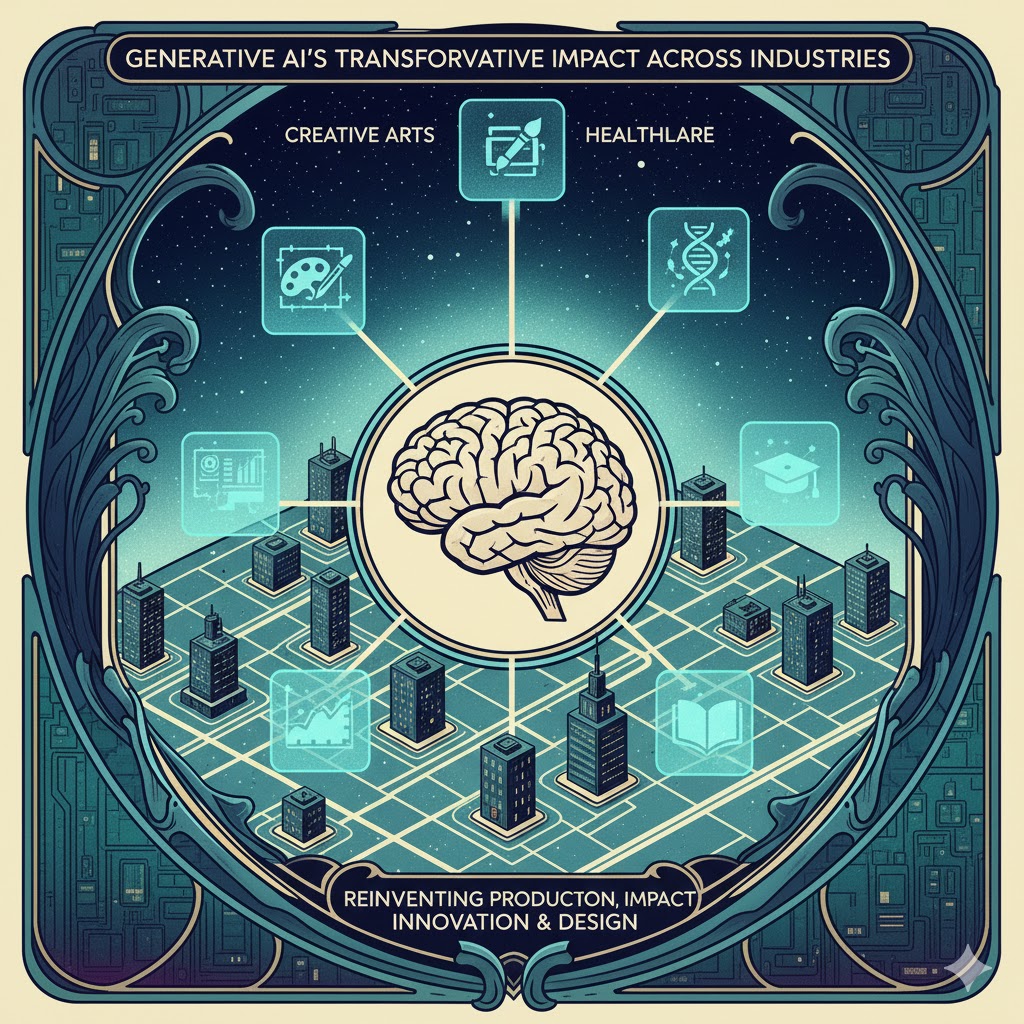

Generative AI – typified by large language models like OpenAI’s GPT series – is rapidly becoming a cornerstone technology across multiple industries. By generating human-like text and insights from vast data, these systems are revolutionizing how organizations operate. This article examines how generative AI initiatives are making a real-world impact in healthcare, financial services, customer service software, and retail. For each vertical, we explore why generative AI matters, current implementation examples, benefits achieved, key risks and challenges, and the future outlook.

Get business pricing on tech for your team
- Business-only prices and quantity discounts
- Tax-exempt purchasing
- Multiple users, one account, clear invoices
Healthcare: Enhancing Clinical Workflows with AI
Why Generative AI Matters: In healthcare, clinicians are inundated with documentation, data entry, and information retrieval tasks that eat into time for patient care. Generative AI promises to alleviate these burdens by quickly synthesizing medical information, drafting documentation, and even providing decision support. This matters because it addresses critical pain points like physician burnout and fragmented patient experiences. As one health AI leader put it, AI can serve as a “giant microscope” over healthcare data – revealing insights and patterns not readily visible to humans, thereby helping deliver the “right care to the right patient at the right time”prnewswire.comprnewswire.com.
Current Implementations: Leading health systems have begun deploying generative AI “agents” within clinical workflows. For example, Hackensack Meridian Health (New Jersey’s largest health network) has built multiple AI agents using Google Cloud’s Vertex AI and Gemini large-language modelsprnewswire.comprnewswire.com. In 2025, Hackensack became the first health system to deploy a generative AI clinical note summarization agent at scale, now used by over 7,000 clinicians across 18 hospitals and 500 care sitesprnewswire.com. This agent automatically summarizes patient medical records and visit notes for providers, tailored by specialty (so an oncologist’s summary highlights different details than a urologist’s)healthcaredive.comhealthcaredive.com. Hackensack has also rolled out a NICU nurse assistant (providing neonatal nurses instant access to best-practice guidelines) and a lab results summarizer that flags important trends and drafts patient communication about resultsprnewswire.comprnewswire.com. All these tools are powered by Google’s Gemini 2.5 model and integrated directly into the hospital’s electronic health record (EHR) system for seamless usecompleteaitraining.comcompleteaitraining.com. Other healthcare implementations include AI agents for prior authorization (e.g. an agent that detects when a treatment needs insurer approval and auto-generates the request, with human staff reviewing for accuracy)healthcaredive.comhealthcaredive.com and patient outreach bots (e.g. a virtual assistant that helps women determine breast cancer screening eligibility and schedule mammograms, under clinician oversight)healthcaredive.comcompleteaitraining.com.
Benefits and Early Impact: Generative AI is already delivering tangible efficiency and care improvements in healthcare:
- Reduced Administrative Load: Hackensack’s note-summarization agent has generated over 17,000 clinical note summaries since June 2025, saving clinicians significant time on paperworkhealthcaredive.comhealthcaredive.com. Early results show specialists are spending 5–20% less time on EHR tasks after adopting these AI toolscompleteaitraining.comcompleteaitraining.com. This “time back” means doctors can focus more on patients instead of screens, helping to “free up pajama time” (after-hours charting) and reduce burnoutprnewswire.comprnewswire.com.
- Faster, Proactive Patient Care: By automating routine documentation and data parsing, generative AI shortens the time to inform and treat patients. For instance, an AI-generated lab summary allows primary care physicians to communicate results and preventive care suggestions to patients much faster, enabling quicker follow-upscompleteaitraining.comcompleteaitraining.com. At Hackensack, using AI to draft patient messages from lab results has led to clearer explanations for patients and more timely interventionscompleteaitraining.comcompleteaitraining.com.
- Improved Decision Support: Generative models can sift through vast historical patient data to find patterns or predict risks. Hackensack plans to leverage Google’s generative models to analyze current and past patient records for prognostic indicators – for example, predicting which patients might need escalated care – to support clinical decision-makingprnewswire.comprnewswire.com. In essence, AI agents serve as tireless assistants, surfacing insights (like key lab trends or relevant prior notes) that a human might miss in time-pressed situations.
- Personalized and Specialty-Tuned Insights: Because these AI systems can be tuned to specific medical domains, they ensure relevance. Hackensack’s deployment showed that summaries could be customized per specialty, so each clinician sees information most pertinent to their practicehealthcaredive.com. This relevancy improves user experience – doctors get high-yield information at a glance, rather than wading through irrelevant data.
Key Risks and Challenges: Despite the promise, healthcare adopters of generative AI must navigate significant challenges:
- Data Privacy and Security: Healthcare data is highly sensitive. Generative AI needs access to patient information to be useful, raising concerns about HIPAA compliance and data security. There is a risk of sensitive patient data being inadvertently exposed if not properly safeguardedncbi.nlm.nih.govncbi.nlm.nih.gov. Ensuring that no protected health information leaks into AI model outputs or public domains is paramount – especially as models may “remember” and regurgitate data if not carefully controlledncbi.nlm.nih.govncbi.nlm.nih.gov.
- Accuracy and “Hallucinations”: Generative models sometimes fabricate incorrect or nonsensical information (a phenomenon known as hallucination). In medicine, an AI confidently providing a wrong diagnosis or erroneous treatment recommendation could cause harm if taken at face value. Thus, human oversight is essential – clinicians must verify AI outputs. Many implementations keep a human in the loop; for example, an AI-drafted note or prior-auth request is reviewed by a clinician or staff before finalizinghealthcaredive.comhealthcaredive.com. This ensures safety but does reduce full automation. Maintaining trust also means thorough validation of AI suggestions against medical evidence.
- Bias and Equity Concerns: If the model’s training data or usage is biased (e.g. underrepresenting certain populations), the AI’s outputs could inadvertently worsen health disparitiesncbi.nlm.nih.govncbi.nlm.nih.gov. For instance, an AI might less accurately summarize or recommend care for minority patients if its data skews toward majority groups. Ongoing monitoring and bias mitigation are needed so that generative AI doesn’t propagate existing inequities in carencbi.nlm.nih.govncbi.nlm.nih.gov.
- Integration and Scalability: Incorporating AI into clinical workflows at scale is non-trivial. Models must integrate with EHR systems (Hackensack’s approach was to embed AI inside their Epic EHR, rather than a separate app, to streamline usagecompleteaitraining.com). Scaling to thousands of users requires robust IT infrastructure and training for staff to trust and effectively use the tools. Additionally, operating large models can be costly and resource-intensive, so health systems must ensure the benefits justify the investment and that latency is low enough for real-time use.
- Regulatory and Liability Questions: Use of AI in direct patient care raises questions of accountability. If an AI tool makes a suggestion that leads to an error, who is responsible – the provider, the hospital, or the software vendor? Regulations and guidelines (such as the FDA’s emerging framework for clinical AI or the NIST AI Risk Management Framework) are still catching upncbi.nlm.nih.gov. Until clearer standards are in place, many organizations proceed cautiously, treating AI advice as a recommendation that requires physician sign-off.
Future Outlook: The future of healthcare will likely feature “multi-agent” AI systems working in concert to support clinicians and patients. Hackensack’s AI chief analogized this to an MRI giving a multi-layered view of patient health – AI agents could integrate diagnostics, history, and real-time data to provide a comprehensive pictureprnewswire.comprnewswire.com. In coming years, we can expect generative AI to assist in clinical decision support (e.g. suggesting diagnoses or care plans based on vast datasets), patient self-service (symptom-checker chatbots that draft advice or reminders), and medical research (summarizing scientific literature or even helping design clinical trials). Critically, these advances will be guided by a “human+AI” model: routine tasks and initial drafts by AI, with clinicians focusing on verification, complex cases, and the human touch. As one Google Cloud director noted, healthcare AI deployments are moving beyond “incremental optimization” toward transformative change, but success requires strategic use and a “shared commitment to…impact” with providersprnewswire.com. If done responsibly, generative AI could help resolve some of healthcare’s toughest challenges – from clinician burnout to gaps in patient outreach – while preserving empathy and quality in care.
AI clinical note summarization software
As an affiliate, we earn on qualifying purchases.
As an affiliate, we earn on qualifying purchases.
Financial Services: Streamlining Knowledge and Client Service
Why Generative AI Matters: In financial services, timely and accurate information is everything – whether it’s answering client queries, making underwriting decisions, or detecting fraud. Banks and insurance firms manage enormous volumes of documents, regulations, and market data. Generative AI serves as a powerful tool to digest and communicate this information rapidly. It can act as an always-on financial assistant, retrieving answers from policy manuals or analyzing trends in seconds. Crucially, the financial industry’s stringent regulatory environment means any AI deployment must be secure, compliant, and accurate, but the payoff is substantial: more efficient operations and better customer experiences. A banking AI index noted that heavy investment in AI R&D (over 1,200 AI/ML patents at Bank of America alone) has positioned banks well to implement advanced AI use casesciodive.comciodive.com. Many banks were early adopters of automation and have strong governance, making them a “blueprint” for how to roll out AI with proper checks and balancesciodive.com.
Current Implementations: Leading financial institutions are launching generative AI initiatives both for internal productivity and customer-facing services. A prime example is Bank of America’s “AskGPS” – a generative AI assistant for the bank’s Global Payment Solutions team (launched in late 2025). Built in-house and trained on over 3,200 internal documents (product guides, term sheets, FAQs), AskGPS allows employees to query complex product and payments information in natural language and get answers in secondsprnewswire.comprnewswire.com. It’s essentially a domain-specific ChatGPT for the bank’s corporate payments division, capable of handling anything from basic inquiries to intricate scenario advice. Notably, AskGPS supports 29 languages, vital for a global bank serving clients across regionsciodive.com. Prior to generative AI, staff might spend an hour searching through manuals or calling colleagues for an answer; now the AI can retrieve the needed info almost instantlyprnewswire.comprnewswire.com. Another example in finance is the use of gen AI to assist coders and analysts – Bank of America reported thousands of its developers have incorporated AI coding tools into workflows to accelerate software deliveryciodive.com. Meanwhile, wealth management advisors are piloting AI summarization tools to digest research and client portfolios for quick insights. On the customer side, banks continue to enhance chatbots (e.g. BoA’s Erica chatbot introduced in 2018) with generative capabilities. Though heavily regulated, some banks are carefully testing GPT-powered customer service for tailored financial advice, ensuring a human is in the loop to oversee compliance.
Benefits Realized: Early deployments of generative AI in finance are delivering clear benefits in efficiency and service quality:
- Significant Time and Cost Savings: By turning what used to be hour-long research tasks into instant answers, generative AI saves employees enormous time. Bank of America estimates AskGPS could save “tens of thousands of employee hours annually”prnewswire.comprnewswire.com. A complex client query that once required an hour of digging through resources (or waiting on phone calls across time zones) can now be resolved in momentsprnewswire.com. This productivity gain not only reduces labor costs but also allows staff to handle more client requests per day. In aggregate, automating routine knowledge searches at scale translates to major efficiency improvements for large financial firms.
- Enhanced Client Service and Speed: Faster access to information means clients get answers more quickly. For Bank of America’s business clients, AskGPS enables “faster turnaround on product and onboarding inquiries” and more tailored solutions because the AI’s responses are grounded in thousands of vetted internal resourcesprnewswire.comprnewswire.com. This helps relationship managers deliver the clarity and advice clients expect in today’s on-demand environmentprnewswire.com. Multilingual support further improves service quality for global customers – staff can instantly respond in the client’s preferred language, a huge advantage for a diverse client baseciodive.com. Overall, generative AI allows financial institutions to be more responsive and informed, boosting client satisfaction and trust.
- Empowered Employees & Improved Onboarding: Generative AI assistants act as a “virtual mentor” for employees, especially newer ones. Instead of needing years of experience or knowing whom to call for an answer, an employee can ask the AI and learn on the fly. Bank of America found AskGPS is “easing the onboarding process for new hires”, who use it as a go-to for decoding acronyms or understanding products without extensive manual trainingciodive.com. Seasoned employees likewise leverage AI to surface best practices and precedent cases from across the firm, enhancing their advisory capabilitiesprnewswire.com. In essence, the AI democratizes knowledge, making every employee as informed as the organization’s collective memory.
- Strategic and Scalable Solutions: Banks are using generative AI as part of a broader strategy to automate routine tasks while scaling expertise. Once an AI tool like AskGPS is built for one division, the underlying technology (a secure LLM on internal data) can be adapted to other lines of business. Indeed, Bank of America’s approach is to build “adaptable tools that benefit multiple lines of business” rather than siloed solutionsciodive.com. We are seeing AI knowledge assistants for payments, another for wealth management, others for IT support, etc., all under a governance framework. This reusability amplifies the ROI of AI investments. Additionally, these tools often integrate with existing systems (like chat interfaces or intranets) for smooth adoption. The scalability also extends to handling growing volumes of queries – an AI can field many more questions simultaneously than a human team, without added headcount.
Key Risks and Challenges: The financial sector’s adoption of generative AI comes with its own set of concerns to manage:
- Data Security and Privacy: Financial institutions deal with highly sensitive data (personal financial info, transaction details). Any AI system must be airtight in preventing data leaks. There’s a risk that a generative model could expose confidential information if it’s not properly restricted to in-house data or if prompts are not monitored. Banks mitigate this by training models only on approved internal documents and keeping them behind firewalls. Still, vigilance is needed to ensure no proprietary or client data is inadvertently generated in a response. Strict access controls and encryption are table stakes.
- Accuracy, Hallucinations, and Compliance: An incorrect answer in finance could mean a misinformed client or a compliance violation. Generative AI can sometimes produce a confident-sounding but wrong answer (hallucination), which is dangerous in domains like finance that require precision. For example, if asked about a regulatory rule or product fee, the AI must quote the exact current policy – a made-up answer could lead to compliance breaches or client disputes. To address this, banks like BofA have tested and tuned models extensively and often limit the AI to retrieval-augmented generation (providing sourced answers from verified documents rather than free-form invention). Even so, employees are trained to double-check AI outputs, especially for high-stakes information. The governance frameworks in banking (risk, compliance, audit) are being applied to AI: model outputs are monitored, and any identified errors are used to further fine-tune the system. Alexandra Mousavizadeh of Evident Insights noted that the banking sector’s strong existing governance functions make it a model for responsible AI use – “it’s already got all of the checks and balances and governance and risk functions you need”ciodive.com.
- Regulatory and Ethical Constraints: Financial regulators are closely watching AI deployments. Banks must ensure that AI use complies with regulations around consumer protection, fair lending, data usage, and more. For example, using an AI chatbot to give investment advice triggers regulatory scrutiny – any such tool likely needs clear disclaimers and human review. There’s also a risk of model bias: if an AI were used in credit decisions or fraud detection, biased training data could result in discriminatory outcomes. Institutions have to validate that AI models don’t inadvertently redline or favor certain groups unfairly. The complexity of global financial regulations means AI answers may need to be localized – an accurate answer for one country could be wrong elsewhere, so the AI must be context-aware. Financial firms are proceeding cautiously, often keeping AI assistants internal (for employee use) rather than directly facing customers until they are confident in its reliability and compliance.
- Integration and Talent Challenges: Implementing generative AI at scale may require significant IT overhaul and upskilling of staff. Legacy systems in banking are not always AI-friendly, so integration (ensuring the AI has access to the latest data from various silos) is a technical hurdle. Moreover, bank employees need training to effectively use AI tools and interpret their outputs – shifting workflows that have been manual for decades. Culturally, there can be resistance or fear (e.g. “Will AI take over my job?”). Successful deployments pair the AI with change management: clarifying that the AI is there to augment staff, not replace them, and showcasing success stories where employees achieved more with the AI’s help.
Future Outlook: Generative AI is poised to become a standard part of the financial services toolkit. In the near future, expect more intelligent assistants across departments – from customer support bots that handle routine banking queries conversationally, to AI advisors that help bankers analyze market data in real-time. Banks will likely deepen their use of AI in fraud detection and risk management by having models generate scenario analyses or distill risk reports. We may also see industry-wide collaboration on AI standards to ensure security (perhaps consortiums of banks training models on shared anonymized data to better detect fraud or money laundering). Over the next few years (2024–2025 and beyond), institutions will focus on moving pilots to production. Notably, Bank of America’s success with AskGPS and related AI tools has propelled it into the top ranks of AI maturity among global banksciodive.comciodive.com, and other banks will follow suit to stay competitive. The end goal is an AI-augmented financial workforce: routine tasks (searching docs, drafting reports, coding simple functions) handled by AI, while human experts spend more time on strategy, client relationships, and complex decision-making. If properly managed, generative AI could help financial firms achieve new levels of efficiency and insight, all while maintaining the trust and stability that is the bedrock of the industry.
As an affiliate, we earn on qualifying purchases.
Customer Service Software: Toward 80% Automation with AI Agents
Why Generative AI Matters: In the customer service domain, success is defined by quick, accurate, and personalized responses to customer inquiries. Traditional customer support often struggles with volume (think of thousands of support tickets or chats daily), variability of questions, and the need for consistent quality. Earlier generations of chatbots were rule-based or intent-based – they could handle simple FAQs or follow a script, but fell apart when conversations went off-script or became complexopenai.comopenai.com. This often led to frustration and the need to escalate to human agents. Generative AI offers a game-changing improvement: it can understand natural language in all its nuances, maintain context over multi-turn conversations, and even perform actions. In other words, generative AI can enable virtual agents that are far more capable and autonomous than past bots, leading to higher resolution rates and customer satisfaction. With consumers increasingly open to AI-driven interactions (75% of consumers who have used generative AI believe it will improve customer service experienceszendesk.com), companies see an opportunity to scale support and reduce costs without sacrificing experience.
Current Implementations: One of the leaders in bringing generative AI to customer service is Zendesk, a major customer service software provider. In 2023–2025, Zendesk worked with OpenAI to develop a new class of AI-powered support agents that move beyond simple chatbotsopenai.comopenai.com. These AI agents, piloted on Zendesk’s platform, can manage entire support conversations autonomously, handling clarifying questions and complex tasks to drive issues to resolutionopenai.comopenai.com. The implementation uses OpenAI’s GPT-4 and related models, along with Retrieval-Augmented Generation (RAG) that pulls in relevant knowledge base articles for accurate answersopenai.com. Notably, Zendesk’s system employs a multi-agent architecture: different specialized AI “sub-agents” collaborate during a support interactionopenai.com. For example, a Task Identification agent first determines what the customer needs beyond a simple intent label (it can ask follow-up questions to clarify)openai.com. Then a Conversational RAG agent fetches information grounded in the ongoing dialog (e.g. if a user asks about refund policy, it might ask which region, then retrieve the region-specific refund policy)openai.com. Next, a Procedure Compilation agent can translate company policies or workflows (written in natural language) into a structured set of steps that the AI must followopenai.com. Finally, a Procedure Execution agent can take actions like calling APIs or updating records to carry out the solutionopenai.com – for instance, actually processing a refund or resetting an account, under defined business rules. All these happen behind the scenes, giving the customer a seamless experience of a single helpful AI assistant. Other customer service software providers and in-house support teams are implementing similar generative AI solutions: from AI that drafts responses for human agents to review, to fully automated chat assistants on websites. For example, at its 2024 conference, Zendesk showcased how these AI agents can be deployed across channels (chat, email, phone via transcriptions) to resolve ~80% of incoming queries without human interventionopenai.comopenai.com. Even companies like Meta and Salesforce are integrating generative AI into their support products to auto-suggest replies or power self-service Q&A for users. The trend is clear: customer support is embracing AI agents to handle the heavy lifting of routine interactions.
Benefits Achieved: Generative AI is proving particularly effective in customer service, yielding benefits for both companies and customers:
- Higher Resolution Rates & Faster Responses: The ultimate goal in support is to resolve customer issues quickly. Generative AI agents can tackle a larger share of issues end-to-end, often instantly. Zendesk’s early adopters have seen dramatically increased automation rates, targeting up to 80% of customer inquiries resolved by AI without needing a human handoffopenai.comopenai.com. Unlike old bots that only answered simple FAQs, these AI agents can handle multi-step problems (e.g. troubleshooting a product, processing a return) by reasoning and taking actions. This reduces wait times for customers – no more “Your request has been escalated, expect a response in 24 hours.” AI can often provide help in seconds. Faster issue resolution improves customer satisfaction and loyalty, as issues that might have taken several email exchanges or calls can be closed in one intelligent chat session.
- Efficiency and Cost Savings: By automating a large portion of support interactions, companies can significantly cut customer service costs. Human support agents are expensive and can be overwhelmed by volume spikes; an AI agent, once trained and set up, can scale effortlessly to handle many queries in parallel. This means companies can support more customers without linear increases in headcount. Human agents are then freed to focus on the most complex or high-value cases. Additionally, generative AI can assist human agents when full automation isn’t possible – for instance, suggesting reply drafts or summarizing conversation history, which speeds up the work of the live agent. This combination of full AI self-service and AI-assisted human service drives efficiency. Zendesk reported “faster setup, more accurate responses, and smoother user journeys” with their AI agent pilot, indicating not just labor reduction but also improved process qualityopenai.comopenai.com. For support teams, what used to take days of building decision-tree bots can now be done in minutes by specifying a policy and letting the AI figure out the flowopenai.comopenai.com – a huge reduction in maintenance effort.
- Personalization and Better CX: Generative AI can maintain context and personalization in a conversation, something prior bots struggled with. It can remember what a user said earlier, adapt answers to the user’s situation, and even mirror the user’s tone in its responses. This leads to a more human-like, natural interaction. Customers feel heard when an AI says, for example, “I see you’ve ordered this product twice before; let’s troubleshoot why it’s not working for you now” – showing awareness of their history. AI can also proactively offer help based on context (e.g. if it knows a customer’s warranty is expiring, it might mention renewal options). These touches improve the user experience (UX), making the support feel truly one-to-one. A study by Zendesk found 70% of customer experience leaders believe generative AI is making digital customer interactions more efficient, and consumers increasingly expect AI to be part of their service experiencezendesk.com. Essentially, a well-implemented AI agent can deliver fast service without making the customer feel like they’re talking to a clueless robot – a win-win for experience.
- Consistency and 24/7 Availability: Unlike human agents who might provide varying answers or have off days, an AI system gives consistent responses based on the knowledge it’s trained on. This helps enforce company policies and messaging uniformly. If the business updates a policy, the AI can be updated once and all customers get the new info from that point on. Moreover, AI agents don’t need sleep or breaks – customers can get support at any hour. This 24/7 availability meets the needs of global customers and those who prefer self-service at odd hours. It also helps catch issues early; for example, a customer having trouble at midnight can resolve it via the AI chat instead of waiting until call centers open, potentially preventing frustration or order cancellations.
Key Risks and Challenges: While the advantages are compelling, deploying generative AI in customer service comes with considerations to manage:
- Accuracy and Hallucination Risks: Just as in other domains, a generative AI might sometimes produce an incorrect or irrelevant answer. In customer service, an AI hallucination could mean giving a customer wrong information about their account or a product – which can erode trust and cause confusion. Strict guardrails are needed. Zendesk addressed this by combining the AI with RAG (it bases answers on actual knowledge base docs) and by having a procedure compliance agent that ensures the AI’s actions align with defined business rulesopenai.com. Many companies also keep a fallback: if the AI is not confident or goes out of bounds, it should hand off to a human agent. Monitoring tools are set up to track the AI’s “chain of thought” and decisions for auditing accuracyopenai.comopenai.com. Despite these measures, there’s a lingering risk of an AI misunderstanding a query or failing to solve an unusual problem, so businesses must continuously test and tune the system. Early in deployment, it’s common to have humans review a sample of AI-handled chats to ensure quality.
- Loss of Human Touch and Empathy: Customer service isn’t only about facts – it often involves empathy, especially when customers are upset or confused. An AI, no matter how advanced, may not fully grasp emotions or convey compassion the way a skilled human can. There’s a paradox where AI can deliver “higher quality yet less empathy” if not carefully designeddiginomica.com. Companies risk alienating customers if the AI responses feel too robotic or dismissive of the customer’s feelings. To mitigate this, training the AI on an appropriate tone is important (e.g. apologizing for inconveniences, using polite and understanding language). Some interactions, particularly sensitive ones (like billing disputes or personal complaints), might still be best handled by people. Striking the right balance – leveraging AI speed while preserving the human touch when needed – is a key challenge. Zendesk’s philosophy has been “AI that puts humans first,” meaning AI handles what it can and knows when to loop in a persondiginomica.com.
- Privacy and Customer Data Usage: AI agents often rely on customer data to personalize answers (like order history, location, etc.). Companies must be careful stewards of this data. There’s a need to ensure that the AI only uses data in ways customers have consented to, and that it doesn’t expose one customer’s information to another. Additionally, if using third-party AI services (like OpenAI’s API), companies have to ensure data shared with the model isn’t stored or used to train external models, to protect customer privacy. Many companies solve this by using either in-house models or privacy-focused settings that don’t log conversation content. Nonetheless, transparency with users is important – customers should be informed when they are chatting with an AI and how their data is handled.
- Maintaining Brand Voice and Quality: Customer service is an extension of a company’s brand. There’s a risk that an AI might respond in a way that doesn’t align with the company’s voice or values. For example, if a brand’s tone is very friendly and casual, the AI needs to reflect that; if it suddenly responds in a stiff or overly technical manner, it creates dissonance. Companies have to train the AI on their style guides and preferred tone. Similarly, ensuring the AI doesn’t produce any inappropriate or biased content is crucial – one off-color or insensitive response can become a PR issue. Content filtering and continuous model refinement are needed to uphold the brand’s standards in every AI interaction.
- Scalability and Real-time Performance: As companies roll out AI support globally, they must ensure the system can handle peak loads (e.g. a surge of chats during a product launch or holiday season) with low latency. Large language models can be resource-intensive; if responses become slow under load, it will frustrate users. This requires investment in robust infrastructure or using efficient model variants for high volume. Additionally, multi-language support is a challenge: providing equally good service in many languages might require fine-tuning models or ensuring the model has strong multilingual training. Some companies may need separate instances or models for different languages to maintain quality.
Future Outlook: The future of customer service will likely be a landscape where AI agents and human agents work hand-in-hand to deliver exceptional support. In the next couple of years, we’ll see generative AI handling the bulk of straightforward interactions across email, chat, social media, and even voice (with AI transcribing and responding on calls). Human agents will become more like supervisors or specialists, intervening when the AI flags a need for human help or when a customer specifically requests a person. The AI will increasingly be able to not just respond, but also act on the customer’s behalf – for example, proactively fixing an issue (resetting a service, reordering a replacement) during the conversation. This proactive “agentic” capability is something companies like Zendesk are calling “autonomous resolution”openai.comopenai.com. As models improve, the nuance of human language (anger, sarcasm, confusion) will be better understood, enabling the AI to handle even complex emotional scenarios more gracefully.
We may also see industry-specific support AIs – for instance, an AI customer agent fine-tuned for e-commerce issues vs. one for travel bookings – to further boost accuracy. Looking further ahead, integration of generative AI with augmented reality could mean customers troubleshooting physical products via an AI that sees through their phone camera and guides them (mixing vision AI with generative dialogue). Through 2025 and beyond, the push will be towards that ~80–90% automation sweet spot, while still maintaining human oversight. Companies will also invest in AI training for their support staff so they can effectively manage AI-agent teams. In summary, customer service is on the cusp of an AI-driven transformation: expect quicker service, more personalization, and smarter issue resolution – but also an ongoing effort to keep the “service” in customer service, ensuring technology enhances rather than detracts from the customer relationship.
healthcare AI chatbot for patient outreach
As an affiliate, we earn on qualifying purchases.
As an affiliate, we earn on qualifying purchases.
Retail: Personalized Shopping and Operations at Scale
Why Generative AI Matters: The retail sector is incredibly dynamic and data-rich – from millions of product descriptions and reviews to customer preferences, inventory levels, and supply chain data. Generative AI has the potential to reinvent the shopping experience and retail operations by leveraging this data in intelligent ways. On the customer side, AI can serve as a personal shopping assistant, simplifying decision-making with conversational recommendations. Shoppers can describe what they want in natural language (“I need a gift for a 5-year-old’s birthday” or “plan my weekly meals within a $100 budget”) and the AI can handle the heavy lifting of finding suitable products, comparing options, and even placing orders. This is a leap from the traditional e-commerce experience of typing keywords into a search bar and scrolling through countless itemscorporate.walmart.comcorporate.walmart.com. On the operations side, generative AI can optimize retail processes – from generating new product designs or marketing copy, to forecasting demand and managing inventory by analyzing trends in unstructured data (like social media or customer feedback). In essence, generative AI matters in retail because it can create more intuitive, predictive, and efficient shopping journeys, which is key in a highly competitive landscape where customer expectations are continuously rising.
Current Implementations: A headline example in 2025 is Walmart’s partnership with OpenAI to enable shopping through ChatGPT. Walmart – the world’s largest retailer – announced that customers will soon be able to browse and buy Walmart products directly within ChatGPT, using an “Instant Checkout” feature to complete purchases in the chat interfacereuters.com. This means a user could be chatting with ChatGPT about, say, setting up a home office, and seamlessly add recommended Walmart items to their cart and check out without leaving the chat. Walmart has also introduced “Sparky,” a generative AI-powered shopping assistant in its own app, which can help customers with product suggestions or even summarize product reviews for easier readingreuters.com. For example, ask Sparky “What do people say about this TV?” and it will produce a concise summary of common sentiments from the reviews – making it faster to decide if the product fits your needsreuters.com. The goal is to move e-commerce from a reactive model (searching and browsing) to a proactive one where the AI can “learn, plan and predict” what customers might need, sometimes even before they realize itcorporate.walmart.comcorporate.walmart.com. This notion of “agentic commerce” has the AI taking on a more active planning role, like helping a user plan meals for the week and automatically filling the shopping cart with the required ingredientscorporate.walmart.comcorporate.walmart.com.
Other retailers are following suit: OpenAI has similar partnerships with e-commerce platforms Etsy and Shopify to integrate ChatGPT for shopping assistancereuters.com. Amazon, not to be outdone, has been working on its own AI shopping assistant (reportedly called “Rufus”) to answer customer queries on Amazon’s site using a generative modelreuters.com. Additionally, many retail companies are using generative AI behind the scenes. For instance, generating product descriptions at scale using AI (ensuring each item has a compelling description without a content writer typing it manually), or creating personalized marketing emails and ads based on customer segments. On the supply chain side, retailers leverage AI to forecast demand (the generative model might simulate scenarios or parse through news and social media to predict trends) and to automate customer service inquiries (handling questions like “Where is my order?” through AI chatbots). In-store, some retailers are experimenting with AI-assisted shopping via mobile devices: imagine scanning a product in a store and an AI instantly gives you additional info, reviews, or complementary item suggestions. The partnership between Walmart and OpenAI is a strong signal that conversational commerce is becoming mainstream.
Benefits in Retail: The infusion of generative AI in retail is bringing a host of benefits that can improve both the top-line (sales, customer loyalty) and bottom-line (efficiency, cost savings):
- **Seamless and Personalized Shopping Experiences: Generative AI turns shopping into more of a dialogue than a search exercise. Customers can articulate their needs or preferences in their own words, and the AI will handle understanding and curation. This makes shopping more accessible and convenient, especially for complex or open-ended needs (e.g. planning an event, finding a style inspiration). Walmart’s CEO Doug McMillon noted that for years e-commerce was “a search bar and a long list of results,” but now it’s shifting to a multimedia, personalized experience where customers simply chat and get exactly what they needcorporate.walmart.comcorporate.walmart.com. AI can also combine data about the individual customer (their past purchases, browsing behavior) with general product knowledge to tailor recommendations in a way a generic search cannot. The result is a more engaging customer experience that can drive higher conversion rates – customers are more likely to find what they’re truly looking for (and perhaps related items they hadn’t considered). Early data shows promise: by September 2025, an estimated 15% of Walmart’s referral traffic was coming from ChatGPT interactions, up from 9.5% the previous monthreuters.comreuters.com, indicating that shoppers are indeed trying out this new way of shopping.
- Efficiency and Cost Reduction: On the operational side, AI is making retail processes faster and cheaper. Walmart cited that AI enhancements to their product catalog and design processes helped reduce fashion product development timelines by up to 18 weekscorporate.walmart.comcorporate.walmart.com. This suggests generative AI might be aiding in tasks like analyzing fashion trends or even generating initial design prototypes, accelerating the cycle of getting new apparel from concept to shelf. In customer support, Walmart also reported that applying AI (likely in the form of AI chatbots or support agents) cut customer care resolution times by up to 40%corporate.walmart.comcorporate.walmart.com – meaning customer issues are solved much faster, which reduces support costs and keeps customers happy (preventing returns or lost sales from frustration). Generative AI can also automate the creation of marketing content (ads, product copy, social media posts), saving creative teams time and ensuring marketing keeps pace with fast-changing inventory and promotions. Furthermore, by analyzing data to predict demand more accurately, retailers can optimize inventory levels – reducing overstock and stockouts, which directly saves money.
- Increased Sales and Business Opportunities: A well-implemented AI shopping assistant can upsell and cross-sell more naturally by truly understanding context. For example, if you ask ChatGPT to help you plan a barbecue party, it might suggest not just food items but also related products like a new grill tool set or outdoor lights, in a helpful way. This conversational upselling can increase average order value. Also, by lowering friction (instant checkout in-chat, as Walmart is enablingcorporate.walmart.com), AI can reduce cart abandonment – customers are more likely to complete purchases when the process is as easy as sending a message saying “Yes, buy that.” Retailers also see AI as a way to reach new customers through platforms they frequent. If people spend time in AI chat apps, having a presence there (via an AI agent that can sell your products) opens a new sales channel. The stock market appears to recognize these upsides: Walmart’s stock price jumped ~5% on the day it announced the OpenAI partnershipreuters.comreuters.com, reflecting investor optimism that AI-driven commerce could boost Walmart’s performance and help it compete even more strongly against rivals like Amazon.
- Empowered Employees and Better Decisions: Beyond customer-facing uses, AI is helping retail employees and decision-makers. Walmart has been rolling out ChatGPT Enterprise to its teams and even offering OpenAI training certifications to its workforcecorporate.walmart.comcorporate.walmart.com. This enables employees to use AI for tasks like summarizing sales reports, generating code for data analysis, or brainstorming product display ideas. Essentially, it raises the overall productivity and digital savvy of the company. In buying and merchandising, generative AI can compile insights (e.g. summarize customer feedback on a product line) enabling faster, data-driven decisions on what to stock or how to price it. In supply chain, AI might simulate different logistics scenarios in natural language (“What if there’s a spike in demand in the West Coast?”) and give planners heads-up or suggestions. All these contribute to a more agile and responsive retail operation.
Key Risks and Challenges: The use of generative AI in retail is not without pitfalls, and companies must address these to fully realize the benefits:
- Trust and Accuracy in Recommendations: If the AI assistant recommends the wrong products or misunderstands the user, it can lead to poor outcomes (e.g. customers buying something unsuitable and returning it, or getting frustrated and abandoning the cart). For instance, if a user says “I need a dress for a winter wedding” and the AI suggests summer dresses on sale, that’s a fail. The AI must be kept up-to-date on product catalog changes, and it needs guardrails to not suggest items that are out-of-stock or irrelevant. Hallucination is a risk too – the AI might “invent” a feature or even a product that doesn’t exist. Retailers have to tightly integrate the AI with real-time inventory and product data to ensure it only talks about actual, available products. Rigorous testing (using real customer queries) is needed so that the AI’s understanding is robust. If customers encounter too many errors or off-base suggestions, they will lose trust in the tool. Retailers also have to consider how to handle cases where the AI’s advice was taken and led to disappointment – for example, a meal plan AI suggests recipes but the customer finds them too difficult; who is accountable for the experience? Clear messaging that the AI is an assistant that may not always be perfect can set appropriate expectations.
- Privacy and Data Use Concerns: A shopping assistant AI will inherently know a lot about a customer – their purchase history, browsing, possibly even personal info like address or sizes. Using this data to personalize is beneficial, but it must be done in compliance with privacy laws and customer comfort. Walmart’s ChatGPT experience will likely require users to link their Walmart account to ChatGPT so that the AI can access order history, etc., which raises questions: How is that data shared with OpenAI? Is the data kept secure and only used for the intended purpose? Walmart’s site notes that generative AI use is governed by specific guidelines and policiescorporate.walmart.com. Retailers must be transparent about data practices and give users control (like the ability to opt out of AI-based suggestions or data sharing). There’s also a security aspect – enabling transactions through chat opens new surfaces for fraud if not handled carefully (e.g. ensuring it’s really the customer and not someone else instructing the AI to buy things on their behalf). Multi-factor authentication and spending limits may need to be part of the system design.
- Operational Challenges and Change Management: Introducing AI into the shopping workflow is a big change. Internally, integrating with back-end systems (inventory, payment, fulfillment) is complex. For example, when ChatGPT places an order, it needs to interface securely with Walmart’s ordering system – any glitches could result in orders not going through or the wrong items being shipped. Ensuring the AI provides accurate shipping info, honors promotions, and updates with any post-order info (like tracking) requires tight integration. Additionally, retail staff (from customer service to store associates) need to adapt. If AI handles more customer queries, the role of human support shifts to more troubleshooting and oversight. Walmart’s approach of “people-led, tech-powered” suggests they emphasize that AI will remove friction but not replace human connectioncorporate.walmart.com. Training employees to collaborate with AI (for instance, store associates using AI to get answers for customers quickly) can magnify benefits, but it’s a transition that needs managing.
- Brand and Ethical Considerations: Retailers have brand values they must uphold. An AI interacting directly with customers is essentially the voice of the brand, so any missteps can be costly. This means carefully curating the AI’s language (it should reflect the brand’s friendliness or professionalism) and ensuring it doesn’t generate any offensive or biased content. If a user asks for inappropriate advice (unrelated to shopping), the AI must deflect appropriately. There’s also the ethical angle of consumer manipulation – AI could potentially nudge customers too strongly to buy things (because it “anticipates needs”). Retailers must balance helpful recommendations with not overstepping into creepiness or hard-sell territory that could backlash. Regulations or at least industry standards may emerge on how AI can market to consumers. For now, companies will need to self-regulate to maintain customer trust: the AI should genuinely serve the customer’s interests (solving their needs) rather than just pushing whatever the retailer wants to sell.
Future Outlook: The next few years will likely see AI-driven commerce becoming commonplace. Just as mobile shopping went from novel to standard, conversational shopping via AI may become a normal option on retail websites and apps. We can expect the capabilities to expand – for example, AI could handle more complex transactions like configuring a custom product (imagine chatting to build a custom PC or design a furniture layout, and the AI handles all the details). Visual generative AI might also come into play: a shopper might upload a photo of their living room and ask the AI for decor recommendations, and it could generate images showing how different Walmart products would look in the room. On the supply chain side, generative AI could improve supplier interactions (e.g. automated negotiation agents for procurement) and even help in trend forecasting by ingesting global data (social media, economic indicators) to advise buyers on what products to stock up on.
Retailers will likely deepen their collaborations with AI tech companies; those who leverage AI well could gain a competitive edge in efficiency and customer loyalty. Over time, as consumers get used to AI assistants, retailers might personalize at an individual level – your “shopping AI” might become as familiar as a loyal store clerk, knowing your style and needs intimately (with your permission). The “proactive” aspect will grow: your AI might remind you when you’re likely running low on essentials and offer to reorder them, or suggest gift ideas ahead of a friend’s birthday you mentioned. Yet, the human element will remain important in retail for curation, brand storytelling, and experiences. The future is probably AI-augmented retail rather than AI-only retail. Companies like Walmart are signaling that by investing in employee AI literacy and insisting that AI is used to “remove friction and make experiences easier, smarter and more delightful,” not to eliminate human jobscorporate.walmart.comcorporate.walmart.com. Overall, generative AI stands to make retail more responsive and personalized at scale – a boon for shoppers and retailers alike – provided it’s implemented with care for accuracy, privacy, and the human touch.
As an affiliate, we earn on qualifying purchases.
Conclusion
Across healthcare, finance, customer service, and retail, generative AI is proving to be a transformative force – augmenting human capabilities, automating tedious tasks, and unlocking new efficiencies. In healthcare, it’s alleviating administrative overload and providing clinical insights, in finance it’s turning knowledge into real-time intelligence, in customer service it’s enabling highly autonomous yet adaptive support, and in retail it’s reshaping the shopping journey into a proactive, conversational experience. The real-world examples from 2023–2025 – Hackensack Meridian’s AI-assisted clinical workflows, Bank of America’s AskGPS assistant, Zendesk’s resolution-focused AI agents, Walmart’s ChatGPT-powered shopping – illustrate that this is not just hype; tangible benefits are being realized in productivity, cost savings, and user experience improvements.
Yet, these advancements come with a responsibility to manage risks. Privacy, accuracy, bias, and safety are recurrent themes that organizations must address through robust governance, human oversight, and continuous refinement of their AI modelsncbi.nlm.nih.govncbi.nlm.nih.gov. Many are establishing guardrails – from keeping humans in the loop for critical decisions to carefully auditing AI outputs – to ensure that generative AI remains a tool for good and not a source of harm. Scalability and integration are also key: the most successful initiatives have been those that embed AI into existing workflows (like EHR systems or support platforms) so that end-users can adopt them naturally, and that can scale securely across the enterprise.
Looking forward, the future implications are vast. We are likely to see a deeper fusion of generative AI with domain-specific knowledge – specialized medical AIs, finance AIs, etc. – that perform at expert levels in narrow tasks. Human roles will evolve: jobs will shift toward overseeing AI, handling nuanced cases, and focusing on interpersonal aspects that AI can’t replicate. There will be new roles too (prompt engineers, AI auditors, etc.). If earlier technological waves are any guide, generative AI won’t so much replace humans as elevate what humans can achieve. A doctor with an AI assistant, a banker with an AI research tool, a support agent managing an army of AI bots, a retailer with an AI-driven supply chain – these pairings can achieve more than either alone.
In conclusion, generative AI initiatives across industries are delivering meaningful impact – from cutting 5-20% of doctors’ EHR timecompleteaitraining.com, to saving tens of thousands of work-hours in banksprnewswire.com, to automating 80% of customer queriesopenai.com, to reinventing shopping as a chat-based experience. The organizations that harness these technologies thoughtfully, balancing innovation with ethics and oversight, will shape the next era of industry leadership. Generative AI matters because it extends our ability to analyze and create, at a scale and speed previously unimaginable. Used wisely, it can help professionals in every field spend more time on what truly matters – be it caring for a patient, advising a client, delighting a customer, or designing the next great product – while the AI handles the rest. The transformative real-world examples we see today are likely just the early chapters of a much larger story unfolding between 2023 and 2025, one in which AI becomes a collaborative partner in virtually every sector of the economy.
Sources:
- Hackensack Meridian Health & Google Cloud – generative AI in clinical workflowsprnewswire.comprnewswire.comhealthcaredive.comcompleteaitraining.com
- Bank of America’s AskGPS generative AI assistant – implementation and benefitsprnewswire.comprnewswire.comciodive.com
- Zendesk’s AI customer service agents with OpenAI – capabilities and automation ratesopenai.comopenai.com
- Walmart’s partnership with OpenAI ChatGPT – AI-driven shopping experiencereuters.comcorporate.walmart.com
- National Academy of Medicine (2025) – identified generative AI risks in health (privacy, bias, etc.)ncbi.nlm.nih.govncbi.nlm.nih.gov
- CIO Dive & Healthcare Dive articles (2025) – industry context and expert quotes on AI adoption and guardrailsciodive.comhealthcaredive.com
Fall Picks
fall essentials
As an affiliate, we earn on qualifying purchases.