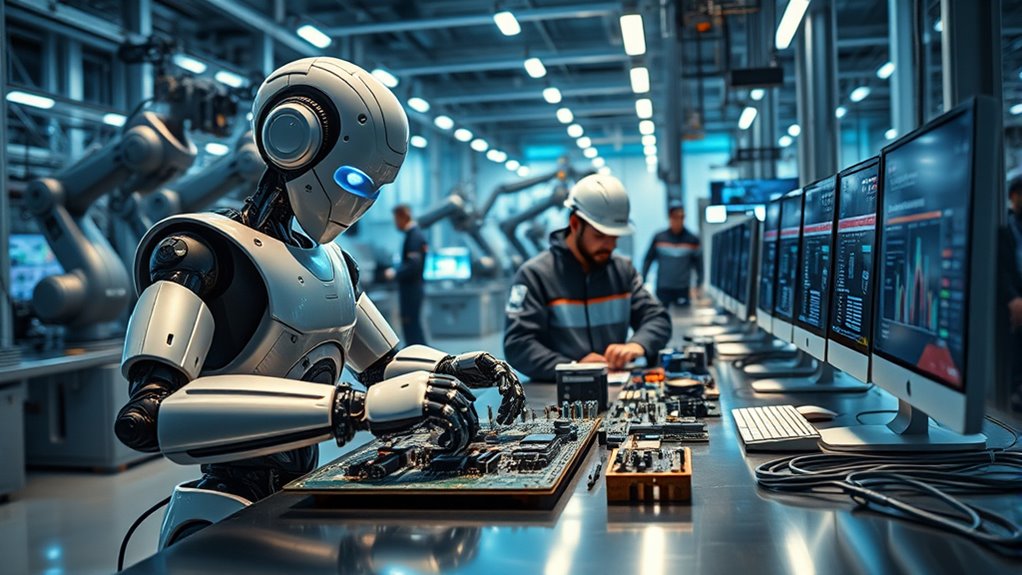

Robots and AI aren’t just taking your job; they’re changing what work looks like by automating routine tasks and creating new opportunities for skilled workers. Instead of stealing jobs, they reshape roles across industries, demanding new skills and expertise. The impact varies by sector, but overall, the workforce evolves rather than shrinks. If you keep exploring, you’ll discover how to adapt and thrive in this shifting landscape.
Key Takeaways
- Automation has displaced some jobs, but it also creates new roles, especially in AI and tech sectors.
- About 14% of workers report job displacement due to automation, but many jobs are evolving rather than disappearing.
- Industries like manufacturing and retail face significant automation risks, yet shifting skill demands lead to new opportunities.
- Rapid AI adoption is transforming job functions, emphasizing digital literacy and specialized skills for emerging roles.
- Overall, robots are redefining rather than solely stealing jobs, prompting workforce adaptation and skill development.
AI for Non-Techies Beginners: A Fun and Practical Guide to Artificial Intelligence, Automation, and Machine Learning for Entrepreneurs, Professionals, and Creative Thinkers
As an affiliate, we earn on qualifying purchases.
As an affiliate, we earn on qualifying purchases.
The Current Impact of Automation on Employment
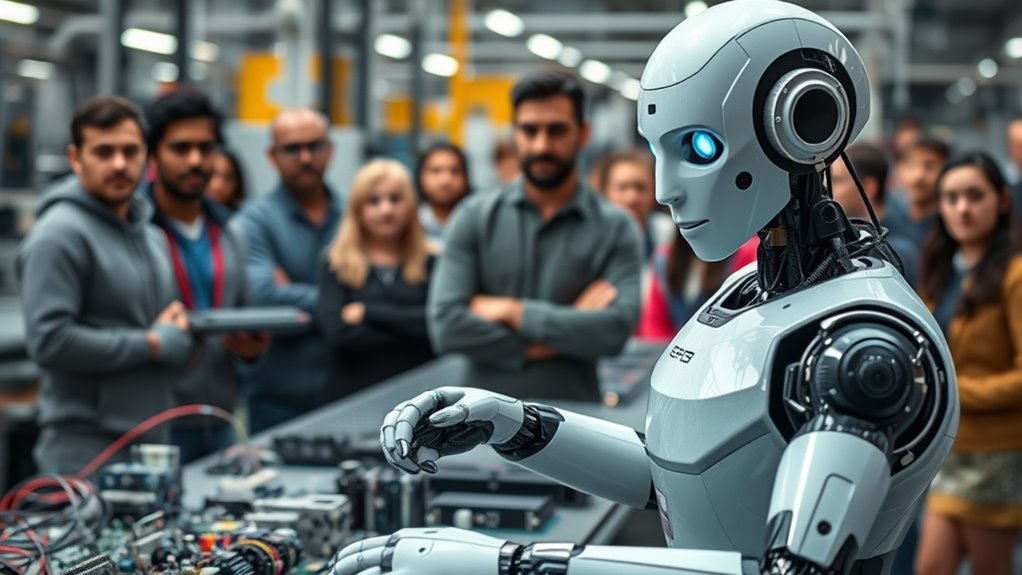
Automation is currently transforming the job landscape, though its impact is still limited. About 14% of workers have experienced job displacement due to automation or AI, showing a notable but not overwhelming effect. In May 2023, AI contributed to roughly 3,900 job losses in the U.S., ranking it as the seventh-largest cause of displacement. Meanwhile, tech sector layoffs have surged, with over 136,831 jobs lost this year alone, marking a significant shift since 2001. Large companies like British Telecom plan to cut 10,000 jobs over seven years using automation and AI strategies. Despite high expectations, actual displacement remains somewhat lower, indicating that automation’s current impact is significant but not as destructive as some feared. Approximately 12.6% of U.S. employment faces a high or very high risk of automation displacement, suggesting that the overall effect is substantial but still limited in scope. Additionally, the rise of specialized garden planters demonstrates how automation and innovative design are redefining traditional roles and functions in related industries.

Designing Courses with Digital Technologies
As an affiliate, we earn on qualifying purchases.
As an affiliate, we earn on qualifying purchases.
How AI Is Transforming Job Roles and Industries
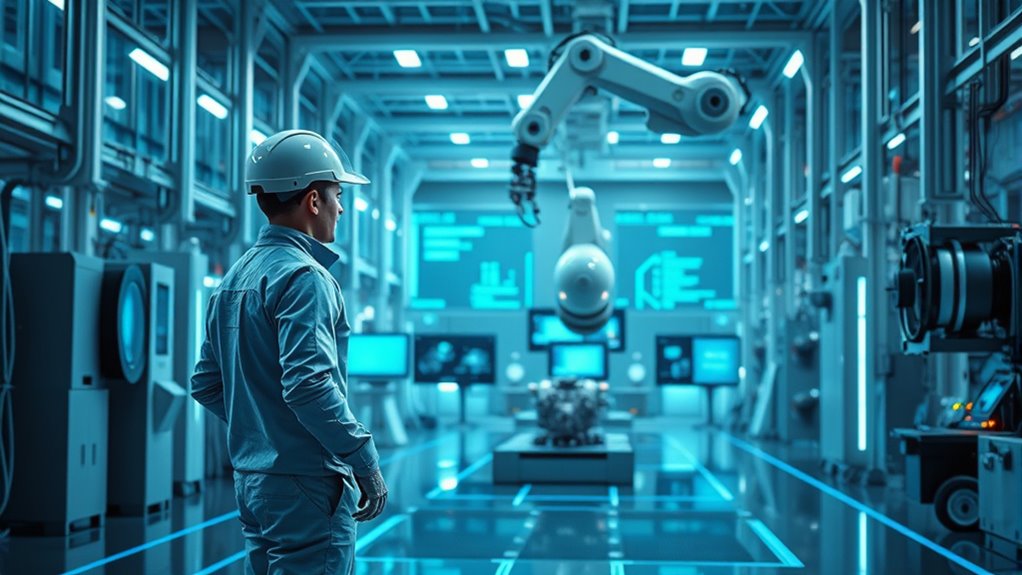
AI is changing how you work by redefining job functions and creating new roles that blend technical skills with industry expertise. Industries are shifting rapidly, with many adopting AI-driven processes that impact daily tasks and strategies. To stay competitive, you’ll need to develop new skill sets and adapt to these evolving roles quickly. AI’s potential to automate cognitive functions and decision-making is enabling organizations to reimagine traditional workflows and unlock new efficiencies. As these technologies expand, understanding the impact on employment becomes essential for workforce planning and development. Additionally, the integration of industry-specific tuning expertise is helping companies optimize their operations and better align with market demands. Moreover, as organizations incorporate digital transformation strategies, they are reshaping the overall job landscape to include more tech-centric roles. Recognizing technological innovation as a driver of change allows workers and companies to stay ahead in this evolving environment, especially as automation technology continues to advance across sectors.
Redefining Job Functions
As technological advancements accelerate, job roles across industries are undergoing rapid transformation. You’ll notice AI reshaping tasks once performed manually, allowing you to focus on higher-level responsibilities. For example, roles like machine learning engineers and generative AI specialists are in high demand, creating new career paths. Skills such as Python, TensorFlow, and NLP are now essential. Tasks like data entry and administrative support are being automated, freeing you from routine work but also requiring new skills for complex problem-solving. AI is not just replacing jobs; it’s redefining them, enabling you to perform tasks more efficiently and creatively. This shift supports the creation of new jobs, especially in healthcare, consulting, and data analysis, while pushing you to adapt and reskill for the evolving landscape. Additionally, understanding home improvement concepts can help professionals better organize and optimize their workspaces to adapt to these new roles, as the integration of AI tools often depends on a well-structured environment and technological proficiency. Developing digital literacy skills is increasingly important to stay competitive and effectively utilize these emerging technologies, as familiarity with technological tools enhances adaptability in the workforce. Embracing continuous learning is crucial to stay ahead in this rapidly changing job environment.
Industry-Specific Shifts
Industries worldwide are experiencing profound changes as new technologies reshape job roles and operational practices. In retail, automation threatens 7.5 million jobs by 2025, with a 30% displacement rate. Manufacturing faces similar shifts, replacing 4.6 million jobs—mainly through robots—at a 20% rate. Transportation is hit hardest, with 3.3 million jobs at risk due to self-driving tech, with a 50% displacement rate. Financial services see 2.9 million roles affected by AI tools like contract review systems, at 28%. Customer service jobs—around 2.5 million—are increasingly automated via chatbots, with a 40% displacement rate. These shifts are driven by rapid AI development, which will continue to redefine roles, often replacing routine tasks while creating new opportunities within industries. The integration of automated systems is accelerating, leading to a significant transformation in workplace dynamics. Widespread automation could affect 1.2 billion employees and impact $14.6 trillion in wages, indicating that these technological changes have significant implications for the global workforce. Additionally, the ongoing advancement of AI-driven automation highlights the importance of adapting skills to remain relevant in evolving job markets, especially as the role of copyright and privacy policies evolve alongside technological innovations. Understanding the impact of biodiversity on sustainable development can also inform how industries approach environmental responsibility amidst these technological shifts. Moreover, awareness of regulatory frameworks can help industries navigate compliance challenges associated with rapid technological changes.
Skillset Evolution
The rapid development of artificial intelligence is actively reshaping the skills required across various job roles and sectors. You’ll notice a shift in demand for new abilities, with AI increasingly featured in job postings. This change means that many workers must reskill or upskill to stay relevant. For example, 92% of ICT jobs are expected to transform due to AI, emphasizing continuous learning. Organizations support this through training, with 84% providing resources for AI skills development. Core skills will also evolve, with 39% expected to change by 2030. AI-related job postings have increased by 108% from December 2022 to December 2024, reflecting a significant shift in workforce needs. Additionally, the integration of digital literacy into educational curriculums is becoming essential to prepare future workers for this evolving landscape.
- AI is redefining technical skills, making some less pertinent by replacing manual and routine tasks, which shifts the focus toward more strategic and creative competencies.
- Role-specific job tasks are shifting, creating new opportunities.
- Soft skills like communication and empathy remain vital.
- Ongoing training is essential for workforce adaptation.
- Additionally, industries such as automotive tuning are increasingly leveraging AI for performance optimization and diagnostics, further influencing the skillsets required in specialized fields. Furthermore, the integration of holistic health practices like yoga into corporate wellness programs highlights the importance of adaptable skills in promoting overall well-being and resilience among employees.

Makeblock mBot Robot Kit with Scratch Coding Box, STEM Projects for Kids Learn to Code with Scratch Arduino, Programmable Robot with 4 Programming Learning Projects, Gifts for Boys Girls Aged 8-12
Unlock the World of Coding with Ease: The mBot robotics kit makes coding learning easy just like block…
As an affiliate, we earn on qualifying purchases.
As an affiliate, we earn on qualifying purchases.
Displacement vs. Creation: The Balance of New Opportunities
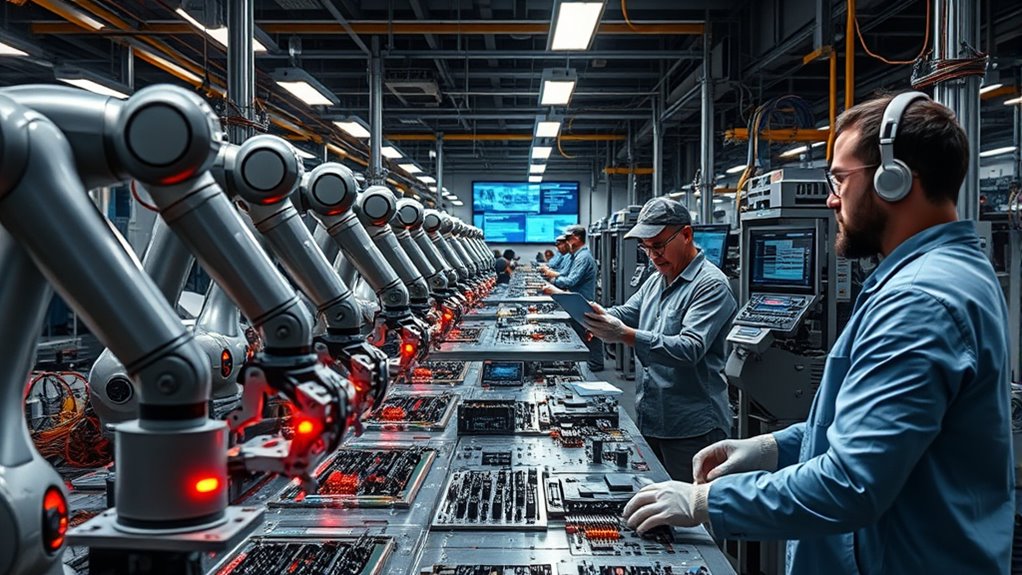
As robots and AI displace millions of jobs, they also create new opportunities that demand different skills. You’ll need to adapt quickly, embracing ongoing training and shifting industry demands. Recognizing how technological adaptation can foster growth is essential for thriving in a changing environment. Keeping an eye on emerging trends and the recurring patterns in job markets can help individuals anticipate future demands and prepare accordingly. Balancing job losses with emerging roles is key to understanding how the workforce can thrive amid technological change. Additionally, understanding the raw food diet can serve as a metaphor for adapting to change—embracing new, unprocessed approaches to sustain growth. Recognizing how nutritional value of juices can contribute to overall well-being highlights the importance of staying adaptable and open to new methods of nourishment and productivity. Developing an understanding of climate control technologies, like heat pumps, exemplifies how innovations can improve energy efficiency and create new industry standards for sustainability and comfort.
Job Losses and Gains
While automation and AI are displacing millions of jobs worldwide, they also open new opportunities for employment and innovation. You’ll find that around 14% of workers have experienced displacement, and by 2030, about 5 million jobs could be lost to robots and autonomous systems. Yet, new roles are emerging, especially in sectors like human augmentation, valued at over $492 billion in 2025. Automation has freed up resources, with over 34% of tasks now automated, leading to fresh job creation. Companies are investing heavily in AI, which can generate roles that complement human skills. Some key points include: significant contributions to Indian cinema, growth in emerging sectors like human augmentation, automation freeing resources for new roles, AI-driven job creation in related fields, and the evolving balance between displacement and opportunity.
New Skill Demands
Automation and AI are rapidly changing skill demands in the workforce, creating both challenges and opportunities. You’ll need to develop new skills, like advanced IT, robotics, and data analysis, to stay competitive. Digital literacy is essential as basic tech skills become fundamental, while social and emotional skills grow more valuable for human interaction and empathy. As automation reduces the need for manual and routine cognitive tasks, you must adapt through retraining and upskilling. New roles are emerging in industries like aerospace, automotive, and electronics, emphasizing the importance of specialized knowledge. This shift isn’t just about job loss; it’s about transforming the job landscape, with automation fueling productivity gains and creating opportunities for those willing to evolve. Staying proactive and continuously learning is key. Investing in automation technology is also crucial, as it can help businesses remain competitive and adapt to these changing demands.
Industry Transformation Trends
Industry transformation driven by AI and robotics involves a delicate balance between job displacement and new opportunity creation. While automation displaces roles—especially in routine sectors—it’s also generating millions of new jobs and redefining skills. You should note that:
- About 14% of workers have lost jobs to AI or automation.
- An estimated 69 million new roles will emerge by 2027.
- Over 46.5% of jobs in energy, utilities, and mining face high displacement risk.
- 77% of employers plan to retrain staff to work alongside AI.
This shift impacts industries like tech, energy, and customer service, with robotics and AI reshaping roles and creating growth areas like human augmentation. The challenge lies in balancing job loss with the opportunities these technologies bring.

The Dyslexia Guide for Adults: Practical Tools to Improve Executive Functioning, Boost Literacy Skills, and Develop Your Unique Strengths
As an affiliate, we earn on qualifying purchases.
As an affiliate, we earn on qualifying purchases.
High-Skill Demand and the Future Workforce

As technological advancements accelerate, the demand for high-skill workers is increasing across various industries. You’ll find roles like data scientists growing 36% with median salaries around $112,590, and information security analysts rising 33%, driven by cybersecurity needs. Globally, about 170 million new jobs are expected this decade, mainly fueled by AI, green tech, and economic shifts. Skills like leadership, AI, data analytics, and technical certifications are essential, while adaptability and problem-solving remain core. The table below highlights emerging high-skill roles:
| Role | Growth/Salary |
|---|---|
| Data Scientists | 36% growth, $112,590 median |
| Info Security Analysts | 33% growth |
| Skilled Trades | Expanding with tech innovations |
| Green Tech Professionals | Increasing demand |
These trends show a future where high skills redefine, not replace, your role.
Economic and Social Consequences of Automation

Technological advances are reshaping the job landscape at an unprecedented pace, leading to both opportunities and challenges. You might see new industries emerge, but millions could face job loss. Over 300 million jobs worldwide could be displaced by AI, with 41% at risk within five years. The global human augmentation market is valued at nearly half a trillion dollars, reflecting heavy investment. Robots are projected to displace 5 million jobs by 2030, and over a third of business tasks are now automated. These shifts bring social impacts, like 14% of workers experiencing displacement and 30% fearing job loss by 2025. Meanwhile,:
- 60% of jobs in advanced economies are vulnerable
- Industry sectors like energy and manufacturing face high automation risks
- Employers plan widespread retraining efforts
- Automation may create new roles yet to be defined
Preparing for a Workforce in Transition
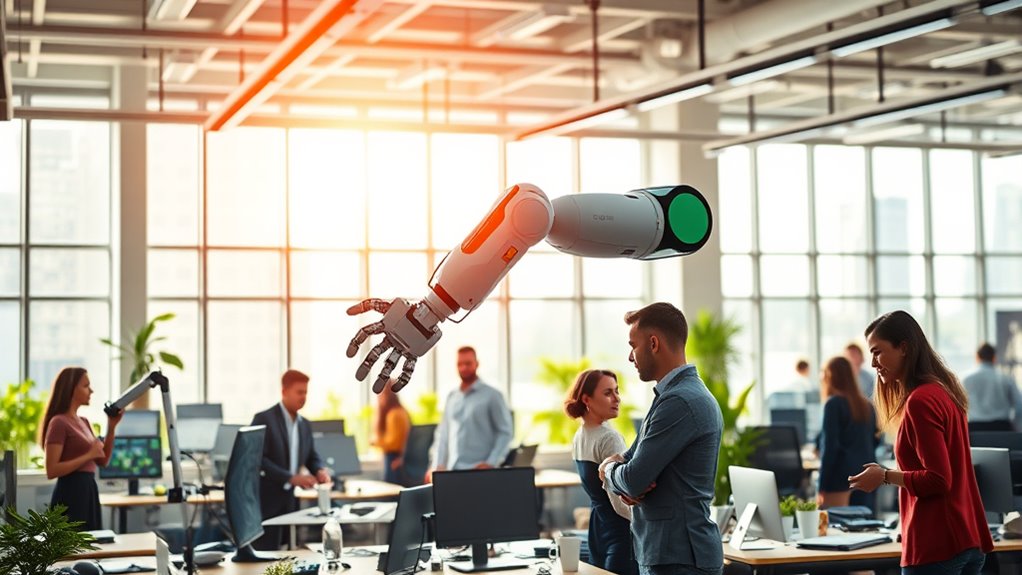
Preparing for a workforce in shift requires proactive efforts to adapt to rapid changes driven by automation and technological innovation. You’ll need to focus on upskilling, as 85% of employers plan to prioritize workforce development to meet new job requirements. Expect new roles in data analysis, AI, cybersecurity, and green energy sectors to grow considerably, while traditional jobs like farmworkers and delivery drivers also expand. To stay competitive, you must develop human-centered skills such as resilience, flexibility, and social influence. Governments and companies are investing in education and training programs to help workers transition smoothly. Recognize that job creation and displacement will occur simultaneously, but the overall job market is expected to expand by 78 million jobs by 2030, offering new opportunities for those prepared to evolve.
Frequently Asked Questions
How Can Workers Adapt to Changing Job Requirements Caused by Automation?
To adapt to changing job requirements caused by automation, you need to focus on upskilling and reskilling. Embrace learning new skills like AI, big data, and cybersecurity, and develop your flexibility, resilience, and creative thinking. Stay proactive by taking advantage of training programs and support systems. Keep updating your knowledge, stay adaptable, and cultivate leadership and social skills to remain valuable in evolving workplaces.
What Policies Are Effective in Managing Ai-Driven Unemployment?
You need effective policies to manage AI-driven unemployment. Invest in reskilling programs and promote lifelong learning so workers can develop new skills. Strengthen social safety nets like unemployment benefits and consider basic income support. Encourage innovation and AI-related startups to create new jobs. Implement clear regulatory frameworks that guarantee responsible AI use, transparency, and ethical standards. These measures help you adapt to changing job markets and maintain economic stability.
Which Industries Will Benefit Most From Automation in the Future?
You might think automation will only replace jobs, but it’s actually reshaping industries for the better. Manufacturing, healthcare, logistics, and agriculture are set to benefit most, boosting efficiency, safety, and productivity. Robots handle repetitive, hazardous, or complex tasks, freeing humans for creative and strategic roles. Embracing this shift helps you stay ahead, leveraging technology to improve outcomes and open new opportunities rather than just losing jobs.
How Does Automation Influence Income Inequality Globally?
Automation influences income inequality globally by widening the gap between high- and low-income workers. It boosts returns for capital owners and high-skilled employees, often leaving less-educated workers displaced or with stagnant wages. As automation replaces routine jobs, those with advanced skills benefit more, increasing polarization. To address this, you’ll need policies that promote education, retraining, and fair redistribution to guarantee the economic gains are shared more equitably worldwide.
What Skills Will Be Most Valuable in an Ai-Driven Economy?
Imagine a future where AI transforms every industry—what skills will make you thrive? In this AI-driven economy, your programming expertise, especially in Python and machine learning, becomes essential. Data analysis, cloud computing, and ethical awareness will set you apart. Strong communication and adaptability also matter, helping you navigate and innovate in a rapidly changing landscape. Prepare now, and you’ll be the one shaping the future, not just reacting to it.
Conclusion
As you consider the evolving job landscape, it’s clear that automation’s impact isn’t just about loss but also opportunity. Coincidentally, as some roles fade, new ones emerge, often requiring skills you might not expect. Embracing change now can help you adapt and thrive in this shifting world. Remember, while technology reshapes industries, your ability to learn and grow remains the key to staying ahead—perhaps even finding new paths you hadn’t imagined.