
Executive take
Two moves, one signal: generative AI is crossing from pilots to regulated, at-scale deployment.
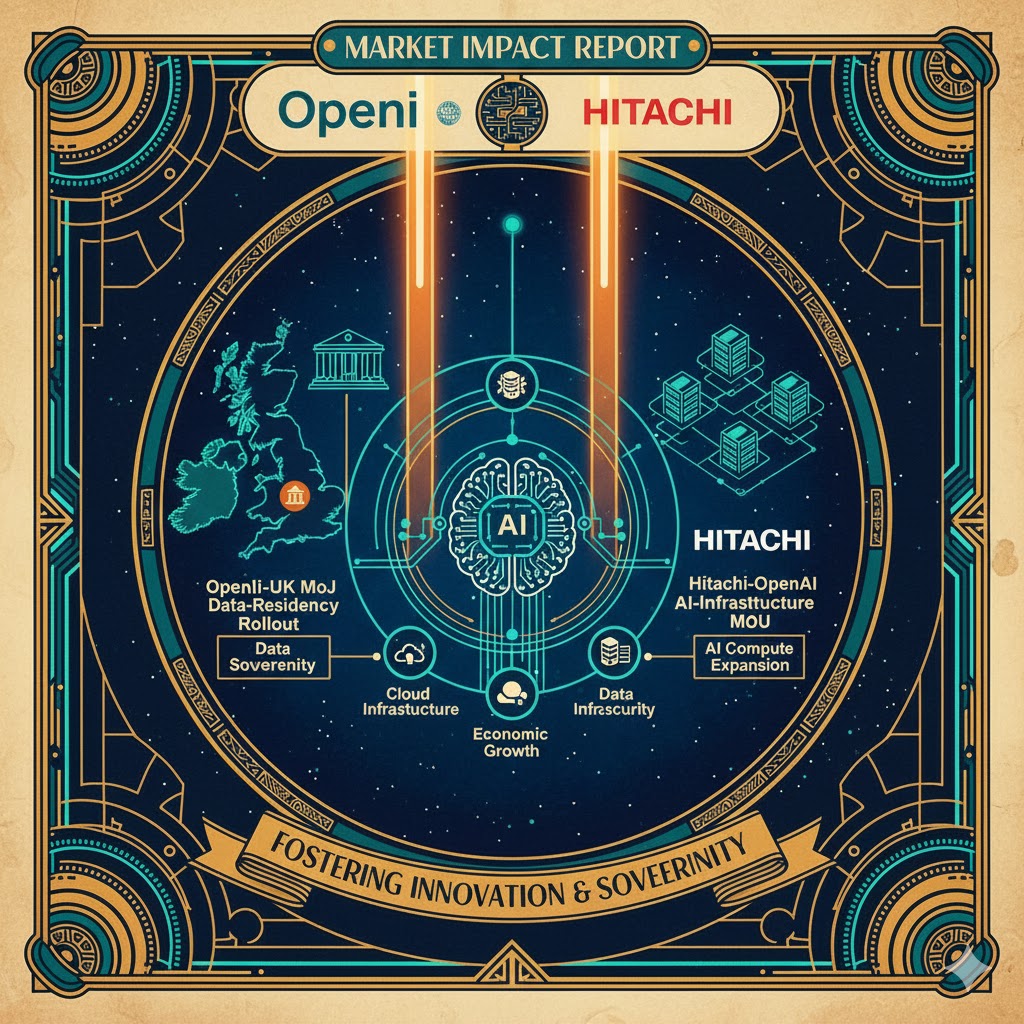
- UK Ministry of Justice + OpenAI: ChatGPT Enterprise to ~2,500 civil servants with a UK data-residency option across API, Enterprise, and Edu. This meaningfully lowers sovereignty and compliance friction for the UK public sector and regulated industries. Reuters+2OpenAI+2
- Hitachi + OpenAI MoU: a strategic partnership to accelerate global AI data-centre build-out (power, cooling, modular/prefab halls). This tightens the link between model providers and physical infrastructure, pulling utilities, EPCs, and data-centre builders into the GenAI demand curve. hitachi.com+2Nasdaq+2
UK data residency compliant AI cloud services
As an affiliate, we earn on qualifying purchases.
As an affiliate, we earn on qualifying purchases.
What changes now (and why it matters)
1) Public sector & justice ecosystem (UK first, EU spillover)
- Barrier removal: Regional data-residency becomes table-stakes for procurement; MoJ is the first live reference. Expect copy-cat RFPs across central departments, devolved administrations, and local councils. The Register+1
- Workflows: Low-risk use cases (summaries, drafting, triage, data extraction, transcription) move to production; adoption playbooks will standardize. Reuters
- Competitive shift: Azure OpenAI (UK regions), Google’s sovereign controls, AWS Bedrock, and Anthropic must match clear, contractual UK residency guarantees and auditability—beyond marketing claims of “regionalization.” Reuters
Near-term winners: G-Cloud consultancies, SaaS with gov-grade controls (records retention, FOI/DSAR support), justice-tech ISVs (transcription, case-prep, disclosure).
KPIs to watch: procurement frameworks adding GenAI SKUs; ratio of POCs→BAU deployments; % of departments mandating in-country storage.
2) Regulated industries (FS, health, insurers, critical infra)
- Adoption unlock: If justice can run ChatGPT Enterprise with UK residency, risk committees in FS/health have a precedent. Expect policy updates to allow vendor GenAI if (a) data is stored in-region, (b) logging/audit are on, (c) prompts/results retention is configurable. Reuters+1
- New RFP clauses: “Where is prompt/content stored and processed?”, “egress controls?”, “model-update cadence and rollback?”, “human-review controls for adverse decisions?”
- Competitive shift: Incumbents with existing UK/EU compliance stacks (Microsoft, Google, AWS, Salesforce, ServiceNow, IBM, Oracle) gain if they can prove like-for-like residency and governance; point tools without compliance depth get squeezed. Reuters
Winners: Compliance automation vendors, audit/logging platforms, DLP & key-management providers; systems integrators with model-risk teams.
Risks: “Residency ≠ sovereignty”; buyers will press for jurisdictional processing, supplier-subprocessor lists, and model-version attestations. The Register
3) Cloud, colocation, and sovereign compute
- Raised bar: OpenAI offering UK data-residency (and its earlier Stargate UK initiative) pressures hyperscalers and colos to market jurisdiction-specific stacks (compute, storage, key custody, support personnel). OpenAI+1
- Edge for UK/EU colos: Facilities with proven compliance postures (IL-levels/NCSC guidance alignment) and power availability can command premiums.
- Competitive shift: Expect more joint announcements (model vendor × infra operator × GPU supplier) to de-risk supply chains and timelines. OpenAI
4) Power, utilities, EPCs, and data-centre builders (Hitachi–OpenAI)
- Demand certainty: The MoU frames multi-year capex for AI halls; modular/prefab designs compress time-to-capacity and standardize interfaces for power and cooling. hitachi.com+1
- Grid implications: Emphasis on outside-the-fence power quality, connections, and waste-heat reuse; utilities and municipalities become strategic partners, not just vendors. hitachi.com
- Competitive shift: EPCs that productize modular AI halls, liquid cooling, and on-site low-carbon generation move up the stack; traditional bespoke builders face margin pressure. Datacenter Dynamics
Winners: Prefab data-hall specialists, advanced cooling OEMs, switchgear/transformer suppliers, and colos with fast-track land/power.
Risks: MoUs are non-binding; site control, grid lead-times, and component bottlenecks can slip delivery. hitachi.com
5) Semiconductor & accelerator ecosystem
- Upstream pull-through: Standardized, prefab designs accelerate the cadence of GPU/DPU/optics deployments; vendors aligned to liquid cooling + dense racks benefit first. Datacenter Dynamics
- Competitive shift: NVIDIA remains advantaged, but AMD/others gain if modular blueprints certify multi-vendor options to derisk supply.
6) Cybersecurity, governance, and assurance
- Control surfaces expand: Residency adds storage controls; buyers now want prompt/result retention policy, enclave options, KMS/HSM segregation, and model-risk reporting.
- Competitive shift: Platforms with end-to-end audit trails (who prompted what, when, and with what model-hash) become procurement defaults in gov/regulated sectors. Reuters

Dictation Depot LLC Express Scribe Transcription Kit – Professional Software, Heavy Duty Infinity IN-USB-3 Foot Pedal, Spectra FLX-10 Headset – 16GB Memory, USB Interface
- Foot Pedal Type: Three-button USB foot pedal
- Device Quality: High quality ergonomic design
- Cord Length: 10-foot cord
As an affiliate, we earn on qualifying purchases.
As an affiliate, we earn on qualifying purchases.
How verticals can capitalize (playbooks)
Public sector & justice
- Move beyond pilots with a Use-Case Catalog (summarization, evidence bundling, form-fill, meeting minutes, transcription).
- Bake in governance: retention windows, FOI/DSAR searchability, red-team prompts, model-hash pinning per workflow. Reuters
Financial services
- Fast-track “low-risk” ops: KYC narrative generation, policy summarization, customer-comms drafting—with in-region storage and strict redaction.
- Update third-party risk frameworks to explicitly assess model updates, egress, and co-tenancy.
Healthcare
- Start with non-diagnostic workloads (admin notes, referrals, benefit letters) under UK residency; keep PHI minimal and redacted by default.
Colocation & builders
- Publish AI-hall reference designs (rack density, cooling curves, power envelopes), add contractual SLAs tuned for LLM training/inference. Datacenter Dynamics
SaaS & ISVs
- Ship a “UK-Residency Mode”: explicit data-path diagrams, region-locked storage, and admin toggles for log retention + export. Use MoJ as a public case pattern (without sensitive details). The Register

AI-Powered Contract Management: AI-Powered Contract Management:AI contract management, legal automation, contract lifecycle management, AI legal tech, … compliance monitoring, smart contracts.
As an affiliate, we earn on qualifying purchases.
As an affiliate, we earn on qualifying purchases.
Competitive dynamics to expect (next 6–12 months)
- Residency becomes checkbox-critical in RFPs across UK public sector and regulated industries; vendors without it lose shortlist status. TechRadar
- Gov reference deals proliferate (justice → health → local gov). Procurement frameworks (e.g., G-Cloud) add clearer GenAI categories. Reuters
- Infra bundling: model vendors + GPU suppliers + colos announce “capacity corridors,” locking in power and delivery slots. hitachi.com
- Governance premium: Solutions with strong audit, KMS segregation, DSAR/FOI readiness win higher ACVs.

The Visionary Unveiling – The Bugatti Hyper Loop Thermal Pod (HLTP) — DATA Centers Decoded: Welcome to 2030 DATA Center Cooling Systems HLTP: A hyper-advanced modular adaptation to cooling systems
As an affiliate, we earn on qualifying purchases.
As an affiliate, we earn on qualifying purchases.
Risks & watch-outs
- Sovereignty overreach: Residency ≠ full sovereignty—processing location, staff jurisdiction, and sub-processors still matter. Expect regulator scrutiny. The Register
- Lock-in: Deep workflow integration into a single LLM stack raises switching costs; buyers should negotiate exportable logs/artifacts and model-neutral orchestration.
- Infrastructure timelines: MoU momentum can be capped by grid and components; plan for phased capacity and hybrid placement. hitachi.com