
By Thorsten Meyer — November 9, 2025

Get business pricing on tech for your team
- Business-only prices and quantity discounts
- Tax-exempt purchasing
- Multiple users, one account, clear invoices
TL;DR
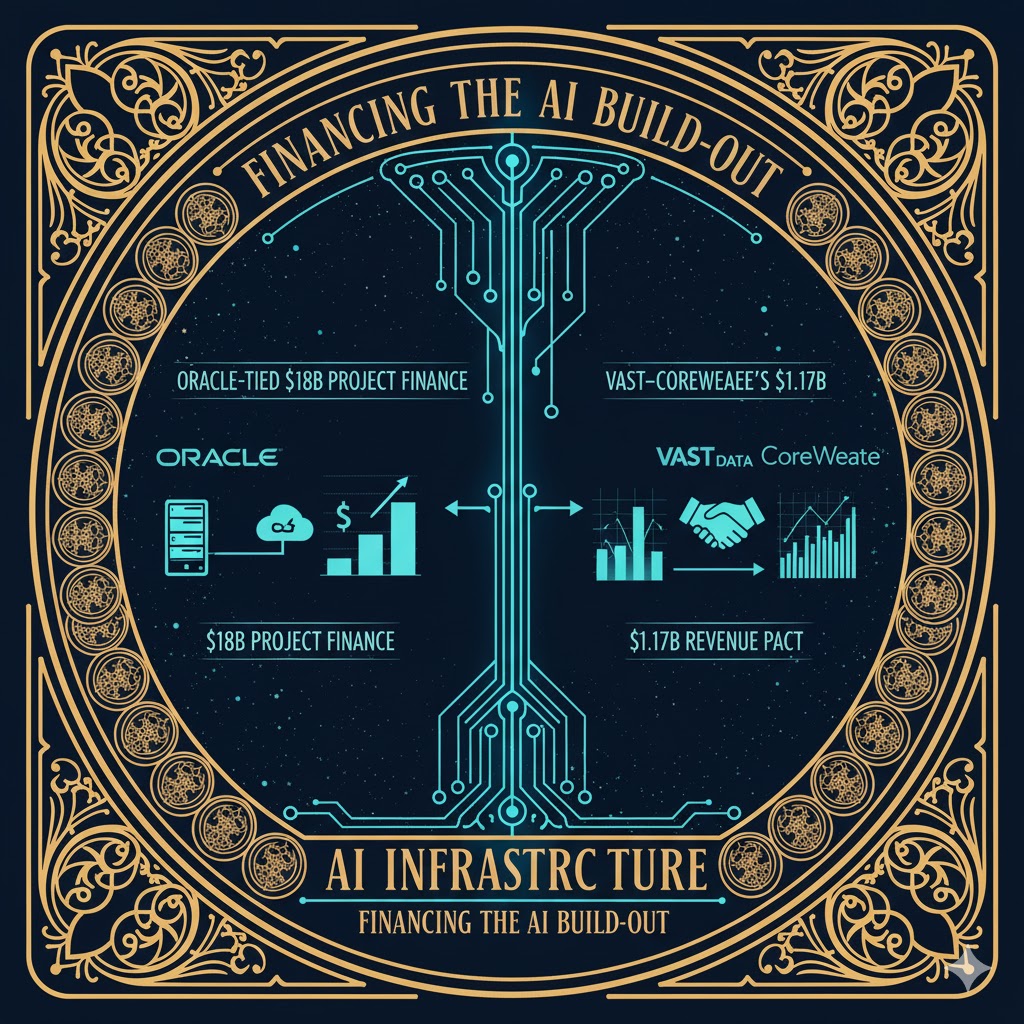
Two deals this week show how the AI stack is being funded end-to-end:
- Debt: ~20 banks are syndicating an $18B project-finance loan to build a New Mexico data-center campus tied to Oracle, priced around SOFR + 250 bps with a four-year tenor and two one-year extensions. Reuters+2Yahoo Finance+2
- Revenue: VAST Data signed a $1.17B multi-year commercial agreement with CoreWeave, making VAST the primary data platform across CoreWeave’s GPU cloud. Reuters+1
Together, these signal a maturation of AI infrastructure financing: banks are comfortable underwriting hard assets at unprecedented scale, while cloud-native data platforms lock in software + services revenue tied to GPU utilization.
enterprise data center server racks
As an affiliate, we earn on qualifying purchases.
As an affiliate, we earn on qualifying purchases.
Why this matters (and to whom)
For capital markets
- Project finance goes AI-native. Traditional PF structures—long-dated, asset-backed, cash-flow anchored—are now funding hyperscale campuses. The Oracle-linked loan’s SOFR + 250 bps pricing and extendable 4+1+1 structure suggests lenders see durable tenancy and power-contract visibility, despite grid bottlenecks and supply-chain risk. Reuters+1
- Securitization runway. With ~20 banks leading and distributing, expect tranches to migrate to insurers and infrastructure debt funds hunting yield with investment-grade characteristics. (Bloomberg first reported the size and agent bank roster.) Reuters
For AI operators & ISVs
- Data layer is now a profit center. VAST becomes CoreWeave’s primary data foundation, aligning storage, metadata, and data-pipeline performance with GPU-hour economics. This is a classic “attach-rate” story: more training/inference → more data movement/state → more VAST ARR. Reuters+1
- Ecosystem gravity. CoreWeave has been assembling a full-stack AI cloud (including its earlier W&B acquisition), and the VAST pact tightens its differentiation beyond “just GPUs.” Reuters
For policymakers & regions
- Industrial policy meets load growth. The New Mexico campus is part of a larger “Stargate/Project Jupiter” narrative linking OpenAI, Oracle, SoftBank, and regional developers; local incentives and water/power planning are central to pace and scale. palabra.+1
As an affiliate, we earn on qualifying purchases.
Reading the signals
- Debt appetite is backstopping AI demand volatility. Bank syndicates underwriting $18B for an Oracle-anchored campus implies comfort with tenant credit and multi-year compute demand. If rates ease in 2026, refis could lower WACC—creating room for additional phases. Reuters
- Software-defined storage as AI OPEX. The VAST–CoreWeave contract is not capex financing; it’s multi-year, usage-linked revenue that scales with model size, context windows, checkpointing cadence, and retrieval-heavy inference. This is where data locality and throughput convert directly into GPU efficiency and margin. Reuters
- Power is the real bottleneck. Even with capital secured, interconnect queues, transformer lead times, and water constraints will dictate timelines. The financing’s two extension options anticipate such frictions. Reuters
software-defined storage solutions
As an affiliate, we earn on qualifying purchases.
As an affiliate, we earn on qualifying purchases.
What could break (risk map)
- Grid delays / interconnect risk: Slippage in substation upgrades or transmission approvals could force schedule resets, triggering cost-overruns and extension options on the loan. Reuters
- Rate path & refinancing risk: If SOFR stays higher for longer, debt service tightens. Conversely, faster cuts improve economics and could catalyze campus expansion. Reuters
- Vendor concentration risk: VAST’s $1.17B is a win, but concentration in a few hyperscale-style buyers means exposure to procurement cycles and GPU supply dynamics. Reuters
industrial power backup systems for data centers
As an affiliate, we earn on qualifying purchases.
As an affiliate, we earn on qualifying purchases.
Competitive implications
- Clouds vs. GPU clouds: CoreWeave’s data-platform standardization increases switching costs and speeds workload onboarding—an answer to the big three clouds’ proprietary AI stacks. Expect rivals to tighten their own data operating systems (indexing, vector stores, checkpoint orchestration). Reuters
- PF as the norm for AI campuses: After New Mexico, look for copy-paste structures (club deals + mini-perms + extensions) across power-rich, incentive-ready regions. The agent bank mix (SMBC, BNP Paribas, Goldman, MUFG) is a template others can follow. Reuters
What I’ll watch next (Q4’25–Q1’26)
- Syndication depth & final pricing on the $18B loan, including insurer take-up and any mezzanine slices. Reuters
- CoreWeave workload mix growth (training vs. inference) and how that flows into VAST’s recognized revenue cadence under the agreement. Reuters
- Permitting, water, and power milestones for Project Jupiter/Santa Teresa, including any PPA disclosures or SST (solid-state transformer) deployments to compress interconnect timelines. palabra.
Key data points (for your board slide)
- $18B: Oracle-tied campus loan; SOFR + 250 bps; 4-year maturity + two 1-year extensions; ~20 banks syndicating. Reuters+1
- $1.17B: VAST–CoreWeave agreement; VAST as primary data platform across GPU cloud; multi-year term. Reuters
Bottom line
AI infrastructure is bifurcating into two funding lanes—asset-backed debt for steel-and-silicon campuses and usage-linked software contracts for the data layer. The former proves that lenders believe AI demand is durable; the latter proves that the data operating system is now a core profit lever in GPU clouds. Expect more of both.
Fall Picks
fall essentials
As an affiliate, we earn on qualifying purchases.