
By Thorsten Meyer | ThorstenMeyerAI.com | February 2026
Executive Summary
Hyperscalers will spend $602 billion on infrastructure in 2026, a 36% increase over 2025. NVIDIA’s Blackwell GPUs are sold out through mid-2026, with a backlog of 3.6 million units. Global datacenter electricity demand is projected to hit 945 TWh by 2030 — nearly 3% of global consumption. Export controls, rare-earth retaliations, and packaging bottlenecks are fragmenting the supply chain that makes all of it possible.
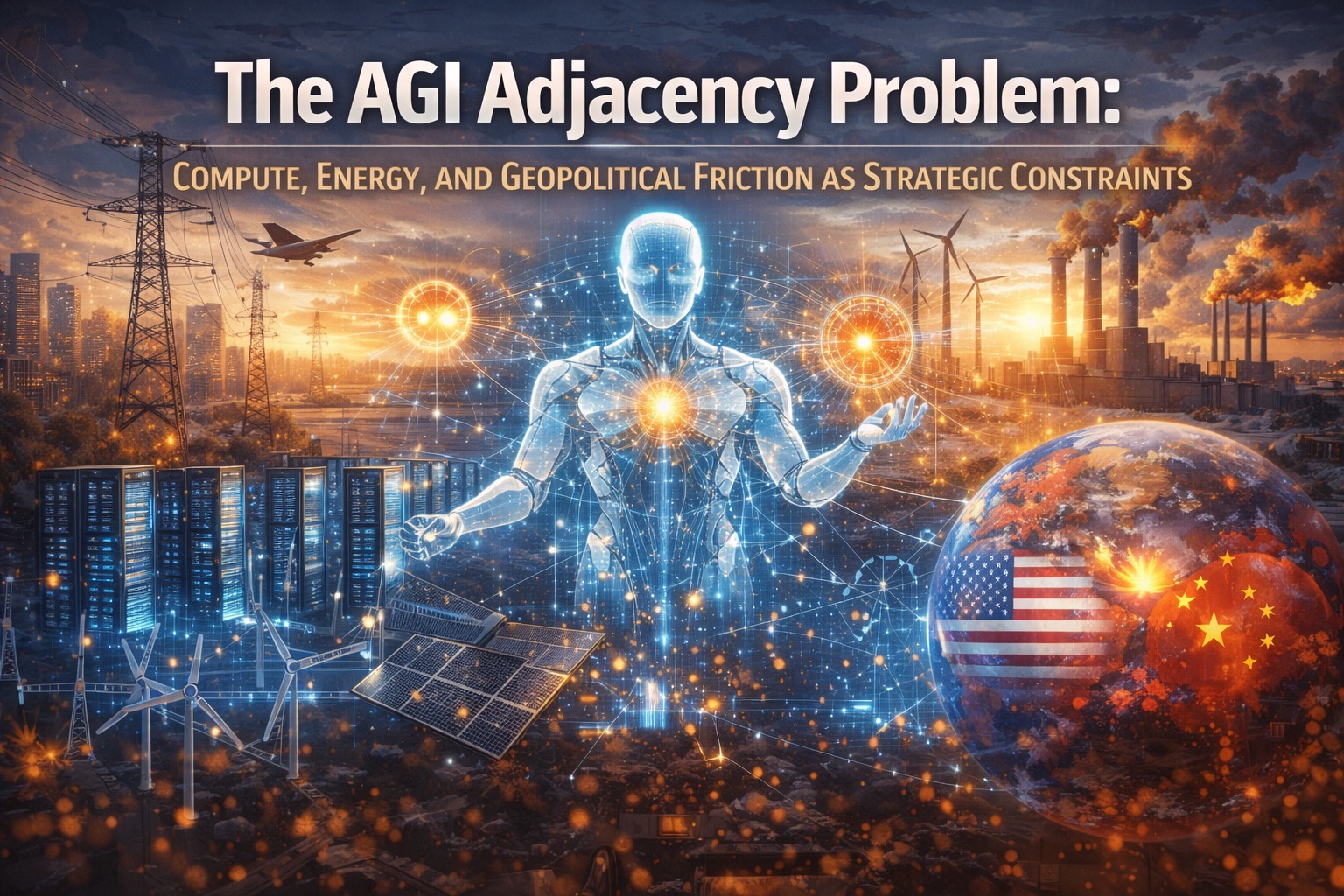
AGI discourse fixates on model capabilities. Executives and policymakers should fixate on what actually determines who deploys frontier AI at scale: chips, energy, packaging capacity, grid reliability, water, and geopolitical access. This is the AGI adjacency problem — the infrastructure layer that governs whether intelligence breakthroughs translate into operational advantage or remain trapped in research labs.
The implication is stark: AI strategy is now inseparable from infrastructure strategy. Organizations that treat AI as a software procurement problem will discover, too late, that they’ve made a hardware dependency bet they didn’t understand.
| Metric | Value |
|---|---|
| Hyperscaler capex 2026 | $602B (36% YoY increase) |
| NVIDIA Blackwell backlog | 3.6M units, sold out through mid-2026 |
| Global datacenter power demand 2026 | ~500 TWh (260 TWh US alone) |
| TSMC CoWoS capacity end-2026 | 120,000–130,000 wafers/month |
| NVIDIA share of TSMC CoWoS | >60% of 2025–2026 capacity |
| H100 cloud rental price decline | 64–75% from peak |
| Sovereign cloud market projection | $154B → $823B by 2030 |
This article maps the constraint landscape across compute, energy, geopolitics, and enterprise exposure — and provides a framework for strategic planning under infrastructure-governed conditions.

HP NVIDIA Tesla M60 16GB Server GPU Accelerator Processing Card 803273-001
- Memory Capacity: 16GB
As an affiliate, we earn on qualifying purchases.
As an affiliate, we earn on qualifying purchases.
1. The Capability Race vs. the Infrastructure Reality
Public discourse frames AI as an intelligence race. Model benchmarks dominate headlines. Every quarter brings a new frontier model that edges past the previous leader on reasoning, coding, or multimodal tasks.
Operationally, none of it matters without a physical chain:
- Advanced chips — designed by NVIDIA, AMD, or custom ASICs; fabricated almost exclusively at TSMC’s leading-edge nodes
- Advanced packaging — CoWoS and other 2.5D/3D packaging that integrates HBM memory with logic dies
- Datacenter build-out — physical facilities with power, cooling, networking, and physical security
- Power contracts — long-term electricity agreements sufficient for multi-megawatt deployments
- Cooling and water systems — liquid cooling infrastructure now essential for AI-density racks
- Transmission infrastructure — grid connections capable of delivering sustained high loads
Any break in this chain delays or reprices AI programs, regardless of model quality. A company with access to GPT-5 but insufficient inference capacity is no better positioned than a company running GPT-4 with abundant compute.
The Chain Has Already Broken — Multiple Times
The bottleneck has shifted repeatedly since 2023. First, HBM memory was the constraint. Then TSMC CoWoS packaging. Then GPU supply. Now, increasingly, the binding constraint is power — the most fundamental physical resource in the chain.
| Bottleneck | Peak Period | Current Status |
|---|---|---|
| HBM3e memory | 2023–2024 | Easing; SK Hynix and Samsung expanding |
| TSMC CoWoS packaging | 2024–2025 | Still tight; fully booked through 2026 |
| GPU supply (Blackwell) | 2025–2026 | Sold out through mid-2026 |
| Datacenter power | 2025–ongoing | Binding constraint in key regions |
| Grid transmission | 2025–ongoing | Multi-year permitting timelines |
| Water/cooling capacity | 2025–ongoing | Emerging constraint; regulatory pressure rising |
“The AI race is not an intelligence race. It’s a kilowatt race, a packaging race, and a permitting race — and no foundation model can solve any of them.”

Liquid Cooling For Data Centers (HVAC Industrial Books)
As an affiliate, we earn on qualifying purchases.
As an affiliate, we earn on qualifying purchases.
2. Compute Is Strategic, Not Merely Technical
Compute Access as Industrial Capacity
Compute access increasingly resembles strategic industrial capacity — more akin to steelmaking or semiconductor fabrication than to software licensing. Firms with privileged access to high-performance infrastructure gain compounding advantages:
- Faster iteration cycles. Training runs that take weeks at scale take months without scale. The difference is not linear; it compounds through more experiments, faster feedback, and earlier product launches.
- Lower marginal inference costs. H100 cloud rental prices have fallen 64–75% from their 2023 peaks, but only for those with reserved capacity or owned infrastructure. Spot pricing remains volatile.
- Stronger product defensibility. Companies that can serve inference at lower cost can offer capabilities competitors can’t match economically.
The Dependency Trap
Everyone else faces a dependency structure that resembles utility-scale risk:
| Risk Category | Manifestation | Enterprise Impact |
|---|---|---|
| Procurement delays | Blackwell sold out through mid-2026 | 12–18 month gaps in capacity planning |
| Pricing volatility | H100 spot prices swing 30–40% quarterly | Unpredictable AI unit economics |
| Provider concentration | 3 hyperscalers control ~65% of cloud GPU | Single-provider lock-in risk |
| Capacity allocation | Priority goes to largest customers | SMEs and public sector rationed |
| Model availability | Providers can restrict or deprecate models | Sudden capability regression |
For public institutions and critical sectors — healthcare, defense, financial regulation — these dependencies raise resilience questions identical to those in energy and telecom. The difference is that most organizations haven’t recognized AI infrastructure as critical infrastructure yet.
Callout: If your organization’s most important AI workflows run on a single cloud provider, you don’t have an AI strategy. You have a vendor dependency.
enterprise power backup systems for AI infrastructure
As an affiliate, we earn on qualifying purchases.
As an affiliate, we earn on qualifying purchases.
3. Energy as the Hidden Governor
The Power Wall
As AI workloads scale, energy moves from a background variable to the binding constraint on AI deployment. The numbers are now impossible to ignore.
IEA projects US datacenter power demand at 260 TWh in 2026. Gartner forecasts global datacenter electricity rising from 448 TWh in 2025 to 980 TWh by 2030. AI-optimized servers will represent 44% of total datacenter power by 2030, up from 21% in 2025.
The GB200, NVIDIA’s latest Blackwell platform, draws over 1,200W per chip at peak. Average rack density is expected to grow from 36 kW in 2023 to 50 kW by 2027. These aren’t marginal increases — they represent a fundamental change in what datacenters require from the grid.
Energy Economics Shape AI Economics
| Energy Variable | AI Impact | Strategic Implication |
|---|---|---|
| Power price per MWh | Directly sets inference cost floor | Location arbitrage becomes competitive weapon |
| Grid reliability | Latency-sensitive workloads disrupted by outages | Redundancy requirements increase cost |
| Permitting timelines | New datacenter capacity delayed 2–5 years | Supply-demand mismatch persists |
| Decarbonization targets | Constrain where new capacity can be built | RE procurement becomes competitive advantage |
| Transmission capacity | Limits power delivery to facility | Grid bottleneck independent of generation |
Datacenter siting now follows grid capacity and permitting conditions more than proximity to customers. Northern Virginia, the world’s densest datacenter corridor, is already facing grid constraints. New builds are shifting to regions with surplus generation — nuclear sites, hydropower corridors, and areas with underutilized grid capacity.
“The constraint on frontier AI is no longer intelligence. It’s electricity. And unlike intelligence, you can’t download more of it.”
Water: The Other Resource Constraint
Water is AI infrastructure’s second physical dependency. Water absorbs heat 3,000 times more effectively than air, making liquid cooling essential for AI-density deployments. The global liquid cooling market will surge from $2.8 billion in 2025 to over $21 billion by 2032, growing at 30%+ annually.
The tension is real: 45% of datacenter facilities globally may face high water stress exposure by the 2050s. Among facilities currently under construction, 30% are in regions where water scarcity is expected to intensify. The EU expects to roll out regulation in 2026 requiring datacenter operators to meet minimum water-usage standards.
Google and Microsoft have both pledged to become “water positive” by 2030 — returning more water than they consume. The gap between pledge and performance will shape public trust and permitting outcomes.
advanced 3D packaging for AI chips
As an affiliate, we earn on qualifying purchases.
As an affiliate, we earn on qualifying purchases.
4. Geopolitical Controls and Supply Chain Fragmentation
The New Geography of Compute
Export controls, technology restrictions, and industrial policy are reshaping who gets access to frontier AI hardware. This is no longer a trade policy footnote — it’s a structural feature of AI deployment.
The US has tightened semiconductor export controls repeatedly since October 2022. The latest rounds extend restrictions to foreign affiliates, with congressional pressure (the AI OVERWATCH Act, advanced by the House Foreign Affairs Committee in January 2026) pushing to prohibit Blackwell chip sales to foreign entities of concern for two years. China has retaliated with licensing requirements on rare-earth oxides, metals, and magnet products — materials essential to the semiconductor supply chain.
The Fragmentation Map
| Control Layer | Mechanism | Strategic Effect |
|---|---|---|
| US chip export controls | Performance thresholds, end-use restrictions | Regional divergence in capability access |
| China rare-earth controls | Export licensing for critical materials | Supply chain vulnerability for chip manufacturers |
| EU sovereignty requirements | CADA, €180M sovereign cloud tender | Mandatory local processing for sensitive workloads |
| Data localization mandates | National data residency requirements | Multi-jurisdiction deployment complexity |
| ITAR/EAR compliance | Defense and dual-use restrictions | Limits on cross-border AI collaboration |
Taiwan: The Single Point of Failure
TSMC fabricates virtually all frontier AI chips. NVIDIA has booked over 60% of TSMC’s CoWoS advanced packaging capacity for 2025–2026. TSMC’s monthly CoWoS capacity stands at ~80,000 wafers per month, projected to reach 120,000–130,000 by end of 2026 — but demand continues to outpace expansion.
Taiwan’s centrality to the AI supply chain is the single largest geopolitical risk factor in AI infrastructure. TSMC is building facilities in Arizona and Japan, but these won’t reach the scale or advanced process capability of Taiwan fabs for years. Diversification is real but slow.
Callout: Every AI strategy that assumes uninterrupted access to frontier chips is, implicitly, a bet on Taiwan Strait stability. Make that bet explicit in your risk register.
“Geopolitics doesn’t pause for product roadmaps. The organizations that plan for fragmentation — not just efficiency — will be the ones still operating when supply chains shift.”
5. Enterprise Exposure: Where the Risks Sit
The Cloud Abstraction Illusion
Many enterprises underestimate their infrastructure exposure because they consume AI as cloud APIs. The abstraction is real — you don’t see the GPU, the cooling system, or the power contract. But the risks propagate through.
| Exposure Channel | Risk Vector | Warning Signal |
|---|---|---|
| Pricing changes | Cloud GPU costs passed through | Quarterly cost increases >15% |
| Service-level variability | Inference latency spikes during demand peaks | SLA violations during critical periods |
| Model deprecation | Provider discontinues or restricts models | Capability regression without alternative |
| Regional compliance | New data sovereignty mandates | Workloads forced to migrate on short notice |
| Capacity allocation | Provider prioritizes larger customers | Degraded throughput for smaller accounts |
| Supply chain disruption | Chip shortage flows through to cloud capacity | Extended waitlists for reserved instances |
The Financial Exposure
AI cloud spending is now a capital planning issue, not just an IT budget line. Hyperscalers’ capital intensity has reached staggering levels — Microsoft dedicating 45% of revenue to capex, Oracle reaching 57%. These costs will eventually flow through to customers.
The inference cost trajectory offers both promise and risk. Median LLM inference prices have fallen 200x per year since 2024, but this masks significant variance. Frontier models remain expensive: Claude 3.5 Sonnet at $3.00/$15.00 per million input/output tokens versus commodity models at $0.08/$0.30. The gap between frontier and commodity pricing creates a bifurcated market where capability access depends on budget scale.
Enterprise boards should scrutinize AI business cases for:
- Realistic capacity assumptions. Don’t plan for compute availability you haven’t contracted.
- Downside scenarios. Model a 50% cost increase and a 30-day capacity disruption simultaneously.
- Single-supplier concentration. If >70% of AI workloads run on one provider, you’re exposed.
- Architecture flexibility. Can you migrate workloads across providers within 90 days?
6. Public Sector and National Compute Capacity
The Sovereignty Spectrum
Governments face a strategic choice that most haven’t confronted honestly: rely on global hyperscaler ecosystems or cultivate domestic capability. Full-stack sovereignty — owning everything from chip design to cloud platform — is unrealistic for all but two or three nations. The question is where on the spectrum to invest.
The EU has moved from strategy documents to physical infrastructure. The European Commission’s €180 million sovereign cloud tender (expected to award by early 2026) demands quantifiable metrics for technological sovereignty. The AI Factories initiative pools EuroHPC supercomputing resources — LUMI in Finland, Leonardo in Italy — to let startups and researchers access training compute at reduced cost. France and Germany convened a Summit on European Digital Sovereignty in November 2025, launching a joint task force to report in 2026.
Selective Sovereignty: What’s Feasible
| Sovereignty Layer | Feasibility | Current Leaders |
|---|---|---|
| Secure processing for sensitive workloads | High | EU (CADA), UK, Japan |
| Regional compliance zones | High | EU, India, Brazil |
| Domestic chip design | Medium | US (CHIPS Act), EU, China |
| Advanced chip fabrication | Low | US, Taiwan, South Korea only |
| Public-interest compute programs | Medium | EU (AI Factories), UK (ARIA), UAE |
| Domestic talent pipelines | Medium | All jurisdictions, with varying investment |
Uncertainty label: The economic viability of broad public compute initiatives remains uncertain and highly jurisdiction-dependent. The EU’s AI Factory model is promising but unproven at the scale needed to compete with hyperscaler capacity. Most national programs will supplement, not substitute, commercial cloud.
“Sovereignty isn’t about building everything yourself. It’s about ensuring that no single external decision — a chip export ban, a price increase, a service policy change — can shut down your critical AI operations.”
7. Environmental and Social Externalities
Infrastructure Friction Is Rising
AI infrastructure expansion doesn’t happen in a vacuum. It happens in communities with power grids, water systems, and neighbors. Organizations that ignore these externalities are already paying the price.
| Externality | Scale | Policy Response |
|---|---|---|
| Power competition | Datacenters competing with residential/industrial users | Utility commission pushback; capacity queuing |
| Water consumption | 45% of facilities may face high water stress by 2050s | EU minimum water-usage standards (2026) |
| Land and permitting | Multi-year approval timelines for large facilities | Expedited processes in some jurisdictions |
| Carbon emissions | Datacenter emissions rising despite RE commitments | Scope 2/3 reporting mandates |
| Community opposition | NIMBYism against datacenter concentration | Social license requirements for approvals |
Northern Virginia’s Loudoun County — home to the world’s densest cluster of datacenters — has become the canonical example. Local power utility Dominion Energy faces strain from demand that has doubled in a decade. Community opposition to new facilities is intensifying. The pattern is replicating in Dublin, Singapore, Amsterdam, and emerging hubs in the US Southeast.
The lesson: social license is now a constraint on AI infrastructure as real as kilowatts and cooling capacity. Organizations that engage local stakeholders early, share economic benefits, and mitigate environmental impacts will secure capacity faster than those that don’t.
8. Strategic Planning Under Constraint
The Constraint-Governed Portfolio
Traditional AI planning starts with models and use cases. Infrastructure-governed planning starts with constraints and works backward to what’s deployable. Executives should classify AI workloads by their constraint profile:
| Workload Class | Primary Constraint | Architecture Requirement | Planning Horizon |
|---|---|---|---|
| Compute-critical | Hardware, inference cost | Long-horizon capacity contracts; reserved instances | 18–36 months |
| Latency-critical | Location, network topology | Edge/regional deployment; content delivery | 6–12 months |
| Regulation-critical | Data governance, audit | Jurisdiction-aware architecture; sovereignty zones | Ongoing |
| Resilience-critical | Uptime, continuity | Multi-provider; fallback to smaller models | Immediate |
| Cost-critical | Budget, unit economics | Commodity models; on-premise for high volume | Quarterly review |
This shifts AI planning from model-centric roadmaps to infrastructure-governed portfolios. The question isn’t “What’s the best model?” — it’s “What’s the best model we can reliably operate, at acceptable cost, under the constraints we face?”
Financial Discipline for AI Infrastructure
AI economics are now capital planning questions:
- Long-term infrastructure commitments. Reserved capacity contracts of 1–3 years are becoming standard for serious AI deployments.
- Variable inference cost risk. Budget for ±50% variance in inference costs over a 12-month horizon.
- Productivity realization lag. Goldman Sachs projects $7 trillion in AI-driven GDP impact over a decade, but enterprise-level returns may take 3–5 years to materialize at scale.
- Capex vs. opex trade-off. On-premise infrastructure offers up to 18x cost advantage per million tokens over API access — but requires capital, talent, and operational maturity.
9. Practical Implications and Actions
For Enterprise Leaders
- Add infrastructure dependency mapping to AI governance. Track chip, cloud, energy, and network dependencies for every critical AI workflow. If you can’t map the dependency chain from model to power grid, you can’t manage the risk.
- Negotiate capacity and price protections. For mission-critical AI use cases, reserved capacity with price caps isn’t optional — it’s risk management. Treat GPU capacity like energy futures.
- Diversify deployment architecture. Multi-region is table stakes. Multi-provider is the next requirement. Target no more than 70% of AI workloads with any single provider.
- Integrate energy planning with AI expansion. Include grid reliability stress tests and decarbonization constraints in datacenter site selection. Your sustainability team and your AI team need to talk.
- Develop continuity playbooks. Predefined degradation modes when advanced model access is constrained. What happens if your frontier model provider goes down for 72 hours? If you don’t have an answer, build one.
- Model the financial downside. Every AI business case should include a scenario where compute costs increase 50% and capacity is constrained for 30 days. If the case doesn’t survive that test, it’s not robust.
For Policymakers and Public Sector Leaders
- Establish geopolitical risk review for AI sourcing. Quarterly review of export controls, sanctions exposure, and compliance obligations. The regulatory landscape is moving faster than annual planning cycles.
- Invest in selective sovereignty. Full-stack sovereignty is a fantasy for most nations. Target sovereign processing capacity for the 10–15% of workloads that genuinely require it. Spend the rest of the budget on talent and governance.
- Engage local stakeholders early. Communities that feel heard during planning approve projects faster than communities that feel bulldozed. Water, power, and economic benefit sharing should be part of every infrastructure proposal.
- Monitor the “public-interest compute” trajectory. The EU AI Factories model, UK ARIA, and similar programs are experiments worth watching. If they prove viable, they may become templates for how democracies ensure broad access to AI infrastructure.
The Bottom Line
The AGI adjacency problem is not a futurist concern. It’s a 2026 planning constraint. Every organization deploying AI at scale is making bets on chip supply, energy availability, grid reliability, and geopolitical stability — whether they recognize those bets or not.
The capability race is real, but capabilities without infrastructure are academic. The winners of the next five years won’t be the organizations with the best models. They’ll be the organizations that secured the chips, contracted the power, diversified their suppliers, and built the governance to operate under constraint.
The AGI adjacency layer — compute, energy, and geopolitics — is where AI strategy meets physical reality. Plan for the infrastructure you can secure, not the intelligence you wish you had.
AI strategy without infrastructure strategy is just a presentation deck.
Thorsten Meyer is an AI strategy advisor who reads utility commission filings and TSMC earnings calls with equal enthusiasm — because the future of AI runs on kilowatts and wafer starts, not just parameters. More at ThorstenMeyerAI.com.
Sources:
- Gartner: Electricity Demand for Data Centers to Grow 16% in 2025 and Double by 2030 — November 2025
- IEA: Energy Demand from AI — 2025
- Goldman Sachs: Why AI Companies May Invest More than $500 Billion in 2026 — 2025
- IEEE ComSoc: Hyperscaler Capex > $600 Bn in 2026 — December 2025
- NVIDIA Blackwell B200/GB200 Sold Out Through Mid-2026 — December 2025
- TSMC CoWoS Capacity and NVIDIA Booking — December 2025
- TrendForce: TSMC CoWoS-L/S Fully Booked — December 2025
- Epoch AI: LLM Inference Price Trends — 2025
- S&P Global: Water Stress in Data Centers — 2025
- MSCI: When AI Meets Water Scarcity — 2025
- Congressional Research Service: US Export Controls and China — Advanced Semiconductors — 2025
- Mayer Brown: Administration Policies on Advanced AI Chips — January 2026
- European Commission: €180M Sovereign Cloud Tender — October 2025
- McKinsey: Accelerating Europe’s AI Adoption — The Role of Sovereign AI Capabilities — 2025
- Introl: Hyperscaler CapEx Hits $600B in 2026 — January 2026
- Goldman Sachs: AI to Drive 165% Increase in Data Center Power Demand by 2030 — 2025
- Fusion Worldwide: Inside the AI Bottleneck — CoWoS, HBM, and Capacity Constraints Through 2027 — 2025
- CSIS: Sovereign Cloud–Sovereign AI Conundrum — 2025