In May, Coinbase cut about 700 people — 14% of its staff — and told them the company was rebuilding around AI.
CEO Brian Armstrong’s memo was full of the language of inevitability: engineers now ship in days what used to take a team weeks, non-technical staff are writing production code, workflows are being automated, and the firm has reached “an inflection point, not just for Coinbase, but for every company.” The plan is to rebuild around AI-native pods — small teams, in some experiments a single person directing agents that cover what used to be three jobs.
It’s a clean story. It’s also, on the numbers, not really the story.
Axios’s San Francisco team put its finger on the tension in a single line: companies are increasingly blaming AI for job cuts, but a messier mix of automation, cost-cutting, and market pressure is doing the actual work. The question worth asking — about Coinbase and about the dozens of firms doing the same thing — is whether AI is driving these layoffs or merely justifying them.
My answer is that it’s mostly justifying them today, and that this is the least interesting true thing about the situation. The alibi is a distraction from a real signal sitting right next to it.
AI is the alibi.
The reorg is the signal.
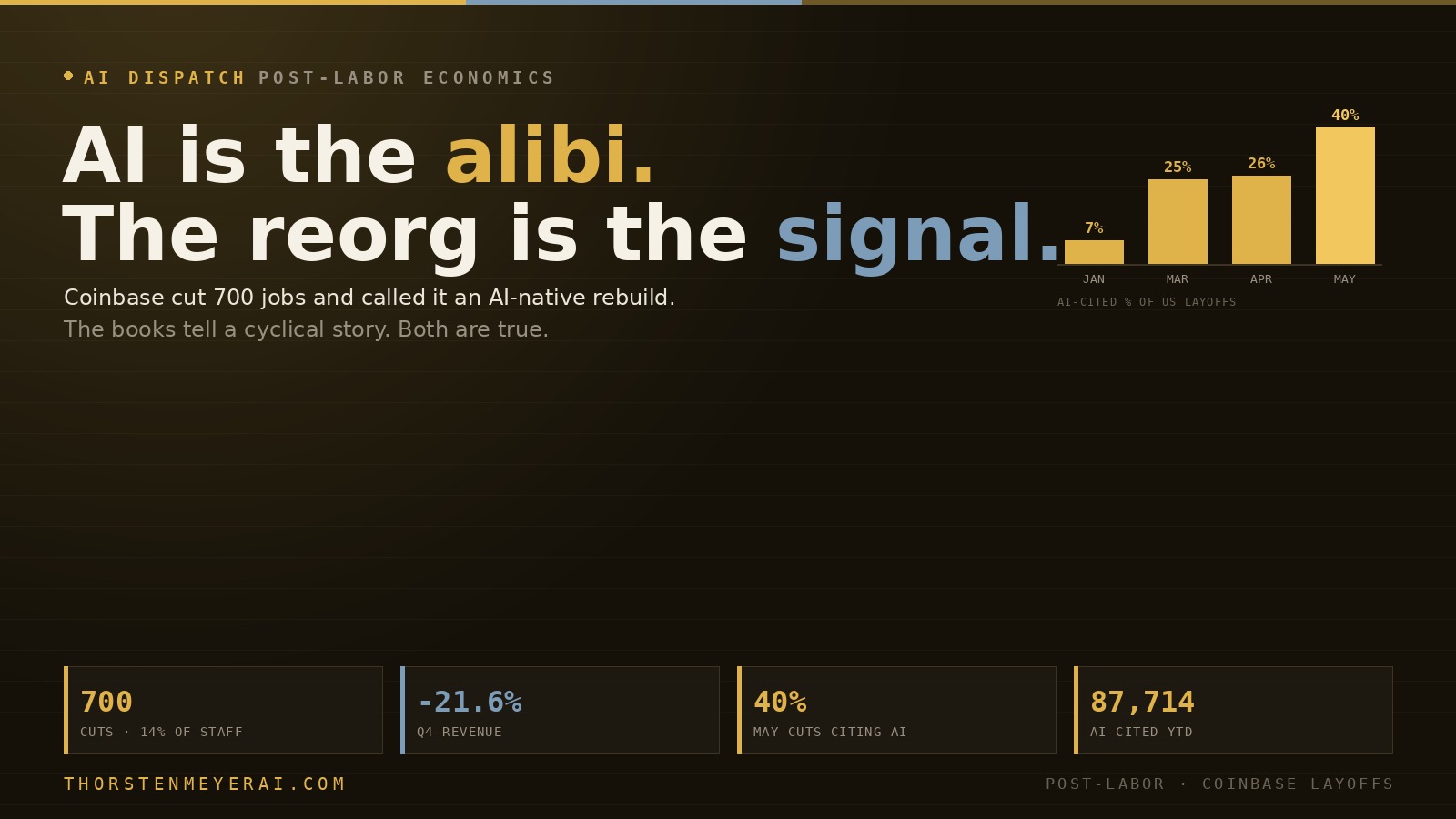
Coinbase cut 700 jobs (14%) and called it an AI-native rebuild. The books tell a cyclical story. Both are true — and the part everyone’s arguing about is the least important one.
◆ What Coinbase said
- Rebuild around “AI-native pods”1-person teams
- Engineers ship in days, not weeksclaimed
- Flatten org; leaders stay ICs≤5 layers
- “An inflection point for every company”narrative
■ What the books show
- Q4 revenue decline−21.6%
- Q4 net loss−$667M
- Bitcoin off its October peak−33%+
- Prior downturn cuts (no AI excuse)2022 · 2023
Stop asking whether AI cut the 700 jobs — mostly it didn’t, the cycle did. The displacement narrative is itself a tool of wage discipline: if you think the machine is coming, you don’t ask for a raise. The real question post-labor keeps circling — as production shifts from headcount to capital and agents, who captures the surplus the missing workers used to be paid for?
What Coinbase actually did
The headline number is 700 jobs, confirmed in the company’s Q2 8-K, with $50–60M in restructuring charges. But the reorg matters more than the count. Management layers were capped at five below the top, every leader was told to stay a hands-on individual contributor — the “player-coach” model — and the employee-to-manager ratio was pushed toward 15-plus, part of the broader “megamanager” trend sweeping corporate America. Armstrong’s stated end-state is striking: rebuild the company as “an intelligence, with humans around the edge aligning it.”
That is not a normal layoff memo. It’s an operating-model thesis.

Plaud Note Pro AI Voice Recorder Transcribe & Summarize for Meetings Calls
- High-Accuracy Transcription: Supports 112 languages with speaker labels
- Instant Structured Summaries: Creates mind maps, To-Do lists, proposals
- Multimodal Input Capture: Record audio, add images, type notes
As an affiliate, we earn on qualifying purchases.
As an affiliate, we earn on qualifying purchases.
The case that AI is the alibi
Now the inconvenient context. Coinbase’s quarter was ugly: revenue fell 21.6% in Q4 2025, the company posted a $667M net loss, and Bitcoin had dropped more than a third from its October peak. A Mizuho analyst told Bloomberg the crypto downturn was probably the real reason for most of the cuts and that AI is “an easy excuse.”
It’s a pattern Coinbase knows well. It cut 18% of staff in 2022 and another 21% in early 2023 — both during crypto winters, both long before “AI-native” was a phrase anyone used. The 2026 cut lands in exactly the same place in the cycle. The function that took the deepest hit, by recruiter estimates, was international product, trust and compliance, and platform groups — not the revenue core. That’s the geography of cost-cutting, not of automation.
Coinbase isn’t alone, and that’s the point. It joins Block, Pinterest, and Shopify in tying workforce cuts to AI, and — as Axios notes — none of these companies offered concrete AI productivity metrics on their earnings calls before the announcements. The transformation was asserted, not measured.
The macro data carries the same asterisk. Challenger, Gray & Christmas reports that AI has been the most-cited reason for U.S. layoffs three months running, climbing from 7% of cuts in January to 40% in May, with 87,714 AI-attributed cuts year-to-date — already past the full-year 2025 total. That looks like a smoking gun until you read the methodology: Challenger tracks what employers say, not what independent analysis can verify. It’s self-attribution. A labor attorney at Duane Morris told Axios that the jobs actually eliminated by AI at firms like Meta, Cloudflare, and Coinbase have so far been minimal, and that most employers are still in the “figure out how our existing people can use this” phase. Even Sam Altman has warned about “AI-washing” — dressing up ordinary cuts in transformation language.

Agentic Artificial Intelligence: Harnessing AI Agents to Reinvent Business, Work and Life
As an affiliate, we earn on qualifying purchases.
As an affiliate, we earn on qualifying purchases.
Why the alibi is so useful
Here’s the part that gets too little attention: the AI-layoff narrative is economically valuable to employers whether or not AI is actually cutting jobs.
Start with optics. A layoff driven by a crypto crash is a distress signal; a layoff framed as an AI-native rebuild is a foresight signal. Same 700 people, opposite message to investors weeks before nobody-wants-to-look-behind-the-curtain. Andy Challenger captured the slipperiness perfectly: regardless of whether a given role is being replaced by AI, the money for that role is being redirected toward AI. The worker and the robot don’t have to actually trade places for the budget line to.
Then there’s the quieter mechanism, the one a developer named Mo Bitar flagged and a Goldman economist conceded is plausible in the short run: fear of AI displacement discourages workers from asking for raises or switching jobs. If you believe the machine is coming for your seat, you sit very still. The AI-layoff story, repeated across enough headlines, does real work on the labor market before any actual automation does — it shifts bargaining power from labor to capital by managing expectations. For a post-labor economist, that’s the most important sentence in this whole episode: the narrative of displacement is itself a tool of wage discipline. You don’t need the technology to bite to get the effect.

The AI-Powered Project Manager: The Ultimate Playbook to Save Dozens of Hours, Master Prompt Engineering, and Deliver High-Impact Projects. (The AI-Powered Series)
As an affiliate, we earn on qualifying purchases.
As an affiliate, we earn on qualifying purchases.
The signal hiding underneath
So if the immediate cuts are mostly cyclical and the narrative is mostly convenient, why do I say the alibi is hiding something real?
Because the reorg isn’t cover. The reorg is the leading edge.
Collapsing engineer, designer, and product manager into one agent-directing human is not a headcount trick — it’s a genuine redefinition of the unit of work. “An intelligence, with humans around the edge aligning it” is a literal description of where frontier software teams are heading, and Coinbase is saying the quiet part into a memo. Goldman’s Joseph Briggs makes the relevant distinction: AI-layoff claims are most credible precisely at large tech firms, because that’s where adoption is furthest along and the most tasks are exposed. The job here isn’t being eliminated by AI so much as redesigned so that fewer humans are needed per unit of output — and then the cyclical downturn provides the occasion to act on it early.
That’s the trap in the driver-vs-alibi framing: it’s a false binary. Three things are true at once. The immediate cuts are mostly cost-driven. The AI story is mostly a narrative layered on top. And the structural shift the narrative gestures at is real — it just hasn’t shown up in the aggregate labor data yet. Confusing any one of these for the whole picture gets you a bad forecast.

AI Coding with VS Code: Build Full-Stack Apps Faster Using GitHub Copilot, Agentic Workflows, Custom AI Assistants, and Prompt Engineering (Quick Start Developer Series)
As an affiliate, we earn on qualifying purchases.
As an affiliate, we earn on qualifying purchases.
What the data actually shows right now
The measured reality is genuinely undramatic, which is why honesty matters here. Goldman’s read is that AI is currently creating more jobs than it’s destroying, largely on the back of the data-center construction boom, and that AI adoption will push unemployment modestly higher over time — on the order of half a percentage point — while spinning up new roles that offset some of the loss. Productivity gains have historically flowed into higher wages eventually.
The real near-term risk Briggs names is timing: unemployment could spike if companies adopt AI faster than displaced workers can retrain into new roles. That transition-speed gap — not some sudden robot apocalypse — is the thing to actually worry about, and it’s the thing the breathless “AI took the jobs” coverage obscures by crying wolf early.
My read
Stop asking whether AI cut the 700 jobs. It mostly didn’t; the crypto cycle did, with AI handed the microphone. Ask instead what the Coinbase reorg reveals about where the bundle of tasks one salary used to buy is going — and the answer is that it’s being unbundled, handed to agents, and re-aggregated under far fewer people. That’s the post-labor transition arriving not as mass unemployment but as quiet redefinition, one org chart at a time, with the cyclical downturn supplying both the cover story and the budget.
If you’re reading these announcements — as a worker, an operator, or an investor — three habits help. Separate self-attribution from causation: the absence of productivity metrics is the tell. Watch the structure, not the headcount: a flattening, a one-person pod, a “human at the edges” model is the real signal; the cyclical number is noise. And take the expectations game seriously: the displacement narrative is doing measurable work on wages and mobility well ahead of the displacement itself.
The deeper question the Coinbase memo raises isn’t “is my job safe.” It’s the one post-labor economics keeps circling: as the unit of production shifts from headcount toward capital and agents, who captures the surplus that the missing workers used to be paid for? That’s the conversation the AI-as-culprit headlines keep us from having. The alibi isn’t just covering for a crypto crash. It’s covering for the fact that nobody has answered that question yet.
Reporting drawn from Axios San Francisco, Coinbase’s May 2026 announcement and Q2 8-K, Bloomberg, Fortune, Challenger, Gray & Christmas (March–May 2026 job-cut reports), CBS News, and Goldman Sachs commentary. Challenger figures reflect employer self-attribution, not independently verified causation. Analysis and opinions are the author’s.