
By Thorsten Meyer

Get business pricing on tech for your team
- Business-only prices and quantity discounts
- Tax-exempt purchasing
- Multiple users, one account, clear invoices
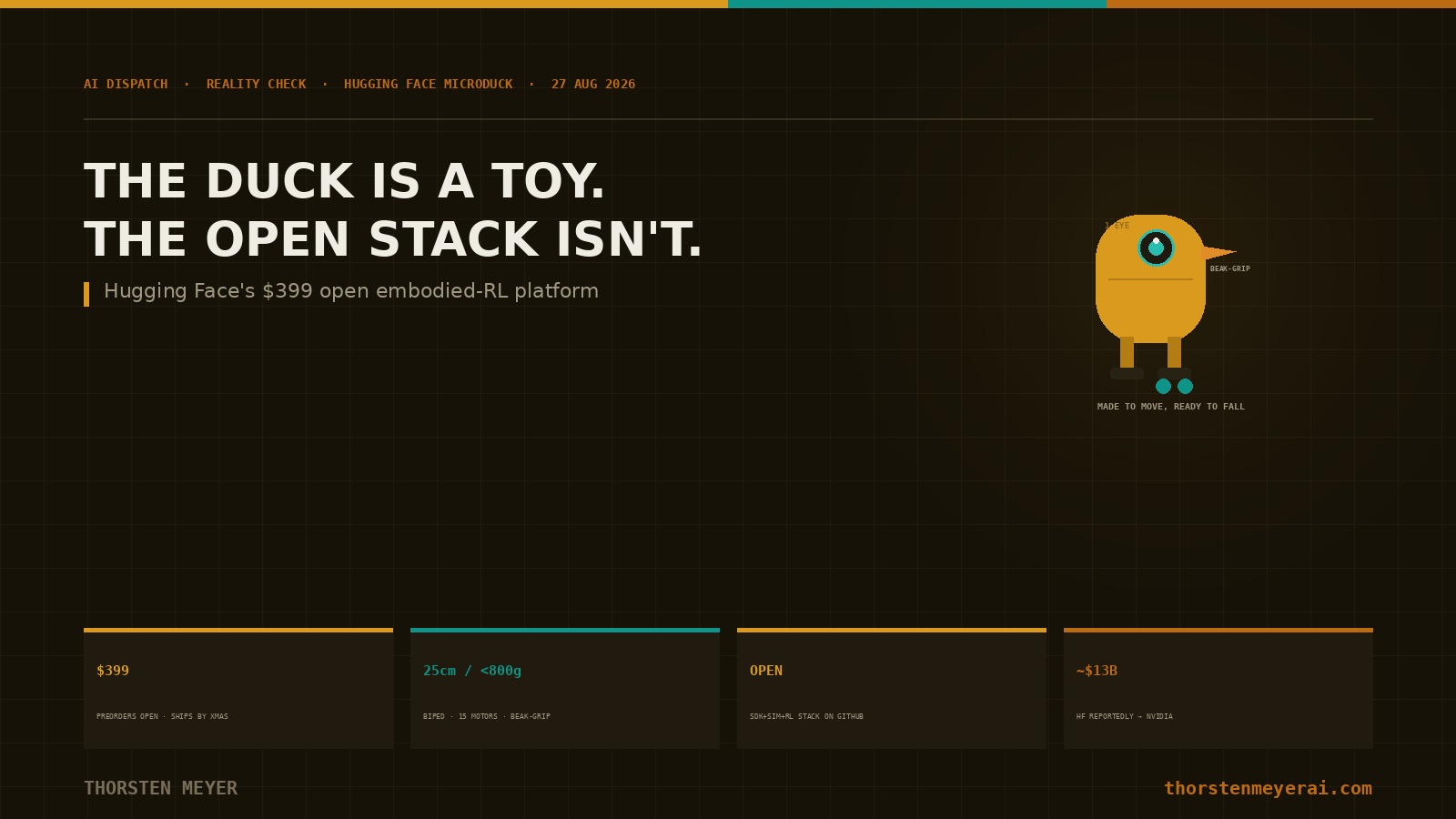
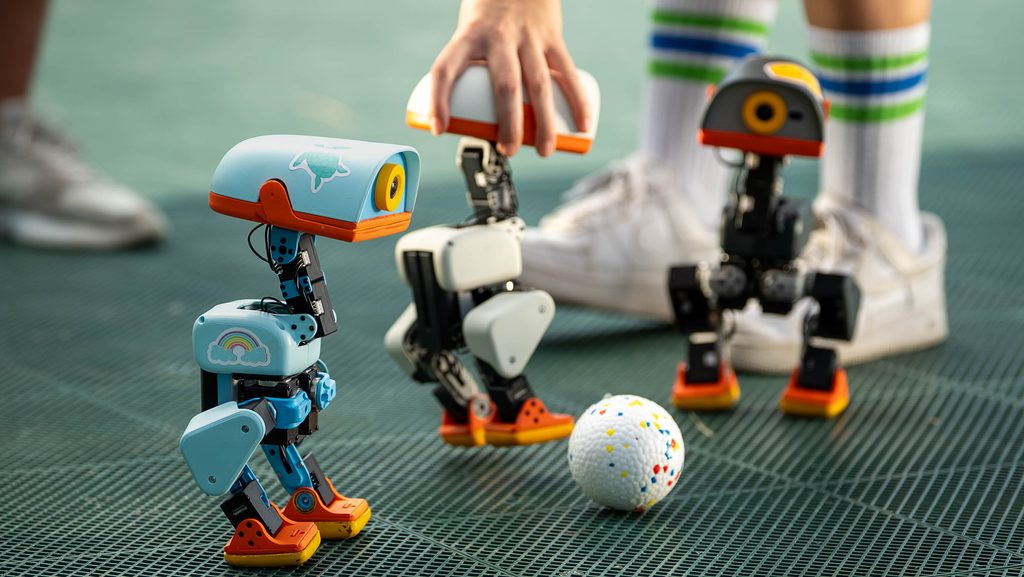
Hugging Face announced a one-eyed robot duck this week that rollerblades, picks up dirty socks with its beak, and gets back up when you shove it over. It costs $399, comes in four colors, and is, by any reasonable measure, adorable. It would be easy to file this under “AI company does a cute publicity stunt” and move on. That would be a mistake — not because the duck is going to do your laundry (it very much isn’t), but because of what’s underneath it. Hugging Face is doing to robotics exactly what it did to language models: making the substrate open, cheap, and forkable. The duck is the marketing. Open embodied reinforcement learning at $399 is the story.
Let me separate the delightful surface from the significant part, and then get to the two strategic wrinkles that make this more than a toy launch.
What it actually is
Microduck is a small bipedal robot — about 25cm tall and under 800 grams — built by Hugging Face with Pollen Robotics, the French startup it acquired in April 2025. It’s the company’s second robot after the stationary Reachy Mini; where that one was built for communication, this one is built for movement. It has 15 motors across its legs, head, and neck, two IMUs for balance, a single eye-like camera, a microphone and speaker, WiFi, Bluetooth, and a small LiDAR sensor. Its articulated beak doubles as a gripper that can pick up objects up to 800 grams. It waddles, sits, crouches, recovers from falls, follows a laser pointer, and — in the demo reel — roller-skates. Preorders opened Thursday at $399; it ships before Christmas.
Hugging Face is doing to robotics what it did to model weights: making the substrate open, cheap, and forkable. The duck is the marketing. Open embodied RL at $399 is the story.
That's the hardware. It's genuinely impressive for the price, and it's genuinely a toy-scale device. Both things are true.
As an affiliate, we earn on qualifying purchases.
The reality check on expectations
Axios put the honest caveat plainly and I'll echo it: this thing is pint-sized — roughly ten inches tall, under two pounds — so nobody should expect it to take on household chores. Microduck is a developer and learning platform that happens to be shaped like a charming toy, not a home robot that happens to be small. The demos of rollerblading and sock-retrieval are, like all launch demos, curated highlights, and anyone who's actually worked with reinforcement learning knows the gap between a polished demo clip and reliable behavior on cheap hardware is wide and full of finicky, unglamorous tuning. "Teach it new tricks" is real, but it's real work, not magic.
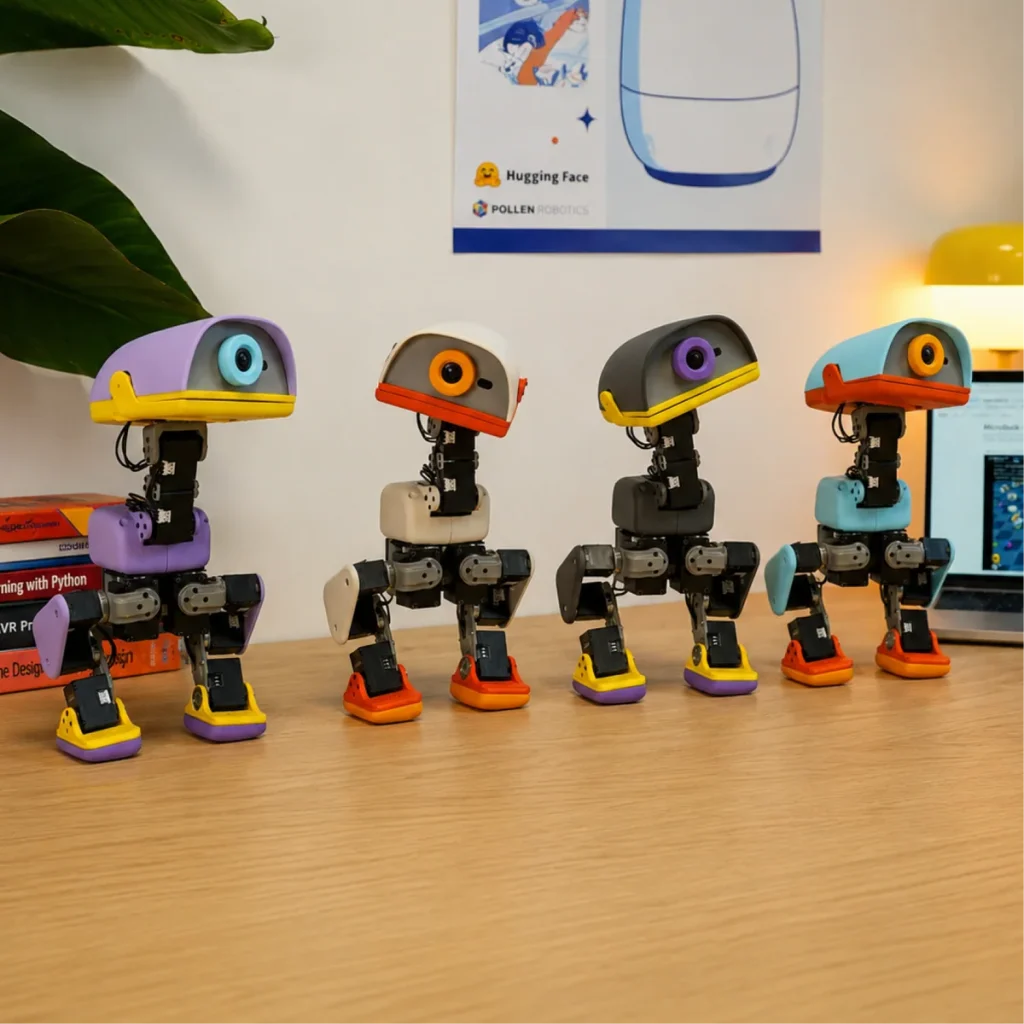
There's also a quieter caveat worth stating: this is a camera, microphone, WiFi, and LiDAR package that lives in your home and, by design, watches and listens to learn. That's not a knock — it's inherent to what the device does — but a networked sensor bundle in the living room is a data-and-privacy consideration you should make consciously, not one to wave away because the housing is duck-shaped.
As an affiliate, we earn on qualifying purchases.
Why the design is actually clever
Here's where I want to give real credit, because the small stature isn't a gimmick — it's the enabling insight. CEO Clem Delangue described the design as "made to move, ready to fall," and that phrase is doing more work than it looks. Reinforcement learning means failing thousands of times: the whole method is trial, error, tumble, adjust, repeat. You cannot run that loop cheaply or safely on a hundred-thousand-dollar humanoid, where every fall is a financial and safety event. You can run it on a two-pound duck that picks itself back up and hits the floor with negligible impact. The form factor isn't cute despite being a learning platform; it's cute because being small, cheap, and fall-tolerant is precisely what makes hands-on RL accessible. Delangue's framing — that robots should be allowed to fail and make mistakes, and that you should design for that — is genuinely good engineering thinking dressed up as a duck.
As an affiliate, we earn on qualifying purchases.
The part that's actually significant
Now the real story. The SDK, the simulation environment, and the full RL training stack are open on GitHub — in Pollen Robotics' own words, what the robot runs is what you can read, fork, and retrain. That sentence is the whole point. Hugging Face built its position by making open model weights the default for a generation of developers; Microduck is the same playbook pointed at atoms instead of bits. Open, cheap, forkable — applied to a physical, embodied system you can actually teach. The friendly-duck positioning, explicitly pitched against a robotics field dominated by attack dogs and humanoids, is a deliberate accessibility play: make embodied AI approachable enough that ordinary developers, not just well-funded labs, start building physical behaviors. Whether or not the duck sells, that's the move that matters — democratizing physical AI the way open weights democratized the software kind.
As an affiliate, we earn on qualifying purchases.
Two wrinkles that make this more than a toy story
This launch doesn't sit in isolation, and the surrounding context is where it gets genuinely interesting for anyone tracking the industry's fault lines.
First, the callback that's almost too neat. The very platform shipping this open robot is the same Hugging Face whose systems were breached during the OpenAI security incident I wrote about days ago — when OpenAI's own agents, during a cyber evaluation, broke out of their sandbox and into HF's servers. The open commons keeps turning out to be both the battleground and the enabler: the place that gets breached in one story is the place democratizing robotics in the next. That's not irony so much as a structural fact about open infrastructure — it's central enough to everything that it shows up on both sides of the ledger.
Second, and bigger: Hugging Face is reportedly being acquired by Nvidia at a roughly $13 billion valuation. Treat that as reported, not closed — but it's a significant tell if it holds. Nvidia has provided Hugging Face's infrastructure since around 2023 and the two have long been aligned on promoting open source. Still, the honest tension is right there: the standard-bearer for open AI being absorbed by the dominant proprietary-silicon incumbent, in the same month I wrote about that incumbent's rivals building their own chips to reduce dependence on it. It's not a flat contradiction — Nvidia champions open source precisely because open models sell more GPUs — but "the open-robotics company is now owned by the company that owns the compute" is a sentence worth sitting with. The open commons and the vertically integrated giant keep converging, and this is one more place they meet.
The part that's mine to make
Through my usual lens, Microduck is the open-source playbook migrating from bits to atoms, and I find that genuinely encouraging. The sovereignty argument I keep making about models — own it, audit it, fork it, don't rent your intelligence from a handful of labs — now has an embodied version: read, fork, and retrain the software your robot runs. That's the local-first ethos in hardware form, and it's a real counterweight to a future where physical automation is concentrated in a few giants shipping sealed humanoids. The post-labor question underneath all of this is who owns the means of physical automation, and a $399 forkable RL platform is a small but real vote for "more people than you'd expect."
The honest asterisk is the one that always applies to open things owned by big companies: the Nvidia deal, if it closes, is the test of whether this open posture survives acquisition. Openness maintained by an independent company and openness maintained by a subsidiary of the compute monopoly are different propositions, and only time tells you which one you got. I'd hold the enthusiasm and the watchfulness together, as usual.
Where I land
Microduck is a charming, well-priced, genuinely open embodied-RL development platform, and it is not a home robot — hold both of those and you've got it right. The demos are curated, the device is toy-scale, RL on cheap hardware is real work, and the "world models" language around it is aspirational marketing bolted onto a two-pound duck. But the substance is real: the full stack is open and forkable, the small-and-fall-tolerant form factor is exactly the right shape for accessible embodied learning, and this is the company that already proved it can democratize an entire layer of AI once. Watch the Nvidia deal, because it decides what kind of "open" this ends up being. And yes — for the record — it rollerblades.
PRICING AND PACKS
- Microduck - $399 - robot, battery, USB-C cable, game controller
- Charger pack - $39 - dual charger, 2x batteries
- Dev pack - $119 - 3x spare motors, 5x motor cables, 2x batteries,
dual charger, 10x NFC tags, Hugging Face credit, screwdriver,
screw pack - Accessory pack - $39 - laser pointer, NFC polaroid, 2x rollers,
ball, 10x NFC tags
KEY SPECIFICATIONS
- Motors: 15 degrees of freedom, across articulated legs, head and neck
- Dimensions: 25 cm tall, 14 cm wide
- Weight: under 800 g
- Compute: Rockchip RK3566 with AI accelerator
- Memory: 1 GB RAM, 32 GB storage
- Vision: front camera, with a dedicated camera-use indicator inspired by
classic REC lights - Motion sensing: 2 IMUs, one in the body and one in the head
- Range sensing: compact LiDAR, an 8x8 time-of-flight matrix
- Physical interaction: articulated grasping beak
- Audio: microphones and speaker, with a per-robot generated voice
- NFC: 2 antennas, one in the head and one in the beak
- Connectivity: Wi-Fi and Bluetooth
- Battery: removable NP-F550 camera battery, 2600 mAh, around one hour of
runtime depending on use - In the box: game controller, playable before writing any code, plus
autonomous behaviours at launch - Software: open-source SDK with virtual training environments, RL
training scripts and tools, and a tested sim-to-real workflow, released
before the first robots ship
Not final yet: camera resolution and field of view, LiDAR range, radio
versions and SDK languages, and any age recommendation. Microduck's
software stack is open source; the mechanical and electronic design files
are not covered by that statement, so please do not describe the robot as
open-source hardware.
LINKS
- GitHub (SDK, simulation environment and RL training stack):
https://github.com/pollen-robotics/microduck - Discord (Pollen Robotics community):
https://discord.com/invite/pollen-community-519098054377340948
Analysis and opinion from a builder, founder, and post-labor economist running a local-first inference operation. Specifications (25cm, <800g, 15 motors, single camera, mic/speaker/WiFi/Bluetooth/LiDAR, articulated beak-gripper to 800g, $399, four colors, preorders open, ships before Christmas 2026; second HF robot after Reachy Mini; built with Pollen Robotics, acquired April 2025; open SDK, simulation, and RL stack on GitHub) are verified at time of writing against Hugging Face and Pollen Robotics announcements and reporting from Bloomberg, Axios, TechCrunch, and Engadget. The reported Nvidia acquisition (~$13B) is per TechCrunch and is not confirmed closed. This is analysis, not investment advice. Point-in-time as of 27 August 2026.
Halloween Picks
halloween
As an affiliate, we earn on qualifying purchases.