You work alongside AI tools daily now, transforming how your team collaborates and communicates. AI helps automate routine tasks like data entry, scheduling, and customer support, boosting efficiency and job satisfaction. It’s used to analyze data quickly, identify insights, and support flexible remote work. Many teams trust AI more than they used to, fostering a culture of experimentation and openness. Keep exploring how AI can further enhance your workplace—there’s much more to discover.
Key Takeaways
- Teams integrate AI tools for routine tasks like data entry, scheduling, and report generation to boost efficiency.
- AI collaborates with humans as teammates, supporting decision-making with instant insights and analysis.
- Clear communication and transparency about AI roles foster trust and accountability within teams.
- Ongoing training and open dialogue encourage effective human-AI collaboration and adoption of AI tools.
- AI enhances remote and hybrid work by facilitating seamless collaboration, workload management, and flexibility.

The Executive Assistant Playbook: Master the Skills, Tools & Strategies to Thrive in the Modern Workplace
As an affiliate, we earn on qualifying purchases.
As an affiliate, we earn on qualifying purchases.
The Rise of AI as a Collaborative Partner
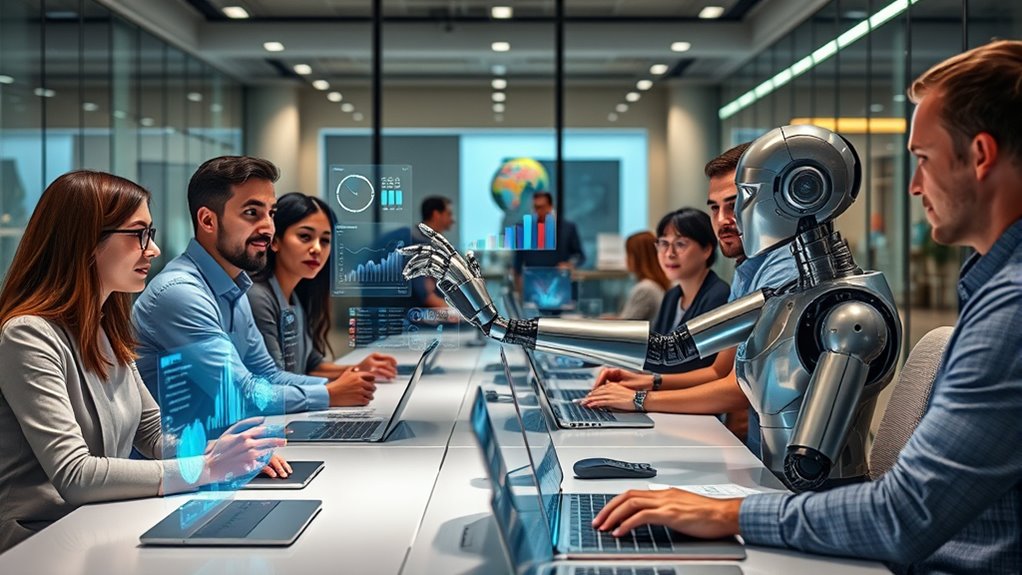
The rise of AI as a collaborative partner is transforming how you work by integrating intelligent agents directly into daily tasks. You now rely on AI tools to streamline workflows, automate routine activities, and provide real-time insights. With 40% of workers collaborating with AI as teammates, it’s clear this partnership is becoming essential. High performers report better relationships with AI than with human colleagues, trusting AI more than two-thirds of the time. Many delegate tasks to AI, boosting efficiency and job satisfaction—81% of workers say it improves their experience. As AI adoption rises to 91% in businesses, it’s evident that AI isn’t just a helper; it’s reshaping the very fabric of teamwork and productivity in the modern workplace. Additionally, understanding projector technology can help teams better visualize data and presentations, enhancing overall communication and collaboration.

Automated Software Testing: Introduction, Management, and Performance: Introduction, Management, and Performance
As an affiliate, we earn on qualifying purchases.
As an affiliate, we earn on qualifying purchases.
How AI Enhances Workplace Relationships and Trust

As AI becomes more embedded in daily work routines, its impact on workplace relationships and trust is increasingly evident. You may find that working alongside AI tools boosts your confidence, as they handle repetitive tasks and provide data-driven insights, reducing errors and frustration. Many workers report stronger bonds with AI, trusting it more than some colleagues because it’s consistent and unbiased. This trust fosters collaboration, as you rely on AI to inform decisions without fear of favoritism. Additionally, AI’s support encourages transparency, making communication clearer and more objective. When AI assists in project management or communication, it smooths interactions and builds mutual respect. Moreover, ongoing advancements in natural language processing are making AI interactions more intuitive and human-like, further strengthening trust and collaboration. Overall, integrating AI into your workflow can strengthen relationships and create a more trustworthy, collaborative environment.

The AI Productivity Blueprint: 10X Yor Efficiency and Reclaim Your Time in Just 30 Days (AI For Beginners)
As an affiliate, we earn on qualifying purchases.
As an affiliate, we earn on qualifying purchases.
Tasks Delegated to AI for Increased Efficiency

Delegating tasks to AI has become a common strategy for boosting workplace efficiency. You now rely on AI to handle routine activities like data entry, scheduling, and report generation, freeing up your time for strategic work. AI tools can analyze large datasets quickly, identify patterns, and generate insights faster than humans. Many teams use AI to streamline customer support by automating responses and managing inquiries, reducing wait times. Content creation, such as drafting emails or marketing materials, is increasingly delegated to generative AI, ensuring faster turnaround. You might also trust AI to monitor workflows, flag issues, and suggest improvements. This delegation allows you to focus on high-value tasks, enhances productivity, and accelerates project timelines—all while maintaining accuracy and consistency. Additionally, Automation’s role in business intelligence enables real-time decision-making and predictive analytics, further empowering teams to stay ahead in competitive markets.

Language Translator Device, 150 Languages Two-Way Instant Translator Device, 4" 1 HD Screen Accuracy Real-time Voice Translation Support Offline&Chatgpt&Record&Photo Translation for Business Travel
98% High-Accuracy Voice Translation Device: This language translator device supports WIFI/hotspot access methods. allows you to establish contact…
As an affiliate, we earn on qualifying purchases.
As an affiliate, we earn on qualifying purchases.
AI’s Role in Improving Job Satisfaction and Engagement

Regularly collaborating with AI can substantially boost your job satisfaction and engagement. When AI handles repetitive or mundane tasks, you can focus on more meaningful work that sparks creativity and problem-solving. This shift not only makes your day more interesting but also gives you a greater sense of purpose. Many workers report feeling more valued and motivated when AI takes care of busywork, leading to higher morale. Additionally, AI tools provide instant insights and support decision-making, empowering you to perform at your best. Trust in AI’s capabilities can foster a stronger connection to your work, reducing frustration and burnout. Furthermore, understanding Forsale 100 can help organizations optimize their use of AI tools more effectively. Overall, integrating AI into your daily routine creates a more fulfilling work environment, helping you stay engaged and satisfied.
Strategies for Integrating AI Into Daily Workflows

Integrating AI into your daily workflows requires a strategic approach to maximize its benefits without disrupting productivity. First, identify tasks that AI can handle efficiently, such as data analysis, scheduling, or content generation. Set clear goals for AI use, ensuring it complements your strengths and fills gaps in your process. Train your team to use AI tools effectively, emphasizing transparency and accuracy. Incorporate AI gradually, starting with pilot projects to evaluate impact and refine workflows. Regularly review AI performance and gather feedback to optimize integration. Establish policies to manage AI output, encouraging verification and ethical use. Be aware that AI tools can improve collaboration, enabling teams to work more cohesively and efficiently. By aligning AI with your daily routines, you create a seamless partnership that boosts efficiency, enhances decision-making, and preserves your team’s focus on higher-value work.

You need to guarantee AI-generated content meets quality standards, so you don’t fall into the trap of workslop that hampers productivity. Addressing bias risks is vital, as unchecked AI outputs can reinforce stereotypes and skew perceptions. Transparency around AI use and standards helps build trust and prevents misunderstandings about the work’s origin and accuracy. Implementing ethical hacking principles can also enhance the oversight of AI systems, ensuring vulnerabilities are addressed before they impact the output.
Managing AI Content Quality
Managing AI content quality presents a critical challenge as organizations leverage AI-generated work, often grappling with issues like inconsistent accuracy and embedded biases. You need to establish clear standards and review processes to guarantee AI output aligns with your quality expectations. Regularly verify facts, data, and tone, especially since AI can produce plausible but incorrect information. Implement feedback loops where human reviewers refine AI outputs, improving reliability over time. Be aware of biases that AI may introduce and actively work to identify and mitigate them. Transparency is key—inform your team about AI limitations and encourage critical evaluation. Additionally, understanding relationship dynamics can help in fostering collaborative environments where feedback and communication enhance AI oversight. By maintaining rigorous oversight and fostering a culture of accuracy, you can maximize AI’s benefits without compromising content quality.
Addressing Bias Risks
Bias risks in AI-generated work can undermine trust and accuracy, making it essential to recognize and address these issues early. If left unchecked, biases can skew results, reinforce stereotypes, and damage credibility. To manage these risks:
- Regularly audit AI outputs for bias and fairness.
- Use diverse training data to reduce systemic biases.
- Incorporate human oversight for critical decisions.
- Train your team on bias awareness and detection.
- Adjust AI models based on feedback and new data.
- Understanding the importance of training data quality helps ensure more equitable AI outcomes.
Ensuring Transparency Standards
Maintaining transparency in AI-generated work is essential to build trust and guarantee accountability across organizations. You need clear guidelines on how AI tools are used, ensuring team members understand AI outputs and their limitations. Document AI processes and decision-making criteria, so everyone can verify and interpret results accurately. Communicate openly about when AI is involved in tasks, avoiding hidden or misleading practices. Regularly audit AI outputs for bias, inaccuracies, and consistency, and share findings with your team. Encouraging a culture of openness ensures team members feel confident in AI contributions without suspicion. By establishing transparency standards, you foster trust, reduce errors, and promote responsible AI adoption that aligns with organizational values and ethical practices. Additionally, understanding the cyber threat landscape helps organizations anticipate and mitigate potential risks associated with AI tools.
The Impact of AI on Remote and Hybrid Work Models

AI is transforming how you work remotely by offering greater flexibility and efficiency. As hybrid models grow more common, many employees see AI as key to balancing in-office and remote tasks. Some experts even predict offices may become obsolete as AI-enabled remote work becomes the norm. Incorporating professional equipment and optimizing workflows with AI tools further enhances productivity and collaboration.
AI Enables Remote Flexibility
The rise of AI has considerably enhanced remote and hybrid work models by providing employees with greater flexibility and control over their schedules. AI tools enable you to work efficiently from anywhere, reducing the need to be tied to a physical office. With AI handling routine tasks, you can focus on more strategic work, improving work-life balance. It also allows you to adapt your work hours to fit your personal life better. You’ll experience increased autonomy and productivity, thanks to AI’s ability to streamline workflows.
- Work from any location seamlessly
- Adjust schedules for better balance
- Automate repetitive tasks easily
- Collaborate efficiently across distances
- Manage workload flexibly and effectively
Hybrid Models Gain Traction
As AI continues to advance, more organizations are embracing hybrid work models that combine remote and in-office arrangements. This shift is driven by AI’s ability to boost productivity, facilitate collaboration, and provide flexibility. With AI tools, employees can seamlessly switch between remote and office work without losing efficiency, making hybrid setups more appealing. About half of remote-capable employees now work in hybrid roles, and a quarter of new job postings include hybrid options. AI enhances communication, automates routine tasks, and supports project management across dispersed teams. As a result, organizations see increased job satisfaction and better collaboration, encouraging wider adoption. This trend signals a fundamental change in how workplaces operate, with AI at the core of creating adaptable, efficient hybrid environments.
Office Obsolescence Predictions
With AI transforming workplace dynamics, many experts predict that physical offices may become increasingly obsolete. As AI enhances remote and hybrid work, traditional office spaces could fade in importance. You might find yourself working seamlessly from anywhere, supported by AI tools that boost productivity and collaboration. This shift could lead to:
- Reduced need for physical office buildings
- Greater reliance on virtual collaboration platforms
- Increased flexibility for remote workers
- Cost savings for companies on office expenses
- A shift in company culture toward digital-first interactions
This evolution suggests that the future of work will prioritize AI-enabled remote environments. Offices may no longer serve as the central hub, replaced by flexible, AI-powered spaces designed for dynamic, distributed teams.
Adoption Trends and Future Outlook of AI in Teams

Adoption of AI within teams is rapidly accelerating as organizations recognize its potential to enhance collaboration and boost productivity. Companies are integrating AI at a faster pace, with 77% actively doing so and 58% of employees using AI regularly. This trend is driven by the proven benefits, such as increased job satisfaction (81%) and improved teamwork. Future outlooks indicate that AI will become more strategic, especially in hybrid and remote work settings. Organizations like McKinsey and BCG highlight gaps in effective AI use, but firms embracing AI strategically, like Frontier Firms, show promising results. Here’s a snapshot of current trends:
| Aspect | Data Point |
|---|---|
| Adoption Rate | 77% of businesses are integrating AI |
| Regular Use | 58% of employees use AI regularly |
| Future Focus | Strategic use and hybrid collaboration will grow |
Skills Development and Niche Specialization Through AI
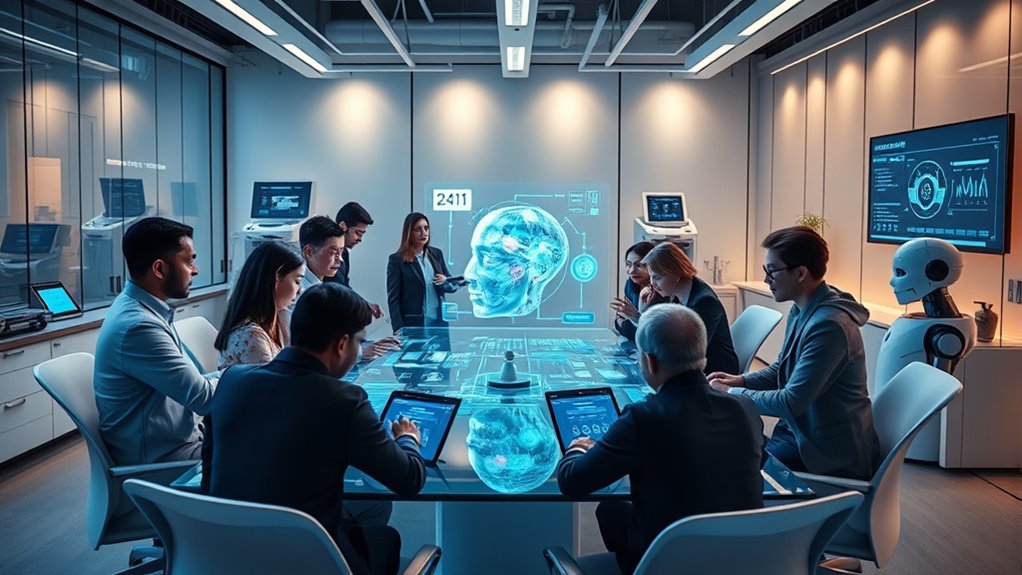
AI tools are transforming how you acquire new skills and develop niche expertise faster than ever. By leveraging AI, you can streamline learning processes and focus on specialized areas that set you apart. This shift empowers you to stay competitive in a rapidly evolving workplace.
Accelerating Skill Acquisition
Artificial intelligence is revolutionizing how you acquire new skills and develop niche expertise. AI accelerates learning by providing personalized feedback, simulating real-world scenarios, and offering instant access to vast knowledge. It enables you to focus on specific areas, rapidly building your proficiency. With AI, you can:
- Access tailored courses and tutorials instantly
- Practice skills through realistic, interactive simulations
- Receive real-time feedback to improve faster
- Learn at your own pace, anytime and anywhere
- Discover niche opportunities with AI-driven market insights
This targeted approach helps you master complex skills efficiently, reducing the time needed for traditional training. As AI continues evolving, your ability to acquire expertise and specialize in niche fields becomes faster and more precise, giving you a competitive edge in today’s fast-paced work environment.
Niche Expertise Development
As technology accelerates your ability to acquire new skills, it also opens doors to niche specialization that was once difficult to achieve. AI tools now serve as personalized mentors, helping you develop expertise in highly specific fields quickly. By leveraging generative AI, you can dive deep into niche topics, gaining insights and practical knowledge tailored to your goals. AI-driven platforms offer targeted training modules, real-time feedback, and curated resources that boost your mastery in specialized areas. This enables you to stand out in competitive markets and build unique skill sets without lengthy, traditional training. As a result, you can refine your niche expertise faster, opening new opportunities for career growth, consulting, or entrepreneurship. AI fundamentally becomes your gateway to becoming a true expert in your chosen specialized domain.
Building a Collaborative Culture With AI Tools
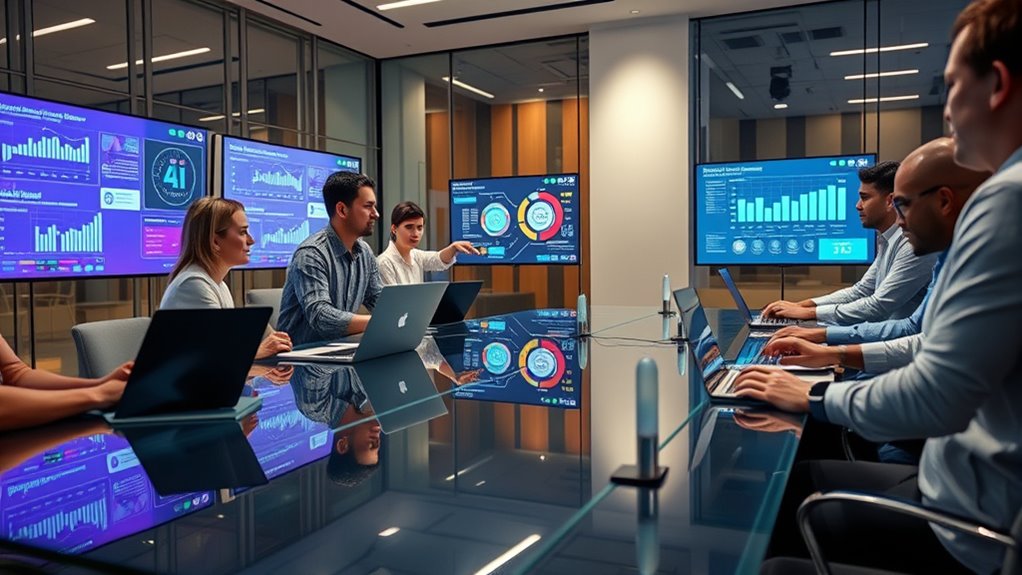
Creating a collaborative culture with AI tools requires intentional effort to foster trust, open communication, and shared goals. You can do this by setting clear expectations for AI use, encouraging transparency about AI-generated work, and promoting feedback. Emphasize teamwork by integrating AI as a partner, not a replacement. Cultivate an environment where employees feel comfortable experimenting and learning from AI tools. To help, consider these strategies:
- Promote transparency about AI’s role in projects
- Encourage open dialogue about AI successes and challenges
- Provide ongoing training on AI tools and best practices
- Recognize collaborative efforts between humans and AI
- Establish shared goals that include AI-enhanced outcomes
Frequently Asked Questions
How Do Teams Ensure Ethical Use of AI in Collaboration?
You guarantee ethical AI use by setting clear guidelines and promoting transparency. You encourage your team to verify AI outputs and avoid hiding AI involvement, fostering honesty. Regular training on bias and privacy helps prevent misuse. You also monitor AI interactions, address ethical concerns promptly, and promote a culture of responsibility. By staying informed about evolving standards, you build trust and ensure AI benefits everyone ethically and fairly.
What Are Effective Ways to Validate Ai-Generated Outputs?
You can’t just blindly accept AI outputs — that would be like trusting a magician with your life savings! Instead, always verify AI-generated results by cross-checking with trusted sources, consulting human experts, and testing for biases or inconsistencies. Use multiple tools to compare outputs, and develop clear validation protocols. Regularly review AI performance and train your team to spot errors, ensuring your AI collaboration stays accurate, ethical, and reliable.
How Can Managers Address Bias in AI Tools?
You can address bias in AI tools by actively monitoring outputs, providing diverse training data, and encouraging transparency. Regularly review AI results for fairness, involve multiple perspectives in evaluations, and update models to correct biases. Promote a culture where team members feel comfortable questioning AI decisions, and implement checks to guarantee the AI aligns with your organization’s values and standards, reducing bias and improving trust.
What Training Is Needed for Employees to Work Effectively With AI?
Imagine equipping employees with a lantern that illuminates the path of AI integration. You need training that covers AI fundamentals, ethical use, and critical thinking to navigate AI outputs confidently. Encourage hands-on practice, foster curiosity, and teach how to verify AI results. By doing so, you empower your team to harness AI responsibly, turning it into a guiding light rather than a blind spot, boosting efficiency and trust.
How Does AI Integration Impact Team Communication Dynamics?
AI integration transforms team communication by streamlining information sharing and reducing miscommunication. You’ll find it easier to collaborate when AI tools organize data, automate updates, and provide real-time insights. This boosts clarity and efficiency, allowing you to focus on meaningful interactions. However, be mindful of over-reliance, as it can lead to reduced face-to-face conversations. Embrace AI as a communication enhancer, not a replacement, to foster better teamwork.
Conclusion
As you embrace AI as a daily teammate, you’ll find it seamlessly enhances your workflow and relationships. Coincidentally, many teams discovering AI’s potential also report increased satisfaction and trust—almost like the tools are working alongside you, not just for you. By integrating AI thoughtfully, you uncover new skills and foster a collaborative culture. So, as you navigate this evolving landscape, remember that AI’s partnership might just be the key to your next breakthrough.