

Artificial intelligence can act as both a catalyst and a catastrophe for climate change. It offers powerful tools to cut emissions, optimize renewable energy, and improve climate science, but it also increases energy use, resource extraction, and electronic waste. The impact depends on how you develop and deploy AI—carefully balancing its benefits against environmental risks. Want to discover how to harness AI’s potential responsibly? Keep exploring these vital insights.
Key Takeaways
- AI can significantly reduce emissions and enhance renewable energy efficiency, acting as a climate solution.
- However, AI’s high energy consumption and resource extraction pose environmental risks, potentially exacerbating climate issues.
- Data centers and AI infrastructure could consume up to 21% of global energy by 2030, risking increased carbon emissions.
- Advances in AI-driven environmental monitoring accelerate climate science but require sustainable practices to minimize impact.
- Responsible deployment, transparency, and innovation are crucial to ensuring AI acts as a catalyst rather than a catastrophe.
The Promising Role of AI in Accelerating Climate Solutions

Artificial intelligence is rapidly transforming how we tackle climate change by accelerating the development and deployment of effective solutions. By 2035, AI could cut global greenhouse gas emissions by 3.2 to 5.4 billion tonnes of CO2-equivalent annually, especially in power, transport, and food sectors. It boosts renewable energy efficiency, increasing solar and wind load factors by up to 20%. AI also speeds up the adoption of low-carbon technologies like electric vehicles and alternative proteins, leading to 3-6 GtCO2e reductions yearly. In transportation, AI-driven optimization, such as shared mobility, can cut emissions by about 0.6 GtCO2e annually. Plus, these benefits outweigh the energy use from data centers, provided decarbonization efforts are in place, making AI a powerful tool against climate change. GMC tuning techniques can also be applied to optimize energy use in data centers, further reducing the carbon footprint of AI technologies.
Environmental Costs and Challenges of AI Deployment

You should consider how AI’s energy use increases electricity demand and contributes to climate change. Training large models also demands significant resources, including rare metals, which can harm the environment. These factors highlight the environmental costs tied to AI’s growth and deployment. Data centers account for a substantial portion of energy consumption, further intensifying the environmental impact. Additionally, the carbon footprint associated with AI development can be considerable, emphasizing the need for sustainable practices in the field.
Energy Consumption Impact
Have you considered how the rapid growth of AI technology is substantially increasing energy consumption worldwide? Data centers, cryptocurrencies, and AI together used nearly 2% of global electricity in 2022, about 460 TWh—similar to France’s total. AI demand could double by 2026, reaching 1,000 TWh, comparable to Japan’s entire electricity use. U.S. data centers consumed 4.4% of electricity in 2023; this could triple by 2028 due to AI workloads. By 2030, data centers might account for up to 21% of global energy needs. Large AI models, like GPT-4, require extensive resources for training, emitting significant greenhouse gases. As the table shows, energy use and environmental impacts are escalating: AI hardware sales, especially NVIDIA servers, serve as proxies to estimate this rise, indicating a substantial increase in energy demand. Additionally, the environmental costs of AI deployment highlight the importance of sustainable energy consumption practices to mitigate climate change impacts.
Resource Extraction Concerns
Did you know that the rapid expansion of AI relies heavily on extracting finite natural resources, often at great environmental cost? The demand for rare earth minerals needed for AI hardware like semiconductors and GPUs drives intensive mining, which damages habitats, pollutes soil and water, and uses toxic chemicals. These activities mostly occur in the Global South, where environmental protections are weaker, causing disproportionate harm. Additionally, AI hardware’s short lifespan leads to frequent disposal, resulting in growing electronic waste containing hazardous substances like lead and mercury. This e-waste often ends up improperly recycled, contaminating ecosystems and threatening public health. The massive water demand for cooling data centers further stresses local water supplies, while fossil-fuel-powered processes and transportation of materials increase AI’s overall carbon footprint. Moreover, the environmental impacts of resource extraction are closely linked to environmental costs, highlighting the need for sustainable practices in AI development.
Systemic Risks and Unintended Consequences of AI in Climate Context

AI’s deployment in climate efforts can trigger disruptive economic shifts, as industries adapt or struggle with automation and resource reallocation. Misinformation and eroded trust may spread if AI-driven data is manipulated or misunderstood, undermining public confidence in climate policies. Additionally, the pressure for resource extraction to develop AI infrastructure can intensify environmental degradation, creating unintended negative impacts. As AI increasingly influences decision-making processes, automation’s role in business intelligence may further accelerate these risks, emphasizing the need for careful oversight and ethical considerations.
Disruptive Economic Dynamics
As AI continues to expand, it triggers disruptive economic dynamics that pose systemic risks and generate unintended consequences in the climate domain. You might find that data center energy use grows rapidly, with emissions rising as AI infrastructure expands and relies on nonrenewable energy sources. This increase can offset the climate benefits from AI-driven efficiency improvements unless powered sustainably. Additionally, AI reshapes investment flows, favoring some green technologies while sidelining others, potentially creating market volatility. The scale-up of AI infrastructure might divert resources from critical climate projects, and disparities in AI access can deepen regional inequalities. Regulatory uncertainties further complicate sustainable investments, risking delays in climate action. All these factors combine to produce a complex web of economic risks that demand careful management.
Misinformation and Trust
How does AI-driven misinformation threaten public trust in climate science? AI can rapidly generate and spread persuasive false content, creating echo chambers that reinforce climate denial and skepticism. Social media algorithms amplify these messages, making misinformation more accessible and harder to identify. AI-generated deepfakes and false narratives erode confidence in legitimate climate science and institutions, fueling mistrust. Conversational AI chatbots can cloak lies in scientific language, confusing users and undermining expert consensus. Detecting misinformation becomes harder as AI models struggle with hallucinations and require continuous expert input. These systemic risks threaten to overwhelm fact-checking efforts and deepen societal divisions, making it more challenging to build consensus on climate action. Recent studies show that AI can generate highly realistic misinformation at scale, ultimately risking weakening public trust and delaying critical climate responses. Additionally, the difficulty in distinguishing between authentic and AI-manipulated content increases the potential for widespread misinformation, further destabilizing public confidence.
Resource Extraction Pressures
The rapid expansion of AI technology is intensifying resource extraction pressures, posing significant systemic risks to the environment. Your demand for advanced hardware drives the need for raw materials like metals and rare earth elements, often sourced through unsustainable mining practices. This process can cause habitat destruction and environmental degradation, yet transparency remains limited. Additionally, the energy required to produce and operate AI models strains local power grids, increasing carbon emissions and global energy demand. Water consumption for cooling data centers puts further pressure on municipal supplies and ecosystems. As AI continues to grow, these resource extraction challenges threaten to amplify environmental harm and supply chain vulnerabilities. Addressing these risks requires sustainable sourcing and more efficient resource management. Mining practices impact habitats and ecosystems, further exacerbating environmental concerns.
Advances in Climate Science Through AI Technologies

Advances in AI technologies are transforming climate science by enabling faster and more precise analysis of vast environmental datasets. You can now monitor environmental changes more efficiently with AI-driven geospatial models trained on satellite data, detecting burn scars, floods, and land use shifts. AI processes enormous climate datasets rapidly, making it possible to track iceberg melt rates in Antarctica up to 10,000 times faster than manual methods. Machine learning improves the resolution of climate variables, allowing real-time assessments of events like storms or droughts. AI algorithms help uncover hidden trends and feedback loops, deepening our understanding of climate dynamics. Self Watering Plant Pots promote sustainable gardening practices by reducing water waste and ensuring consistent moisture for plants. Open access to AI-enhanced models promotes global collaboration, accelerating research and innovation in climate science, and empowering you to better comprehend and respond to climate changes.
The Growing Infrastructure Footprint of AI Systems
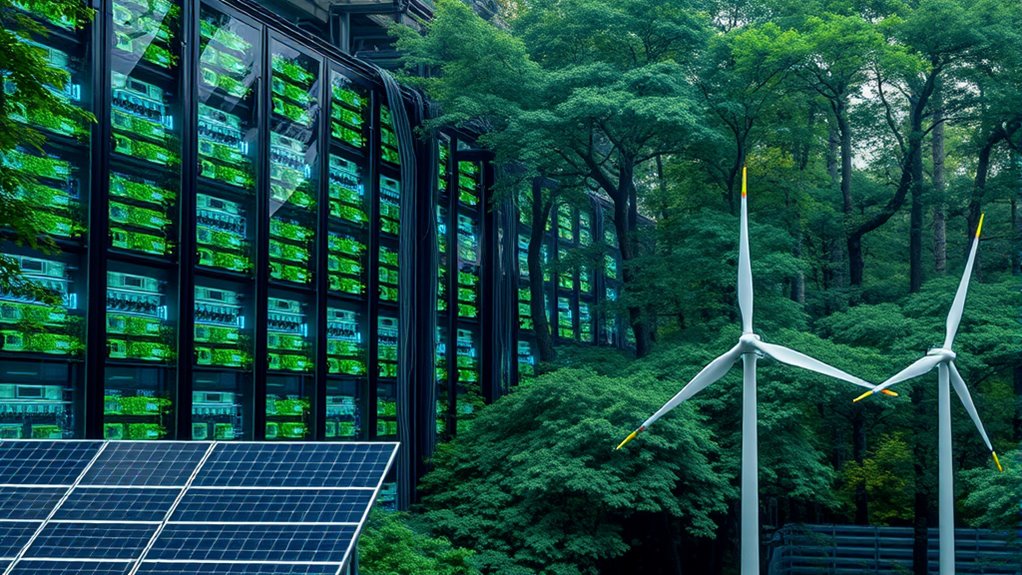
AI’s growing role in climate science relies heavily on extensive infrastructure, which is expanding rapidly to support the increasing demand for data processing and model training. This surge in AI activity means data centers could account for up to 21% of global energy demand by 2030. Electricity use from data centers is expected to double between 2022 and 2026, driven mainly by AI adoption. Larger models like GPT-4 require exponentially more energy for training and inference, raising environmental concerns. Additionally, the use of traditional butter making techniques in various cultures highlights the importance of sustainable and efficient processes, which could inform energy-efficient practices in AI infrastructure.
- Data centers may grow over 30-fold by 2035, reaching 123 GW in the US alone.
- Hyperscale facilities might consume between 500 MW and 2 GW each.
- Specialized AI centers often use 50 MW or more per site.
- Grid reforms aim to support this increasing energy demand efficiently.
Strategies for Harnessing AI’s Benefits While Mitigating Risks

Harnessing the benefits of artificial intelligence in climate solutions requires careful strategies to maximize positive impacts while minimizing environmental risks. You should invest in developing energy-efficient AI algorithms and hardware to reduce the technology’s carbon footprint. Transparent assessment of AI’s environmental trade-offs is essential to prevent unintended consequences or rebound effects that could worsen emissions. Prioritizing responsible deployment involves establishing standards and regulations that guarantee ethical use and environmental safety. Incorporating AI-driven predictive models and early warning systems can improve disaster preparedness and resource management, but you must also monitor their energy consumption. Supporting innovations in carbon capture, recycling, and sustainable energy optimization helps balance benefits with risks. Additionally, understanding the contrast ratio in projectors emphasizes the importance of visual clarity, which can be analogized to the need for clear, transparent policies in AI deployment. Ultimately, a balanced approach ensures AI advances aid climate goals without exacerbating environmental challenges.
Frequently Asked Questions
How Can AI Be Effectively Regulated to Ensure Environmental Sustainability?
You can effectively regulate AI for environmental sustainability by enforcing mandatory transparency and environmental reporting, setting strict standards for data centers, and requiring lifecycle assessments. Implement clear metrics for energy, emissions, and resource use, and promote the adoption of green energy. Accelerate permitting processes responsibly, foster global standardization, and incentivize sustainable practices. Collaborate with stakeholders to develop adaptive policies, ensuring AI growth aligns with environmental goals and minimizes ecological impacts.
What Are the Most Sustainable Practices for Developing AI Hardware?
You should focus on designing energy-efficient hardware by using specialized AI processors and neuromorphic computing to minimize power use. Incorporate modular designs for easy upgrades and recycling, and guarantee responsible manufacturing with recycled materials and pollution controls. Power your data centers with renewable energy sources, optimize cooling with AI, and adopt circular economy principles like design for disassembly. These practices help reduce environmental impact while advancing AI technology sustainably.
How Does AI Influence Global Climate Policy and International Cooperation?
You should know AI accelerates global climate policy and cooperation, with studies showing AI-driven solutions can cut energy waste by up to 30%. It enhances forecasting, improves disaster preparedness, and supports sustainable land management, fostering international collaboration. By providing accurate data for negotiations and enabling tailored climate actions, AI builds trust among nations. However, you must also contemplate its energy demands, which require strong governance to guarantee AI’s positive role in combating climate change.
Can AI Help Reduce the Environmental Impact of Existing Industries?
Yes, AI can help minimize the environmental impact of industries. You can use AI to optimize manufacturing processes, cut waste, and improve energy efficiency. By analyzing data, AI guides better resource management and helps predict potential issues before they escalate. It also streamlines supply chains and enhances renewable energy integration. However, you should also consider AI’s energy demands to ensure your efforts don’t inadvertently harm the environment.
What Ethical Considerations Should Guide AI Deployment in Climate Solutions?
Think of ethical considerations as the compass guiding your AI deployment in climate solutions. You should prioritize fairness and equity, ensuring biased data doesn’t deepen inequalities. Be transparent about decision processes, fostering trust and accountability. Develop energy-efficient systems to reduce environmental impact, and establish clear legal and ethical standards. By doing so, you steer AI toward a sustainable future where technology uplifts everyone, not just a few.
Conclusion
As you explore AI’s role in tackling climate change, remember that while it can boost renewable energy efficiency by up to 30%, it also consumes significant energy—equal to the annual electricity use of some small countries. By staying informed and advocating for responsible AI practices, you can help guarantee these powerful tools accelerate solutions without causing unintended harm. Embrace AI’s potential wisely, and you’ll be part of shaping a sustainable future for all.