

AI in medicine is shifting from augmentation—helping clinicians with diagnosis and workflow—to full autonomy, where it can make complex decisions independently. It’s now capable of high-accuracy diagnostics, predicting outbreaks, and speeding up drug development. Autonomous systems are managing workflows and providing personalized treatments, transforming healthcare delivery. If you want to explore how this evolution impacts patient care and the challenges involved, there’s much more to discover below.
Key Takeaways
- AI is evolving from supporting diagnostic and administrative tasks to autonomous decision-making in clinical workflows.
- Advanced AI systems now analyze multimodal data for personalized treatment plans without human intervention.
- Diagnostic accuracy has increased significantly, with autonomous AI surpassing expert-level performance in some areas.
- Automation extends to complex procedures like robotic surgeries and medical coding, reducing clinician workload.
- Regulatory and ethical frameworks are adapting to accommodate the shift from AI augmentation to full autonomy in healthcare.
Advancements in Diagnostic Precision and Early Detection
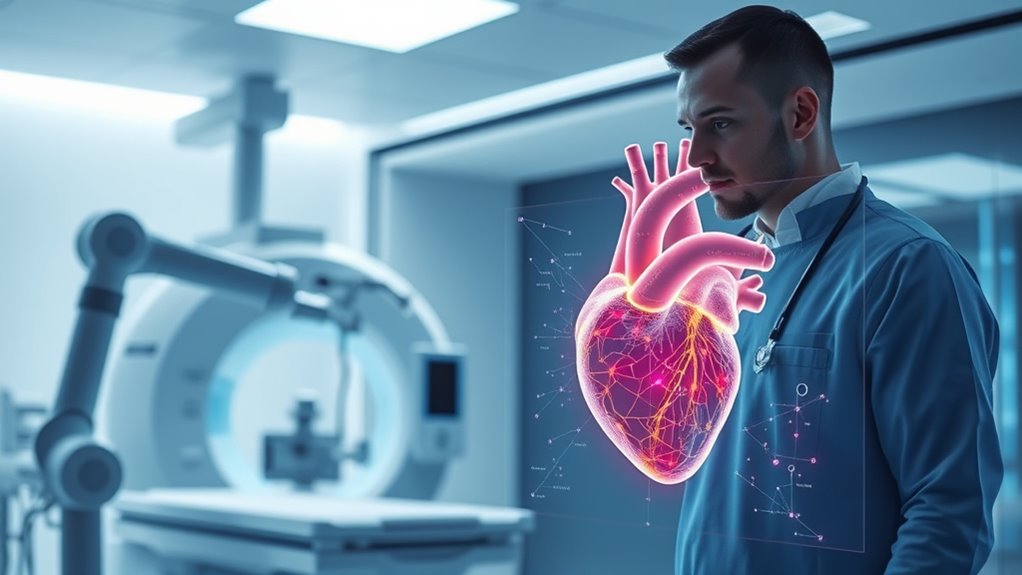
Advancements in diagnostic precision and early detection are transforming healthcare by enabling more accurate and timely interventions. AI has profoundly improved diagnostic agreement among pathologists, reaching 86.4% for HER2-low and 80.6% for HER2-ultralow, cutting misclassification by 65%. While AI models perform comparably to non-expert physicians, they still lag behind experts by about 16%. Digital pathology-based AI expands access to targeted therapies by refining diagnostic accuracy for specific cancer markers. Overall, AI’s diagnostic accuracy stands at 52.1%, varying across specialties. It simplifies complex processes by analyzing diverse data types, making diagnosis faster and more reliable. Additionally, AI enhances early detection by analyzing medical images and patient data to identify diseases before symptoms appear, enabling proactive care and better outcomes. Incorporating color accuracy into imaging analyses can further improve the precision of diagnostic tools, ensuring that visual assessments are as reliable as other data-driven methods.
Transforming Drug Discovery and Personalized Treatment Approaches

AI is revolutionizing how you discover new drugs and tailor treatments to individual patients. It speeds up development cycles, making therapies available faster and more cost-effective. With AI, you can expand treatment options and improve precision medicine to better meet each patient’s unique needs. Additionally, ongoing advancements in automation technologies are further enhancing the efficiency and scalability of personalized medicine approaches.
Accelerating Drug Development Cycles
The integration of artificial intelligence into drug development is revolutionizing how quickly new medicines reach patients. AI accelerates target identification from multi-year efforts to just months by analyzing complex biological data. Lead optimization cycles shrink from 4-6 years to 1-2 years through predictive modeling and virtual screening. Some AI-designed drugs enter clinical trials within about a year, vastly faster than traditional timelines. Overall, AI can cut development durations from over 10 years to just 1-3 years by streamlining discovery and preclinical phases. Digital twin technology enables clinical trial simulations, reducing participant numbers and trial durations. This rapid progression boosts industry growth, cuts costs, and enhances the efficiency of bringing new medicines to market. Ethical considerations surrounding AI-driven healthcare innovations are also increasingly vital to ensure responsible development and application.
Enhancing Precision Medicine
Building on how AI accelerates drug development, its role in transforming precision medicine is equally essential. You can leverage AI algorithms to analyze complex data—genomics, proteomics, and clinical records—to identify disease biomarkers and molecular targets vital for personalized treatments. Machine learning uncovers novel pathways, speeding up targeted therapy discovery. AI also enhances biomarker development for diagnosis, prognosis, and predicting treatment responses. By creating predictive models, you can stratify patients into subgroups most likely to benefit from specific therapies, improving outcomes. Deep learning models facilitate de novo drug design, optimizing pharmacokinetics and reducing off-target effects. Integrating protein structure predictions allows for tailored drug development. Additionally, data integration is crucial for achieving truly personalized therapeutic strategies. Overall, AI enables more precise, individualized treatment plans, markedly advancing the scope and effectiveness of precision medicine.
Expanding Treatment Options
Expanding treatment options through advanced drug discovery methods is revolutionizing how you develop and personalize therapies. AI accelerates discovery by reducing timelines from years to months and cutting costs by up to 70%. It improves success rates in early trials, with AI-designed drugs achieving 80-90% success compared to traditional methods. By analyzing vast datasets, AI enables virtual screening of millions of compounds, exploring chemical space beyond manual limits. Personalized approaches are now possible with AI models that match drugs to individual genetic profiles and create digital twins for trial optimization. This allows for more targeted, effective treatments with fewer side effects. As adoption grows, AI’s role in expanding and customizing therapies continues to reshape the future of medicine.
- Faster drug discovery timelines
- Cost-effective virtual screening
- Higher success rates in clinical trials
- Personalized treatment development
- Digital twin simulations for trials
Enhancing Clinical Workflow and Administrative Efficiency

AI transforms clinical workflows and administrative processes by automating routine tasks and improving accuracy, allowing healthcare providers to focus more on patient care. AI medical scribes reduce documentation time by up to 2 hours daily and cut note errors by 29%, boosting efficiency. Automated note-taking integrated with EHR systems enhances documentation quality by 38% and decreases duplication by 35%. Workflow automation handles repetitive tasks like scheduling and prior authorizations, with over 35% of organizations adopting RPA for real-time processing. AI also detects and corrects billing errors before claims submission, reducing denials. Automated denial appeals and digitized workflow forms speed up administrative processes while minimizing errors. These innovations streamline operations, lower costs, and free clinicians to spend more time on direct patient interactions. Additionally, implementing Kia Tuning options can further optimize operational efficiency through performance enhancements.
Leveraging Predictive Analytics for Population Health Management

Predictive analytics helps you identify high-risk patients and forecast disease outbreaks before they happen. By analyzing diverse data sources, you can target interventions more effectively and allocate resources proactively. This approach enables you to improve community health outcomes while reducing unnecessary hospitalizations. Furthermore, leveraging predictive analytics supports continuous monitoring and evaluation of interventions, ensuring that strategies remain effective and adaptable over time. Incorporating testing methodologies into data validation processes can enhance the accuracy of predictions and improve overall health management efforts.
Disease Outbreak Prediction
Have you ever wondered how health officials can anticipate and contain disease outbreaks before they spiral out of control? AI-driven predictive analytics play a crucial role in this process. They integrate diverse data sources like satellite images, social media, and search trends to improve outbreak forecasting accuracy. These models can simulate how populations respond to interventions such as lockdowns and policy changes, helping refine strategies. Unlike static models, AI adapts quickly to evolving epidemic conditions, providing real-time insights. Large-scale reviews show a growing consensus on AI’s transformative impact on infectious disease prediction. Additionally, the use of predictive analytics in disease modeling enhances the ability to forecast outbreaks with greater precision and timeliness.
High-Risk Patient Identification
Leveraging predictive analytics, healthcare providers can identify high-risk patients more accurately and efficiently than ever before. By integrating social determinants of health, pharmacy claims, clinical biomarkers, and medication adherence data, models improve risk stratification. Deep learning applied to electronic health records outperforms traditional scoring methods, predicting mortality, readmissions, and length of stay with greater precision. AI and machine learning enable rapid detection of at-risk patients before symptoms appear, uncovering patterns invisible to clinicians. Patient journey analytics help tailor interventions and optimize outreach. Consider the following:
| Key Advantage | Impact |
|---|---|
| Data Integration | Enhanced prediction accuracy |
| AI Algorithms | Faster patient identification |
| Personalized Care | Better health outcomes |
This approach streamlines population health management, saving time and resources while improving care quality.
Navigating Regulatory, Ethical, and Adoption Challenges

Guiding the regulatory, ethical, and adoption challenges of AI in medicine requires careful consideration of evolving frameworks, patient rights, and clinical integration. You must navigate complex issues like data privacy, transparency, and bias, which can hinder implementation. Regulatory bodies such as the FDA and ICH are developing guidelines, but the “black box” problem complicates approval and risk management. Ethical concerns about patient autonomy, confidentiality, and health disparities demand ongoing oversight. Adoption hurdles include the need for clear guidance, clinician education, and adaptable workflows. Additionally, liability frameworks are still evolving, making responsibility for AI-driven decisions unclear. To succeed, you must focus on robust data governance, early regulatory engagement, and transparent communication with stakeholders. Moreover, creativity can be cultivated by anyone, regardless of skill level, which underscores the importance of fostering innovation and adaptability within healthcare settings.
The Future Landscape: From Supportive Tools to Autonomous Systems
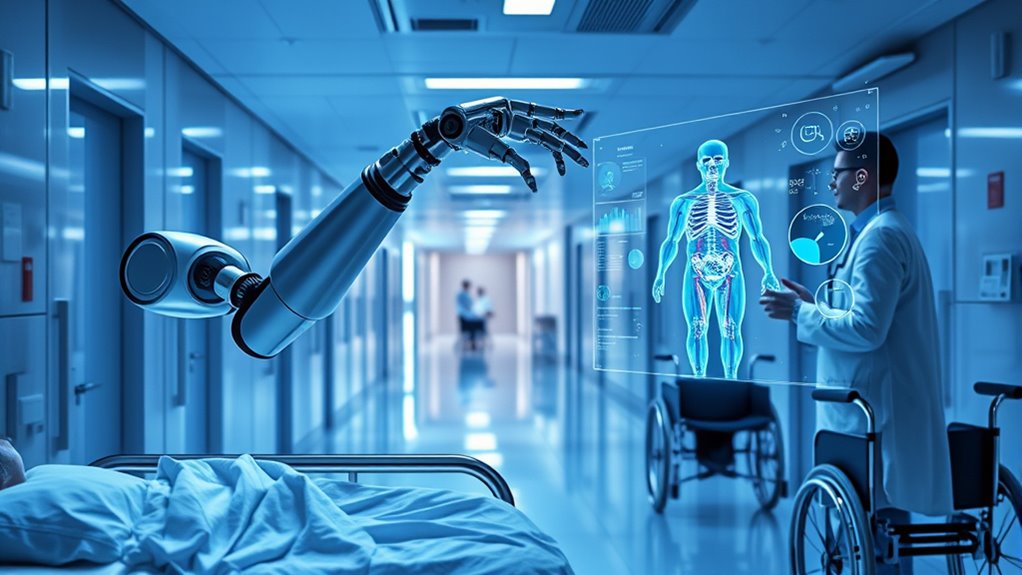
As AI continues to evolve in medicine, its role is shifting from primarily supporting clinical decisions to taking on more autonomous functions. You’ll see autonomous AI agents that analyze multimodal data—genetic, radiology, histopathology—and make personalized treatment decisions with high reliability. Diagnostic accuracy now reaches up to 98%, often surpassing experts, while decision tools exceed 87% accuracy, streamlining care. Automation extends to clinical workflows, like medical coding and robotic surgeries, reducing workload and improving outcomes. The table below highlights key advancements:
| Supportive Tools | Autonomous Systems |
|---|---|
| Help clinicians | Make independent decisions |
| Provide guidance | Execute complex workflows |
| Enhance speed | Improve personalization |
| Reduce workload | Enable proactive care |
These shifts promise a future where AI seamlessly integrates into daily practice, advancing patient care.
Frequently Asked Questions
How Will AI Impact Doctor-Patient Relationships in the Future?
AI will likely transform your doctor-patient relationship by making interactions more collaborative and informed. You’ll have greater access to health information, empowering you to participate in decisions actively. However, you might experience concerns about losing personal connection or trust if AI reliance grows too much. Your doctor will use AI as a tool to enhance care, but maintaining open communication and trust will remain key to preserving a strong, positive relationship.
What Safeguards Are in Place for AI Decision-Making in Critical Cases?
You can rely on safeguards like state laws requiring human oversight for AI decisions in critical cases, guaranteeing medical necessity and accountability. Transparency mandates mean you’re informed when AI is involved in your care. Data privacy regulations protect your sensitive health info, and bias safeguards aim for equitable treatment. These measures work together to ensure AI supports safe, responsible decision-making, but continual updates are necessary as technology and regulations evolve.
How Accessible Will Ai-Driven Healthcare Be in Underserved Regions?
Imagine a remote village where AI-powered telehealth connects residents to specialists. In underserved regions, AI-driven healthcare becomes more accessible through mobile clinics with integrated AI tools for diagnostics and treatment planning. While challenges like limited infrastructure exist, initiatives are increasingly deploying affordable, scalable solutions. These efforts improve early detection, personalized care, and resource allocation, making AI healthcare more reachable for vulnerable populations, especially with ongoing investments and technology adaptation.
What Are the Long-Term Legal Liabilities of AI Errors in Medicine?
You’ll face increasing long-term legal liabilities from AI errors in medicine as the technology becomes more autonomous. If an AI system causes harm, you might be held responsible under negligence or product liability laws, especially if the AI’s decision-making process isn’t transparent. As standards evolve, failing to adapt your practices could lead to legal consequences, making it essential that you stay informed about regulations and guarantee AI safety and accountability.
How Will AI Influence Medical Training and Clinician Skill Development?
AI will markedly influence your medical training and skill development by providing personalized learning experiences, immersive simulations, and real-time feedback. You’ll learn to interpret AI outputs critically and collaborate effectively with these tools, enhancing diagnostic skills and decision-making. As AI integrates further, you’ll need to stay updated on its capabilities, ethical considerations, and limitations, ensuring your expertise evolves alongside advancing technology and prepares you for future clinical environments.
Conclusion
As you embrace AI’s evolving role in medicine, remember how the lighthouse guided sailors safely home—it’s now illuminating pathways toward more precise, efficient care. From early detection to autonomous systems, AI’s journey mirrors a voyage from trusted compass to autonomous navigator. Stay adaptable and vigilant, for like Icarus’s wings, the technology’s potential soars high—but must be balanced with caution. Together, you can steer this transformative tide toward a future where healthcare truly empowers.