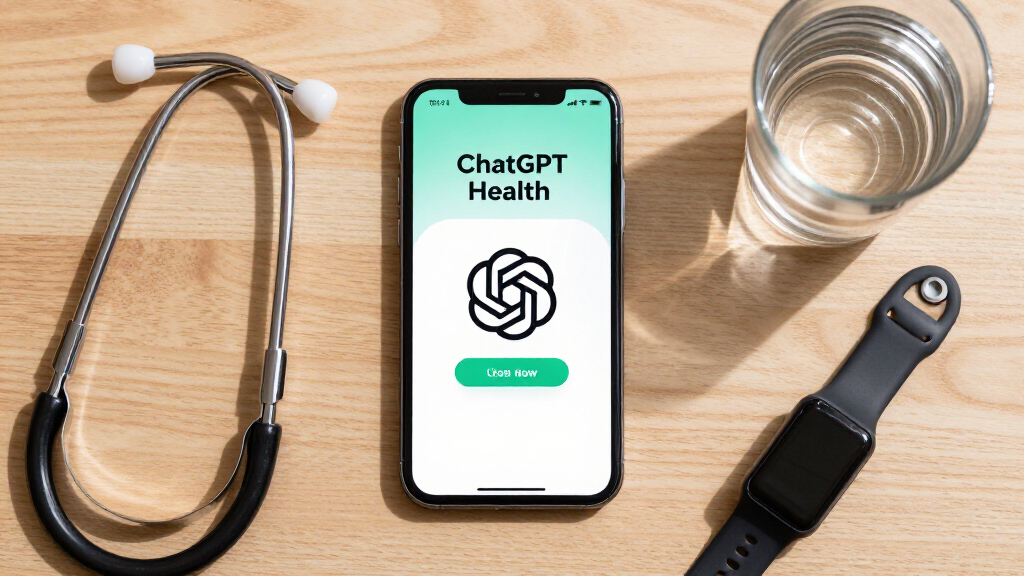

Product launch / January 2026

Launching Health in ChatGPT

ChatGPT Health is a dedicated space for connecting medical records and wellness apps so health answers can reflect a user’s own labs, visits and activity—not only generic guidance.

2 years Development
60 Countries represented
6+ Named app links
0 Health chats used for training

A separate health workspace inside ChatGPT

The product formalizes an already-common behavior: asking ChatGPT about health. Connected personal data is intended to make responses more relevant while preserving a clear boundary between assistance and clinical care.

Personal context

Reflect actual health data

Answers can draw on connected lab results, medical history, exercise and wellness activity instead of relying solely on a generic prompt.

Everyday support

Explain and prepare

Potential uses include understanding results in plain language and preparing informed questions for a physician or care visit.

Product boundary

Support—not treatment

OpenAI says ChatGPT Health is not intended to diagnose or treat a medical condition and should not replace professional care.

Named wellness integrations

Apple Health Function MyFitnessPal Peloton Weight Watchers AllTrails
United States / Medical records

Records connected through b.well

The launch includes a U.S. partnership with health-data connectivity firm b.well. Medical-record connections outside the United States have not been announced.

From fragmented data to a contextual answer

The core proposition is a connected chain: user-authorized sources provide personal context, ChatGPT interprets the question, and the output supports a better-informed conversation with a professional.

1 Wellness apps

Activity, nutrition and fitness signals

2 Medical records

Labs, visits and available history

🔒 3 Health space

Separately stored conversation context

4 Explanation

Personalized, plain-language support

5 Professional care

Questions and decisions stay with people

Health data raises the stakes

OpenAI presents privacy architecture as a defining part of the product. These are company claims at launch; independent auditing and real-world scrutiny remain important.

Stored separately

Health conversations are kept apart from ordinary ChatGPT chats, according to OpenAI.

Purpose-built encryption

The dedicated health experience is described as using protections designed for sensitive information.

Excluded from model training

OpenAI says conversations in Health are not used to train its AI models.

What the launch promises—and what it does not

The distinction between wellness support and medical decision-making will shape user expectations, regulatory attention and the product’s long-term reach.

Capability or claim ChatGPT Health Clinical care Open question
Connect wellness data ✓ Named integrations ~ Varies by provider More apps and devices
Connect medical records ~ U.S. via b.well ✓ Core clinical record Availability beyond the U.S.
Explain health information ✓ Intended use ✓ Professional context Independent accuracy testing
Diagnose or treat ✗ Not intended ✓ Licensed care Regulatory interpretation
Health chats used for training ✗ OpenAI says no ~ Different systems apply Independent privacy audit
Company statements describe the product at launch; independent validation is still limited.

Small launch now, broader access later

Initial access is restricted to a small early-user group on web and iOS. A waitlist is in place, but a full public-release date has not been stated.

Phased rollout

Early users first

OpenAI said it planned to expand access to waitlisted users after the initial release, followed by more platforms and regions. Timing remains a key marker to watch.

Limited
Next
Open
U.S. Early access
EEA Not initially offered
Switzerland Not initially offered
United Kingdom Not initially offered

The launch is the beginning of the test

Connecting AI to sensitive personal information turns privacy, accuracy and accountability from abstract concerns into product requirements.

Accuracy

Will results hold up independently?

OpenAI cites HealthBench and physician input, but researchers have not yet had broad access to test real-world performance.

Regulation

Wellness tool or medical device?

That distinction influences oversight. Features that interpret labs may draw attention from health and data-protection authorities.

Data governance

What happens across services?

Users will need clarity about permissions, retention and governance when information passes between connected third-party systems.

Four signals will define the rollout

The product’s credibility will depend less on the announcement than on what follows: evidence, integrations, geographic reach and regulator response.

Independent tests

External evidence on answer quality

More connections

Additional apps, records and devices

Regional expansion

Availability outside initial markets

Regulator reaction

Health and privacy authority guidance

ChatGPT Health at a glance

What is ChatGPT Health?

A dedicated ChatGPT space where connected medical records and wellness apps can provide personal context for health-related answers.

Who can use it?

At launch, a small group of early users on web and iOS. Broader access is planned through a waitlist.

Will health chats train OpenAI’s models?

OpenAI says no. It states that Health conversations are separated, encrypted and excluded from model training.

Can it diagnose or treat conditions?

No. OpenAI positions it as support for understanding and preparing—not as a replacement for professional medical care.

Source: OpenAI product announcement and stated launch details / Vetted by the thorstenmeyerai.com team

TL;DR

OpenAI has launched ChatGPT Health, a dedicated space inside ChatGPT where users can connect medical records and wellness apps for more personalized health answers. The company says health chats are stored separately, encrypted, and not used to train its models. Access is limited to a small group of early users at launch, with a waitlist for broader availability.

OpenAI has launched ChatGPT Health, a dedicated space inside its chatbot where users can connect medical records and wellness apps to get more personalized answers to health questions. The company announced the feature in January 2026, describing it as its most direct move into consumer health — an area where, by its own count, more than 230 million people already turn to ChatGPT every week.

ChatGPT Health sits in a separate section of the app and on the web. Users can link data from services including Apple Health, Function, MyFitnessPal, Peloton, Weight Watchers and AllTrails, according to OpenAI. In the United States, users can also pull in medical records through a partnership with health data connectivity firm b.well. The goal, the company said, is for answers to reflect a person’s actual lab results, visit history and activity rather than generic guidance.

On privacy, OpenAI said Health conversations are stored separately from other chats, protected by purpose-built encryption, and are not used to train its AI models. The company said it developed the product over two years with input from more than 260 physicians across 60 countries, and evaluated it using HealthBench, a clinician-informed testing framework it released in 2025.

Availability is limited at launch. OpenAI is opening the feature to a small group of early users on web and iOS, with a waitlist for broader access. It is not initially offered in the European Economic Area, Switzerland or the United Kingdom — regions with stricter data-protection regimes. OpenAI has stressed the tool is not meant to diagnose or treat any medical condition.

At a glance
announcementWhen: announced January 2026; phased rollout…
The developmentOpenAI announced ChatGPT Health, a dedicated health experience inside its chatbot that connects to medical records and wellness apps.

Why Putting Health Data in ChatGPT Raises the Stakes

Health is already one of the most common reasons people use ChatGPT, and this launch formalizes that behavior and ties it to sensitive personal data. For users, the appeal is practical: an assistant that can read lab results, explain them in plain language, and help prepare questions for a doctor’s visit. For OpenAI, it is a bid to turn a high-frequency use case into a durable product, and it pushes an AI company closer to territory long guarded by physicians and health regulators. The move also lands as rivals pursue the same ground — Anthropic has been expanding Claude’s health and life-sciences capabilities — raising competitive pressure on privacy guarantees and answer quality as the main differentiators.

Amazon

Apple Health compatible fitness tracker

As an affiliate, we earn on qualifying purchases.

As an affiliate, we earn on qualifying purchases.

Two Years of Physician Input Behind the Feature

According to OpenAI, ChatGPT Health was shaped over two years of work with physicians, whose feedback was used to tune how the system responds to medical questions. The company released HealthBench in 2025 as an open evaluation framework measuring how models handle realistic health conversations. Demand has never been the question: OpenAI says hundreds of millions of health-related queries already flow into ChatGPT weekly, and independent surveys have found a large share of adults consult AI chatbots about symptoms. Regulators have so far said little about general-purpose chatbots, and OpenAI has positioned the product as a wellness tool, not a medical device — a distinction that determines how much oversight it faces.

Amazon

MyFitnessPal premium subscription

As an affiliate, we earn on qualifying purchases.

As an affiliate, we earn on qualifying purchases.

Accuracy, Regulation and Access Remain Open Questions

How reliably ChatGPT Health will answer real patient questions outside OpenAI’s own evaluations is unproven; independent researchers have not yet had broad access to test it. The timeline for general availability is unstated, and OpenAI has not said when — or whether — medical-record connections will extend beyond the United States. How regulators respond is another open question: the product is framed as a wellness tool, but features that interpret lab results could attract scrutiny from health authorities and data-protection agencies, particularly if availability expands into Europe. It is also not yet clear how data handled by connected third-party apps is governed once it leaves those services.

Amazon

medical record management app

As an affiliate, we earn on qualifying purchases.

As an affiliate, we earn on qualifying purchases.

Waitlist Now, Wider Rollout Promised Later

OpenAI said it will expand access from the initial early-user group to people on its waitlist in the coming weeks, as of the January announcement, with more platforms and regions to follow. The next markers to watch are announcements of additional app and device integrations, any move into markets outside the United States, and the first independent evaluations of answer quality. Reactions from health regulators and privacy authorities — especially in the EU and UK, where the product is not yet offered — will shape how fast the rollout can go.

Source: OpenAI

Amazon

personal health data encryption device

As an affiliate, we earn on qualifying purchases.

As an affiliate, we earn on qualifying purchases.

Key Questions

What is ChatGPT Health?

A dedicated space inside ChatGPT, announced by OpenAI in January 2026, where users can connect medical records and wellness apps so answers reflect their own health data rather than generic information.

Who can use ChatGPT Health right now?

At launch, access is limited to a small group of early users on web and iOS, with a waitlist for everyone else. It is not initially available in the European Economic Area, Switzerland or the United Kingdom.

Will OpenAI use my health data to train its AI?

OpenAI says no. The company states that Health conversations are stored separately from other chats, protected by purpose-built encryption, and excluded from model training. That promise has not yet been independently audited.

Can ChatGPT Health diagnose or treat medical conditions?

No. OpenAI explicitly says the product is not intended for diagnosis or treatment and is designed to support — not replace — care from medical professionals.

Which apps and services connect to ChatGPT Health?

OpenAI named Apple Health, Function, MyFitnessPal, Peloton, Weight Watchers and AllTrails among the launch integrations. In the United States, medical records can be connected through a partnership with health data firm b.well.

Source: OpenAI

You May Also Like

Your Funnel in a Minute: How AI Form Builders Make It Possible

Discover how AI form builders transform simple prompts into complete lead funnels in seconds. Learn what they do, their strengths, and how to leverage them for your business.

Building AI Infrastructure With The Effingham County Community

OpenAI says it is building AI infrastructure with Effingham County, but the project’s location, scale, costs and timeline remain undisclosed.

Vibe Coding: The Emergent Language of Human-AI Collaboration

Introduction: Coding Without Code Programming once meant strict syntax. Now, it means…

Artificial Intelligence for Electoral Actors

While artificial intelligence offers electoral actors transformative tools, understanding its benefits and risks is essential to harness its full potential responsibly.