
To design the foundation of life after AI, focus on creating ethical governance, fostering global collaboration, and supporting human-centered creativity. Emphasize building robust frameworks that promote transparency, inclusivity, and shared values while exploring new social structures like DAOs and a post-work economy. Invest in education that nurtures empathy and critical thinking. By aligning technological innovation with cultural and moral growth, you’ll help shape a resilient future. Keep exploring to open more ways to build this new foundation.
Key Takeaways
- Develop ethical frameworks and standards for AI integration aligned with human rights and societal values.
- Foster global collaboration to establish shared norms, governance, and responsible AI deployment practices.
- Redesign societal structures to prioritize creativity, empathy, and community over traditional employment models.
- Implement universal basic income and social systems supporting lifelong learning and well-being in an AI-driven world.
- Promote cultural innovation by exploring AI-human artistic collaborations and addressing philosophical questions of consciousness and identity.
The Societal Transformation in a Post-AI Era

Have you ever wondered how society will change once AI has fully transformed our daily lives? As AI automates many jobs, you’ll notice a shift in how we perceive work and purpose. Traditional employment may become less central, giving way to roles focused on creativity, empathy, and community building. Society might prioritize lifelong learning to adapt to rapid technological changes. You’ll also see new social structures form, like decentralized autonomous organizations, which promote transparency and collective decision-making. Cultural and artistic pursuits could flourish as people find more time for exploration. Additionally, the integration of sound healing science could influence community wellness practices, fostering collective healing and social cohesion. Overall, society will evolve into a more interconnected, innovative, and reflective space, reshaping human interactions and values in profound ways.
Economic Paradigms and the Shift Toward Universal Basic Income
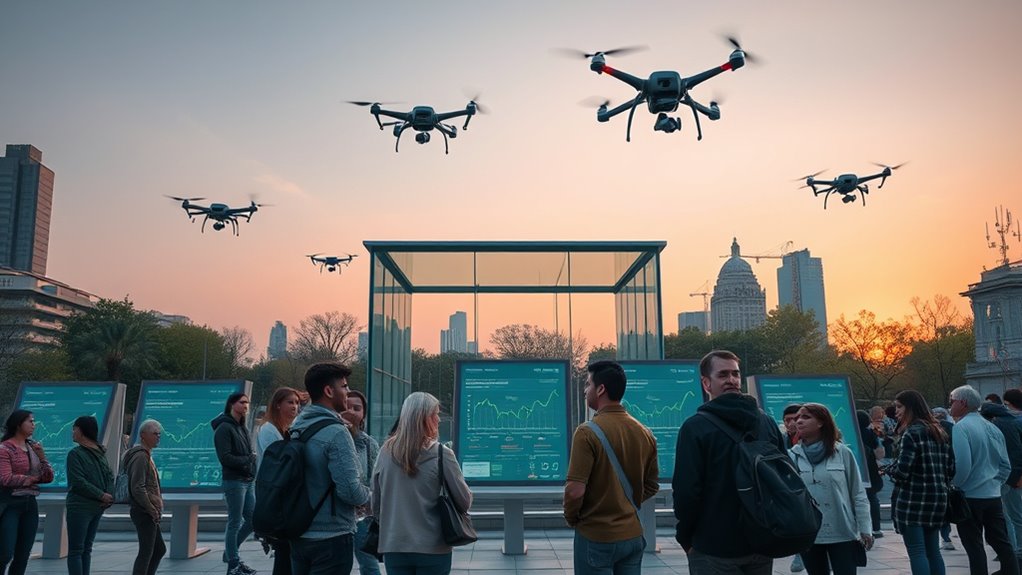
You’ll need to contemplate how to implement UBI effectively and guarantee it reaches those who need it most. As AI disrupts traditional economies, maintaining stability becomes a pressing challenge that requires innovative strategies. Finding the right balance between support and sustainability will be vital for a resilient post-AI economy. Incorporating dynamic communication exercises can help strengthen community understanding and cooperation during this transition.
UBI Implementation Strategies
As AI continues to reshape the workforce, implementing Universal Basic Income (UBI) emerges as a practical solution to address widespread unemployment and economic instability. Your focus should be on designing adaptable policies that guarantee fair distribution and sustainability. Consider the following strategies:
- Pilot Programs: Test UBI models in diverse communities to evaluate impacts and refine approaches.
- Funding Models: Explore options like wealth taxes, automation levies, or reallocating existing social welfare budgets.
- Phased Rollouts: Implement UBI gradually, prioritizing vulnerable populations to build trust and demonstrate benefits.
- Integration with Social Services: Combine UBI with targeted programs for healthcare, education, and job training to maximize societal uplift.
- Additionally, breakfast delivery trends highlight the importance of innovative logistics and customer preferences, which can inform scalable and efficient distribution systems for social programs.
Economic Stability Challenges
The widespread adoption of AI threatens to disrupt traditional economic models, prompting a reevaluation of how societies maintain stability amid rapid technological change. As automation replaces many jobs, you’ll need to consider new ways to support economic security. Universal Basic Income is gaining traction as a solution, providing a safety net for those displaced by AI-driven shifts. Shifting to this paradigm requires rethinking how wealth is distributed and how social programs are funded. You’ll face challenges in ensuring sustainability, managing inflation, and maintaining motivation for work. Policymakers and communities must collaborate to develop adaptable frameworks that balance innovation with stability. Ultimately, your goal is to create an economy that sustains everyone, even as AI transforms the nature of work and income. Incorporating insights from economic stability, such as flexible policies and diversified support systems, can help address these emerging challenges.
Technological Enhancements and Human Creativity

You can harness AI to boost your artistic expression and solve complex problems more creatively. By collaborating with AI, you unlock new ideas and approaches that were previously out of reach. This partnership pushes human creativity forward, opening fresh possibilities across all fields. Additionally, understanding emotional support strategies can help individuals navigate the challenges of change more effectively.
AI Amplifies Artistic Expression
Technological advancements in AI are revolutionizing artistic expression by providing creators with powerful tools that expand their creative potential. You can now generate complex visuals, compose music, and craft written works with unprecedented ease. AI-driven platforms enable real-time collaboration, transforming how artists experiment and refine their craft. These tools challenge traditional boundaries, allowing you to explore new genres and styles. As a result, artistic innovation accelerates, fostering a cultural renaissance rooted in technological synergy. Moreover, the role of attention becomes crucial in mastering these tools and translating digital creations into meaningful art.
Enhancing Human Problem-Solving
How can human problem-solving reach new heights with the help of advanced AI tools? By leveraging AI’s analytical power, you can process vast data sets quickly, uncover hidden patterns, and generate innovative solutions. AI acts as your partner, offering real-time insights and predictive models that enhance decision-making. You can simulate complex scenarios, test hypotheses, and identify *ideal* strategies more efficiently than ever before. This collaboration enables you to focus on creative thinking, ethical considerations, and strategic planning—areas where human intuition excels. As AI handles routine analysis, you gain more time for critical thinking and idea development. Incorporating organized systems can further streamline workflows and improve overall efficiency. Together, you can tackle multifaceted challenges—from scientific research to societal issues—pushing the boundaries of what’s possible in problem-solving.
Creative Collaboration With AI
Have AI tools truly transformed creative collaboration by amplifying human imagination? Absolutely. They enable you to experiment with new ideas, push boundaries, and accelerate artistic processes. AI acts as a creative partner, offering suggestions, generating content, and providing insights that deepen your work. This synergy *unlocks* innovative possibilities across arts, design, and storytelling, empowering you to explore uncharted territories. To elevate your creative collaboration, consider these aspects:
- Leveraging AI for rapid prototyping and iterative feedback
- Using generative models to inspire original concepts
- Combining human intuition with AI-driven data analysis
- Exploring cross-disciplinary projects that blend technology and art
- Incorporating health benefits to enhance overall well-being and sustain creative energy
Educational Reforms for Future Workforce Readiness

Are educational systems prepared to equip students with the skills they’ll need in a rapidly evolving AI-driven workforce? Likely not, but you can help change that. Focus on integrating AI literacy and critical thinking into curricula, ensuring students understand AI’s capabilities and limitations. Emphasize developing skills that machines can’t replicate, such as creativity, empathy, and complex problem-solving. Encourage hands-on learning through project-based activities and real-world applications. Teachers should be trained to adapt to new tools and methodologies, fostering a culture of continuous learning. Collaboration between educators, industry leaders, and policymakers is essential to design relevant programs. By prioritizing adaptable, forward-thinking education, you prepare the next generation not just to survive but to thrive in a future shaped by AI. Incorporating predictive analytics into education can help tailor learning experiences to individual student needs and improve overall outcomes.
Ethical Frameworks and Governance of AI Development

Establishing robust ethical frameworks and governance for AI development is essential to guarantee that technological advances align with societal values and human rights. You must create clear standards that guide AI design, deployment, and oversight. This involves fostering international cooperation to develop consistent norms, ensuring transparency in AI decision-making processes, and holding developers accountable for potential harms. Additionally, you should prioritize risk mitigation strategies to prevent misuse or unintended consequences. Effective governance requires engaging diverse stakeholders — policymakers, technologists, and communities — to shape responsible AI practices. By doing so, you’ll help build trust, promote fairness, and ensure AI benefits society while respecting individual rights. Ultimately, strong ethical frameworks serve as the foundation for sustainable, trustworthy AI progress. Incorporating Gold IRA Rollovers into retirement planning can also serve as a safeguard for financial stability amid technological and economic shifts.
New Societal Structures: Post-Work Society and DAOs
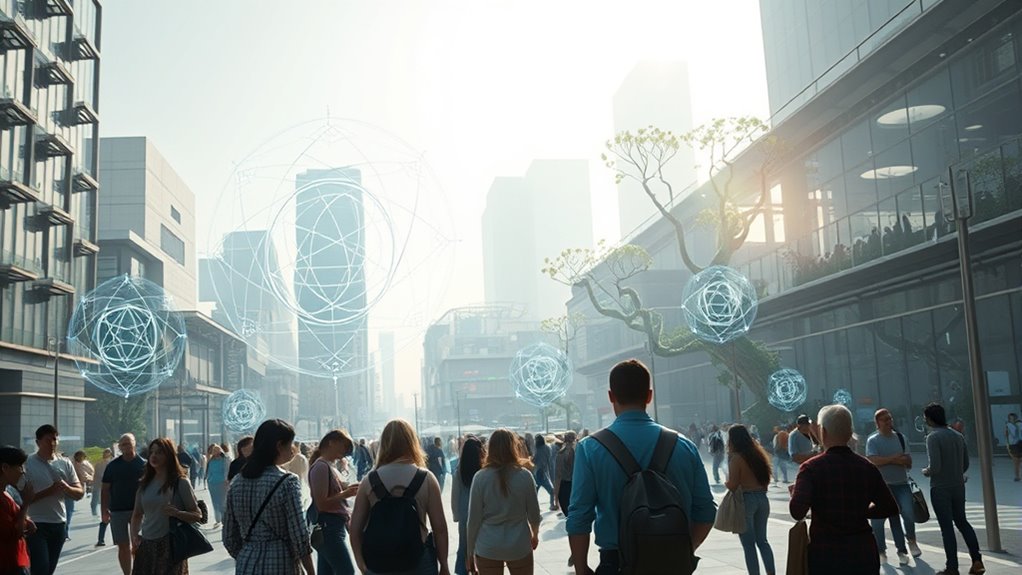
As society grapples with the ethical and governance challenges of AI, new social structures are emerging to redefine how we organize ourselves. You might find yourself in a post-work society where AI handles routine tasks, freeing you to pursue passions, creativity, or community engagement. Decentralized Autonomous Organizations (DAOs) are gaining traction as community-driven entities that operate transparently without hierarchical control. They enable collective decision-making, allowing you to participate directly in governance and resource allocation. These structures foster greater autonomy, accountability, and inclusivity, aligning with a future where work is less central. As AI reshapes economic and social landscapes, you’ll navigate new systems that emphasize collaboration, shared ownership, and purpose beyond traditional employment, fundamentally transforming societal organization.
Cultural and Philosophical Renaissance Driven by AI

AI’s integration into society sparks a profound cultural and philosophical renaissance, inspiring new forms of artistic expression and challenging long-held beliefs about human purpose. You’ll find innovative art blending human creativity with machine intelligence, pushing the boundaries of imagination. Philosophical debates deepen around consciousness, identity, and morality as AI prompts reflection on what it means to be human. This movement fosters a renewed curiosity about existence and our place in the universe.
AI-driven creativity sparks a cultural renaissance, redefining human identity and expanding our understanding of consciousness and existence.
- Exploration of AI-generated art and literature as new cultural frontiers
- Reassessment of human uniqueness in the age of intelligent machines
- Revival of philosophical inquiry into consciousness and ethics
- Integration of AI into spiritual and existential practices for deeper understanding
Global Collaboration and the Future of Humanity

Global collaboration is becoming essential as AI advances, breaking down geographic and cultural barriers to address shared challenges. You’ll find that working across borders enhances innovation, allowing diverse perspectives to shape AI development responsibly. International cooperation helps create unified standards, reducing risks and ensuring AI benefits everyone. You’ll need to engage with global institutions, policymakers, and tech leaders to craft effective regulations and ethical frameworks. Collaboration also accelerates the sharing of research, resources, and best practices, making AI safer and more equitable. As AI’s influence expands, your role involves fostering open dialogue and partnerships that promote trust and transparency. Together, you can shape a future where humanity’s collective intelligence guides AI toward positive societal outcomes, ensuring that no one is left behind in this technological evolution.
Frequently Asked Questions
How Will AI Impact Social Inequality and Access to Resources?
AI can both widen and bridge social inequality. You might find that access to AI-driven resources becomes uneven, deepening existing gaps. However, you can also work toward equitable solutions by promoting inclusive policies, expanding AI literacy, and ensuring affordability. By actively supporting initiatives that democratize AI benefits, you help create a future where everyone has fair access to technological advancements and resources, reducing disparities rather than increasing them.
What Role Will Human Empathy Play in a Highly Automated Society?
In a highly automated society, human empathy becomes your anchor, your bridge to genuine connection. As AI handles routine tasks, your ability to understand and share others’ feelings will define social cohesion. It’s what sets you apart, fostering trust and compassion that machines can’t replicate. This empathy will shape communities, influence leadership, and create spaces where humans thrive beyond efficiency—reminding you that true progress is rooted in understanding each other.
How Can International Cooperation Prevent Ai-Related Conflicts?
You can foster international cooperation by advocating for global AI standards and norms, encouraging open dialogue among nations, and supporting cross-border research initiatives. By participating in international organizations and promoting transparency, you help prevent conflicts over AI development and use. Building trust through shared regulations and ethical frameworks ensures AI benefits are distributed fairly, reducing tensions and promoting peaceful collaboration worldwide. Your proactive engagement is essential for a harmonious AI-driven future.
What New Ethical Dilemmas Might Emerge With Advanced AI Systems?
You might face new ethical dilemmas like deciding who’s responsible if advanced AI causes harm or makes biased decisions. Privacy could become even more challenging as AI gathers and analyzes vast personal data. You’ll need to navigate questions about consent, transparency, and whether AI systems should have rights or moral considerations. Balancing innovation with safeguarding human values will be essential, requiring ongoing ethical reflection and international standards.
How Will AI Influence Human Identity and Purpose in Daily Life?
AI influences your human identity and purpose by shifting what you value and how you see yourself. You might find new meaning through creativity, innovation, or community efforts enabled by AI. As AI handles routine tasks, you focus more on empathy, relationships, and personal growth. This transformation encourages you to redefine your role in society, explore new interests, and reflect on what truly gives your life purpose amidst this technological evolution.
Conclusion
As you navigate this new world shaped by AI, remember that your choices will forge the future’s foundation. Coincidentally, just as technology advances, so does your opportunity to influence societal values and ethics. Embrace innovation with responsibility, knowing that human creativity and collaboration remain essential. In this delicate balance, you hold the power to build a resilient, equitable post-AI society—one where life’s true essence flourishes amid progress.