
TL;DR

Get business pricing on tech for your team
- Business-only prices and quantity discounts
- Tax-exempt purchasing
- Multiple users, one account, clear invoices
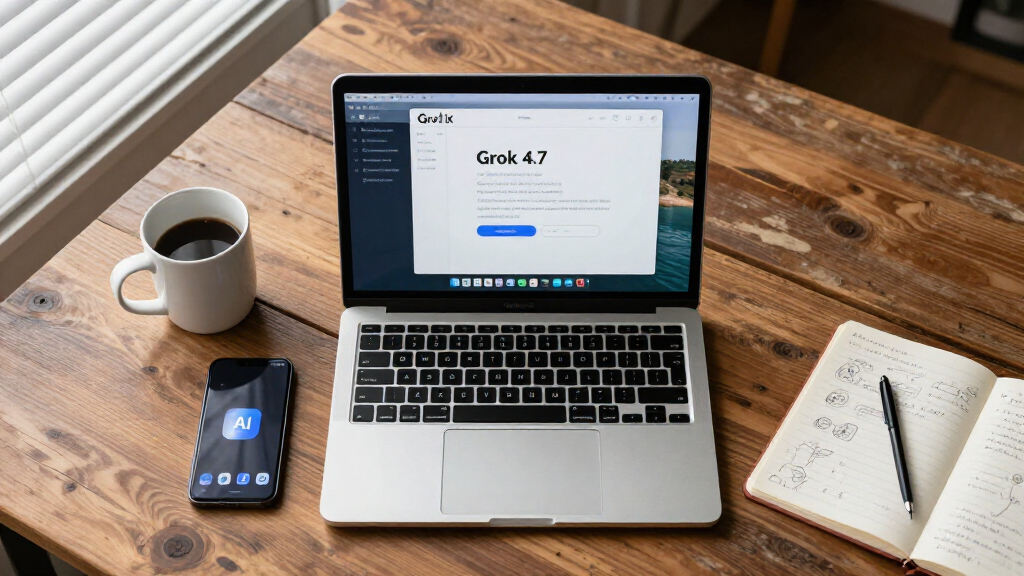
xAI has released Grok 4.7, described in initial reporting as a larger model that arrives late relative to competitors’ frontier releases. Details on benchmarks, availability and pricing were not included in the launch coverage, so the model’s actual standing remains unverified.
xAI has launched Grok 4.7, the latest version of the company’s flagship AI model, with initial coverage characterizing the release as a larger model that arrives after competitors have moved the frontier forward. The launch headline — “It’s Bigger, But Late to the AI Frontier Party” — signals the central tension: xAI is scaling up its models while rivals including OpenAI, Google and Anthropic have consolidated perceived leads in recent release cycles. Specific benchmark results, availability and pricing details were not included in the available coverage and remain unconfirmed.
The confirmed development is the release itself: Grok 4.7 is now the newest model version from Elon Musk’s AI company, succeeding earlier Grok releases. According to the launch framing reported by Yahoo Tech, the model is “bigger” — language that typically points to a larger parameter count or greater training compute, though xAI did not publish exact figures in the available coverage.
The second element of the framing — being “late to the AI frontier party” — is an editorial characterization rather than a measured result. It reflects the widely observed dynamic of the past year, in which OpenAI’s GPT-series models, Google’s Gemini line and Anthropic’s Claude models have repeatedly traded benchmark leads while xAI’s Grok releases have tended to follow rather than set the pace. Whether Grok 4.7 changes that pattern cannot be determined without independent benchmark evaluations, which had not been published at the time of writing.
Readers should treat three things as distinct: the launch is confirmed; the claim that the model is larger is attributable to launch coverage but not yet quantified; and the claim that xAI is behind the frontier is interpretation, not an established ranking. No third-party evaluation of Grok 4.7 was available in the reported material.
Why This Launch Matters for the AI Race
The AI frontier market has consolidated around a small number of labs that can afford the compute and talent required to train top-tier models. Each major release is now a positioning event: it shapes enterprise procurement, developer adoption and the narrative of who is actually leading.
For xAI, Grok 4.7 is a test of whether the company’s strategy — heavy infrastructure investment paired with integration into X (formerly Twitter) and Musk’s broader ecosystem — can translate into competitive model quality. If the model merely matches rather than exceeds rivals, xAI’s differentiation rests mainly on distribution and price rather than raw capability.
For users and buyers, the practical stakes are concrete: a genuinely competitive Grok 4.7 would add pricing pressure and choice in a market where a handful of providers set the terms. A model that trails the frontier would leave the current hierarchy largely intact.
As an affiliate, we earn on qualifying purchases.
Grok’s Road to Version 4.7
xAI released its first Grok model in late 2023, positioning it as a challenger with real-time access to data from X. Subsequent versions — through the Grok 3 and Grok 4 families — brought larger-scale training runs, and Musk has repeatedly promoted the company’s Colossus data center buildout in Memphis as the hardware backbone for frontier-scale training.
Throughout that period, xAI’s releases have generally followed, rather than preceded, comparable moves by OpenAI and Google. That pattern is the backdrop for the “late to the party” framing of the Grok 4.7 launch: each xAI release has been judged against a frontier that competitors have already moved.
“xAI Launches Grok 4.7. It’s Bigger, But Late to the AI Frontier Party.”
— Yahoo Tech launch coverage headline
As an affiliate, we earn on qualifying purchases.
What Grok 4.7 Claims Are Still Unverified
Several basic facts about Grok 4.7 are not yet confirmed in the available coverage:
- Model size — the “bigger” claim has no published parameter count or compute figure behind it.
- Benchmarks — no independent or vendor-published evaluation results were available at the time of writing.
- Availability and pricing — it is not yet clear which tiers of X subscribers or API customers get access, or at what cost.
- Capabilities — any claims about reasoning, coding or agentic performance remain unverified until third-party testing appears.
The “late to the frontier” characterization should also be treated cautiously: frontier leadership is contested and shifts with each release cycle, and no single ranking settles it.
As an affiliate, we earn on qualifying purchases.
How Grok 4.7 Will Be Judged
Expect the first wave of independent benchmarks from testing organizations and AI researchers within days of wide availability, covering reasoning, coding, mathematics and agentic tasks. Those results will determine whether the “bigger” release translates into measured capability gains.
Watch also for xAI’s own technical documentation, rollout details across X and the xAI API, and pricing announcements. Rival labs’ response — release cadences at OpenAI, Google and Anthropic tend to accelerate around competitor launches — will indicate how seriously Grok 4.7 is viewed inside the industry.
AI model training compute hardware
As an affiliate, we earn on qualifying purchases.
As an affiliate, we earn on qualifying purchases.
Where I land
My read: a launch this thin on verifiable detail — no published benchmarks, no size figures, no pricing — should be treated as a positioning event, not a proven capability leap. The “bigger but late” framing is plausible given xAI’s track record of following rather than setting the frontier, but plausible is not the same as demonstrated, and I would not draw conclusions until independent evaluations appear.
The strongest counterargument is that release framing routinely undersells models from challengers, and xAI’s infrastructure buildout has been aggressive enough that Grok 4.7 could surprise on benchmarks. “Late” also cuts both ways — arriving later can mean incorporating techniques rivals had to pioneer the hard way.
What would change my assessment: strong third-party benchmark results placing Grok 4.7 at or near the top on reasoning and coding, plus competitive pricing and broad availability. Conversely, benchmark results in the middle of the pack would confirm the late-to-the-frontier characterization.
Source: xAI
Key Questions
What is Grok 4.7?
Grok 4.7 is the newest version of xAI’s flagship AI model, succeeding earlier Grok releases. Its launch has been reported by Yahoo Tech, which characterized it as a bigger model arriving after competitors’ frontier releases.
Is Grok 4.7 actually bigger than previous versions?
Launch coverage describes it as “bigger,” but no parameter count or training-compute figures have been published. Treat the size claim as attributable to launch framing rather than a verified specification.
How does Grok 4.7 compare to models from OpenAI, Google and Anthropic?
That cannot yet be determined. No independent benchmark results were available at the time of writing. The claim that xAI is “late” to the frontier is an editorial characterization, not a measured ranking.
Who can access Grok 4.7?
Availability details were not included in the available coverage. xAI has historically rolled out Grok versions to X subscribers and API customers in stages, but specifics for 4.7 are unconfirmed.
Why does the timing of this launch matter?
Frontier AI is a race for enterprise contracts, developer adoption and perception of leadership. A release that merely matches rivals leaves xAI differentiated mainly by distribution and pricing rather than capability.
Source: xAI
Fall Picks
fall essentials
As an affiliate, we earn on qualifying purchases.