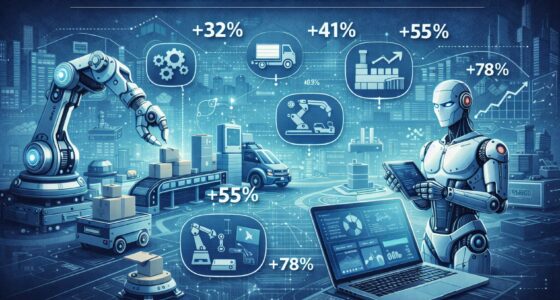

By 2030, automation and AI will reshape the global workforce, displacing millions of routine jobs while creating new roles in sectors like green energy, healthcare, and tech. You’ll need to adapt by reskilling and embracing continuous learning, as industries evolve rapidly. Organizational flexibility and cross-sector collaboration will be key to staying competitive. Understanding regional differences and emerging opportunities can help you future-proof your career — keep exploring to learn more about how this transformation unfolds.
Key Takeaways
- Up to 30% of jobs worldwide may disappear due to automation by 2030.
- New employment opportunities will emerge in sectors like renewable energy, healthcare, and AI.
- Significant workforce shifts require widespread reskilling and lifelong learning initiatives.
- Industry-education collaboration is essential to align skills with future automation-driven jobs.
- Remote work and organizational flexibility will become critical adaptations in a heavily automated economy.
reskilling online courses for future jobs
As an affiliate, we earn on qualifying purchases.
As an affiliate, we earn on qualifying purchases.
The Future of Jobs: Displacement and Creation

As automation and AI continue to evolve, they are transforming the job landscape in profound ways. You’ll see that up to 30% of jobs worldwide could disappear by 2030, mainly due to AI replacing routine tasks. However, this shift isn’t all loss; AI is also expected to generate between 78 million and 170 million new jobs, many in emerging fields. You’ll need to adapt as 60% of current U.S. jobs will undergo significant task changes because of automation. While some roles will vanish, new opportunities will arise, requiring you to stay flexible and open to reskilling. Overall, the workforce will experience a dynamic blend of displacement and growth, emphasizing the importance of continuous learning and adaptation. Incorporating home decor solutions like wall organization and adaptable workspaces can also support flexible working environments amidst these changes.

AUPSEN Desk Organizers and Accessories, 5-Tier Desktop Paper File Organizer with Removable File Holder, Desk Accessories & Workspace Organization for Home Office Supplies (Black)
【Boost Work Efficiency】AUPSEN desk organizer shelf with 5 sliding paper trays and a movable file rack is the…
As an affiliate, we earn on qualifying purchases.
As an affiliate, we earn on qualifying purchases.
Skills Shift: Preparing the Workforce for 2030

To stay ahead in the evolving job market, you need to prioritize reskilling and upskilling efforts. As demand shifts for new skills not covered in current education systems, adapting training programs becomes essential. Collaborating with industry and reforming education will be key to preparing workers for the jobs of 2030. Additionally, understanding the signs of a checked-out partner can help in fostering better workplace relationships and maintaining team cohesion during transitional periods.
Reskilling Imperatives Emerge
The rapid advancement of AI and automation is transforming the job landscape, making reskilling an urgent priority for workers and organizations alike. With 59% of workers needing upskilling by 2030, you must adapt quickly to stay relevant. Reskilling isn’t just about learning new skills—it’s about transforming your entire approach to work. Companies are investing heavily in training programs, recognizing the importance of a flexible, future-ready workforce. You’ll need to identify emerging skills and seek opportunities for continuous learning. This shift calls for proactive engagement in education and skills development to avoid job displacement and leverage new opportunities. Staying ahead now means embracing reskilling efforts as a core part of your career strategy.
- Rapidly evolving skill requirements demand constant learning
- Organizations are prioritizing reskilling initiatives
- Reskilling enabling new career pathways amidst automation
- Recognizing the importance of trustworthy information can help guide effective reskilling efforts.
New Skills Demand
Reskilling efforts set the stage for meeting the new skills demand that will define the workforce of 2030. As automation and AI reshape industries, you’ll need to develop skills that complement these technologies, such as critical thinking, creativity, and advanced digital literacy. Many jobs will require expertise in emerging fields like renewable energy, environmental engineering, and data analysis. Skills-based hiring is gaining momentum, emphasizing practical abilities over traditional degrees. You’ll also need to adapt quickly, learning new tools and processes to stay relevant. Collaboration between industries and education providers will be essential, ensuring you gain targeted, future-proof skills. Preparing now means embracing lifelong learning and remaining flexible, so you can thrive amid rapid technological change and shifting job requirements. Staying informed about industry trends will also help you anticipate future skill needs and adapt proactively.
Education System Adaptation
As AI and automation reshape industries, education systems must evolve quickly to meet the emerging skills demand of 2030. You’ll need to focus on developing adaptable curricula that emphasize critical thinking, digital literacy, and technical skills. Collaborations between industry and education are essential to ensure training aligns with future job requirements. Schools should prioritize lifelong learning programs, practical experience, and flexible pathways for reskilling and upskilling. Embracing online platforms and modular courses will help reach a broader audience. By proactively transforming education, you prepare workers to thrive amid rapid technological change. Incorporating projector technology into training programs can also enhance experiential learning and digital engagement.

BestMassage Electric Power Lift Chair Recliner Sofa for Elderly Massage Chair, Adjustable Furniture with Vibration Massage and Lumbar Heated,Remote Control,USB Ports for Living Room (Black, Leather)
Enhanced Comfort : Elevate relaxation for elderly individuals with this electric power lift chair recliner sofa. Designed to…
As an affiliate, we earn on qualifying purchases.
As an affiliate, we earn on qualifying purchases.
Demographic and Economic Influences on Employment Trends

You’ll see that demographic shifts, like the rise of Gen Z and Millennials, are fundamentally changing the workforce landscape. At the same time, economic pressures push companies to adapt quickly to societal changes and market uncertainties. Together, these forces shape employment trends and require strategic responses to build a resilient, inclusive workforce for 2030. Considering the cost and budgeting factors involved in workforce development can help organizations allocate resources effectively for these transitions.
Demographic Shifts Reshape Workforce
Demographic shifts are poised to particularly influence the future of work, as the workforce evolves alongside changing population dynamics. As Millennials and Gen Z become dominant, their values and skills reshape workplace culture, priorities, and expectations. Meanwhile, aging populations in many countries reduce the number of working-age individuals, affecting labor supply and productivity. These changes also influence workplace diversity, inclusion, and the demand for flexible work arrangements. Studies indicate noticeable improvements in pore size with consistent use. Glycolic acid benefits for skin help in controlling oil production, preventing acne formation. – The rise of younger generations bringing new skills and perspectives – Aging populations prompting increased automation and productivity strategies – Shifts in regional workforce availability impacting global talent distribution
Economic Pressures Drive Adaptation
Economic pressures are compelling organizations and governments to modify their approaches to employment in response to shifting workforce demographics. As populations age and new generations like Millennials and Gen Z enter the workforce, companies face rising labor costs and a need for new skills. Economic uncertainty, inflation, and global competition push businesses to prioritize efficiency and automation, reducing reliance on traditional roles. The green economy’s growth creates new opportunities, but also demands significant investment in reskilling workers. Regional disparities further influence adaptation strategies, with low-income economies lagging behind advanced ones in adopting AI. To stay resilient, organizations must balance cost pressures with innovation, emphasizing flexible work arrangements and workforce development. This dynamic environment accelerates the shift toward skills-based hiring and continuous learning. Additionally, the adoption of automation technology is transforming traditional job roles, making adaptability and ongoing training essential for future success.
AI for Non-Techies Beginners: A Fun and Practical Guide to Artificial Intelligence, Automation, and Machine Learning for Entrepreneurs, Professionals, and Creative Thinkers
As an affiliate, we earn on qualifying purchases.
As an affiliate, we earn on qualifying purchases.
Technological Breakthroughs Shaping the Job Landscape

Technological breakthroughs are revolutionizing the job landscape at an unprecedented pace, driven mainly by advances in artificial intelligence and automation. These innovations are transforming how work is done, creating both opportunities and challenges. AI-driven tools like generative AI accelerate automation of complex tasks, affecting professions requiring expertise and creativity. Automation is becoming more versatile, impacting sectors from manufacturing to healthcare, and embedding in 70% of new applications by 2030. Digital access is expanding rapidly, reshaping business models and workforce engagement. As these breakthroughs evolve, you’ll need to adapt quickly, embracing new skills and workflows. Additionally, understanding how to identify bad lemon juice can help individuals maintain well-being amidst rapid technological changes. – Generative AI enhances creative and analytical tasks across industries. – Broader digital access fuels remote work and global collaboration. – Rapid technological adoption demands ongoing reskilling to stay competitive.
The Evolving Workplace: Flexibility and Adaptability
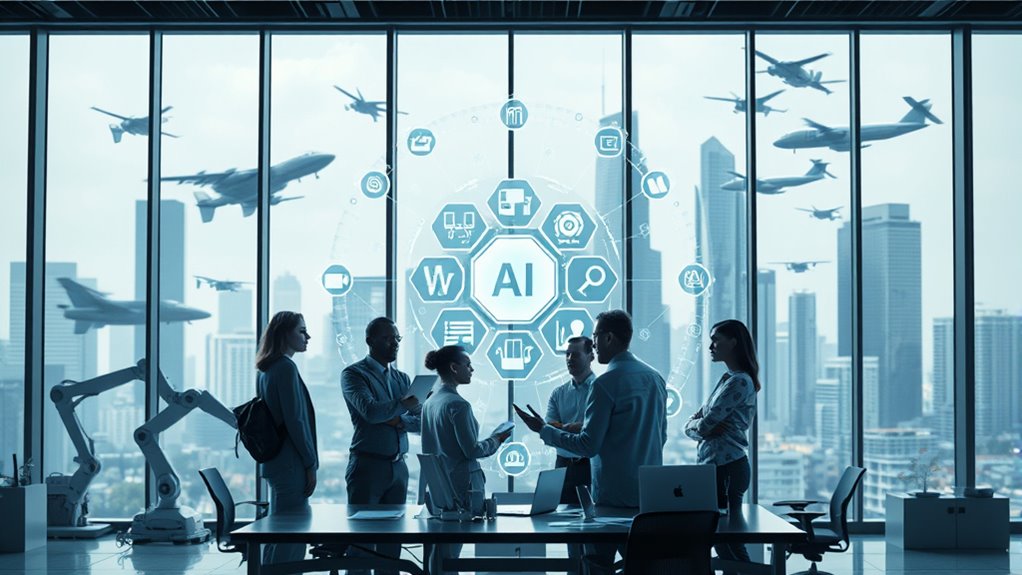
As AI and automation reshape the way work gets done, organizations must become more flexible and adaptable to stay competitive. You’ll need to embrace new work models, like remote and hybrid arrangements, to attract and retain talent. Flexibility allows your team to respond quickly to changing demands and technological shifts, ensuring continued productivity. To succeed, you’ll also need to foster a culture of continuous learning, encouraging employees to upskill and reskill regularly. This agility helps bridge the skills gap created by automation and keeps your workforce resilient. Additionally, your organization should implement adaptive processes that can evolve with technological advances. For example, understanding Honda Tuning options can inspire innovative approaches to employee engagement and operational improvements. By prioritizing flexibility and adaptability, you’ll position your business to thrive amid ongoing disruptions and to capitalize on emerging opportunities in a heavily automated economy.
Opportunities in Emerging Sectors and Roles

Emerging sectors and roles are opening up exciting opportunities for workers willing to adapt and develop new skills. As automation reshapes industries, you’ll find growing demand in fields like renewable energy, environmental engineering, and healthcare. These sectors offer roles that require specialized knowledge, providing pathways for career growth. You can leverage emerging technologies to enhance your capabilities and stay relevant in the job market.
- Opportunities in green energy and sustainability initiatives
- Growing need for healthcare professionals and tech-enabled care roles
- Demand for specialists in AI, cybersecurity, and data analysis
Closing the Skills Gap: Education and Industry Collaboration

Bridging the skills gap requires strong collaboration between educational institutions and industry leaders to guarantee workers acquire the relevant competencies for the future job market. You need to foster partnerships that align curricula with emerging industry needs, ensuring students learn skills like digital literacy, AI, and green technologies. Employers should actively participate in designing training programs, offering apprenticeships, internships, and real-world projects. This cooperation accelerates upskilling and reskilling efforts, helping workers transition into new roles created by automation. By sharing resources and expertise, both sectors can adapt quickly to technological changes. You’ll find that investment in practical, industry-relevant education builds a resilient, adaptable workforce ready to meet the demands of an increasingly automated economy, reducing unemployment risks and supporting economic growth.
Regional Disparities and Global Workforce Resilience

Regional disparities in AI adoption and workforce development pose significant challenges to building a resilient global economy. These gaps can deepen economic inequalities, leaving low-income regions behind in job creation and skills development. You might notice that advanced economies rapidly integrate AI, boosting productivity, while developing nations struggle with limited infrastructure and access. This imbalance hampers global growth and stability. To understand these issues better, consider:
Regional gaps in AI adoption threaten global economic stability and inclusive growth.
- The lag in AI infrastructure and digital access in low-income countries
- How limited educational resources hinder workforce upskilling
- The risk of increased economic inequality and social unrest
Addressing these disparities requires targeted investments, international cooperation, and inclusive policies. Without action, regional gaps will persist, threatening the resilience of the entire global workforce in the face of automation.
Strategies for Future-Proofing Careers in an Automated Economy

As automation and AI reshape the global workforce, staying ahead requires proactive strategies to safeguard your career. Focus on continuous learning to develop skills that are harder to automate, like creativity, problem-solving, and emotional intelligence. Embrace upskilling and reskilling opportunities, especially in emerging fields like renewable energy or digital technology, through online courses and industry certifications. Build a strong network to stay informed about industry shifts and new opportunities. Cultivate adaptability by staying open to role changes and new responsibilities. Develop digital literacy to work effectively alongside AI tools. Ultimately, consider skills-based hiring trends by demonstrating your unique abilities through portfolios or practical projects. Staying proactive ensures you remain relevant and resilient amid rapid technological change.
Frequently Asked Questions
How Will AI Affect Income Inequality Globally by 2030?
You’ll see AI widen income inequality globally by 2030 because it benefits those with advanced skills and access to technology while displacing lower-skilled workers. As automation replaces jobs like cashiers and administrative assistants, many may struggle to find new opportunities without reskilling. Meanwhile, high-income workers and tech-savvy individuals will likely profit more, deepening economic divides unless proactive measures like education reform and equitable policies are implemented.
What Ethical Considerations Arise From Increased AI Automation in Workplaces?
Think of AI automation as a double-edged sword slicing through workplace ethics. You must consider fairness, making sure AI doesn’t unfairly discriminate or widen inequality. Privacy is essential; protecting employee data from misuse is critical. Transparency matters—employees should understand AI’s role in decisions. You need accountability, so automated systems can be challenged if errors occur. Balancing innovation with these ethical principles ensures that technological progress benefits everyone, not just a few.
How Can Small Businesses Adapt to Rapid Technological Changes?
To adapt to rapid technological changes, you should stay informed about emerging trends and invest in upskilling your team. Embrace skills-based hiring and leverage industry partnerships for training. Prioritize digital access and flexibility in your workplace, and focus on integrating new tools gradually. By being proactive, fostering innovation, and staying adaptable, you’ll position your small business to thrive amid ongoing automation and tech advancements.
What Role Will Government Policy Play in Workforce Transition?
The government’s role is to be the guiding light during this shift, helping you navigate changes through policies that support reskilling and upskilling. They can create safety nets, fund education reforms, and encourage industry partnerships. By acting early, they guarantee the workforce doesn’t get left behind. With strong policies, you can turn challenges into opportunities, proving that with the right support, you’re prepared to weather any storm.
How Will Mental Health and Employee Well-Being Be Impacted by Automation?
Automation can impact your mental health and well-being in both positive and negative ways. You might experience increased stress due to job insecurity or adapting to new technologies. However, automation can also reduce repetitive tasks, giving you more time for meaningful work and personal growth. To thrive, focus on upskilling, seek support, and advocate for workplace policies that prioritize mental health, ensuring you stay resilient amidst change.
Conclusion
As you navigate the rapidly evolving job landscape of 2030, remember that the future of work isn’t just changing — it’s transforming at a mind-boggling pace, reshaping your career prospects in ways you can’t even imagine. By embracing continuous learning, adapting to new technologies, and staying resilient, you’ll not only survive but thrive in this hyper-automated economy. The key is to stay ahead of the curve, or risk being left behind in the dust of progress.