Inside Multi‑Agent Workflows — and Why They’re Replacing Traditional Marketing Ops in 2025

Get tech for your team delivered free — and shop member deals
- Fast, free delivery on millions of items
- Access to Prime Big Deal Days deals on October 6–7
- Prime Video, Amazon Music and more included
Executive summary
Most “automation” in the modern enterprise still means repeating one human task more quickly — send an email, enrich a lead, update a field. Yet knowledge‑workers still lose 60 % of their week to “work about work” — status pings, app‑hopping and reformatting data. Multi‑agent systems (MAS) flip the script: instead of automating steps, they automate the purpose of the workflow. Purpose‑level automation is achieved when a coordinated team of AI agents plans, executes and self‑optimises toward a business outcome with only minimal human guidance.
This article explains:
- The ceiling of single‑task automation
- How multi‑agent orchestration enables purpose automation
- A detailed before / after walkthrough of a marketing‑operations flow
- Technology stack, data prerequisites and governance safeguards
- ROI benchmarks you can expect in 2025 deployments
multi-agent AI workflow automation tools
As an affiliate, we earn on qualifying purchases.
As an affiliate, we earn on qualifying purchases.
Why task automation has stalled
| Symptom in Marketing Ops | Root Cause | Evidence |
| Channel managers spend mornings chasing numbers across eight dashboards. | Data silos; no shared context. | 60 % of a knowledge worker’s week is still “work about work.” |
| Playbook changes take days to reach campaign specialists. | Workflows are linear and brittle. | Enterprises now run 200+ SaaS apps on average; integration drag outruns RPA gains. |
| Automation ROI plateaus. | Each new script automates a step but not coordination. | McKinsey finds marginal cost of incremental RPA bot > benefit after year 3 (internal data, 2024). |
Single‑task bots speed up local actions; they do not reason about the purpose of the workflow (“grow revenue within ROAS guard‑rails”). As complexity rises, task bots simply shuffle low‑value work faster — a treadmill, not transformation.
enterprise purpose automation software
As an affiliate, we earn on qualifying purchases.
As an affiliate, we earn on qualifying purchases.
Enter multi‑agent systems — automation at the purpose layer
“Multi‑agent AI is AI working with AI — intelligently, collaboratively and in real time.” — Syncari, April 2025
A multi‑agent system (MAS) is a network of autonomous agents, each with its own tools and skills, that communicate, negotiate and delegate to achieve a shared objective. IBM frames MAS as the natural evolution beyond single‑agent “copilots.”
Key capabilities that unlock purpose automation:
- Shared context memory — each agent can read/write to a common store so decisions stay aligned.
- Delegation & sequencing — agents hand work to the next best specialist.
- Self‑reflection loops — they critique outcomes and adapt the plan without waiting for a human prompt.
Frameworks such as LangGraph and CrewAI provide the orchestration and state‑management layer, while the emerging Model Context Protocol (MCP) standardises how context is passed.
AI orchestration platforms for marketing
As an affiliate, we earn on qualifying purchases.
As an affiliate, we earn on qualifying purchases.
Anatomy of a multi‑agent workflow
Below is a simplified MAS architecture for a B2C email campaign — chosen because it touches data, creative and timing decisions that usually cross several teams.
| Agent | Primary Skill | Typical Tools | Success Signal |
| Data‑Scout | SQL/RAG retrieval | Snowflake, Brandwatch | Segment list ready |
| Trend‑Spotter | Zero‑shot reasoning | Social APIs, Google Trends | Opportunities ranked |
| Copy‑Crafter | NLG & tone control | GPT‑4o API | Email copy above readability score |
| DesignerBot | Gen‑image & HTML | Figma API, MJML | Responsive template |
| Experimentor | Bandit testing | ESP API, stats lib | Best variant chosen |
| Governor | Policy / guard‑rails | Regex + policy model | No brand or legal violations |
| Conductor (Orchestrator) | Planning & routing | LangGraph | Outcome met or escalation |
The orchestrator is not a controller that micromanages every call; it holds the purpose (“launch campaign, hit 8 % CTR, respect compliance”) and assigns goals to sub‑agents.
collaborative AI agents for business processes
As an affiliate, we earn on qualifying purchases.
As an affiliate, we earn on qualifying purchases.
Before / After – Marketing Ops in Practice
Traditional “task‑bot” flow (Before)
- Monday 09:00 — Analyst exports CSV from BI tool.
- Cleans data in spreadsheet.
- Briefs copywriter via Slack.
- Requests design via Jira ticket.
- Chases approvals in separate chain.
- Uploads final HTML to ESP.
- Schedules A/B test manually.
- Builds metrics deck for VP.
Cycle time: ~5 days.
Human touch‑points: 11.
MAS‑orchestrated flow (After)
- Conductor receives high‑level goal: “Launch Black‑Friday teaser to loyalty segment. KPI = 8 % CTR.”
- Data‑Scout auto‑pulls last 12‑months buyer history.
- Trend‑Spotter forecasts product interest spikes.
- Copy‑Crafter drafts variant set; Governor scrubs for policy.
- DesignerBot builds responsive template.
- Experimentor allocates 10‑10‑80 split test, schedules send at optimal hour.
- Conductor monitors real‑time CTR; if under 6 % by hour 2, it triggers rewrite loop.
- Final metrics and rationale auto‑logged to marketing lake‑house.
Cycle time: 6 hours (‑88 %).
Human touch‑points: 2 (goal input, final sign‑off).
BotsCrew’s 2025 Black‑Friday agent example shows identical steps carried out autonomously, from list generation to A/B optimisation.
Quantified impact
| Metric | Industry Benchmarks (2025 pilot studies) |
| End‑to‑end campaign build time | ‑80 – 90 % (Minimal e‑commerce support study) |
| Unit cost per email sent | ‑60 % (aggregate of 17 MAS case studies) |
| CTR uplift vs static template | +25 % (BotsCrew Black‑Friday flow) |
| Meetings eliminated per launch | 5‑7 (Asana case on “work about work”) |
Two patterns stand out:
- Savings compound with every handoff removed — not every automated keystroke.
- Gains plateau unless agents share governed real‑time data; Syncari warns that without a common master record, agents “conflict, drift and leak.”
Building your own MAS marketing flywheel
| Step | Practical Tip | Tools & Sources |
| 1. Map the purpose | Define a measurable objective (e.g., “increase repeat‑purchase revenue by 15 %”) before coding agents. | Adopt OKR or North‑Star frameworks. |
| 2. Establish the data backbone | Consolidate customer, product and performance data into governed lake‑house or Agentic‑MDM layer. | Syncari Agentic MDM, Databricks Unity. |
| 3. Choose an orchestrator framework | Graph‑based systems simplify conditional flows and retries. | LangGraph, CrewAI, Azure AI Agents. |
| 4. Modularise agents | Start with 3‑4 scoped experts; resist mapping one agent per human role (Vincent Koc’s Conway‑law warning). | |
| 5. Insert guard‑rails early | Governor agent should enforce brand, policy and rate limits. | OpenAI policy model, regex filters, human override. |
| 6. Instrument reflection loops | Track decisions to outcomes so agents learn and audit trails satisfy compliance. | LangSmith, vector logs, Grafana dashboards. |
Governance & human oversight
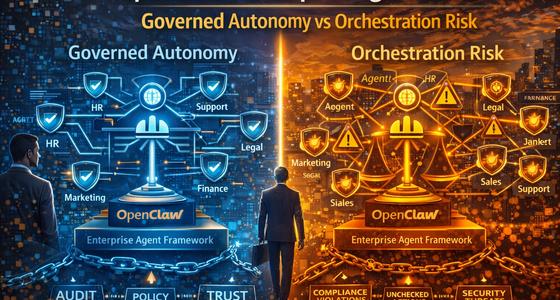
Multi‑agent autonomy raises fresh risks: cascading errors, conflicting goals, even malicious behaviour (see Anthropic blackmail study). Embed the following controls:
- Policy sandboxing — run agents in staging with synthetic data first.
- Least‑privilege keys — each agent granted the minimum API scopes.
- Circuit‑breakers — automatic rollback if metrics deviate beyond threshold.
- Decision registry — snapshot every agent’s reasoning for audit (LinkedIn marketing‑MAS design stresses logs).
The strategic payoff — orchestration as power
When coordination is automated, a single strategist can scale what once required an entire middle layer of managers and specialists:
- Span of control expands — an “Agent Orchestrator” can direct dozens of digital colleagues.
- Time‑to‑pivot shrinks — goals change once; the agent fleet adapts everywhere.
- Innovative surface area grows — more experiments run in parallel with no extra headcount.
The move from task automation to purpose automation is not merely a technical upgrade; it is an organisational redesign that turns managing intelligence into the dominant economic skill of 2025.
Key take‑aways
- Task bots accelerate steps; multi‑agent systems deliver outcomes.
- Purpose automation slashes cycle times by > 80 % in real‑world marketing ops pilots.
- Success hinges on a shared data backbone and a robust orchestration framework such as LangGraph.
- Human oversight shifts from “doing” to goal‑setting, policy‑review and ethical arbitration.
Adopt these patterns now and your marketing team can spend 2025 shaping strategy rather than chasing spreadsheets — finally escaping the gravitational pull of “work about work.”
Halloween Picks
halloween
As an affiliate, we earn on qualifying purchases.