By Thorsten Meyer | ThorstenMeyerAI.com | February 2026
Executive Summary
180,000 developers adopted OpenClaw in weeks. An audit of 2,890+ skills found 41.7% contain serious security vulnerabilities. That juxtaposition is the entire story of agent infrastructure in 2026: adoption velocity that outpaces governance maturity by an order of magnitude.

OpenClaw — the open-source AI agent framework that went viral in late January 2026 — illustrates a category shift that every enterprise leader needs to understand. Agent frameworks are no longer prompt interfaces. They’re action systems: browser automation, messaging integration, external tool invocation, scheduled and event-driven execution. When a framework can send emails, execute transactions, and operate browsers on behalf of users, the risk profile isn’t “model hallucination.” It’s unauthorized action at machine speed.
The market context: the AI agent market reached $7.84 billion in 2025 and is projected to hit $52.62 billion by 2030 (CAGR 46.3%). Gartner projects 40% of enterprise applications will feature task-specific agents by end of 2026, up from under 5% in 2025. 57% of companies already have agents in production. The OECD estimates 27% of employment across member countries is at high automation risk — meaning execution-capable agent platforms will interact with a meaningful share of operational tasks over time.
The strategic question for C-level leaders is no longer “Is open-source agent infrastructure powerful?” It’s: “Can we govern it with enterprise-grade identity, policy, and incident response?” The evidence says: not yet — and the window for building governance before incidents force it is closing fast.
| Metric | Value |
|---|---|
| OpenClaw developer adoption | 180,000+ |
| Skills audited (ClawSecure) | 2,890+ |
| Skills with security vulnerabilities | 41.7% |
| Skills with high/critical severity | 30.6% (883 skills) |
| Critical severity findings | 1,587 |
| High severity findings | 1,205 |
| Skills with malware indicators (ClawHavoc) | 18.7% |
| AI agent market (2025) | $7.84 billion |
| AI agent market (2030 projected) | $52.62 billion |
| CAGR (agent market) | 46.3% |
| Enterprise apps with agents (2026, Gartner) | 40% (from <5%) |
| Companies with agents in production | 57% |
| Enterprises using agents in workflows | 85% |
| OECD jobs at high automation risk | 27% |
| Enterprises lacking mature agent infrastructure | 80%+ |
| OWASP Agentic Top 10 contributors | 100+ experts |
| MCP servers with command injection flaws | 43% |

Architectures for the Intelligent AI-Ready Enterprise: Building real-world solutions with MongoDB
As an affiliate, we earn on qualifying purchases.
As an affiliate, we earn on qualifying purchases.
1. Why OpenClaw Is Strategically Important
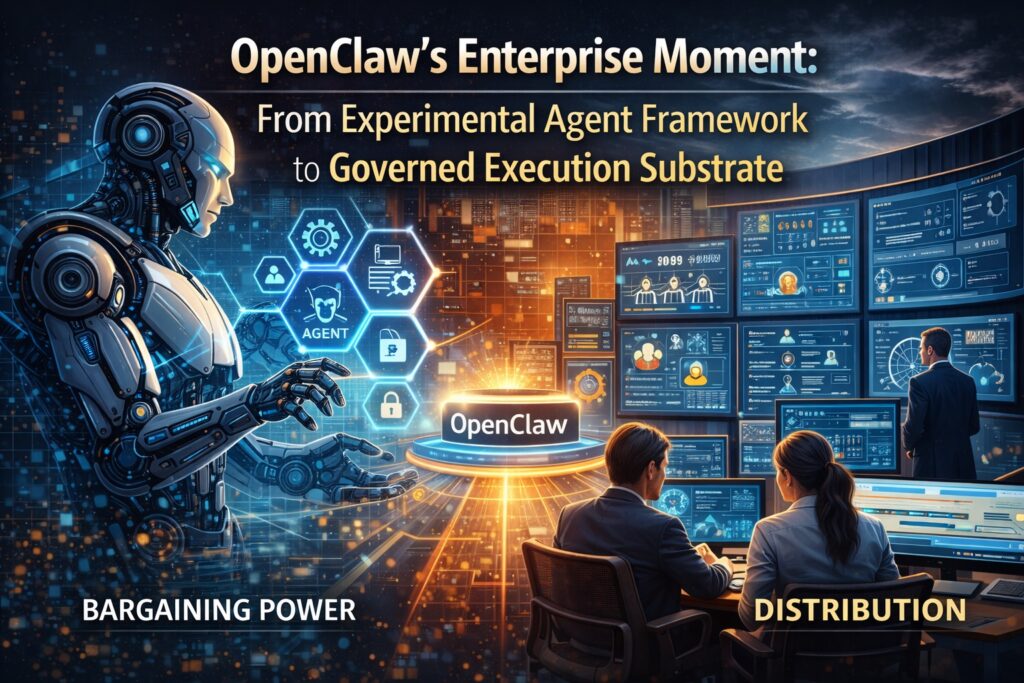
OpenClaw didn’t emerge in a vacuum. Originally launched as Clawdbot by Austrian developer Peter Steinberger in November 2025, rebranded twice under trademark pressure, the framework achieved viral adoption because it solved a real problem: giving users a self-hosted, open-source AI agent that could actually do things — not just generate text.
From Prompt Interfaces to Action Systems
The category shift matters:
| Capability | What It Means | Risk Shift |
|---|---|---|
| Browser automation | Agent navigates, fills forms, clicks | Unauthorized transactions |
| Messaging integration | Agent sends/reads emails, Slack, etc. | Data exfiltration, impersonation |
| External tool invocation | Agent calls APIs, databases, services | Credential leakage, privilege escalation |
| Scheduled execution | Agent runs tasks without human trigger | Policy drift, unmonitored actions |
| Event-driven execution | Agent responds to triggers autonomously | Cascading failures, kill-switch gaps |
This shifts the threat model from model quality (hallucination, bias) to action governance (authorization, auditability, containment). A hallucinating chatbot gives you a wrong answer. A hallucinating agent with browser access gives you an unauthorized wire transfer.
The Adoption Numbers
The adoption velocity is striking — and the governance gap it reveals is the strategic issue:
| Adoption Indicator | Value |
|---|---|
| OpenClaw developers | 180,000+ |
| Companies with agents in production | 57% |
| Companies in pilot | 22% |
| Companies in pre-pilot | 21% |
| Enterprise apps with agents (2026) | 40% (Gartner) |
| Fortune 500 piloting agentic systems | 45% |
| Enterprises experimenting with AI agents | 62% |
| Autonomous agent deployment by 2027 | 50% (from 25% in 2025) |
| Senior execs increasing AI budgets | 88% |
| LangGraph monthly downloads | 34.5 million |
| LangGraph enterprise deployments | 400+ (Cisco, Uber, JPMorgan) |
85% of organizations have adopted agents in at least one workflow. But more than 80% lack the mature infrastructure to safely scale agentic systems across operations. That’s not a paradox — it’s the normal sequence in infrastructure adoption. Cloud computing, containers, and SaaS all followed the same arc: first experimentation, then incidents, then controls standardization. The question is how expensive the “incidents” phase gets.
“85% of enterprises have adopted agents. 80% lack the infrastructure to govern them. That’s not a paradox — it’s a countdown.”
Security Tool for Development Board – 64 Scripts for System Vulnerabilities & Attack Testing for Users
Multi-Functional Support — The Security Tool for Development Board features 64 diverse scripts designed to cater to various…
As an affiliate, we earn on qualifying purchases.
As an affiliate, we earn on qualifying purchases.
2. The Security Evidence: OpenClaw as Case Study
The ClawSecure audit of the OpenClaw ecosystem is the most comprehensive public security analysis of an agent framework to date — and its findings should change how every enterprise thinks about agent supply chains.
The Audit Numbers
| Finding | Value |
|---|---|
| Skills audited | 2,890+ |
| Skills with vulnerabilities | 41.7% |
| High/critical severity skills | 30.6% (883) |
| Critical findings | 1,587 |
| High findings | 1,205 |
| Vulnerability types | Command injection, data exfiltration, credential harvesting, prompt injection |
| Skills with ClawHavoc malware indicators | 18.7% |
41.7% of widely used skills contain substantive vulnerabilities. 30.6% have at least one high or critical severity finding. 18.7% exhibit indicators associated with the ClawHavoc malware campaign — including memory harvesting and command-and-control callbacks.
These aren’t theoretical risks. They’re findings from auditing the actual skills that developers are installing and running.
The Broader Agent Security Landscape
OpenClaw’s vulnerabilities aren’t unique to OpenClaw. They reflect systemic risks across the agent ecosystem:
| Incident / Finding | Impact |
|---|---|
| MCP servers: command injection (March 2025) | 43% of tested implementations vulnerable |
| MCP servers: unrestricted URL fetching | 30% of implementations |
| CVE-2025-6514 (mcp-remote) | Critical RCE; 437,000 downloads; affected Cloudflare, Hugging Face, Auth0 |
| Drift/Salesforce OAuth breach (August 2025) | Stolen tokens; 700+ organizations compromised |
| ChatGPT credentials on dark web (2025) | 300,000+ credential sets |
| EchoLeak (Microsoft 365 Copilot) | Zero-click prompt injection; business data exfiltration |
| Supabase Cursor agent (mid-2025) | Prompt injection via support tickets; SQL exfiltration of tokens |
The pattern: agent frameworks inherit the classic software vulnerability surface (injection, broken access control, credential exposure) plus agent-specific vectors (prompt injection, tool poisoning, context corruption, delegated trust abuse).
“An agent framework doesn’t just introduce AI risk. It reintroduces every software supply chain risk you thought you’d solved — at a layer where the execution surface is broader and the blast radius is larger.”

HSI Investigations Federal Officer Law Enforcement Special Agent #C25006B Government Honor Challenge Bar Award
Beautiful Artwork
As an affiliate, we earn on qualifying purchases.
As an affiliate, we earn on qualifying purchases.
3. The OWASP Agentic Top 10: A Governance Vocabulary
The OWASP Top 10 for Agentic Applications, released for 2026 with input from 100+ industry experts, provides the first peer-reviewed taxonomy of agent-specific security risks. Three of the top four risks revolve around identities, tools, and delegated trust boundaries.
Why This Matters for Enterprise Leaders
The OWASP framework gives security teams a shared vocabulary — the same function that the original OWASP Top 10 served for web applications two decades ago. Without it, agent security conversations devolve into vendor-specific threat narratives. With it, organizations can standardize risk assessment, procurement requirements, and incident classification.
| Governance Requirement | What It Addresses | Why Agents Make It Harder |
|---|---|---|
| Identity verification | Who authorized this action? | Agents act on delegated authority; trust chains are implicit |
| Permission boundaries | What can this agent do? | Tool registries expand dynamically; permissions drift |
| Audit trails | What did the agent actually do? | Multi-step workflows span tools, APIs, browsers |
| Containment | How do we stop a compromised agent? | Event-driven execution continues without human presence |
| Supply chain integrity | Are the skills/tools trustworthy? | Community-contributed skills lack systematic review |
The EU AI Act’s Article 14 requires demonstrable human oversight for high-risk AI systems. When an agent framework executes actions across browsers, APIs, and messaging systems — with skills contributed by an open community where 41.7% contain vulnerabilities — “demonstrable oversight” requires architecture, not aspiration.
eufy Security 5-Piece Home Alarm Kit, Home Security System, Keypad, Motion Sensor, 2 Entry Sensors, Home Alarm System, Control from The App, Links with eufyCam, Optional 24/7 Protection
Easy Setup: Install in minutes all by yourself. The entry sensors attach to doors and windows, while the…
As an affiliate, we earn on qualifying purchases.
As an affiliate, we earn on qualifying purchases.
4. A Governance Model for OpenClaw-Class Platforms
Enterprise adoption of agent frameworks requires four governance layers. None of them are optional — and none of them ship with the framework.
Layer 1: Identity-First Architecture
| Control | Implementation | Why It Matters |
|---|---|---|
| SSO/OIDC integration | Agents authenticate through enterprise identity | Eliminates shadow credentials |
| Service account boundaries | Each agent workflow has a distinct identity | Limits blast radius |
| Short-lived credentials | Tokens expire and rotate automatically | Prevents persistent access from compromised agents |
| Delegation chains | Every agent action traces to a human authorizer | Supports EU AI Act Article 14 compliance |
The Drift/Salesforce breach — where stolen OAuth tokens compromised 700+ organizations — demonstrates what happens when agent integrations share long-lived credentials without rotation.
Layer 2: Policy-First Execution
| Control | Implementation | Why It Matters |
|---|---|---|
| Deny-by-default permissions | No tool access unless explicitly granted | Prevents privilege creep |
| Environment segmentation | Dev/test/prod boundaries for agent workflows | Contains experimental failures |
| Domain allowlists | Explicit lists for external API and URL access | Blocks exfiltration paths |
| Runtime policy gates | Checks before every tool invocation | Catches policy drift in real time |
51% of enterprises already use two or more methods to control agent tools (APIs, dashboards, human reviews). The gap is standardization: each method covers a different slice of the attack surface, and most organizations haven’t integrated them into a coherent policy layer.
Layer 3: Evidence-First Operations
| Control | Implementation | Why It Matters |
|---|---|---|
| Immutable action logs | Every agent action recorded, tamper-resistant | Forensic capability |
| Full prompt/tool traces | Complete audit trail of decision chain | Explainability; regulatory compliance |
| Incident taxonomy | Classified against OWASP Agentic Top 10 | Standardized response |
| Cross-tool observability | Agent actions correlated across systems | Detects multi-step attack patterns |
The emerging “agent SIEM” pattern — cross-tool observability for agent actions — will be as important for agent governance as traditional SIEM was for network security. Without it, a compromised agent’s actions are invisible until the damage surfaces.
Layer 4: Human Accountability
| Control | Implementation | Why It Matters |
|---|---|---|
| Named process owners | Every autonomous workflow has a human accountable | Prevents orphaned agents |
| Incident response runbooks | Pre-built playbooks for agent-specific incidents | Reduces response time |
| Kill-switch procedures | Immediate halt capability for agent workflows | Containment when things go wrong |
| Escalation thresholds | Defined triggers for human intervention | Keeps human oversight meaningful |
“Agent frameworks ship with capabilities. They don’t ship with governance. That’s not a bug — it’s the design choice that makes enterprise adoption an architecture problem, not a procurement decision.”
5. Where Enterprise Adoption Will Land
Agent adoption won’t be uniform. It will follow a risk-stratified pattern determined by the governance maturity of each domain.
Near-Term Success (2026-2027)
| Domain | Why It Works | Governance Requirement |
|---|---|---|
| IT operations / internal support | Bounded scope; reversible actions | Standard monitoring + audit |
| Knowledge workflows | Low transactional risk; human review | Permission controls + logging |
| Customer operations | Supervised autonomy; clear escalation | Runtime policy + kill-switch |
| Developer tooling | Technical users; sandbox environments | Environment segmentation |
Slower Adoption
| Domain | Why It’s Slower | Governance Gap |
|---|---|---|
| High-liability decisions | Legal exposure; audit requirements | Immutable evidence trails not standard |
| Cross-border operations | Regulatory fragmentation | No harmonized agent compliance framework |
| Safety-critical workflows | Deterministic control requirements | Probabilistic systems can’t guarantee |
| Financial transactions | Irreversible; high-value | Real-time containment immature |
The Economic Calculus
The right metric isn’t “cost to run an agent.” It’s total cost of reliable autonomous execution:
| Cost Component | Visible? | Magnitude |
|---|---|---|
| Compute and API costs | Yes | Moderate and declining |
| Governance infrastructure | Partially | Significant upfront |
| Incident remediation | No (until it happens) | Potentially catastrophic |
| Compliance retrofits | No (until required) | Escalating with regulation |
| Legal exposure | No (until litigation) | Unbounded in high-stakes domains |
Open-source agent frameworks reduce experimentation cost and speed diffusion. But unmanaged diffusion increases hidden risk costs. The organizations that capture value from agents will be those that invest in governance infrastructure before the incidents force it — not after.
6. Practical Implications and Actions
For Enterprise Leaders
1. Treat agent frameworks like production middleware, not innovation sandbox tooling. OpenClaw-class platforms execute real actions across real systems. The governance standard is infrastructure, not experimentation.
2. Require pre-deployment threat modeling for every agent workflow touching external systems. The OWASP Agentic Top 10 provides the taxonomy. Use it before deployment, not after incidents.
3. Implement runtime policy gates before tool invocation. Deny-by-default. Every tool call requires explicit authorization. Every external domain requires an allowlist entry.
4. Separate developer convenience credentials from production credentials. The 300,000+ ChatGPT credentials on the dark web and the 700+ organizations compromised through stolen OAuth tokens demonstrate what happens when credential hygiene fails at the agent layer.
5. Create quarterly independent assurance reviews of autonomous workflows. Not self-assessment. Independent review against the OWASP framework, with named findings and remediation timelines.
For Security Leaders
6. Audit your agent supply chain. If 41.7% of OpenClaw skills contain vulnerabilities, assume your agent ecosystem has similar exposure. Inventory every skill, integration, and tool chain.
7. Build agent-specific incident response runbooks. Traditional IR playbooks don’t cover agent-specific attack vectors: prompt injection, tool poisoning, delegated trust abuse, context corruption.
8. Deploy cross-tool observability for agent actions. The “agent SIEM” pattern: correlate agent actions across APIs, browsers, messaging systems. Without it, multi-step attacks are invisible.
For Public-Sector Leaders
9. Require agent governance frameworks in procurement. The OWASP Agentic Top 10, EU AI Act Article 14, and emerging standards provide the baseline. Vendors who can’t demonstrate governance shouldn’t win contracts.
10. Map agent deployment against the 27% high-automation-risk occupation profile. OECD data identifies which roles are most exposed. Agent deployment in those domains requires proportionate governance — not blanket automation.
What to Watch Next
- Standardization of agent-security benchmarks and third-party attestations
- Emergence of “agent SIEM” patterns for cross-tool observability
- Consolidation between open frameworks and enterprise governance vendors
- Whether the OWASP Agentic Top 10 becomes the procurement baseline
- Whether the 41.7% vulnerability rate in OpenClaw skills drives community standards or erodes trust
The Bottom Line
OpenClaw’s trajectory — from experimental framework to 180,000-developer ecosystem to 41.7%-vulnerable skill registry — is the compressed lifecycle of every infrastructure category that moved faster than its governance. Cloud did it. Containers did it. SaaS did it. Agents are doing it now, with a twist: the execution surface is broader, the action scope is more consequential, and the supply chain risks are more deeply embedded.
The AI agent market will reach $52.62 billion by 2030. 40% of enterprise apps will have embedded agents by end of 2026. The organizations that capture that value won’t be the ones that deployed agents fastest. They’ll be the ones that governed them before the first incident made governance mandatory.
Agent frameworks ship with capabilities, not governance. The enterprises that build governance before they need it will capture the market. The ones that don’t will fund the incident response industry.
The most dangerous agent isn’t the one that hallucinates. It’s the one that executes confidently, with production credentials, on a workflow nobody owns.
Thorsten Meyer is an AI strategy advisor who believes the most important feature of any agent framework is the one you almost never see used: the kill switch. More at ThorstenMeyerAI.com.
Sources:
- ClawSecure — OpenClaw Skills Audit: 2,890+ Skills, 41.7% Vulnerable (February 2026)
- VentureBeat — OpenClaw: 180,000 Developers and the CISO’s Problem (February 2026)
- Cisco — Personal AI Agents Like OpenClaw Are a Security Nightmare (2026)
- Kaspersky — OpenClaw Vulnerabilities Exposed; ClawHavoc Malware Campaign (2026)
- Trend Micro — What OpenClaw Reveals About Agentic Assistants (February 2026)
- Sophos — OpenClaw: A Warning Shot for Enterprise AI Security (2026)
- MarketsandMarkets — AI Agents Market: $7.84B (2025) to $52.62B (2030)
- Gartner — 40% Enterprise Apps with Agents by End 2026
- G2 — Enterprise AI Agents Report: Industry Outlook 2026
- Lyzr — State of AI Agents in Enterprise: Q1 2026
- OWASP — Top 10 for Agentic Applications 2026 (100+ Expert Contributors)
- OWASP — State of Agentic AI Security and Governance 1.0
- Palo Alto Networks — OWASP Agentic Top 10: Why It Matters
- Unit 42 — Agentic AI Threats (Palo Alto Networks, 2026)
- eSecurity Planet — AI Agent Attacks Q4 2025: Risks for 2026
- Lakera — Year of the Agent: Q4 2025 Attacks (2026)
- Practical DevSecOps — MCP Security Vulnerabilities: Prompt Injection, Tool Poisoning (2026)
- AuthZed — Timeline of MCP Security Breaches (2025-2026)
- Red Hat — Model Context Protocol: Security Risks and Controls
- Reco.ai — AI and Cloud Security Breaches: 2025 Year in Review
- IBM X-Force — 2026 Threat Intelligence Index
- OECD — Employment Outlook: 27% Jobs at High Automation Risk
- OECD — Who Will Be Most Affected by AI? (October 2024)
- Okta — Agentic AI Frameworks: Identity, Security, Governance
- EU AI Act — Article 14: Human Oversight Requirements