
As AI transforms the workforce, traditional measures of employment miss crucial unpaid roles like caregiving and volunteering, which substantially contribute to society. These roles aren’t reflected in official stats but are essential, especially as automation replaces many paid jobs. To better understand and address workforce changes, it’s time to broaden our definition of “work” and include these informal contributions. Exploring this shift can reveal important insights into the evolving landscape of employment and social support.
Key Takeaways
- Traditional metrics overlook unpaid roles like caregiving and volunteering, underestimating actual economic contribution.
- AI automation blurs job boundaries, making unpaid and informal work increasingly vital for societal stability.
- Recognizing unpaid roles could lead to more inclusive social policies and safety nets that reflect true work contributions.
- Rethinking “work” to include unpaid roles addresses workforce displacement and promotes equitable recognition amid AI-driven change.
- Broader definitions of work better capture the evolving nature of labor in the AI era, fostering resilience and social cohesion.

The Caregiver's Notebook: An Organizational Tool and Support to Help You Care for Others
As an affiliate, we earn on qualifying purchases.
As an affiliate, we earn on qualifying purchases.
The Disproportionate Impact of AI on Young and Early-Career Workers

Although AI technology is transforming the job market broadly, early-career workers—particularly those aged 22 to 25—are bearing the brunt of its impact. You may notice that employment in AI-exposed fields like software development and customer service has declined by about 6% for this age group since late 2022, while older workers see growth. Younger workers in tech roles face nearly a 3% rise in unemployment since early 2025, higher than their peers in other fields. Jobs requiring high AI interaction, such as coding or customer support, are shrinking for you and your peers. Meanwhile, employment outside AI-heavy sectors remains stable. This uneven shift highlights how early-career workers are particularly vulnerable to automation and technological disruptions, impacting your job stability and future prospects. Additionally, the importance of job market adaptability is increasingly emphasized as workers navigate these rapid changes.

Peace of Mind Planner, Spiral End of Life Planner with Tabs for Senior, Guided Estate Planning Organizer for Final Arrangements & Important Affairs, 7.9"x10.4", Flower
ORGANIZE ALL YOUR IMPORTANT INFORMATION: This estate planning organizer with tabs covers 16 different components that encompass all…
As an affiliate, we earn on qualifying purchases.
As an affiliate, we earn on qualifying purchases.
Occupational Shifts and Automation Risks in the AI Age

You should consider how AI is transforming certain jobs with high automation risks, especially in tech and customer service roles. While some occupations face significant displacement, others requiring physical skills or complex social interactions tend to be more stable. The long-term impact remains uncertain, as expanding AI applications could broaden automation’s reach across more sectors.
High-Exposure Job Risks
Occupational shifts in the AI age reveal that jobs with high exposure to automation face significant risks of displacement. You’ll notice that roles in computer and mathematical fields, like software development and data analysis, experience the steepest unemployment increases, often correlating with high AI adoption. Customer service jobs, which rely on repetitive tasks, are also vulnerable. Conversely, jobs requiring physical skills or complex interpersonal interactions tend to be more stable. While AI automates many tasks, it also creates new opportunities, especially in AI development and engineering. However, early-career workers in tech and customer service face disproportionate challenges, with unemployment rising faster among younger cohorts. This uneven impact underscores how AI-driven automation reshapes occupational stability and emphasizes the need to adapt workforce strategies.
Uncertain Long-term Impact
The long-term impact of AI on employment remains uncertain because automation’s future scope depends on various dynamic factors. Your job security may hinge on how tasks evolve, error costs, and interconnected workflows. While AI risks are currently concentrated in roles like tech and customer service, expanding applications could affect more jobs over time. Additionally, the development of comfort and support solutions in workplaces could shift the focus toward employee well-being and job satisfaction.

Nextnoid Hardcover Fitness Journal Workout Planner for Men & Women – A5(5.7" x 8.3") Sturdy Workout Log Book to Track Gym & Home Workouts
SMASH YOUR PB'S – Achieve the performance and physique you've always wanted with Nextnoid daily workout journal! Effectively…
As an affiliate, we earn on qualifying purchases.
As an affiliate, we earn on qualifying purchases.
The Disconnect Between Overall Employment Growth and Sector-Specific Displacements

While overall employment numbers continue to grow robustly, this broad trend masks significant sector-specific displacements driven by AI. You’ll notice that industries like tech and customer service experience sharp declines in early-career roles, especially among younger workers. Meanwhile, sectors such as manufacturing and retail remain relatively stable or decline slowly due to automation. Despite these shifts, total employment figures don’t reflect a broad downturn; instead, they hide uneven impacts. Job growth in high-AI-exposure fields often offsets losses elsewhere, creating a disconnect. This divergence shows that while the economy appears healthy overall, certain groups—particularly young and entry-level workers—face disproportionate challenges. It underscores the importance of examining sector-specific trends to understand the true labor market dynamics in the AI era.

Safety Net: Welfare and Social Security, 1929-1979
Used Book in Good Condition
As an affiliate, we earn on qualifying purchases.
As an affiliate, we earn on qualifying purchases.
The Dual Nature of AI-Driven Job Changes: Losses and New Opportunities

You can see that AI is causing both job losses and new opportunities at the same time. While roles like software development and customer service face displacement, demand for AI engineers and data scientists is soaring. Recognizing this dual nature helps you understand how the labor market is transforming in complex ways. A growing number of job roles are emerging to support AI technology, reflecting the evolving needs of the workforce.
Job Losses and Displacement
AI-driven technological advances are reshaping the labor market, leading to significant job losses in certain sectors while simultaneously creating new opportunities. You might notice that roles in computer science, customer service, and manufacturing are shrinking due to automation. Early-career workers, especially those aged 22–25, face disproportionate displacement, with employment declines of 6% between late-2022 and mid-2025. At the same time, AI is generating new roles, such as AI engineers and data scientists, which saw rapid growth in employment. While overall employment remains strong, these sector-specific shifts create anxiety and uncertainty. Displacement is concentrated in jobs with high automation risk, but growth in AI-related roles indicates a dynamic labor landscape. The challenge lies in managing the imbalance between job losses and the emergence of new opportunities. Gold IRA markets highlight the importance of diversified investment options during times of economic transition.
Emerging AI Opportunities
Although automation has caused job disruptions, it also opens new opportunities across various industries. You can leverage AI to enhance productivity, create innovative products, and develop entirely new markets. Demand for AI specialists, data analysts, and machine learning engineers surged, reflecting job growth in tech and related fields. Many roles, like AI trainers or ethical AI consultants, have emerged, offering fresh career paths. Businesses are adopting AI to improve customer experience, optimize supply chains, and automate routine tasks, freeing workers for more strategic, creative work. While some jobs decline, others evolve or expand, requiring new skills. This dual nature means you should view AI as both a challenge and a catalyst for growth, encouraging continuous learning and adaptation to stay relevant in an evolving job landscape. Additionally, automation’s role in business intelligence accelerates data analysis and decision-making, further transforming the employment landscape.
How Public Perception Shapes Labor Market Policies and Responses
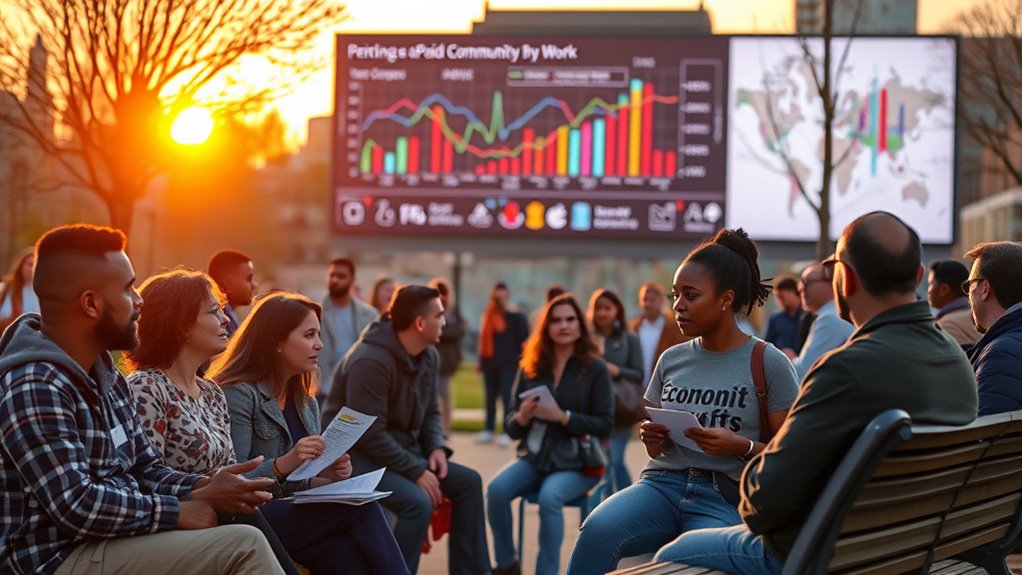
Public perception plays a crucial role in shaping labor market policies and responses to technological change. When the public fears widespread AI job losses, policymakers often prioritize protective measures, like delay regulations or support programs, even if data shows limited immediate displacement. Conversely, optimistic views about AI’s potential create pressure to foster innovation and workforce retraining. This dynamic influences funding, legislation, and public debate. Additionally, understanding the importance of transparency in affiliate marketing disclosures can help policymakers and stakeholders build trust and ensure informed decision-making in labor policy discussions.
Challenges in Measuring True Economic Participation and Work

Measuring true economic participation and work has become increasingly complex as traditional metrics struggle to capture the full scope of modern labor arrangements. Many roles now blend paid and unpaid efforts, making it harder to gauge actual contribution. You might imagine:
- Counting caregiving, community volunteering, or informal gig work often ignored by employment surveys.
- Recognizing unpaid roles that sustain economies but aren’t reflected in official statistics.
- Differentiating between AI-augmented tasks and purely human work, blurring traditional job boundaries.
- Tracking gig, freelance, and platform-based work that’s flexible but often unreported or undervalued.
- Understanding production quantity variance and how it relates to the efficiency and valuation of various work activities, especially in emerging digital economies.
These challenges mean current measures may underestimate the real extent of work people perform, especially as AI and digital platforms reshape how, where, and what work looks like today.
The Limitations of Traditional Metrics in a Changing Work Environment

Traditional employment metrics often fall short in capturing the full scope of modern work, especially as AI reshapes how people contribute to the economy. These metrics focus mainly on paid, formal jobs, ignoring unpaid roles like caregiving or community work that considerably impact society. They also overlook gig work, freelance projects, and informal labor, which are increasingly common. As AI automates tasks traditionally performed by workers, job definitions blur, making it harder to measure employment accurately. You might find that employment rates don’t reflect actual economic participation, especially for those engaged in hybrid or unpaid roles. Relying solely on traditional metrics risks underestimating work contributions and misguiding policy responses in this rapidly evolving landscape. Moreover, adapting mailing list strategies can be essential for policymakers and organizations to effectively communicate and gather insights about these shifting employment patterns.

As AI continues to reshape the labor market, policymakers must reconsider how they support work that falls outside conventional employment metrics. You should recognize that unpaid and informal roles—like caregiving, community service, or volunteering—are essential to society but often go uncounted. To address this, imagine:
- Expanding social safety nets to include unpaid labor contributions
- Creating new metrics that measure informal and hybrid work roles
- Developing policies that value caregiving and community work through stipends or benefits
- Encouraging platforms that recognize and compensate unpaid or gig-based activities
- Promoting formal recognition of informal work to ensure these contributions are acknowledged in social policies
Supporting these roles requires rethinking traditional frameworks, ensuring that all forms of contribution are acknowledged and valued. Doing so helps build a more equitable system that adapts to the evolving nature of work in the AI era.
Toward a Broader Definition of Work in the Era of AI

The rapid integration of AI into the workplace challenges our narrow view of what constitutes work, prompting us to reconsider its definition. As AI transforms jobs, you must see that unpaid roles—like caregiving, community work, or volunteering—are essential efforts that sustain society. These roles often go unrecognized in traditional metrics but are crucial to well-being and social stability. Expanding our understanding of work means valuing these contributions equally. Consider this emotional table reflecting different roles:
| Paid Work | Unpaid Roles | AI-Enhanced Tasks |
|---|---|---|
| Office jobs | Caring for loved ones | Data analysis with AI |
| Manufacturing | Community volunteering | Customer support bots |
| Healthcare | Mentoring youth | Automated diagnostics |
| Education | Neighborhood organizing | AI tutoring systems |
Recognizing all forms of effort creates a more inclusive, resilient future.
Frequently Asked Questions
How Can Policymakers Better Capture Unpaid and Informal Work Roles?
Policymakers can better capture unpaid and informal work by developing extensive surveys and integrating data from community organizations and gig platforms. You should also promote standardized reporting mechanisms and leverage technology to track informal activities. Encouraging citizens to report unpaid roles and recognizing these contributions in economic indicators will help create a clearer picture of actual work, ensuring policies address all forms of labor effectively.
What Are the Long-Term Implications of Redefining “Work” in Society?
Redefining “work” in society could broaden your understanding of participation and value, recognizing unpaid, informal, and hybrid roles. It might lead you to advocate for more inclusive policies, like social safety nets or universal basic income, that support diverse contributions. This shift encourages a fairer economy, where your varied efforts—paid or unpaid—are acknowledged, fostering social cohesion and resilience as traditional job structures evolve amid AI advances.
How Might AI Influence the Future of Gig and Freelance Labor Markets?
Imagine stepping into a vibrant marketplace where digital platforms connect you instantly to gigs and freelance opportunities. AI will reshape this landscape, making tasks more accessible and personalized, but also more competitive. You might find AI handling routine jobs, pushing you toward more creative, complex roles. Flexibility increases, but so does the need to continually adapt. Embrace new tools, build diverse skills, and stay ahead in this dynamic, tech-driven freelance world.
Are Current Unemployment Statistics Sufficient to Reflect Ai’s Full Impact?
No, current unemployment statistics aren’t enough to capture AI’s full impact. They mainly track traditional employment and overlook unpaid, gig, or informal roles that AI might influence. As AI changes how work is defined and expands into new areas, you need more extensive data that includes unpaid and hybrid roles. This way, you’ll better understand AI’s true effects on economic participation and labor market health.
What Social Safety Nets Are Needed for Workers Displaced by AI?
You need social safety nets that provide income support, retraining opportunities, and job placement assistance. You require accessible healthcare, affordable housing, and mental health services to help you navigate shifts. You want policies that foster lifelong learning, protect gig and informal workers, and encourage economic resilience. You seek a system that adapts quickly, supports diverse work arrangements, and guarantees no one falls behind as AI reshapes your labor landscape.
Conclusion
As AI reshapes the world of work, you stand at the crossroads of change, where the lines between paid and unpaid blur like a shifting tide. It’s time to rethink what we call “work,” embracing every effort that fuels society’s heartbeat. By broadening our definition, you can help craft a future where everyone’s contribution shines, regardless of whether it’s measured in dollars or devotion. Together, you can turn this transformation into a canvas of hope and inclusion.