
Companies are actively redeploying staff by evaluating skills gaps and offering targeted upskilling programs. They use technology like AI and data analytics to match employees to new roles, streamline tasks, and improve decision-making. Many are implementing continuous learning initiatives and cross-training to build agility. Automation boosts productivity and cuts costs, making workforce adjustments essential. To discover effective strategies and examples, explore how organizations are managing this transition successfully.
Key Takeaways
- Companies conduct regular skills assessments to identify gaps and plan targeted reskilling initiatives.
- They implement continuous learning programs and digital upskilling to prepare staff for new roles.
- Automation tools and AI-driven analytics help match employees to emerging opportunities efficiently.
- Cross-training and flexible workforce planning enable quick adaptation to technological changes.
- Organizations foster a culture of lifelong learning to support ongoing workforce transition and resilience.

Professional Development in Online Teaching and Learning in Technical Communication
As an affiliate, we earn on qualifying purchases.
As an affiliate, we earn on qualifying purchases.
The Impact of Automation on Job Displacement and Creation
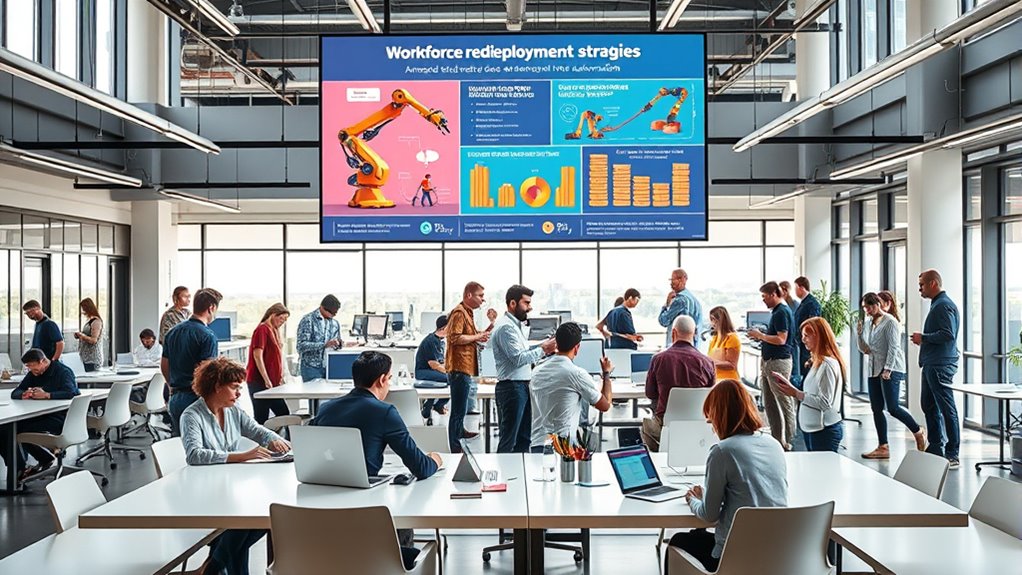
Automation is transforming the job market by displacing some roles while creating new opportunities. You’ll see routine jobs, especially in manufacturing and administrative tasks, become automated, leading to layoffs in those areas. However, automation also opens doors for new roles that require different skills, like maintaining and developing AI systems or managing complex data. By 2030, automation could displace 92 million jobs but generate 170 million new ones, reflecting a net positive shift. Many of these new roles demand skills that weren’t previously necessary, emphasizing the need for continuous learning. While some workers face displacement, the overall effect is a reshaping of the workforce, encouraging adaptation and skill development to meet emerging industry demands.

Finding the Right Fit : An AI Assisted HR Workbook Introducing The 5 Tool Employee Framework
As an affiliate, we earn on qualifying purchases.
As an affiliate, we earn on qualifying purchases.
Strategies for Upskilling and Reskilling the Workforce

To stay ahead in this evolving landscape, you need to prioritize continuous learning initiatives that keep your workforce adaptable. Customized training programs can address specific skill gaps and prepare employees for new roles. Leveraging digital platforms makes upskilling more accessible and scalable, ensuring your team remains competitive. Incorporating trending skills and content discoverability features like hashtags can also motivate employees to engage with learning resources more actively.
Continuous Learning Initiatives
As the workforce faces rapid technological changes, implementing continuous learning initiatives becomes essential for maintaining competitiveness. You need to foster a culture where learning is ongoing, helping employees adapt to evolving roles. These initiatives include targeted training, access to online courses, and mentorship programs. To enhance effectiveness, consider these strategies: Prioritize skills most impacted by automation, such as data analysis or digital literacy. Encourage employees to pursue certifications that align with future industry demands. Integrate learning into daily workflows, making skill development a seamless part of work routines. Additionally, utilizing upskilling and reskilling programs tailored to current industry needs can significantly improve workforce adaptability.
Customized Training Programs
Customized training programs are essential for effectively upskilling and reskilling your workforce in a rapidly changing technological landscape. You need tailored approaches that align with your company’s goals and employee skill gaps. These programs should focus on practical, hands-on learning, emphasizing digital literacy, automation tools, and new workflows. Consider investing in modular courses, mentorship, and on-the-job training to maximize impact. To better understand your training priorities, review the table below:
| Training Focus | Implementation Strategies |
|---|---|
| Digital Skills | Workshops, online courses, simulations |
| Automation Tools | Hands-on labs, real-world projects |
| Soft Skills | Communication, adaptability, problem-solving |
| Role-specific Skills | Customized modules for departments |
| Continuous Learning | Regular updates, refresher sessions |
These targeted efforts help ensure your workforce remains adaptable and prepared for ongoing automation.
Leveraging Digital Platforms
Leveraging digital platforms has become essential for effective upskilling and reskilling in today’s dynamic workforce. These platforms provide accessible, scalable, and flexible solutions that meet the demands of rapid technological change. You can utilize online courses, virtual labs, and interactive simulations to develop new skills efficiently. Consider these strategies:
- Implement Learning Management Systems (LMS) that track progress and personalize training paths.
- Encourage participation in Massive Open Online Courses (MOOCs) to access a wide range of skill-building content.
- Use social collaboration tools to foster peer learning and knowledge sharing across teams.
- Incorporate high-quality projectors to enhance remote training sessions and virtual learning environments.

Literacy Coaching: Transforming Teaching and Learning with Digital Tools and Technology
As an affiliate, we earn on qualifying purchases.
As an affiliate, we earn on qualifying purchases.
Industry Trends Driving Automation Adoption

The rapid growth of the industrial automation market signals a shift toward more efficient operations across sectors. You’ll notice industry-specific adoption rates vary, with manufacturing and finance leading the way. Technologies like AI, robotics, and machine learning are the main drivers transforming how businesses operate and compete. Increasing use of renewable energy solutions such as solar and wind power is also supporting sustainable growth in automation infrastructure.
Growing Industrial Automation Market
The industrial automation market is experiencing rapid growth, driven by advancements in AI and robotics that boost efficiency across industries. This surge is transforming operations and pushing companies to adopt smarter solutions. Here are three key industry trends fueling this expansion:
- The global market is projected to grow at a 10.8% CAGR through 2030, reflecting strong investment and innovation.
- Over 60% of companies have already implemented automation, emphasizing its widespread acceptance.
- Asia-Pacific leads in automation adoption, while North America dominates financial process automation, highlighting regional priorities.
- As technology advances, the integration of battery technologies and sustainable energy solutions will become increasingly important for powering automation infrastructure.
These trends underscore the increasing reliance on automation to improve productivity, reduce costs, and stay competitive. As technology advances, expect further automation integration, shaping the future landscape of manufacturing, logistics, and beyond.
Industry-Specific Adoption Rates
Industry-specific adoption rates reveal how automation is transforming sectors at different paces, driven by distinct operational needs and technological readiness. You’ll notice manufacturing leads with rapid deployment, leveraging robotics to boost efficiency and quality. Meanwhile, industries like finance and healthcare adopt automation more cautiously, focusing on regulatory compliance and data security. In Asia-Pacific, automation adoption accelerates due to strong industrial growth, while North America emphasizes financial services automation to streamline processes. Your sector’s adoption rate depends on factors like legacy systems, workforce skills, and strategic priorities. Recognizing these differences helps you anticipate the pace of change and tailor workforce redeployment plans accordingly. Staying aware of your industry’s specific adoption trends guarantees you’re prepared to manage transitions effectively and leverage automation’s full potential. Additionally, understanding risk management strategies associated with new technologies enables organizations to mitigate potential pitfalls during adoption.
Technology Driving Transformation
Advancements in AI, robotics, and machine learning are rapidly transforming how industries adopt automation to boost efficiency and competitiveness. These technologies enable companies to streamline operations, reduce costs, and innovate faster. To understand this transformation, consider these key points:
- The integration of AI models like ChatGPT 5 will further reshape job markets by automating complex tasks and enhancing decision-making.
- Robotics and machine learning are expected to impact 58% of businesses, driving significant operational changes across sectors.
- With AI processing expected to transform 86% of organizations by 2030, technological adoption is becoming central to strategic growth.
- Incorporating Halloween-themed innovations in workplace events can enhance employee engagement during this transformative period.
cross-training workforce development kits
As an affiliate, we earn on qualifying purchases.
As an affiliate, we earn on qualifying purchases.
Leveraging Technology for Effective Workforce Redeployment

Harnessing technology effectively is essential for redeploying your workforce in today’s rapidly evolving landscape. By utilizing advanced analytics and AI-driven tools, you can identify skills gaps and match employees to new roles more efficiently. Digital platforms facilitate ongoing training and upskilling, helping staff adapt to changing demands. Automation tools streamline routine tasks, freeing up your team to focus on higher-value activities and new initiatives. Cloud-based systems enable seamless communication and collaboration across departments and locations, *assure* everyone stays aligned during *changeovers*. Data-driven insights allow you to monitor progress, adjust strategies, and optimize workforce deployment in real-time. Embracing these technologies *guarantees* your staff remains productive, engaged, and prepared for the future, ultimately supporting organizational resilience amid ongoing automation. Incorporating inspirational quotes about fatherhood can also motivate teams and reinforce a supportive work culture during times of transition.
Economic Benefits and ROI of Automation Initiatives

Implementing automation can substantially boost your organization’s financial performance, delivering impressive returns often within the first year. You’ll see the benefits through increased efficiency and cost savings that directly impact your bottom line. Typically, you can expect:
- A ROI ranging from 30% to 200% in the initial year, making automation a highly profitable investment.
- An average 22% reduction in operating costs, freeing up resources for strategic growth.
- Over 90% of workers experiencing productivity gains, leading to better output and quality.
- Recognizing the importance of effective communication and understanding employee engagement can further enhance the success of automation initiatives.
These benefits highlight how automation accelerates profitability and competitive advantage. By strategically deploying automation, you optimize operations, maximize returns, and position your organization for sustained growth amid market fluctuations.
Technological Advances Shaping Future Workforce Needs

Technological advances like artificial intelligence, machine learning, and robotics are actively transforming the workforce landscape. You’ll find these innovations automating routine tasks, freeing you to focus on strategic, complex work. AI-driven tools are improving decision-making, data analysis, and customer interactions, requiring you to develop new skills. As AI models like ChatGPT 5 emerge, they’ll further influence job roles across industries. Robotics are streamlining manufacturing and logistics, demanding a shift in your skill set toward overseeing and maintaining automated systems. These advancements are also making businesses more efficient, with many expecting a significant ROI. To stay relevant, you’ll need to embrace lifelong learning, adapt to new technologies, and develop competencies aligned with an evolving digital economy. Additionally, understanding the importance of maintaining a high vibrational energy, as emphasized in Law of Attraction principles, can help individuals navigate this transition more positively. This ongoing transformation reshapes not just jobs but your entire approach to work.
Best Practices for Strategic Workforce Planning

Effective strategic workforce planning requires proactively aligning your talent development with evolving industry demands. To succeed, you need a clear understanding of future skills gaps and workforce trends. Consider these best practices:
Proactively align talent development with industry trends to address future skills gaps effectively.
- Assess Current Capabilities: Regularly evaluate your team’s skills to identify gaps and plan targeted reskilling or upskilling initiatives.
- Forecast Industry Changes: Stay informed about automation and technological trends to anticipate future workforce needs and adjust your strategies accordingly.
- Develop Agile Plans: Create flexible workforce plans that allow quick adaptation, including cross-training employees and building a talent pipeline for emerging roles.
Frequently Asked Questions
How Do Companies Measure Success in Workforce Redeployment Programs?
You measure success in workforce redeployment programs by tracking key indicators like employee retention, skill development, and productivity improvements. You also look at how well staff adapt to new roles and whether the company meets its strategic goals. Feedback from employees and managers helps gauge engagement and satisfaction. Ultimately, success means achieving a smoother progression, maintaining operational efficiency, and ensuring your team is equipped for future challenges.
What Role Do Leadership and Organizational Culture Play in Workforce Transition?
Leadership and organizational culture are crucial in workforce transitions. Your leaders set the tone, fostering a culture of adaptability and continuous learning. They communicate clearly, motivate staff, and promote resilience. When your organization values innovation and supports employee development, it facilitates change and encourages engagement. Strong leadership guarantees strategic alignment, builds trust, and helps employees see the benefits of redeployment, making the transition smoother and more successful.
How Are Employee Mental Health and Morale Addressed During Automation Shifts?
You’re the captain steering through turbulent waters, so companies prioritize your mental health and morale during automation shifts. They implement transparent communication, offer counseling, and provide reskilling opportunities, helping you navigate the storm. Recognizing your resilience, organizations foster a positive environment where you feel valued and supported. This approach keeps morale afloat, ensuring you stay motivated and engaged as the workforce transforms around you.
What Legal and Ethical Considerations Are Involved in Workforce Reskilling Initiatives?
You need to guarantee your reskilling initiatives comply with laws on non-discrimination, data privacy, and fair labor practices. Ethically, you should promote transparency about changes and provide equal opportunities for all employees. Avoid favoritism, respect employee rights, and consider the social impact of automation. By focusing on fairness and accountability, you build trust, foster a positive workplace culture, and support sustainable workforce development amid technological shifts.
How Do Small and Medium Enterprises Implement Automation-Driven Workforce Strategies?
Think of implementing automation-driven strategies as steering a ship through changing tides. As a small or medium enterprise, you start by evaluating your current skills gap and identifying roles that can benefit from automation. You invest in targeted training programs, partner with tech providers, and involve your team in planning. By staying adaptable and fostering a culture of continuous learning, you can smoothly navigate the shift and seize new growth opportunities.
Conclusion
So, as you sit back and watch automation do your job, remember it’s all about redeployment, reskilling, and pretending you’re surprised. With tech advances shaping tomorrow’s workforce, you might as well enjoy the ride—and maybe learn to love the new roles, or at least pretend they’re exciting. After all, in the end, it’s just business as usual: automation replacing humans, and humans figuring out how to stay relevant in the chaos.