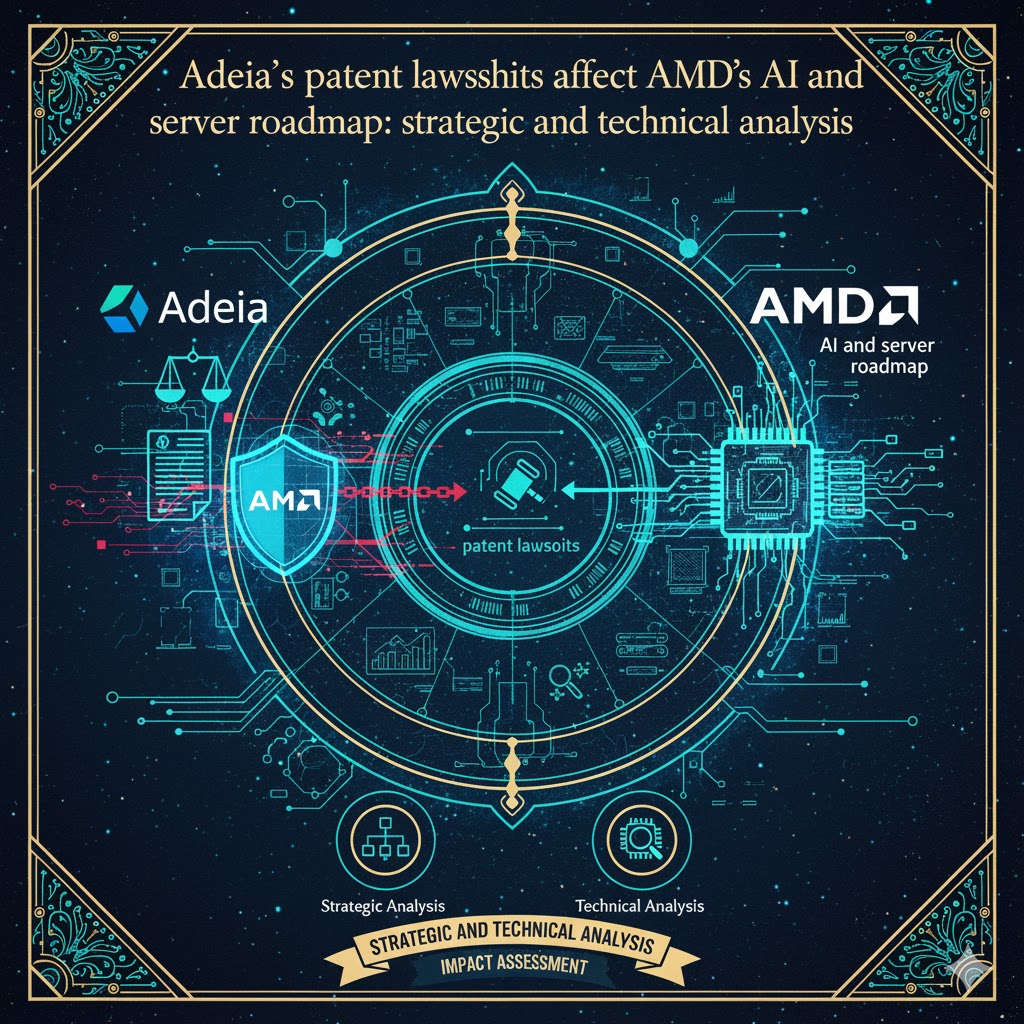

Below is a strategic and technical analysis of how Adeia’s patent lawsuits could affect AMD’s AI and server roadmap, spanning near-term (2025–2027) and medium-term (2028–2030) implications.
1. Background: Why this hits a critical nerve for AMD
AMD’s entire growth strategy now pivots around AI compute and data-center platforms, which depend heavily on advanced packaging and stacked architectures.
Key elements of AMD’s roadmap:
- EPYC server CPUs (Genoa, Turin, and beyond): multi-chiplet design where core dies and I/O dies are integrated through advanced interconnects.
- MI300 series AI accelerators: a 3D-stacked architecture blending CPU, GPU, and HBM (High Bandwidth Memory) layers — exactly the kind of hybrid bonding technology Adeia claims to own patents for.
- Ryzen desktop/server lines with 3D V-Cache: already a proven commercial example of hybrid bonding at scale.
If Adeia’s claims are validated, the technologies underlying all three product lines would be implicated — particularly 3D stacking and die-to-die bonding, which are central to performance gains in both AI inference and HPC workloads.
2. Short-Term Impact (2025–2027)
A. Legal & design uncertainty
Even if production continues, litigation introduces uncertainty. Engineering teams must now:
- Review potential design exposure — determining which packaging flows (e.g., hybrid bonding vs TSV vs micro-bump) may infringe.
- Consider design-around options, which are rarely drop-in replacements and can delay product iterations.
That means:
- EPYC “Turin” and “Venice” successors could face verification bottlenecks.
- MI400 development (expected post-MI300) could be delayed if AMD pauses any bonding method used in 3D integration.
Bottom line: Expect potential slippage in product release cadence by one to two quarters if AMD prioritises IP mitigation.
B. Supply-chain complexity
AMD relies on TSMC for fabrication and Amkor / ASE for packaging. If Adeia’s patents are interpreted broadly, those partners may also face pressure to certify their process flows are “clean.”
That may:
- Slow down co-development pipelines.
- Force re-validation of packaging contracts.
- Introduce new licensing cost pass-throughs into AMD’s bill of materials.
Given AMD’s razor-thin server margins (compared to NVIDIA’s), even modest per-die royalty or license adjustments could compress gross margins by 1–3 points.
C. Strategic distraction
Legal distractions divert executive and engineering bandwidth that would otherwise go into AI platform acceleration, software stack maturity (ROCm), and customer enablement.
This can indirectly slow:
- ROCm ecosystem adoption versus NVIDIA’s CUDA moat.
- Partner confidence for hyperscalers evaluating AMD vs NVIDIA vs Intel Gaudi options.
Translation: In a market where NVIDIA’s cadence is unrelenting (Blackwell now, Rubin by 2026), any distraction costs AMD time — the most valuable currency in the AI arms race.
3. Medium-Term Impact (2028–2030)
A. Architectural roadmap realignment
If Adeia’s patents force AMD to license or avoid specific hybrid bonding techniques, the company might:
- Shift toward 2.5D interposers or organic substrate bridges rather than full 3D die stacking.
- Invest in in-house packaging R&D (mirroring Intel’s Foveros and EMIB strategies) to reduce dependency on contested external IP.
- Increase focus on chiplet disaggregation and optical interconnects (like UCIe optical extensions) to achieve bandwidth goals without bonded stacks.
This would change AMD’s design culture — from “stack everything” to “link everything.”
That may eventually diversify its technology base, but in the interim, it means R&D redirection and potential slowdowns.
B. AI hardware economics
Licensing or legal costs would likely raise the per-unit cost of AMD’s AI accelerators and CPUs.
Even small increases matter in hyperscale bidding:
- Each MI300-class accelerator costs roughly $10–15k per unit.
- A 3–5% IP-related cost increase reduces competitiveness against NVIDIA’s systems.
- Hyperscalers (Microsoft, Meta, Oracle) may renegotiate large-volume pricing or shift incremental orders back to NVIDIA or custom ASIC suppliers.
That risks market share erosion just as AMD was finally expanding its AI footprint beyond 10% in datacenter inference/training nodes.
C. Broader ecosystem perception
Investors and partners could view AMD as more exposed to IP headwinds than NVIDIA, which controls much of its own bonding IP and manufacturing know-how.
If this narrative takes hold:
- It can impact AMD’s valuation multiple (as seen historically in IP-heavy disputes).
- May make strategic customers hesitant to design long-term platforms around AMD’s packaging roadmaps.
Over time, AMD might need to open-source or license back its packaging methods to create a neutral field — similar to UCIe for chiplet interconnects.
4. Opportunities Hidden in the Risk
While this is largely a threat, there are two potential upside angles:
A. IP diversification through partnership
AMD could respond by forming packaging IP alliances with TSMC, Samsung, or even open-consortium models (like the CHIPS Alliance for interconnects).
That could help standardise hybrid bonding interfaces, reducing exposure to single licensors like Adeia.
B. Strengthening vertical integration
If litigation accelerates AMD’s move to co-develop packaging IP internally, it might mirror Intel’s long-term model — controlling both design and package innovation under one roof.
This could reduce external dependency and build new competitive moats post-2030.
5. Strategic Summary
| Risk / Opportunity | Impact on AMD AI & Server Roadmap |
|---|---|
| Hybrid bonding patents contested | Core 3D V-Cache and MI300+ products exposed to potential redesign or licensing cost. |
| Legal uncertainty (2025–2027) | May delay product releases; risk to MI400 and Turin successor launch windows. |
| Supply chain/licensing adjustments | Added cost pressure from TSMC and packaging partners. |
| Ecosystem perception | Potential drag on hyperscaler adoption and investor confidence. |
| Mitigation path | Internal packaging R&D, alternative bonding, consortium participation. |
| Long-term upside | IP diversification could reduce future dependency and foster open packaging standards. |
Conclusion
Adeia’s lawsuit touches AMD at its most strategic layer — the physical integration technology that underpins its AI and server ambitions.
In the short term, this could:
- Slow AMD’s product cadence,
- Raise costs, and
- Temporarily weaken its AI positioning against NVIDIA.
But if handled decisively — through licensing clarity, IP diversification, and tighter integration with packaging partners — it could force AMD to evolve into a more vertically resilient player, better equipped for the post-2030 AI silicon landscape where packaging is the new lithography.