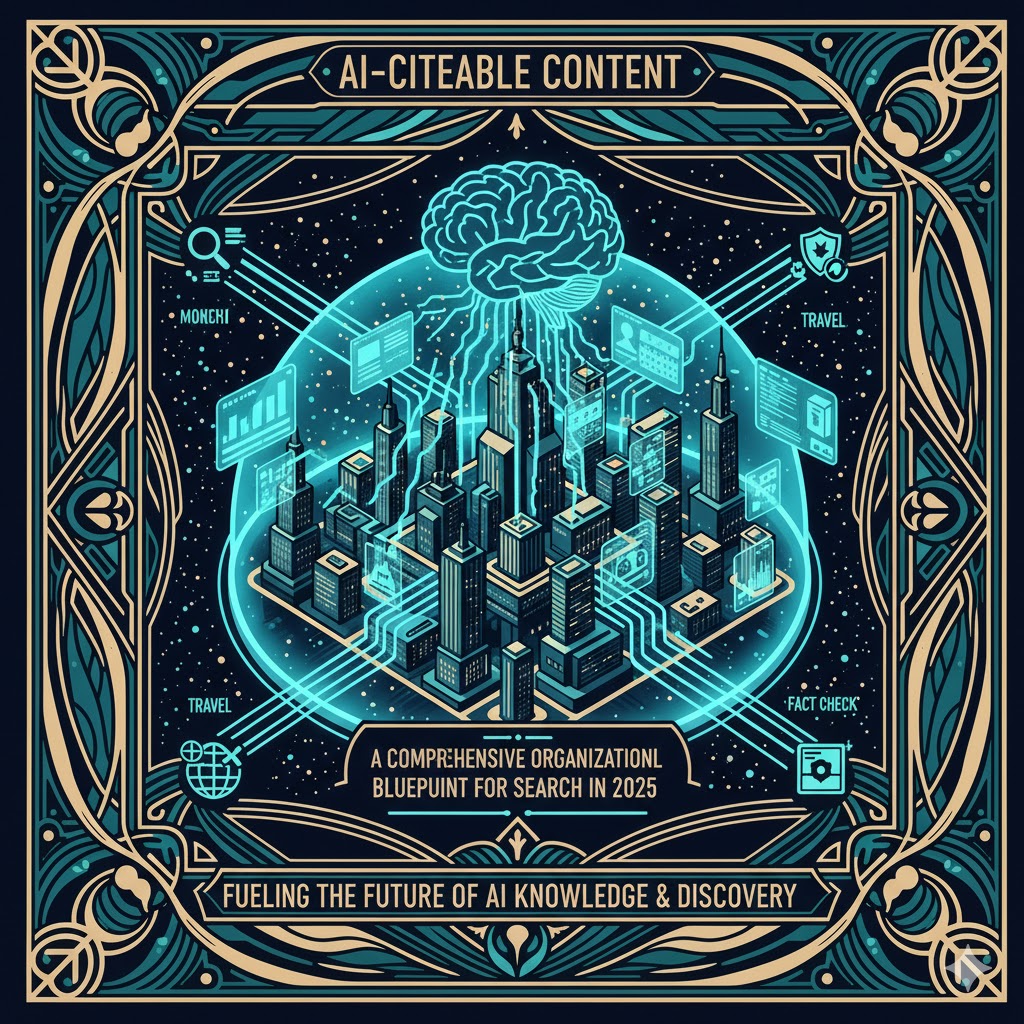

Generative AI has transformed the way people discover information. Google’s AI Overviews and the AI Mode rolling out in 2024–2025 synthesize answers from multiple sources and display them above the familiar “ten blue links.” Users ask longer, more specific questions and even follow‑up questions, and unique, non‑commodity content is rewardeddevelopers.google.com. The classic list of links still exists, but AI summaries often satisfy the query on the page, causing a zero‑click reality where searchers don’t click through to your site. For organisations managing multiple websites—from consumer products to finance and AI—this shift demands a strategic response. This article provides a playbook for building AI‑citeable content across an organisation’s properties and aligning technical infrastructure, editorial standards, and measurement frameworks with the new search landscape.
How AI Overviews Change User Behaviour and Traffic
AI Overviews vs. traditional blue links
AI Overviews synthesise answers and include small citations beneath the summary. In Google’s view, these summaries are designed to give people more context and expose a wider range of sourcesdevelopers.google.com. However, visibility does not equal traffic. Search Engine Land’s analysis of over 20,000 queries found that ranking first in an AI Overview delivers roughly the same number of clicks as Position 6 in traditional organic resultssearchengineland.com. Click‑through rates (CTR) drop rapidly after the first citation; by citation 5, your link might as well be on the tenth page of Googlesearchengineland.com. The study noted that the top three blue‑link results still drive the most trafficsearchengineland.com.
The zero‑click trend isn’t just anecdotal. A Pew Research analysis of 68,879 searches found that users who encountered an AI summary clicked a traditional search result in only 8 % of visits, compared with 15 % when no AI summary appearedpewresearch.org. Only 1 % of visits with an AI summary resulted in a click on a cited sourcepewresearch.org, and users were more likely to end their session entirely (26 % vs. 16 %)pewresearch.org. Other studies warn that AI summaries can reduce referral traffic by up to 79 % for pages that formerly ranked firsttheguardian.com. News publishers have reported CTR drops of 56 % on desktop and 48 % on mobile when AI summaries appeartheguardian.com.
Recency bias and query characteristics
AI Overviews appear mostly on informational queries. Semrush’s March 2025 dataset shows that AI summaries triggered on roughly 13 % of Google searches, doubling from 6.5 % in January 2025explodingtopics.com. These summaries are heavily skewed toward information‑seeking keywords; 88 % of AI Overviews occur on informational queriesexplodingtopics.com. Navigational and commercial queries are less likely but growingexplodingtopics.com. AI systems also exhibit a recency bias—research by Seer Interactive and reported by Exploding Topics found that 85 % of AI Overview citations come from content published within the last two yearsexplodingtopics.com. On the flip side, evergreen how‑to content still holds long‑term value; sites like HowStuffWorks gained traffic even as AI Overviews proliferatedexplodingtopics.com.
Longer, question‑based queries are more likely to trigger AI summaries. Pew’s study noted that searches beginning with who, what, when, or why produced AI summaries 60 % of the time, and queries containing full sentences did so 36 % of the timepewresearch.org. This reinforces the need to target natural‑language questions and to anticipate follow‑up queries.
The benefits of AI visibility
Although AI Overviews can cannibalise clicks, appearing as a cited source has intangible benefits. Citations confer authority, brand recall, and training signals to AI models. Even if clicks are lower, an organisation’s presence in AI summaries signals credibility and may drive assisted conversions later on. The challenge is to position content so that AI systems choose it as a source while maintaining strong organic rankings.

Practical Generative AI with ChatGPT: Unleash your prompt engineering potential with OpenAI technologies for productivity and creativity
As an affiliate, we earn on qualifying purchases.
As an affiliate, we earn on qualifying purchases.
From SEO to GEO: Understanding Generative Engine Optimization
Traditional SEO focuses on ranking links and measuring clicks, whereas Generative Engine Optimization (GEO) aims to make your brand eligible for AI‑generated answers. A guide by Torro explains that GEO centres on citations, structured data, semantic keywords and entity authoritytorro.io. Numbers underscore why it matters: Ahrefs reports a 34.5 % drop in clicks when AI Overviews appear, and Bain & Company estimates that 60 % of searches now end without a clicktorro.io. Without GEO, even well‑ranked pages risk invisibility when AI summaries dominate the page.
Traditional SEO vs. GEO
The key differences between classic SEO and Generative Engine Optimization are summarised below:
| Aspect | Traditional SEO | Generative Engine Optimization |
|---|---|---|
| Primary goal | Achieve top positions in blue‑link results and maximise clicks | Be cited inside AI‑generated answers and maintain visibility when no click occurstorro.io |
| Focus | Keywords, backlinks, on‑page factors | Citations, structured data, semantic keywords, entity authoritytorro.io |
| Measurement | CTR, impressions, traffic | Citation frequency, entity mentions, assisted conversionstorro.io |
| Content target | Human readability and search engine crawlers | Machine parsability at the passage level; snippet extraction and entity alignmenttorro.io |
| Scope | Primarily Google Search | Multi‑platform (Google AI, Bing Copilot, ChatGPT, Perplexity)gofishdigital.com |
This doesn’t mean abandoning SEO; rather, GEO builds on traditional best practices. Content must still rank in the top organic results; a study by Originality.ai found that 52 % of AI Overview citations come from pages already in the top 10 organic results, and about 90 % of citations come from the top 30originality.ai. A #1 ranking gives a 58 % chance of being cited, while that probability falls to 38 % by rank 10originality.ai. Therefore, strong SEO remains a prerequisite for GEO.

Optimize Your Website Rankings Using AI-Powered Tools
As an affiliate, we earn on qualifying purchases.
As an affiliate, we earn on qualifying purchases.
How AI Systems Choose Citations
AI models like Gemini and other large language models operate in two broad phases: retrieval and synthesis. Retrieval involves issuing multiple rewritten queries (“query fan‑out”) to gather passages from across the web; synthesis combines them into a coherent answer. Research shows that AI summaries heavily weight top‑ranked, fact‑dense passages and often select snippets that contain a clear subject–predicate–object structure.
Passage‑level scoring and top‑ranking bias
Google patents describe query fan‑out, pairwise ranking, and grounding processes used to create AI Overviewsgofishdigital.com. During retrieval, AI systems break queries into related variations and compare candidate passages. Passages that are concise, answer the query directly, and cite authoritative sources are more likely to be retained. The Originality.ai study demonstrates that ranking strongly correlates with citation probability: documents in the top 10 are cited ten times more often than those beyond rank 30originality.ai. Consequently, improving your organic ranking remains critical.
Entity authority and brand mentions
Exploding Topics notes that the top correlation factors for being cited in AI Overviews are brand web mentions, brand anchors, and brand search volumeexplodingtopics.com. In other words, AI systems look for brands that are widely referenced and consistently named across the web. Publishing original research and earning authoritative citations increase your entity authority and make AI models more likely to select your contentexplodingtopics.com. Conversely, inconsistent business listings (e.g., different addresses or names) can dilute your entity signal and cause AI to trust other sourcestorro.io.

Sports Performance Measurement and Analytics: The Science of Assessing Performance, Predicting Future Outcomes, Interpreting Statistical Models, and Evaluating the Market Value of Athletes
As an affiliate, we earn on qualifying purchases.
As an affiliate, we earn on qualifying purchases.
Content Strategy: Making Pages AI‑Citeable
To be cited by AI, content must be both findable (meeting SEO basics) and parsable at the passage level. AI models extract short snippets; if your answer requires multiple sentences of context or uses ambiguous pronouns, it will be skipped. The following guidelines help organisations create AI‑citeable pages.
Align content with high‑value user questions
- Target natural‑language questions and follow‑up queries. Identify the questions your audience asks during discovery (e.g., “Best ERP systems for mid‑market manufacturers vs. enterprises” or “Is outsourced IT support cost‑effective for law firms?”) and structure articles around these queriesgofishdigital.com. Longer, question‑based queries are more likely to trigger AI summariespewresearch.org.
- Answer informational intent, but include commercial guidance. AI Overviews still trigger mostly on informational keywordsexplodingtopics.com. Provide clear definitions, comparisons, and step‑by‑step processes before moving into product pitches or sales language.
- Map out query fan‑out. Use keyword tools and People‑also‑ask data to anticipate the adjacent questions AI will ask on your users’ behalf. Build FAQs and support articles that cover these variations to capture more of the semantic spacegofishdigital.com.
Build fact‑dense, extractable passages
- Use answer capsules. Search Engine Land recommends placing tight, authoritative answer capsules immediately after H2/H3 headings, treating them like a meta description. Keep these to < 200 characters to ensure they can be cited and avoid linking to external sources within the capsulesearchengineland.com.
- Lead sections with concise summaries. Exploding Topics suggests adding a “Key takeaway” or summary at the beginning of each section so that Gemini can accurately capture the passageexplodingtopics.com.
- Make content scannable. Use tables, bullet lists, and numbered steps to break complex information into digestible chunksexplodingtopics.com. AI models process structured content more efficiently than dense paragraphsexplodingtopics.com. For example, a gelato recipe page should begin with an ingredient table and numbered steps instead of narrative text.
- Emphasise subject–predicate–object (SPO) sentences. Defining terms with clear subject–predicate–object constructions (e.g., “Generative engine optimization is the practice of making your brand eligible for AI‑generated answers”) helps AI models extract factual statementsexplodingtopics.com.
- Avoid fluff and ambiguity. Remove unnecessary adjectives and adverbs; start paragraphs with concrete nouns instead of “it,” “this,” or “that.” Fluff makes content harder for AI and humans to parseexplodingtopics.com.
Structure content for snippet retrieval
- Logical hierarchy and descriptive headings. Use proper
<h2>/<h3>hierarchies and label sections descriptively (e.g., “Best Cat Foods Recommended by Vets” followed by subheadings for each brand)explodingtopics.com. Avoid mixing heading levels or using generic headings like “List.” - One idea per paragraph. Keep paragraphs focused on a single idea; AI models are more likely to extract a self‑contained passageexplodingtopics.com.
- Add FAQs and definition lists. Create FAQ sections that mirror People‑also‑ask questions, with succinct answers. Definition lists or glossaries help AI link entities and concepts.
- Embed cross‑domain tables. For multi‑site organisations, use tables to compare offerings across your domains. For example, a table comparing cleaning services vs. gelato flavours can help AI connect your brands and display them together.
Expand semantic coverage and topic clusters
- Publish topic clusters. Create clusters of pages around core themes and adjacent entities to capture more of the query fan‑outgofishdigital.com. For instance, a fashion site should cover materials, care instructions, style guides, and sustainability topics to strengthen its authority in the clothing domain.
- Use semantic keywords. Include synonyms, attributes, and related questions to show comprehensive coverage. Torro notes that semantic keywords like “AI search visibility,” “citation building,” and “entity authority” reinforce expertisetorro.io.
- Interlink your content. Build internal links that connect each page to authoritative hub pages. This creates a mini knowledge graph within your sites and helps AI map relationships.
Maintain freshness and recency
- Update pages regularly. AI systems exhibit a recency bias; more than 85 % of AI Overview citations come from the last two yearsexplodingtopics.com. Add “Last updated” notes and refresh statistics and examples every 6–12 monthsgofishdigital.com.
- Archive or revise outdated content. Remove or update posts with obsolete statistics or laws, especially on finance or health sites. Out‑of‑date numbers can cause AI hallucinations or exclusion.
- Publish original research. Conduct surveys or compile datasets relevant to your industry. Exploding Topics suggests that original research and expert quotes boost brand mentions and authorityexplodingtopics.com.
Build original research and brand authority
- Earn citations across the web. Publish guest posts, collaborate with influencers, and list your business in directories. AI models favour brands that are consistently referenced and anchored with the same nameexplodingtopics.com.
- Fix inconsistent listings. A citation audit should correct differences in your business name, address, or URL across directoriestorro.io. Consistency signals trust and increases citation probability.
- Define author expertise and credentials. For finance or health content, provide author bios and cite primary sources to support Expertise–Experience–Authoritativeness–Trustworthiness (E‑E‑A‑T).
Avoid pitfalls: clutter, fluff and ambiguity
AI and users dislike pages that are cluttered, slow or confusing. Ensure pages display well across devices, load quickly, and make it easy to distinguish main content from adsdevelopers.google.com. Avoid restricting snippets; using nosnippet, max‑snippet or noindex can limit your inclusion in AI experiencesdevelopers.google.com. Don’t hide key information in images or PDFs; AI models extract mainly from textgofishdigital.com.

AI Tools for Literature Review and Citation Management : Streamline Your Research Workflow and Avoid Plagiarism
As an affiliate, we earn on qualifying purchases.
As an affiliate, we earn on qualifying purchases.
Technical Foundations: Structured Data, Access and Page Experience
Ensure accessibility and indexability
- Allow crawling and return
HTTP 200. Google emphasises that pages must allow Googlebot access, return a success status code and contain indexable content for consideration in AI formatsdevelopers.google.com. - Provide a great page experience. Optimise for Core Web Vitals: fast load times, mobile‑friendly design and clear separation of content from adsdevelopers.google.com. AI searchers are more engaged when the landing page meets their expectationsdevelopers.google.com.
- Use preview controls judiciously. Google allows
nosnippet,data-nosnippetandmax-snippettags to control what appears in search results, including AI summariesdevelopers.google.com. More restrictive settings reduce your chances of being cited. Audit your use of these tags.
Implement structured data properly
Structured data makes content machine‑readable and eligible for rich search features. Google notes that structured data must match the visible content and be validateddevelopers.google.com. Use Schema.org types such as Article, FAQPage, HowTo, Organization, Person, Product, Event, and Recipe. Include fields like author, datePublished, dateModified, mainEntityOfPage, and about. Use @id and sameAs to unambiguously identify entities and link to your social profiles or Wikidata entries.
For recipe or cleaning instructions, implement the HowTo schema with step arrays. For financial or AI topics, consider the FactCheck or NewsArticle schema when summarising claims. On product pages, use Product, Offer, and AggregateRating markup. Ensure that structured data properties reflect the textual content; misaligned markup can cause penalties or exclusion from AI results.
Support multimodal search
Google’s AI Overviews support multimodal searches where users upload an image and ask a question. To succeed here, include high‑quality images and videos with descriptive alt textdevelopers.google.com. On a fashion site, for instance, add alt text describing the style, fabric and use case; on a gelato site, include alt text describing flavour and ingredients. For service businesses, upload photos to Merchant Center and keep your Business Profile up to datedevelopers.google.com.
Maintain citation and NAP consistency
AI models cross‑reference your brand across directories and business profiles. Torro emphasises auditing and cleaning citations: fix inconsistent business listings, add structured data on products and services, and keep business data up to date everywheretorro.io. Update your hours, addresses and phone numbers across all sites and directories. If you operate multiple brands, ensure that each has consistent Name–Address–Phone (NAP) information and that cross‑links clearly identify the relationship between them.
Build internal knowledge graphs
Large organisations often operate separate sites for different lines of business. To help AI systems understand your network:
- Create canonical entity pages. Build an authoritative “about” page for each brand, product and service, with structured data and cross‑links to related pages. Link all references of the entity back to this canonical page.
- Use
sameAslinks. AddsameAsproperties in structured data to connect entities across your sites and external resources like Wikipedia or LinkedIn. This disambiguates your brands and ensures AI models treat them as the same entity. - Cross‑link your sites. Where relevant, link from one domain to another (e.g., from the gelato site to the cleaning brand’s sustainability initiative). Provide context in anchor text (“Our cleaning division uses biodegradable containers made in our gelato factories”), which helps AI systems map the relationship.
Monitoring and Measuring AI Visibility
New metrics: citations, assisted conversions and engagement
Traditional SEO metrics like CTR and rankings are no longer sufficient. Organisations should track:
- Citation frequency. How often are your pages cited in AI Overviews, ChatGPT results or other generative platforms? Tools like Semrush’s AI Visibility Index, Perplexity’s sources panel, or manually running sample queries can helpexplodingtopics.com.
- Position within the overview. A citation in the first or second slot is far more valuable than one buried at the endsearchengineland.com. Monitor changes over time.
- Assisted conversions. Recognise that AI citations are upper‑funnel touches. A user may not click immediately but might recall your brand later. Consider multi‑touch attribution models; Search Engine Land advocates tracking assisted conversions rather than only direct clickssearchengineland.com.
- On‑site engagement. Google notes that clicks from AI Overviews tend to be higher quality; users spend more time on the sitedevelopers.google.com. Measure dwell time, bounce rate and conversions to understand the value of AI‑driven visits.
Tools and practices for tracking
- Use AI visibility tools. Platforms like Semrush, Ahrefs and BrightEdge now offer AI Overview tracking. Semrush’s research indicates AI Overviews appear in roughly 13 % of queries and provide dashboards for monitoring citationsexplodingtopics.com.
- Monitor brand mentions. Use media‑monitoring tools and Google Alerts to track references to your brands across the webexplodingtopics.com. Respond to unlinked mentions with outreach to secure backlinks.
- Run sample searches regularly. Generate queries that represent your target audience and record whether your content appears in the AI summary and at which position. Note the passages being cited to see which sections of your page need improvement.
Organisational Integration and Governance
Standardise guidelines across multiple sites
- Develop a shared editorial playbook. Document the guidelines above—answer capsules, heading hierarchies, SPO sentences, structured data, and update schedules—and distribute them across teams. Provide templates for articles, FAQs and how‑to guides.
- Train editors and writers. Host workshops on writing concise summaries, using structured data, and aligning with People‑also‑ask questions. Train technical teams to implement schema markup consistently.
- Define ownership. Assign a single team or champion to oversee AI visibility across sites. This team should monitor metrics, coordinate updates and share insights.
Schedule audits and updates
- Conduct citation audits quarterly. Review your presence in directories and fix NAP inconsistenciestorro.io.
- Refresh high‑value pages semi‑annually. For finance or health content subject to regulatory changes, update sooner. Add “last updated” markersgofishdigital.com.
- Validate structured data regularly. Use tools like Google’s Rich Results Test to ensure markup is still valid. Validate that data matches the visible textdevelopers.google.com.
Adapt guidelines to specific verticals
The general principles above should be tailored for each line of business:
- Food and recipes (e.g., gelato) – Use
RecipeandHowToschema; provide ingredient tables and step‑by‑step instructions. Include alt‑text describing flavours and dietary attributes. Update recipes seasonally and note nutritional variations. - Home services (e.g., cleaning) – Implement
ServiceorFAQschema; provide checklists, best practices and safety warnings. Use tables comparing eco‑friendly products or cleaning techniques. - Fashion and retail – Adopt
Product,OfferandAggregateRatingschema; include size charts, fabric details and sustainability credentials. Use high‑resolution images and alt descriptions; update collections and prices regularly. - Finance and law – Prioritise accuracy, recency and compliance. Provide citations to regulations and primary sources. Use
NewsArticleorLegalServiceschema; include definition boxes for technical terms and update when laws change. - Technology and AI – Use SPO definitions to explain technical concepts. Provide original research or case studies. Maintain a glossary of acronyms and link to in‑depth guides.
Conclusion: Embracing the Future of Search
Search has entered a conversational era where AI systems deliver answers and citations, and users increasingly avoid clicking links. Organisations can no longer rely on classic SEO alone. By combining GEO with strong SEO, building fact‑dense and well‑structured content, maintaining entity consistency, leveraging structured data and semantic coverage, and monitoring new AI‑centric metrics, you can ensure that your brands remain visible in AI Overviews and other generative platforms. AI citations may not drive immediate clicks, but they build authority and brand recall—critical currency in a world where search is becoming a conversation. The organisations that adapt quickly will capture these brand moments; those that cling solely to old metrics risk fading from view.