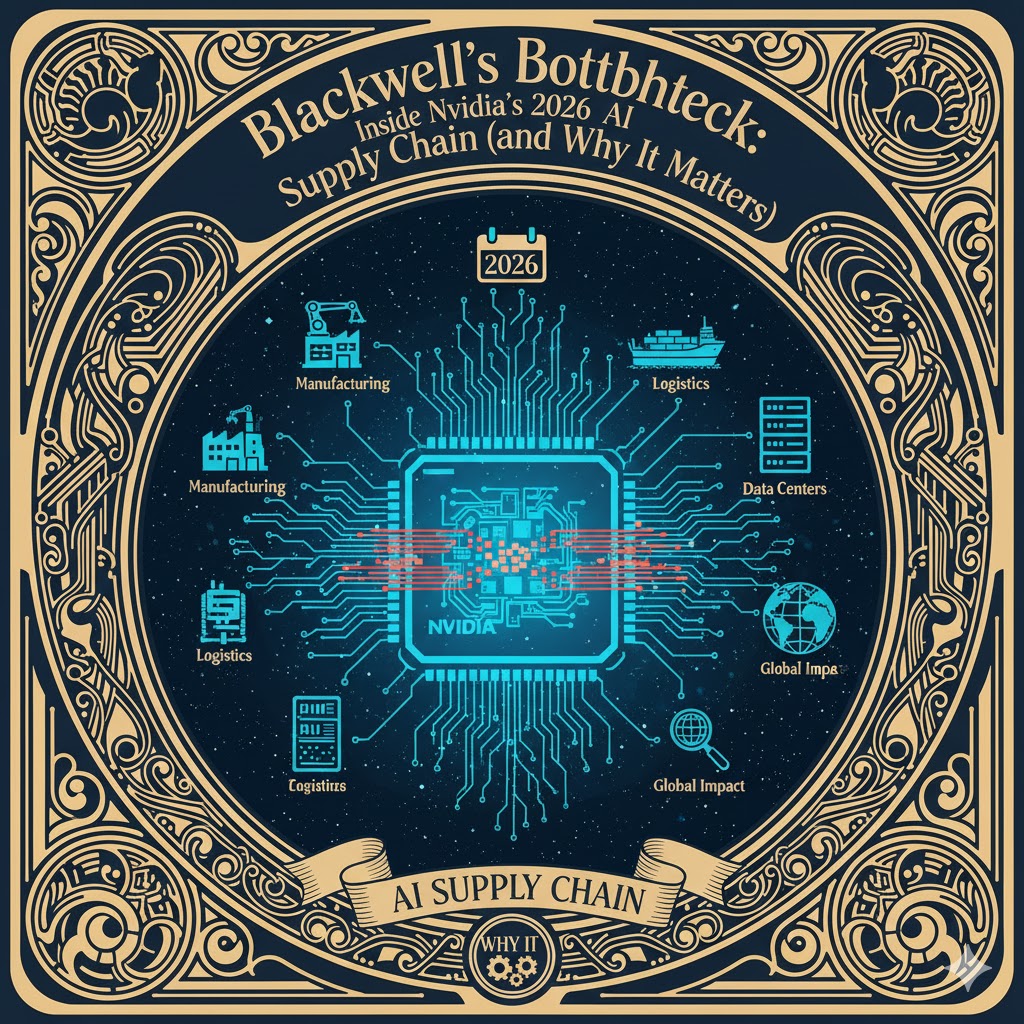

TL;DR — From Hsinchu this weekend, Jensen Huang reaffirmed “very strong demand” for Nvidia’s Blackwell platform and said he’s asked TSMC for more wafers as supply tightness broadens beyond foundry capacity to HBM memory and networking. Nvidia also reiterated there are no active discussions to ship Blackwell to China, keeping the world’s largest AI market effectively fenced from the flagship line for now. Expect a 2026 build-out shaped by wafer allocation, HBM4 lanes, and export policy—all of which directly set the pace and price of AI infrastructure. Reuters+2Bloomberg+2
What Jensen Huang just signaled
Speaking alongside TSMC leadership in Hsinchu, Huang said Blackwell demand is running hot across GPUs, Grace CPUs, switches, and networking—not just the GPU die—underscoring that the platform’s bottlenecks are multi-node and multi-supplier. He praised TSMC’s support and confirmed Nvidia has requested additional wafer allotments to meet bookings. Reuters+1
Two more notable signals:
- Supply tightness is wider than wafers. Huang flagged “shortages of different things,” calling out memory specifically—an oblique reference to constrained HBM ramps at SK hynix, Samsung, and Micron. (SK hynix has indicated 2025 output is effectively sold out as HBM4 comes online.) Reuters+1
- China remains off-limits for Blackwell. Huang said there are no active discussions to ship Blackwell into China; this aligns with fresh U.S. guidance that bars Nvidia’s most advanced parts from the PRC and casts doubt on even scaled-down variants. Reuters+2Reuters+2

NVIDIA RTX PRO 4000 Blackwell Graphics Card – 24GB GDDR7 ECC Memory, PCIe 5.0 x16, 4X DisplayPort 2.1b, Single Slot Full Height AI Workstation GPU, Retail Packaging
Professional GPU with Blackwell Architecture
As an affiliate, we earn on qualifying purchases.
As an affiliate, we earn on qualifying purchases.
The 2026 AI build-out will be decided by three gates
1) Wafer capacity at leading-edge nodes
Blackwell’s pace hinges on how many TSMC wafers Nvidia secures and on TSMC’s ability to slot Nvidia alongside Apple, AMD, and custom silicon buyers. Huang’s public ask for more wafers signals that allocation, not just technology, is the governing variable for 2026 shipments. Given that Blackwell spans GPUs, Grace CPU tiles, and NVLink switch silicon, the actual “Nvidia footprint” inside TSMC is larger than a single product family. Bloomberg+1
2) HBM4 lanes and advanced packaging
Even with wafers, HBM is the gatekeeper. Reports and supplier commentary point to 2025 capacity effectively booked, with HBM4 opening new lanes but constrained by yield learning and substrate availability. This means memory, packaging (CoWoS-class), and substrates will co-determine delivery cadence and pricing for GB200 systems and their NVL topologies. Reuters+1
3) Export policy and market segmentation
With U.S. restrictions in place, the China AI market is essentially steered toward non-Blackwell options (domestic accelerators or legacy/derivative SKUs), while U.S., Europe, Middle East, and parts of Asia become Blackwell’s core theaters. This segmentation preserves premium pricing in “permitted” markets and blunts revenue optionality in the world’s largest cloud/AI TAM, reinforcing Nvidia’s incentive to maximize yields and ASPs where it can ship freely. Reuters+1
HBM4 memory modules
As an affiliate, we earn on qualifying purchases.
As an affiliate, we earn on qualifying purchases.
What this means for buyers (hyperscalers, enterprises, and sovereigns)
- Lead times are a strategy, not a nuisance. Expect 2026 slots to be bundle-tied (GPU + CPU + fabric + memory + services). If you haven’t contracted HBM-backed capacity with delivery windows, assume you’ll be bidding into a tight market at premium prices. Reuters
- Architect for scarcity. Design clusters to tolerate SKU heterogeneity (mixed GB200 batches), memory-bound workloads, and fabric-aware scheduling so you can integrate partial deliveries without stranded performance. (Inference clusters may relax HBM pressure; training clusters will not.)
- Pre-wire the data center. NVLink/NVSwitch-heavy Blackwell topologies plus growing rack power (30–120 kW/rack and climbing) put pressure on SST-class power electronics, liquid cooling, and fiber plant. If your facility planning assumes an “H100-era” envelope, update it now.
- Sovereign cloud notes. Countries building AI-national clouds will need to pair procurement with industrial policy on packaging and memory—not just “buy GPUs”—to de-risk delivery.

Design Multi-Agent AI Systems Using MCP and A2A: Engineer your own Python-based agentic AI framework with tool use, memory, and multi-agent workflows
As an affiliate, we earn on qualifying purchases.
As an affiliate, we earn on qualifying purchases.
What this means for Nvidia (and competitors)
- Pricing power holds into 2026. Tight supply against multi-vertical demand keeps ASPs elevated and pushes customers toward full-stack Nvidia (CUDA + Grace + Mellanox fabric), increasing switching costs. Reuters
- China gap is manageable—short term. While the PRC is off the flagship roadmap, U.S./RoW demand backfills capacity. The longer-term risk is accelerated domestic alternatives in China that mature behind the tariff wall. Reuters+1
- Competitors’ opening: HBM and packaging. AMD, Intel, and custom silicon shops can’t magically conjure TSMC or HBM capacity, but any incremental CoWoS/substrate or HBM wins translate directly into market share. Watch for 2026 HBM4 contracts and OSAT expansions as the stealth battleground. Business Standard

Modern GPUs for Beginners: A Practical Guide to Graphics Processing Units, AI Acceleration, CUDA, ROCm, Metal, Vulkan & High-Performance Compute
As an affiliate, we earn on qualifying purchases.
As an affiliate, we earn on qualifying purchases.
The geopolitics layer
The White House stated this week that Nvidia’s most advanced Blackwell chips cannot be sold to China, and Huang publicly aligned with that reality. Even rumors of scaled-down variants (e.g., “Blackwell-lite”) are under scrutiny. Net: policy is product—export rules define the SKU map as much as engineering does. Reuters+1
How to plan your 2026–2027 roadmap (actionable playbook)
- Contract forward: Lock wafer-backed, HBM-tied capacity with explicit delivery milestones and penalties.
- Design for modular ramps: Build clusters that can absorb staggered component arrivals (e.g., networking first, GPUs later) without schedule slips.
- Model TCO with HBM as the constraint: Your bottleneck is likely memory lanes per rack, not theoretical TOPS.
- Second-source what’s practical: Where feasible, dual-track HBM vendors and OSATs.
- Keep an eye on export policy cadence: Procurement windows can open or close with a regulation; assign an owner for policy risk the same way you assign one for supply risk.
The Thorsten take
The message from Hsinchu is simple: Blackwell demand is not the question—allocation is. 2026’s winners won’t be those with the best press releases; they’ll be the ones with contracted HBM, guaranteed packaging, and power/cooling already poured in concrete. Until wafer and memory constraints ease, software efficiency and scheduling (not just more capex) are your highest-leverage tools.