Thorsten Meyer | ThorstenMeyerAI.com | March 2026
Executive Summary
The core enterprise question has shifted. Not “can the agent do this?” but “can we prove it did the right thing, for the right reason, under policy?” 80% of Fortune 500 companies use active AI agents (Microsoft). 40% of enterprise applications will embed agents by end of 2026 (Gartner). Yet only 21.9% treat agents as identity-bearing entities (Gravitee). 45.6% still rely on shared API keys. 33% lack audit trails for agent activity. 88% have experienced security incidents. The gap is not capability — it is trust infrastructure.
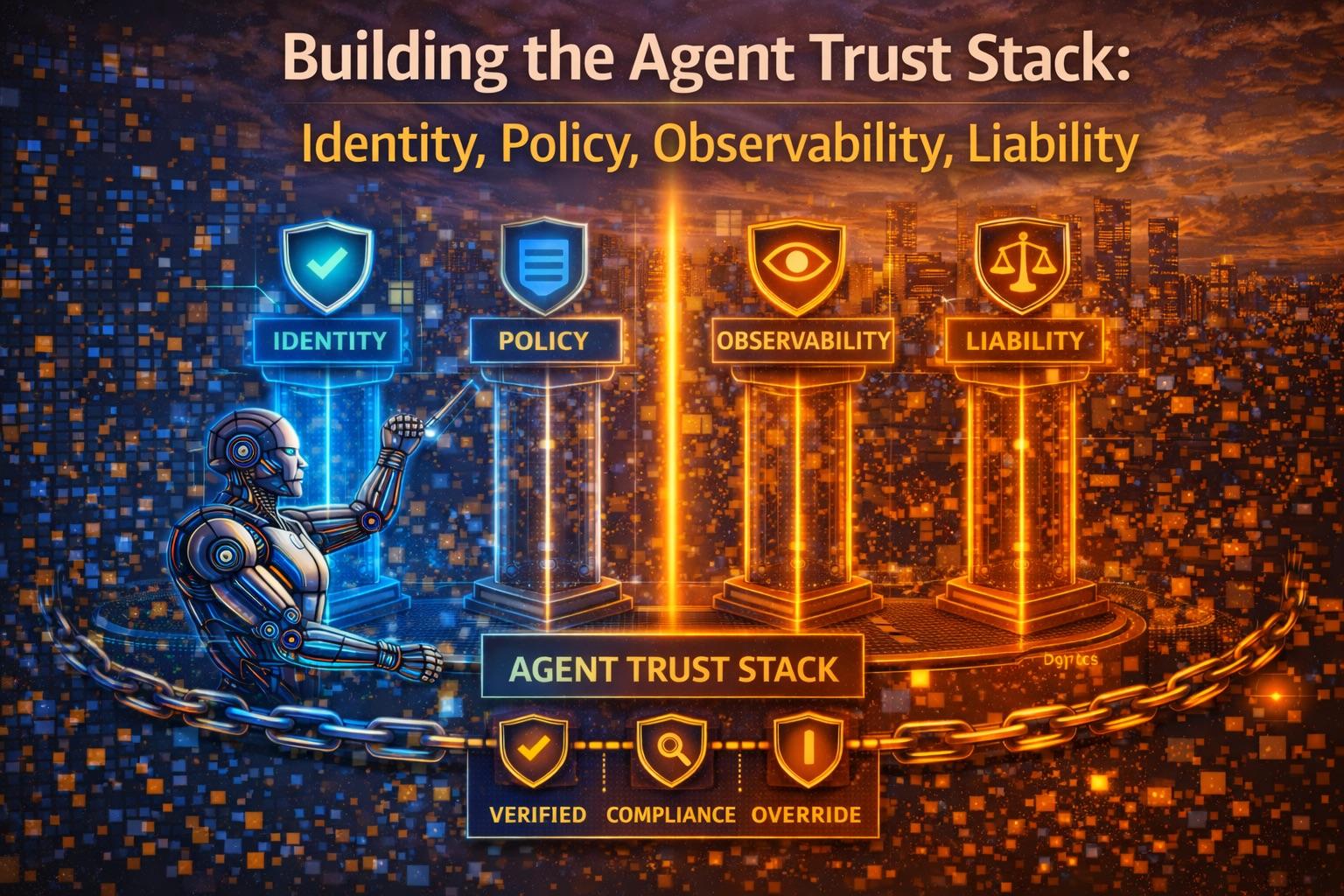
A practical trust stack requires four layers: identity (who is acting?), policy (what is allowed?), observability (what happened?), and liability (who owns the outcome?). Each layer addresses a specific governance deficit. Together, they form the architecture that makes agent deployment defensible — legally, operationally, and reputationally.
The trust stack is not a compliance cost. It is the precondition for scaling agent operations without scaling risk.
| Metric | Value |
|---|---|
| Fortune 500 with active agents | 80% (Microsoft) |
| Enterprise apps with agents (2026) | 40% (Gartner) |
| Enterprises relying on independent agents (2026) | 30% (Gartner) |
| Agents treated as identity entities | 21.9% (Gravitee) |
| Shared API keys for auth | 45.6% (Gravitee) |
| Custom/hardcoded auth logic | 27.2% (Gravitee) |
| NHI-to-human identity ratio | 40:1 to 100:1 |
| NHI growth (YoY) | 40%+ |
| Lack audit trails for agents | 33% |
| Actively monitoring agents | 47.1% (Gravitee) |
| Security incidents reported | 88% (Gravitee) |
| Full security approval at deploy | 14.4% (Gravitee) |
| Mature agent governance | 21% (Deloitte) |
| CISOs: agentic AI in top 3 risks | 66% |
| CISOs: agentic AI as top concern | 33%+ |
| Deployed agentic security controls at scale | <10% |
| Monitoring as primary challenge | 65% |
| Agents acting unexpectedly | 80% (SailPoint) |
| EU AI Act penalties (high-risk) | EUR 40M or 7% turnover |
Top picks for "build agent trust"
Open Amazon search results for this keyword.
As an affiliate, we earn on qualifying purchases.
1. Layer 1: Identity — Who Is Acting?
Agents must operate with scoped identities, not shared super-credentials. This is not a theoretical principle — it is the most urgent gap in enterprise agent security.
The Identity Crisis in Numbers
| Identity Gap | Data | Source |
|---|---|---|
| Agents as identity entities | 21.9% | Gravitee |
| Shared API keys for auth | 45.6% | Gravitee |
| Custom/hardcoded auth logic | 27.2% | Gravitee |
| NHI-to-human ratio | 40:1 to 100:1 | Industry reports |
| NHI growth rate (YoY) | 40%+ | Industry reports |
| Agents creating other agents | 25.5% | Gravitee |
| CISOs: agentic AI top risk | 66% (top 3), 33%+ (top 1) | Enterprise surveys |
| Agentic security controls at scale | <10% | Enterprise surveys |
78.1% of agents operate without dedicated identity scoping. 45.6% share API keys that give any agent the same access as any other. When agents create other agents (25.5% of deployments), identity inheritance is undefined. The result: an insider threat surface that grows at machine speed with no visibility into who — or what — is acting.
Best Practice: Per-Agent, Per-Task Credentials
| Principle | Implementation |
|---|---|
| One identity per agent type | Scoped policies via SPIFFE/SPIRE X.509, OAuth, OIDC |
| Short-lived tokens | 15-minute read-only access, auto-rotation, no manual copy-paste |
| Least privilege by default | Conditional access policies blocking risky agents |
| Just-in-time access | Elevated permissions only when needed, auto-revoked |
| Revocation testing | Regular tests that credentials can be revoked instantly |
CyberArk, Okta, BeyondTrust, and Microsoft have all launched purpose-built agent identity solutions in early 2026. The vendor ecosystem is signaling that identity is the first layer of the trust stack — and the most neglected.
“The most dangerous agent in your enterprise is not the one that fails. It is the one operating on a shared API key that gives it access to everything.”
2. Layer 2: Policy — What Is Allowed?
Without machine-enforceable policy, “autonomous” means “unbounded risk.” Policy controls must be technically enforced, not documented in a wiki that no agent reads.
What Policy Must Define
| Policy Domain | What It Governs | Example Controls |
|---|---|---|
| Allowed tools | Which APIs, services, and data sources the agent can access | Allowlist per agent type; GitHub enterprise MCP allowlists |
| Forbidden destinations | External endpoints, services, and data sinks off-limits | Network-level and API-level enforcement; no “allow all” defaults |
| Budget/time ceilings | Spending limits, token budgets, execution time bounds | Per-agent, per-task budgets; auto-halt at threshold |
| Escalation paths | When and to whom the agent escalates | Named human escalation; confidence thresholds |
| Action classification | Which actions require pre-approval | Tier 0/1/2 classification (see article #41) |
The Policy Gap
| Policy Indicator | Data |
|---|---|
| Agents acting unexpectedly | 80% (SailPoint) |
| Agents creating agents without controls | 25.5% (Gravitee) |
| Full security approval at deploy | 14.4% (Gravitee) |
| Mature governance model | 21% (Deloitte) |
| Have governance policies | 44% (industry surveys) |
80% of IT professionals see agents act unexpectedly. 14.4% deploy with full security approval. The gap between policy intention (“92% say governance is essential”) and policy enforcement (44% have policies, 21% have mature governance) is the single largest operational risk in enterprise AI.
Policy-as-Code
The emerging standard is policy-as-code: machine-readable policy definitions that agents enforce in real time, not governance documents reviewed quarterly. Open Policy Agent (OPA), Attribute-Based Access Control (ABAC), and enterprise MCP allowlists represent the technical foundation. GitHub’s agent control plane (GA February 2026) with push-rule-protected agent definition files is the first major platform implementation.
“A policy that lives in a document is a suggestion. A policy enforced in code is a control.”
3. Layer 3: Observability — What Happened?
If your logs cannot reconstruct a bad action in minutes, your trust stack maturity is insufficient. Observability is not monitoring — it is forensic capability.
What Logs Must Capture
| Log Component | Why It Matters |
|---|---|
| Prompt context hash | Proves what input the agent received; tamper-evident |
| Tool call chain | Complete sequence of API calls, data access, external actions |
| External side effects | Every change the agent made outside its own context |
| Approval checkpoints | Who approved what, when, with what evidence |
| Rollback actions | What was reversed, by whom, at what point |
| Confidence scores | Agent’s own assessment of decision quality |
| Exception triggers | What caused escalation or boundary violation |
The Observability Gap
| Observability Indicator | Data |
|---|---|
| Lack audit trails for agents | 33% |
| Actively monitoring agents | 47.1% (Gravitee) |
| Monitoring as primary challenge | 65% |
| Security incidents reported | 88% (Gravitee) |
| Full security approval | 14.4% (Gravitee) |
33% of organizations have no audit trail for agent activity — a compliance failure without forensic evidence. 52.9% of agents run without active monitoring. 88% report security incidents, but without observability infrastructure, incident investigation is retroactive and incomplete.
The Forensic Standard
Agent-level tracing produces replayable execution graphs: the full sequence of reasoning, tool calls, data access, and external effects that led to a specific outcome. This is not a nice-to-have — it is the foundation of:
- Compliance evidence. EU AI Act, Colorado AI Act, and emerging regulatory frameworks require demonstrable oversight. Audit trails that meet SOC 2 and ISO evidence standards are becoming baseline.
- Incident investigation. SOC teams need playbooks for agent behavior containment: isolating compromised agents, disabling unsafe tool access, auditing prompt/MCP activity, and restoring safe configurations.
- Continuous improvement. Without observability data, organizations cannot distinguish between agents that succeed by luck and agents that succeed by design.
“The difference between a mature agent deployment and an expensive liability is whether you can reconstruct what happened in minutes — not weeks.”
4. Layer 4: Liability — Who Owns the Outcome?
Assigning ownership by workflow segment is now mandatory for procurement and insurance discussions. When an agent acts autonomously, the liability chain must be defined before deployment, not after the first incident.
The Liability Framework
| Role | Owns What | Accountable For |
|---|---|---|
| Operator (IT/Engineering) | Agent deployment, infrastructure, identity | Credential scoping, monitoring, incident response |
| Business owner | Workflow design, autonomy classification | Outcomes of agent-executed business processes |
| Security owner (CISO) | Policy enforcement, audit trails | Breach detection, compliance evidence, access controls |
| Vendor | Model behavior, tool reliability, SLA performance | Indemnification for autonomous actions in breach of guardrails |
The Contracting Shift
| SaaS Model (Legacy) | Agentic Model (2026) |
|---|---|
| Uptime SLAs (99.9%) | Outcome-based SLAs (decision quality, error rates) |
| Standard indemnification | Indemnification for autonomous actions and hallucinations |
| Data processing agreements | Data ownership + process telemetry + learning data rights |
| Security questionnaires | Forensic logging and incident response SLAs |
| Annual audit rights | Continuous audit access + real-time compliance dashboards |
| Model-agnostic pricing | Model-switch rights if quality/cost deteriorates |
The Insurance Gap
More than 70% of organizations deploying AI tools have systems that can act autonomously, but insurance structures have not matched this capability. The “Agentic Exposure Gap” — autonomous systems acting without express human approval — creates a liability blind spot that existing professional liability, cyber insurance, and errors-and-omissions policies do not cover.
Mayer Brown’s February 2026 guidance on contracting for agentic AI explicitly recommends BPO-style indemnification clauses covering:
- Third-party claims from autonomous actions in breach of policy
- Delegation of authority violations
- Data exposure from agent actions
- Financial loss from hallucination-driven decisions
“If your vendor contract does not specify who is liable when the agent acts outside its guardrails, you are self-insuring a risk you have not quantified.”
5. OECD Context: Adoption Barriers Are Organizational
OECD regional broadband data shows household penetration exceeding 98% in advanced economies (e.g., German TL3 region DE237 at 98.9%). Infrastructure connectivity is not the constraint. The trust stack deployment barriers are organizational and governance-related, not technological.
Where OECD Data Is and Is Not Available
| OECD Metric | Available? | Implication |
|---|---|---|
| Broadband penetration | Yes (98.9% in advanced regions) | Infrastructure solved |
| Unemployment rate | Yes (5.0% stable, 11.2% youth) | Transition pressure exists |
| Jobs at high automation risk | Yes (27%) | Trust stack affects displacement pace |
| Agent trust maturity | No direct measure | Gap in OECD measurement framework |
| Governance readiness | Limited (education, R&D proxies) | Enterprise governance not yet measured |
Transparency note: OECD currently provides many enabling indicators (broadband, education, R&D spending) but limited direct “agent trust maturity” measures. This gap should inform both enterprise benchmarking strategy and advocacy for OECD measurement framework expansion.
The 27% of jobs at high automation risk are directly affected by trust stack maturity. Organizations with robust trust infrastructure can deploy agents at governed pace with workforce transition pathways. Organizations without it face both ungoverned displacement and the compound cost of failed deployments (40%+ cancellation rate).
6. Practical Actions for Leaders
1. Create an Agent Trust Architecture Board. Security, legal, operations, and business leadership — with decision rights over identity scoping, policy enforcement, observability standards, and liability mapping. This is not an IT committee; it is a cross-functional governance body.
2. Standardize trust scorecards for every agent deployment. Score each agent across the four layers: identity (scoped credentials?), policy (machine-enforced?), observability (forensic-capable?), liability (ownership mapped?). No agent moves to production without passing all four.
3. Tie vendor contracts to forensic logging and incident response SLAs. Replace uptime-only SLAs with outcome-based SLAs that include decision quality metrics, forensic logging commitments, and defined incident response timelines. BPO-style indemnification for autonomous actions.
4. Run quarterly “agent failure drills.” Simulate mis-execution, data leakage, policy breach, and credential compromise scenarios. Test escalation paths, override latency, rollback capability, and forensic reconstruction speed. If reconstruction takes days, the trust stack is insufficient.
5. Deploy the four-layer trust stack incrementally. Identity first (scoped credentials replace shared keys), then policy (machine-enforceable controls), then observability (forensic logging), then liability (ownership mapping). Each layer strengthens the next.
| Action | Owner | Timeline |
|---|---|---|
| Agent Trust Architecture Board | CIO + CISO + Legal + COO | Q1 2026 |
| Trust scorecard standard | CIO + Risk + Security | Q1 2026 |
| Vendor contract renegotiation | CPO + Legal | Q2 2026 |
| Quarterly failure drills | CISO + Operations | Q2 2026 (then ongoing) |
| Four-layer trust stack deployment | CTO + CISO | Q2–Q4 2026 |
What to Watch
Competition moving toward certified governance modules and assurance attestations, not just model benchmarks. The vendor that can certify its governance layer — with SOC 2-equivalent evidence for agent behavior, not just infrastructure — captures the procurement advantage. Model performance is converging; trust certification will not.
Insurance products specifically designed for agentic AI exposure. The “Agentic Exposure Gap” is a market opportunity for insurers and a cost center for enterprises. Expect specialized agent liability policies within 12 months, with premiums tied to trust stack maturity scores.
OECD measurement framework expansion to include agent governance indicators. Currently limited to enabling metrics (broadband, education). The addition of direct trust and governance readiness measures would provide the benchmarking infrastructure enterprises need for cross-border comparison.
The Bottom Line
21.9% with agent identity scoping. 45.6% on shared API keys. 33% without audit trails. 47.1% monitoring. 88% with incidents. 14.4% deployed with approval. 70%+ with autonomous systems but no matching insurance. 27% of OECD jobs at high automation risk.
The four-layer trust stack — identity, policy, observability, liability — is not a governance framework for the cautious. It is the minimum viable architecture for enterprise agent deployment that survives regulatory scrutiny, procurement due diligence, insurance underwriting, and the compound risk of ungoverned autonomy.
Organizations that build the trust stack will deploy more agents, at higher autonomy levels, with lower incident rates. Organizations that skip it will deploy fast, fail expensively, and spend the next three years rebuilding trust they could have built from day one.
The fastest way to scale agent deployment is to make every deployment trustworthy first.
When the trust stack becomes the procurement requirement, the organizations that built it early will sell their governance advantage as a competitive moat — and the organizations that skipped it will be buying it at a premium.
Thorsten Meyer is an AI strategy advisor who notes that “we’ll add governance later” is the enterprise AI equivalent of “we’ll add the brakes after the car is moving.” More at ThorstenMeyerAI.com.
Sources
- Microsoft Security Blog — 80% Fortune 500 Active Agents; Observability, Governance, Security (Feb 2026)
- Microsoft Security Blog — Four Priorities for AI Identity and Network Access Security (Jan 2026)
- Gravitee — State of AI Agent Security 2026: 21.9% Identity, 45.6% Shared Keys, 88% Incidents
- Gravitee — 14.4% Full Approval, 47.1% Monitor, 25.5% Create Agents
- Deloitte — State of AI 2026: 21% Mature Governance
- SailPoint — 80% Agents Act Unexpectedly
- Gartner — 40% Enterprise Apps with Agents by 2026
- Gartner — 30% Enterprises with Independent Agents by 2026
- Industry Reports — NHI Ratios 40:1 to 100:1, Growing 40%+ YoY
- Industry Surveys — 33% Lack Audit Trails, 65% Monitoring Challenge
- Enterprise Surveys — 66% CISOs: Top 3 Risk, <10% Security Controls at Scale
- CyberArk — Purpose-Built Agent Identity Security (2026)
- Okta — AI Agent Identity Management
- Strata — New Identity Playbook for AI Agents (2026)
- Redpanda — Identity, Policy, Data Governance for Agents (Feb 2026)
- GitHub — Enterprise AI Controls and Agent Control Plane GA (Feb 2026)
- Mayer Brown — Contracting for Agentic AI: SaaS to Services (Feb 2026)
- Cloud Security Alliance — Six-Level Autonomy Framework (Jan 2026)
- EU AI Act — High-Risk Provisions, August 2026
- OECD — 5.0% Unemployment, 11.2% Youth (Feb 2026)
- OECD — 27% Jobs at High Automation Risk
- OECD — Regional Broadband Data (98.9% German TL3)
© 2026 Thorsten Meyer. All rights reserved. ThorstenMeyerAI.com