
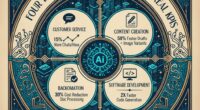
Enterprise AI adoption is booming in 2025, with budgets rising by 75% and investment focusing on customer-facing and generative AI applications. However, sector differences and organizational challenges, like siloed teams and skills gaps, can slow progress. Larger firms and tech sectors lead, but regulatory hurdles and cultural resistance remain obstacles. If you want to understand how these trends impact your industry and strategies, there’s more to explore ahead.
Key Takeaways
- AI budgets are expanding rapidly, with enterprise AI expenditure reaching $13.8 billion in 2024, driven by generative AI adoption.
- Organizational resistance, siloed teams, and governance issues remain key barriers to widespread AI implementation.
- Technology sectors lead in AI adoption, while industries like retail and hospitality show slower integration due to operational challenges.
- AI deployment is concentrated in IT, marketing, and product development, with emerging use cases in autonomous agents and robotics.
- Regulatory uncertainty and skills gaps continue to hinder broader enterprise AI integration efforts in 2025.
Rapid Growth in AI Budgets and Investment Priorities

The rapid growth in AI budgets reflects a clear shift in enterprise priorities, with companies increasingly committing substantial financial resources to AI initiatives. Over the next year, AI spending is projected to rise by 75%, signaling strong confidence in its strategic value. Generative AI, once experimental, now features as a permanent budget line in many organizations, driven by successful internal use cases and rising employee adoption. In 2024, enterprise AI expenditure hit an estimated $13.8 billion—six times higher than the previous year—highlighting the aggressive financial commitment. This surge is especially evident in tech-forward firms focusing on customer-facing generative AI applications. As organizations recognize AI’s potential to transform operations and customer engagement, they’re prioritizing investments to stay competitive in an increasingly digital landscape. Additionally, the increasing understanding of AI’s resource allocation and the importance of skilled talent are shaping how companies plan their future AI strategies.
Organizational Dynamics and Cultural Challenges in AI Adoption

Organizational dynamics and cultural challenges substantially influence the pace and success of AI adoption within enterprises. You might find that internal tensions and divisions slow progress, especially when AI initiatives aren’t aligned with company strategy. Nearly half of C-suite leaders report friction caused by generative AI, often stemming from siloed teams and unclear governance. Without a clear, formal strategy and empowered AI champions, your organization’s adoption success drops markedly. Resistance from employees and departmental conflicts hinder integration, particularly between IT and other units. To overcome these hurdles, a people-first approach is essential—fostering open communication, addressing skills gaps, and building trust. By promoting a culture that values collaboration and transparency, you can accelerate AI integration and maximize its impact across your enterprise. Additionally, understanding the mechanics of organizational structure and processes can help identify areas where AI implementation may face resistance, enabling targeted interventions to facilitate smoother adoption.
Sectoral Variations and Adoption Rates Across Industries

AI adoption varies markedly across industries, with some sectors embracing it more rapidly than others. The Information sector leads, with 25% of firms integrating AI, while Accommodation and Food Services lag at around 2.5%. Technology companies prioritize AI investments, especially in customer-facing applications, driving higher adoption rates. Conversely, industries like retail and manufacturing show slower progress due to operational complexity and regulatory hurdles. Larger firms tend to adopt AI more quickly, but recent data suggest a slowdown in enterprise-wide implementation. Here’s a snapshot:
| Industry | Adoption Rate | Key Focus Areas |
|---|---|---|
| Information | 25% | Data analytics, automation |
| Healthcare | 12% | Patient data, diagnostics |
| Retail | 5% | Customer insights, logistics |
| Accommodation & Food | 2.5% | Service automation |
Furthermore, the pace of AI adoption can be influenced by regulatory considerations, which vary significantly across sectors.
Dominant Functional Areas and Emerging Use Cases of AI

As enterprises adopt AI, certain functional areas stand out as primary drivers of its deployment, with IT, marketing, sales, and product development leading the way. IT leverages AI for automating workflows, enhancing cybersecurity, and managing infrastructure. Marketing and sales focus on generative AI for personalized campaigns, customer engagement, and sales automation. Product development uses AI to accelerate design, testing, and innovation cycles. Customer-facing generative AI applications are rapidly growing, improving support chatbots, virtual assistants, and personalized recommendations. Meanwhile, internal use cases like process automation, data analysis, and workflow optimization continue to drive initial adoption. Emerging use cases include autonomous agents and robotic assistants in logistics, healthcare, and banking, expanding AI’s role beyond internal operations to external revenue opportunities. Maximize Space and Organization
Barriers and Obstacles Hindering AI Integration

Despite the promising growth in AI applications across various functions, many enterprises face significant hurdles that slow down or even halt their progress. Technical limitations, such as integrating agentic and physical AI systems, require complex infrastructure. Operational complexity and siloed initiatives create friction within organizations, reducing efficiency. Workforce readiness remains a challenge, as skills gaps hinder adoption and change management. Regulatory compliance and data security concerns further complicate deployment, especially with sovereignty restrictions. These barriers often lead to fragmented AI efforts and delayed scaling. Additionally, regulatory frameworks can be ambiguous, making organizations hesitant to fully commit to AI initiatives.
Demographic Trends and User Adoption Patterns

Demographic trends reveal that AI adoption spans across all adult generations, with different groups engaging with the technology in unique ways. You’ll find that:
- Gen Z leads in overall adoption, actively integrating AI into both work and personal life.
- Millennials are the heaviest daily users, leveraging AI for productivity and communication.
- 45% of Baby Boomers have used AI recently, with 11% using it daily, showing broad reach.
- Approximately 40% of US employees report AI use at work, doubling since 2023.
- The increasing sophistication of tools is also driven by advancements in AI in Education, enabling diverse tasks and expanding how each generation interacts with AI in meaningful ways.
Frequently Asked Questions
How Are Smaller Enterprises Approaching AI Adoption Amidst Budget Constraints?
You’re likely finding that smaller enterprises approach AI adoption more cautiously due to budget constraints, focusing on critical use cases with high ROI. You might prioritize cost-effective, off-the-shelf solutions and internal skill-building to maximize value without heavy investments. Collaborating with AI vendors or leveraging open-source tools can help you pilot projects and scale gradually, ensuring you stay competitive without overextending financially.
What Role Do AI Ethics and Transparency Play in Enterprise Adoption Strategies?
You need to prioritize AI ethics and transparency in your enterprise adoption strategies to build trust and guarantee responsible use. By clearly communicating how AI models make decisions, addressing bias, and establishing governance protocols, you foster stakeholder confidence. Incorporate ethical guidelines early, involve diverse teams, and maintain transparency about AI capabilities and limitations. Doing so helps mitigate risks, aligns with regulatory expectations, and accelerates wider acceptance across your organization.
How Do Regional Regulatory Differences Impact Sovereign AI Deployment Globally?
You’ll find regional regulatory differences considerably impact sovereign AI deployment worldwide. These regulations dictate where data and models can reside, often requiring local data storage and regional compliance. You must navigate complex legal landscapes, adapt AI solutions to regional rules, and guarantee data sovereignty. Failing to do so risks legal penalties, delays, and reduced trust. To succeed, you need a flexible, region-specific approach that balances innovation with compliance.
What Specific Skills Are Most in Demand for AI Workforce Readiness?
You need to focus on developing technical skills like machine learning, data analysis, and AI programming. Equally important are soft skills such as change management, collaboration, and problem-solving, which help integrate AI into your organization smoothly. Staying current with regulatory compliance, ethical AI practices, and understanding AI architecture will boost your workforce readiness. Continuous learning and cross-disciplinary expertise are essential to keep pace with rapid AI advancements.
How Are Enterprises Measuring ROI From AI Investments in 2025?
You measure ROI from AI investments in 2025 by tracking increased revenue, improved operational efficiency, and cost savings. Enterprises also evaluate success through specific KPIs like faster decision-making, higher customer satisfaction, and enhanced product quality. Many rely on real-time analytics and performance dashboards to monitor AI impact continuously. Additionally, organizations assess intangible benefits such as innovation capabilities and competitive advantage, ensuring AI delivers measurable business value.
Conclusion
As AI continues to weave into your organization’s fabric, imagine a landscape where innovation blooms like endless fields of data-driven possibilities. While hurdles remain, your collective efforts are shaping a future where smarter decisions and seamless integrations become second nature. Keep pushing boundaries, embracing change, and steering the evolving terrain—because in this journey, you’re not just adopting AI, you’re pioneering a transformative wave that will define your industry’s horizon.