
This is the reference page the last eleven articles were building toward.

Get business pricing on tech for your team
- Business-only prices and quantity discounts
- Tax-exempt purchasing
- Multiple users, one account, clear invoices
Over the past weeks this publication has argued that ownership is the only real sovereignty test, that certifications mostly measure practice rather than control, that “not American” is a proxy rather than a standard, and that the binding constraint is increasingly physical. Those are arguments. This is the list.
Every serious supplier a European buyer might actually shortlist, scored on the five things that determine whether a sovereignty claim survives contact with a procurement lawyer:
Ownership (against SecNumCloud’s 24% individual / 39% collective non-EU cap) · Certification (does it test practice or control?) · Jurisdiction (who can compel it) · Weights (can you hold them?) · Exit (can you leave, and at what cost?)
One finding dominates and is worth stating before the table: for almost every company here, the ownership answer is not public. That is the single most important fact in European AI procurement, and it is nobody’s scandal — private companies don’t publish cap tables. But it means the continent’s sovereignty debate is being conducted without the one number its own rules turn on.
Europe’s AI suppliers: the 2026 shortlist
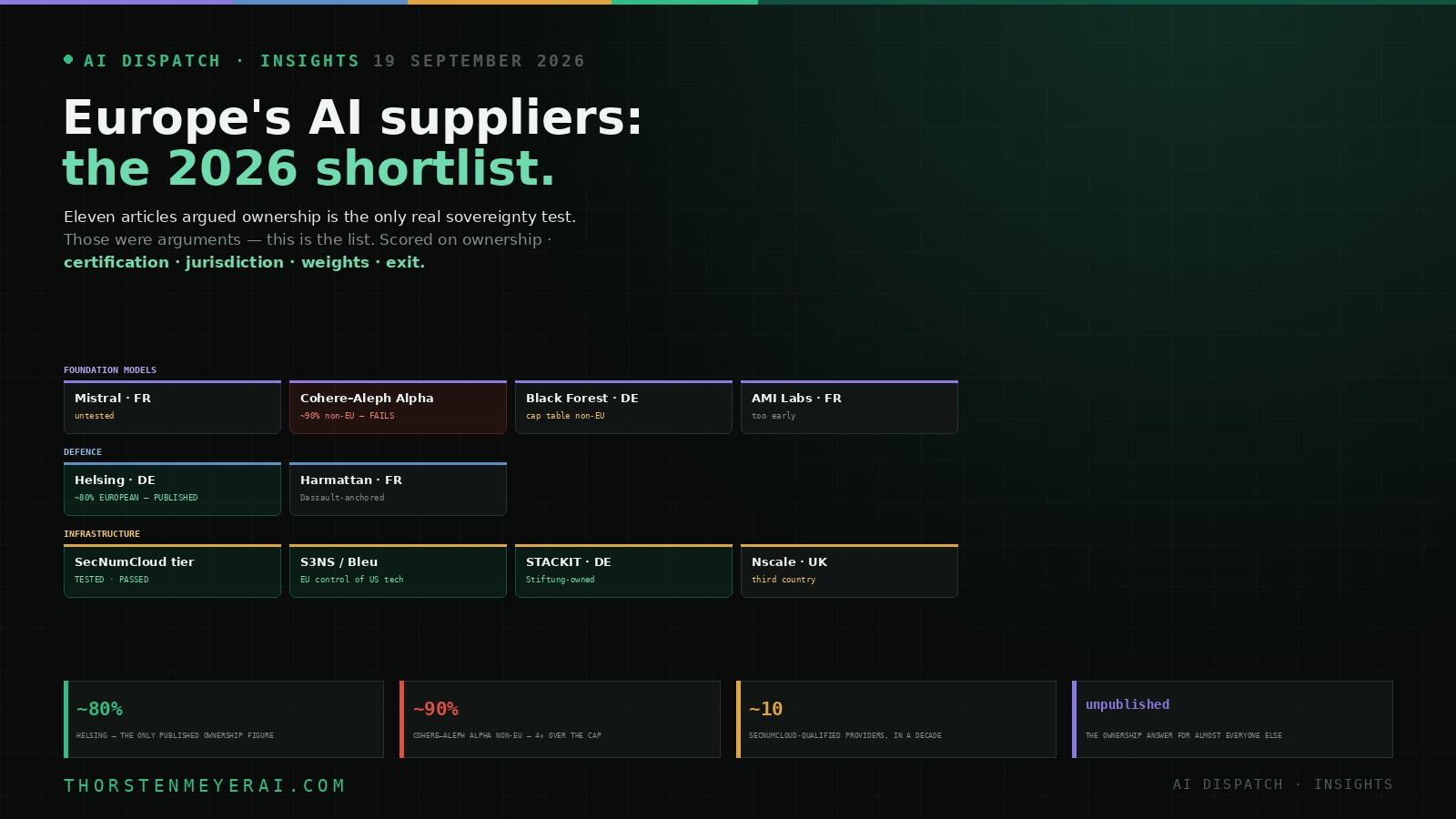
Eleven articles argued that ownership is the only real sovereignty test, certifications mostly measure practice rather than control, and “not American” is a proxy. Those were arguments. This is the list — every supplier a European buyer might shortlist, scored on ownership · certification · jurisdiction · weights · exit.
For almost every company here, the ownership answer is not public. That’s nobody’s scandal — private companies don’t publish cap tables. But it means Europe’s sovereignty debate is being conducted without the one number its own rules turn on (24% individual / 39% collective non-EU). Two exceptions: the SecNumCloud-qualified tier, which has been audited — and Helsing, which publishes.
Defence · classified · DORA · national health data. Your shortlist is short: the SecNumCloud tier, S3NS or Bleu for hyperscaler capability, Mistral for models, Helsing for defence AI. Pay the premium and stop apologizing for the benchmark gap — your alternative isn’t a worse model, it’s no deployment.
Use the best model available, put a router in front of it, and spend the difference on shipping. That argument survived its own steelman and nothing on this page changes it. Everything above the router line, buy only if a law requires it.
Europe’s specialists are excellent and under-celebrated — FLUX, Helsing, ElevenLabs, DeepL, Wayve, Legora are category leaders, not consolation prizes. The generalist race is over as a European story: one French champion with a real jurisdictional edge and a real capability gap, one Canadian-controlled entity with the politics and the balance sheet. Everything else is specialization — the correct strategy, and it should be said out loud rather than treated as retreat. And the ownership data doesn’t exist. Europe built a regime that turns on 24%/39% — then built an industry where almost nobody publishes that number. It’s fixable tomorrow, cheaply: publish your non-EU capital and voting share, update it each round. The ones that do will win procurement they’d otherwise lose. The ones that don’t are telling you something.
The foundation-model tier
Mistral AI — France. Total funding above $3.05B, last equity valuation €11.7B (September 2025 Series C), plus $830M in debt in March 2026 for a Paris data centre. The only European lab with a full-stack ambition: models, Forge, Compute, agents, and a ~1 GW-by-2030 compute target. Ownership: French parent (Mistral AI SAS) — good. ASML is Dutch, therefore EU, so its ~10% doesn’t count against the cap. But a16z, General Catalyst, Lightspeed, Nvidia, Cisco, IBM, Salesforce and DST Global are all non-EU, against a 39% collective ceiling that has never been publicly tested. Certification: SecNumCloud-eligible in principle — the strongest position on the list. Weights: open, Apache-2.0 for much of the range — the most portable option here. Exit: good, because you can hold the weights. The honest caveat: behind the frontier and behind the best Chinese open models on most benchmarks, and it has never disclosed a loss figure.
Cohere–Aleph Alpha — Toronto/Heidelberg. ~$20B combined valuation, Schwarz Group’s €500M leading the Series E, STACKIT as the delivery substrate, dual HQ. Ownership: Cohere shareholders hold roughly 90% — approximately four times over SecNumCloud’s individual cap. This is the only entry where the ownership answer is public, and it fails the EU test while passing the “not American” one. Certification: BSI C5 via STACKIT — which discloses jurisdiction rather than granting immunity. Jurisdiction: Canadian parent, so no CLOUD Act reach — a genuine and underrated strength — but Five Eyes membership and a PIPEDA-scoped adequacy decision are open questions. Weights: enterprise models, not open-weight. Exit: low — a managed relationship on a specific cloud. Best for: German public-sector and enterprise buyers where relationships and BSI C5 clear the bar. Wrong for: French SecNumCloud-gated procurement.
Black Forest Labs — Germany. $3.25B valuation on a $300M round; $450M raised since founding in 2024. FLUX is the honest answer when a developer asks which open image model to use. Ownership: German-domiciled, but the cap table — Salesforce Ventures, a16z, Nvidia, Temasek, Bain Capital Ventures, Canva, Figma Ventures — is heavily non-EU, and the collective share is unpublished. Weights: open, which is the whole point. Best for: anyone who needs generative imaging on infrastructure they control. Narrow, excellent, and portable.
AMI Labs — France. Yann LeCun’s world-models lab, one of the four largest European rounds of Q1 2026. Too early to score on procurement, but it is the most interesting bet on the list because world models are a different architecture rather than a cheaper copy of the same one.
Aleph Alpha — now inside Cohere; see above. Its independent history is a cautionary tale about what happens when a national champion pivots from frontier models to systems integration.
Products Worth Considering

Amazon Kindle Paperwhite (2024), 16 GB, 7-inch Display, Black

Samsung Galaxy Tab S10 Lite – 6 GB RAM, 128 GB storage, up to 2 TB microSD, 10.9‑inch LCD, Gray

Jackery Explorer 300 Portable Power Station, 292Wh
As an affiliate, we earn on qualifying purchases.
The defence tier — and the one company with a published answer
Helsing — Munich. Europe’s most valuable defence-tech company. €12B after Daniel Ek’s €600M Series D in June 2025, with a reported $1.2B round at $18B led by Dragoneer and Lightspeed. Germany’s Bundestag approved an initial €269M HX-2 contract in February 2026 under a framework that could reach €1.46B over seven years. Acquired Keybotic (robot dogs) in January 2026; introduced Lura for submarine detection.
And then the number nobody else on this list publishes: Helsing remains roughly 80% European-owned, per reporting on the round, even though American investors are leading it.
That is the correct way to run this. Take the capital, keep the control, and say what the ratio is. Helsing is the only company here where a procurement officer can check the ownership test against a published figure rather than an inference. Whether 80% survives the next two rounds is the open question — but as a disclosure standard it should be the norm, not the exception.
Harmattan AI — France. $200M Series B at $1.4B, led by Dassault Aviation. The industrial-anchor pattern again: a defence prime backing a defence-AI company, which is the Schwarz/ASML model applied to a sector where it fits naturally.
The infrastructure tier
Nscale — UK. $2B raised in March 2026 at a $14.6B valuation — the largest AI infrastructure round in European history, with Dell and Lenovo among strategic investors. The wrinkle worth noting: Nscale’s partnership with OpenAI on Stargate UK and Stargate Norway means European infrastructure hosting American frontier compute. That is not a criticism — it is a real business and real capacity on European soil. But it is a useful illustration that “European infrastructure” and “European AI sovereignty” are different claims. A European data centre running an American model under an American contract is European in exactly one of the three ways that matter. Also note: the UK is not in the EU. For SecNumCloud and CADA purposes, a British supplier is a third-country supplier.
OVHcloud, Scaleway, 3DS Outscale, Numspot, Cloud Temple, Oodrive — the SecNumCloud-qualified tier. Roughly nine or ten providers hold an active qualification after a decade of the scheme existing. These are the only entries on this entire page that have been independently tested against an ownership rule, which is why they matter out of proportion to their size.
S3NS (Thales–Google) and Bleu (Capgemini–Orange, on Azure) — the joint-venture route. Not European technology; European control of American technology, which SecNumCloud permits by design. If you need hyperscaler capability inside sovereign procurement, this is the sanctioned path.
STACKIT — Schwarz Digits. German-owned, KRITIS-inherited compliance, ~€1.9B division revenue, and the €11B / 200 MW Lübbenau build behind it. The strongest ownership story in European cloud, with the caveat that concentrating national capability in one privately-held conglomerate is its own kind of dependency.
The specialist tier
Worth shortlisting where they fit, not worth pretending they’re foundation-model competitors:
Wayve (UK, $1.2B, autonomous driving) · ElevenLabs (voice) · DeepL (translation) · Poolside (France, code) · Synthesia (UK, video) · Quantexa (UK, decision intelligence) · Owkin (France, biotech) · Isomorphic Labs (UK, $2.1B, drug discovery) · Legora (Sweden, legal, >$100M ARR at $5.6B) · Parloa, n8n, Neura Robotics (Germany).
The pattern here is the one this publication reached in the Cohere analysis: the generalist European LLM lab is a two-horse race and one horse is Canadian. The specialists are where European AI is actually winning — narrow, deep, defensible, and in several cases genuinely world-leading.
The allied tier — new this month
If associate membership proceeds, the shortlist grows:
Cohere (above), plus the research institutes — Mila (Montreal), Vector (Toronto), Amii (Edmonton) — as partners rather than suppliers, and Canada’s AI Sovereign Compute Infrastructure Program as potential capacity.
But per this week’s earlier pieces: no assurance-level pathway exists yet, the ownership arithmetic doesn’t clear, the adequacy decision hasn’t been tested against intelligence law, and the energy is rationed. Allied tier means “watch and negotiate,” not “buy.”
The scorecard
| Supplier | Ownership vs 24/39 | Certification | Jurisdiction | Weights | Exit |
|---|---|---|---|---|---|
| Mistral | FR parent; non-EU VC share untested | SecNumCloud-eligible | EU | Open | Good |
| Cohere–Aleph Alpha | ~90% non-EU — fails | BSI C5 (discloses, ≠ immunity) | CA — no CLOUD Act; Five Eyes open | Closed | Low |
| Black Forest Labs | DE-domiciled; cap table heavily non-EU | — | EU | Open | Good |
| Helsing | ~80% European — published | Defence-grade, contract-specific | EU | Closed | Low (by design) |
| Harmattan | FR; Dassault-anchored | — | EU | Closed | Low |
| Nscale | UK = third country | — | UK | n/a (infra) | Medium |
| SecNumCloud tier | Tested and passed | SecNumCloud | EU | n/a | Medium |
| S3NS / Bleu | EU-controlled JV | SecNumCloud (S3NS) | EU control of US tech | n/a | Medium |
| STACKIT | DE, Stiftung-owned | BSI C5, ISO, SOC 2, DORA | EU | n/a | Medium |
How to actually use this
If you are legally bound — defence, classified, DORA, national health data — your shortlist is short: the SecNumCloud-qualified tier, S3NS or Bleu for hyperscaler capability, Mistral for models, Helsing for defence AI. Pay the premium and stop apologizing for the benchmark gap; your alternative isn’t a worse model, it’s no deployment.
If you are not bound — and statistically you are not — use the best model available, put a router in front of it, and spend the difference on shipping. That argument survived its own steelman, and nothing on this page changes it.
Either way, ask the six questions: who is your ultimate parent and where is it incorporated; what percentage of capital and voting rights is non-EU; who holds the keys and can they be compelled; which of your certifications tests ownership rather than practice; what is your CADA recognition roadmap; and what does exit cost in months.
If a vendor can’t answer the first two immediately, the rest of the meeting is theatre.
The take
Assemble the whole board and three things are clear.
Europe’s specialists are genuinely excellent and under-celebrated. FLUX, Helsing, ElevenLabs, DeepL, Wayve, Legora — these are not consolation prizes. They are category-leading companies that happen not to be frontier LLM labs, which is the one scoreboard Europe was never going to win at this capital level.
The generalist race is over as a European story. One French champion with a real jurisdictional advantage and a real capability gap, and one Canadian-controlled entity with the political backing and the better balance sheet. Everything else is specialization, which is the correct strategy and should be said out loud rather than treated as a retreat.
And the ownership data doesn’t exist. This is the finding that should change behaviour. Europe built a sovereignty regime that turns on a specific number — 24% individually, 39% collectively — and then built an industry where almost nobody publishes that number. Helsing publishes. The SecNumCloud tier has been audited. Everyone else is asking to be trusted on the one question their own regulator says is decisive.
That is fixable, cheaply, tomorrow. Any European AI company that wants to be taken seriously as a sovereign supplier can publish its non-EU capital and voting share and update it each round. The ones that do will win procurement they would otherwise lose. The ones that don’t are telling you something.
Read the certificate, then the shareholder register. And if the register isn’t available, that is the answer.
Sources: Mistral’s total funding (>$3.05B), €11.7B September 2025 Series C valuation and $830M March 2026 debt round via AI Funding Tracker and Crunchbase-derived reporting; Cohere–Aleph Alpha terms (~$20B, ~90/10 split, Schwarz €500M, STACKIT) as previously reported here; Black Forest Labs’ $300M at $3.25B, $450M total, and investor list via Crunchbase News; Helsing’s €12B June 2025 Series D (Daniel Ek), the reported $1.2B round at $18B led by Dragoneer and Lightspeed, the ~80% European ownership figure per FT-sourced reporting, the February 2026 Bundestag €269M HX-2 contract within a framework up to €1.46B over seven years, the Keybotic acquisition and Lura, via Entrepreneurloop and AI Funding Tracker; Harmattan AI’s $200M Series B at $1.4B led by Dassault Aviation via o-mega; Nscale’s $2B March 2026 round at $14.6B, Dell/Lenovo participation and the Stargate UK/Norway partnership via AI Funding Tracker, GoHub Ventures and o-mega; Wayve ($1.2B), Isomorphic Labs ($2.1B), Neura Robotics, Legora ($600M at $5.6B, >$100M ARR) via GoHub Ventures and AI Funding Tracker; the European top-20 composition via Foundevo; SecNumCloud qualified-provider counts, the 24%/39% caps, S3NS and Bleu, and CADA Article 17 per ANSSI documentation and this publication’s earlier certification analysis; STACKIT and Lübbenau figures as previously reported here. Valuations and round terms are as reported, several are unconfirmed by the parties, and private ownership percentages are generally not public — where this page says an ownership share is untested or unpublished, that is the finding, not an omission. Not investment advice; procurement decisions require qualified counsel. Analysis and framing are the author’s.