
Executive summary
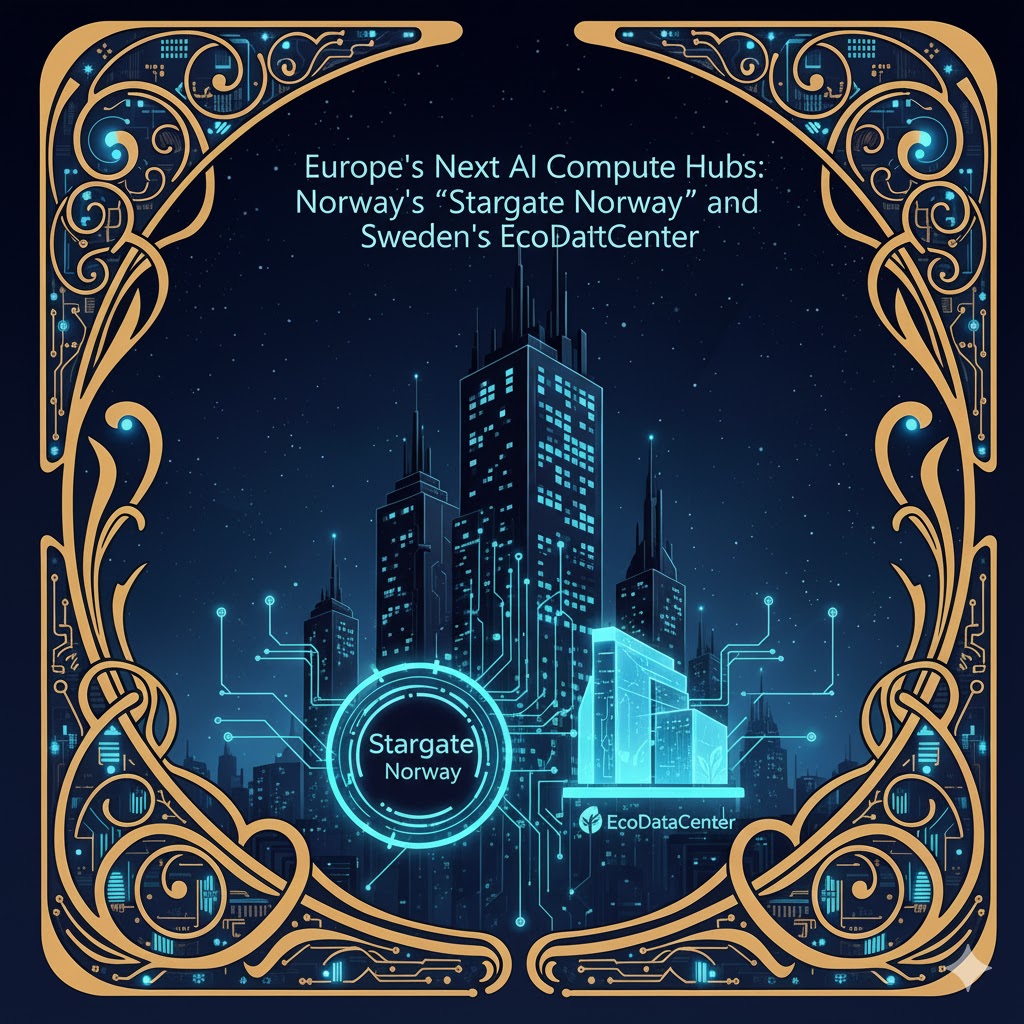
Two Nordic projects are fast-tracking Europe’s sovereign AI capacity: Stargate Norway (a joint venture between Nscale and Aker with OpenAI as first customer) and EcoDataCenter (Sweden). Together they reflect Europe’s pivot from colocation to AI-grade, GPU-dense, renewable-powered infrastructure—with firm capex commitments, grid plans, and anchor tenants already in motion. Expect accelerated build-outs through 2026, with knock-on effects for model training, enterprise private GenAI, and the regional supply chain (power, cooling, networking, and services). Reuters+2nscale.com+2

NVIDIA Quadro RTX 6000
CUDA Cores: 4608 / NVIDIA Tensor Cores: 576 / NVIDIA RT Cores: 72
As an affiliate, we earn on qualifying purchases.
As an affiliate, we earn on qualifying purchases.
1) Project briefs
Stargate Norway (Narvik/Kvandal, Northern Norway)
- Structure & partners. 50/50 JV between Nscale and Aker; OpenAI named as the first customer. Initial phase capex is about $1B. Long-term expansion pathways are explicitly planned. Reuters+1
- Scale & timeline. Targeting ~100,000 NVIDIA GPUs by end-2026, framed as OpenAI’s first European “AI gigafactory.” Early phases start at ~230 MW power, with a path toward ~520 MW as grid capacity is secured. Sited in Kvandal (near Narvik) for access to hydropower and cool climate. Reuters+2Aker Horizons+2
- Sovereignty & sustainability. Marketed as sovereign EU/EEA compute with renewable hydro; aligned to “OpenAI for Countries / Stargate” strategy. Local utility partnerships (e.g., Nordkraft) are part of the grid ramp. OpenAI+1
- Momentum signals. Aker has also invested directly in Nscale; subsequent reporting points to additional sites under consideration in Northern Norway—evidence of a multi-site strategy. e24.no+2highnorthnews.com+2
EcoDataCenter (Falun & Borlänge, Sweden)
- Financing & footprint. €600M debt facility (Deutsche Bank Private Credit & Infrastructure) announced 9 Sept 2025, to scale AI-focused campuses in Sweden. Part of a larger capital stack raised since 2023. Reuters+2ecodatacenter.tech+2
- AI-ready tenants. DeepL has deployed an NVIDIA DGX SuperPOD with GB200 NVL72 systems at EcoDataCenter Falun; reported customers also include BMW. datacenterdynamics.com+1
- Positioning. Sweden’s grid stability, renewable mix, and climate give EcoDataCenter a cost/performance edge for training and fine-tuning workloads, plus opportunities for heat-re-use and high-density liquid cooling. Reuters

The Data Center Mandate: Aligning Data Infrastructure with Enterprise Purpose and Profit
As an affiliate, we earn on qualifying purchases.
As an affiliate, we earn on qualifying purchases.
2) Why these matter now
- Shift from generic DCs to AI-grade clusters. Both projects are purpose-built for GPU-dense, low-latency, high-bandwidth training clusters (NVLink fabrics, next-gen NVIDIA systems), which typical enterprise DCs are not optimized to host. This shortens Europe’s time-to-capacity for frontier-scale model training and large-scale inference. Reuters+1
- Sovereign compute & data gravity. Locating capacity in-region addresses European concerns over data protection, export controls, and resilience. Expect more national programs and anchor-tenant deals linking public-sector use, enterprises, and model labs. OpenAI
- Decarbonized power as a competitive moat. Nordic hydropower + cool ambient temps lower PUE and total cost of training; this increasingly becomes a buyer requirement for hyperscale AI contracts. Reuters+1

ECO-WORTHY RACK6 V2, 6-Layer Server Rack with 600A Busbar, Compatible with All ECO-WORTHY Rack Battery Versions
Designed for ECO-WORTHY 48V 100Ah Server Rack Battery: This rack is specifically designed for ECO-WORTHY 48V 100Ah rack…
As an affiliate, we earn on qualifying purchases.
As an affiliate, we earn on qualifying purchases.
3) Technical profile (at a glance)
- Compute targets. Stargate Norway publicly cites ~100k NVIDIA GPUs in early build-out; EcoDataCenter is not disclosing totals but is already hosting a DGX SuperPOD (GB200 NVL72) for DeepL. Reuters+1
- Power & cooling. Stargate’s ~230 MW → ~520 MW roadmap implies multi-phase substations and high-efficiency cooling; EcoDataCenter’s campuses emphasize AI-grade power density and heat-reuse options. Reuters+1
- Network. Expect NVLink/NVSwitch fabrics inside clusters and multiple terabit uplinks to Nordic and continental backbones for burst traffic and replication. (Inference based on announced NVIDIA systems and AI training norms; corroborated by vendor notes around SuperPOD/GB200 systems.) datacenterdynamics.com

The AI Factory Handbook: Build, Manage, and Scale NVIDIA AI Infrastructure (NCA-AIIO Exam Prep & Real-World Operations)
As an affiliate, we earn on qualifying purchases.
As an affiliate, we earn on qualifying purchases.
4) Regulatory and grid realities
- Permitting & grid queueing. Northern Norway and central Sweden offer relative grid headroom versus congested metro hubs, but delivery still hinges on substation buildouts, transmission upgrades, and phased energization—especially if clusters scale beyond 500 MW. Reuters+1
- EU/EØS policy tailwinds. Projects market themselves as energy-efficient and renewable-powered, anticipating tighter EU scrutiny on data-center sustainability and waste-heat re-use. (Multiple EC proposals and national directives trend in this direction; both projects highlight green credentials in press materials.) nscale.com+1
- Sovereignty narrative. OpenAI’s “Stargate” language emphasizes on-continent, sovereign infrastructure—a political and procurement lever for European governments and critical industries (finance, health, mobility). OpenAI
5) Risk map
- Chip & supply-chain risk. The GPU/NIC/networking supply chain remains the gating factor. Schedule risk rises if Blackwell-class lead times slip or if export regimes tighten. (Market-wide risk, reflected in vendor backlogs and public disclosures.) datacenterdynamics.com
- Grid & permits. Even in hydropower-rich regions, 230–520 MW ramps require careful coordination with TSOs/DSOs; delays in transmission upgrades can push out go-live dates. Reuters
- Capex/interest-rate sensitivity. EcoDataCenter’s debt-led expansion and Nscale/Aker’s multi-phase capex mean sensitivity to funding costs and refinancing windows. Still, anchor workloads (OpenAI, DeepL, blue-chip enterprises) help reduce demand risk. Reuters+1
- Policy volatility. Evolving EU energy efficiency rules for DCs and national power-pricing reforms could alter opex assumptions, although Nordic renewables remain structurally advantaged. ecodatacenter.tech
6) Competitive positioning
- Anchor-tenant model. Stargate Norway’s “first customer: OpenAI” is a strong signal to other hyperscalers and national buyers. EcoDataCenter’s DeepL SuperPOD makes it a reference site for language-AI training in Europe. OpenAI+1
- Multi-site optionality. Reports of additional Nscale/Aker sites in Nordland (e.g., Korgen) point to a portfolio strategy—diversifying grid risk and shortening deployment timelines via parallel construction. highnorthnews.com
- Ecosystem halo. Expect accelerated activity around liquid cooling vendors, transformer/substation EPCs, heat-re-use integrators, dark-fiber providers, and AI ops/observability vendors near both hubs. (Inference from announced specs and Nordic DC build patterns.) Reuters
7) What it means for enterprises (2026–2029)
- Private GenAI with locality guarantees. Regulated sectors gain more options to place RAG/training close to European data estates with contractual sovereignty—reducing compliance friction versus non-EU clouds. OpenAI
- Lower-carbon AI SLAs. Procurement will start to include emissions-intensity and heat-re-use clauses; Nordic sites make it feasible without exorbitant premiums. nscale.com+1
- Faster experimentation cycles. With in-region capacity, teams can iterate fine-tunes/agents faster (less cross-border latency, fewer data-movement constraints). Early access programs around these campuses will be strategic.
8) Actionable opportunities for builders & investors
- Power & cooling: Package liquid cooling + containment + monitoring tailored to GB200/GB300-class racks; offer retro-commissioning to maintain PUE/PUE-weighted SLAs. (Anchor your pitch to EcoDataCenter’s SuperPOD and Stargate’s >200MW ramps.) datacenterdynamics.com+1
- Waste-heat valorization: Build heat-network integrations and district-heating partnerships—a differentiator in municipal approvals and ESG reporting. ecodatacenter.tech
- Sovereign AI services: Productize “EU-sovereign RAG stacks” (ingestion, policy, red-teaming, observability) to run near these clusters; target public sector and industrial buyers first. OpenAI
- Network & data mobility: Offer line-rate encryption, DPUs, WAN acceleration, and peering setups for hybrid topologies (on-prem ↔ Nordic AI hubs ↔ main cloud). Reuters
- Talent & ops: Nordic build-outs will create shortages in high-density DC ops, liquid-cooling techs, and power engineers—a niche for training providers and staffing firms aligned to these sites. Reuters
9) Side-by-side snapshot (key deltas)
- Anchor tenants: Stargate → OpenAI (first customer); EcoDataCenter → DeepL (DGX SuperPOD), BMW among enterprise customers. OpenAI+2datacenterdynamics.com+2
- Power trajectory: Stargate phase-in ~230 MW → ~520 MW; EcoDataCenter growing via staggered campus buildouts (Falun/Borlänge) backed by new debt. Reuters+1
- Compute intent: Stargate has an explicit ~100k GPU target by 2026; EcoDataCenter publishes system class (DGX SuperPOD/GB200) rather than total GPU counts. Reuters+1
- Capital model: Stargate launch phase ~$1B; EcoDataCenter €600M debt in Sept 2025 plus prior equity/asset moves to recycle capital. Reuters+1
10) What to watch next (signals & dates)
- 2026 energization milestones in Narvik/Kvandal; substation and transmission project progress notices from local grid partners (Nordkraft, TSO/DSO filings). Reuters
- Additional Norwegian sites (e.g., Korgen) reaching land, permit, and grid-connection decisions—confirmation of a multi-hub strategy. highnorthnews.com
- Tenant announcements at EcoDataCenter (new SuperPOD footprints, additional automotive/industrial AI deployments). Reuters
- EU policy updates on energy-efficient data centers and heat reuse reporting—these could become procurement requirements and pricing levers for Nordic providers. ecodatacenter.tech
Appendices (sources)
- Reuters on Stargate Norway capex, power, and GPU targets; location near Narvik; and expansion path. Reuters+1
- Nscale & Aker press materials confirming KVANDAL/Narvik siting and JV structure; OpenAI blog introducing Stargate Norway and “OpenAI for Countries.” nscale.com+2Aker Horizons+2
- Reuters/Bloomberg/DataCenterDynamics on EcoDataCenter’s €600M debt raise, DeepL DGX SuperPOD (GB200 NVL72), site locations (Falun/Borlänge), and client set (BMW). datacenterdynamics.com+3Reuters+3bloomberg.com+3
- Regional follow-ups on additional Norwegian sites indicating portfolio scaling (Korgen/Nordland). highnorthnews.com
Bottom line
By late-2026, the Nordics are on track to host some of Europe’s most consequential AI training clusters. If you’re planning enterprise GenAI programs (or building tools to serve them), align pilots and partnerships now—before capacity is fully spoken for and integration slots tighten.