
Everyone is racing to build smarter chatbots. TypeSafe AI is betting that most of the AI work inside businesses doesn’t need a chatbot at all.

Get business pricing on tech for your team
- Business-only prices and quantity discounts
- Tax-exempt purchasing
- Multiple users, one account, clear invoices
Over the past three years, nearly every major model launch has promised the same things: better reasoning, longer context, better code. The launch of Jev went the other way. On September 15, 2026, TypeSafe announced a model that doesn’t generate text at all. datacamp
That sounds like a step backwards, but it isn’t. Jev is the most interesting challenge in a while to a common assumption in enterprise AI: that every problem should be handed to a large language model.
Jev vs. LLMs: who should make the call?
Jev, from TypeSafe AI, is a “System One” model. It doesn’t write text. It returns a typed decision with a confidence score that your software can act on directly.
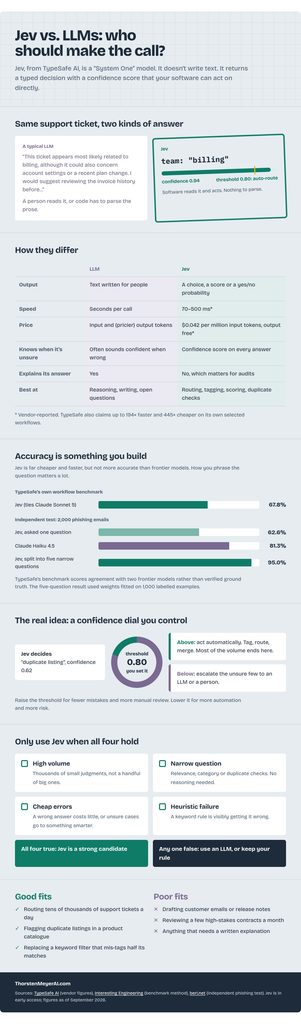
Same support ticket, two kinds of answer
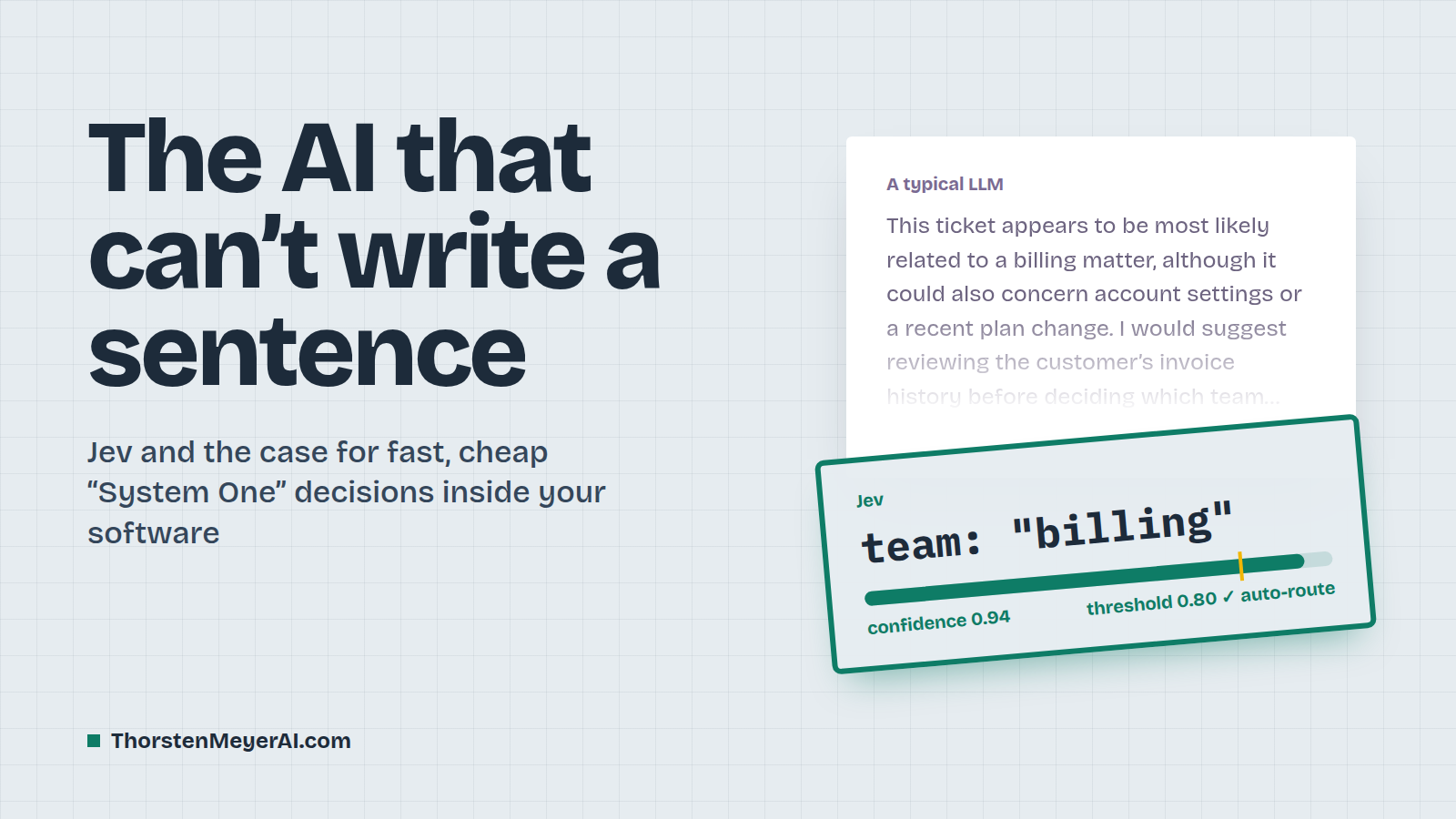
“This ticket appears most likely related to billing, although it could also concern account settings or a recent plan change. I would suggest reviewing the invoice history before…”
A person reads it, or code has to parse the prose.
team: "billing"Software reads it and acts. Nothing to parse.
How they differ
| LLM | Jev | |
|---|---|---|
| Output | Text written for people | A choice, a score or a yes/no probability |
| Speed | Seconds per call | 70–500 ms* |
| Price | Input and (pricier) output tokens | $0.042 per million input tokens, output free* |
| Knows when it’s unsure | Often sounds confident when wrong | Confidence score on every answer |
| Explains its answer | Yes | No, which matters for audits |
| Best at | Reasoning, writing, open questions | Routing, tagging, scoring, duplicate checks |
* Vendor-reported. TypeSafe also claims up to 194× faster and 445× cheaper on its own selected workflows.
Accuracy is something you build
Jev is far cheaper and faster, but not more accurate than frontier models. How you phrase the question matters a lot.
TypeSafe’s benchmark scores agreement with two frontier models rather than verified ground truth. The five-question result used weights fitted on 1,000 labelled examples.
The real idea: a confidence dial you control
“duplicate listing”, confidence 0.62
Raise the threshold for fewer mistakes and more manual review. Lower it for more automation and more risk.
Only use Jev when all four hold
Good fits
- Routing tens of thousands of support tickets a day
- Flagging duplicate listings in a product catalogue
- Replacing a keyword filter that mis-tags half its matches
Poor fits
- Drafting customer emails or release notes
- Reviewing a few high-stakes contracts a month
- Anything that needs a written explanation
What Jev actually is
TypeSafe describes System One Models as a new class of AI model built for decisions inside software, with Jev as its first public release, optimized for automation. You send Jev structured questions and get back typed decisions with probabilities and confidence that your software can act on. typesafe
The name comes from psychology. The category is named after Daniel Kahneman’s fast, intuitive System 1 thinking, and the defining trade is giving up free-form text generation in exchange for parallel sampling, guaranteed schema conformance, and a probability attached to every answer. In Kahneman’s terms, System 2 is slow, deliberate reasoning. System 1 is the quick gut call an experienced person makes without thinking it through. truefoundry
The pedigree is notable. Jev launched with $40M in funding led by DCVC and was built by Diogo Almeida, who co-invented RLHF and InstructGPT at OpenAI. Almeida helped create the training technique behind modern chat assistants, and his new company is openly arguing that the same technique is a poor fit for automation. TypeSafe argues that RLHF creates inherent issues such as mode dropping, overconfidence, and lack of reliability, which mean LLMs require humans in the loop. Its alternative is a training method it calls Reinforcement Learning for Calibrated Decisions (RLCD). devtypesafe
Decisions, not strings
The simplest way to see the difference is to picture one support ticket going through two systems.
An LLM gives you prose: “This looks like it’s probably a billing issue, although it could also relate to account settings…” A human then reads that, or an engineer writes code to pull a usable answer out of the paragraph.
Jev gives you something like team: billing, confidence: 0.94. Nothing needs to be parsed. The software reads the answer and acts on it.
Jev takes program state plus a set of typed questions and answers all of them in a single parallel pass, returning structured values with calibrated probabilities instead of generated text. It handles three kinds of questions: choices, scores, and yes-or-no probabilities.
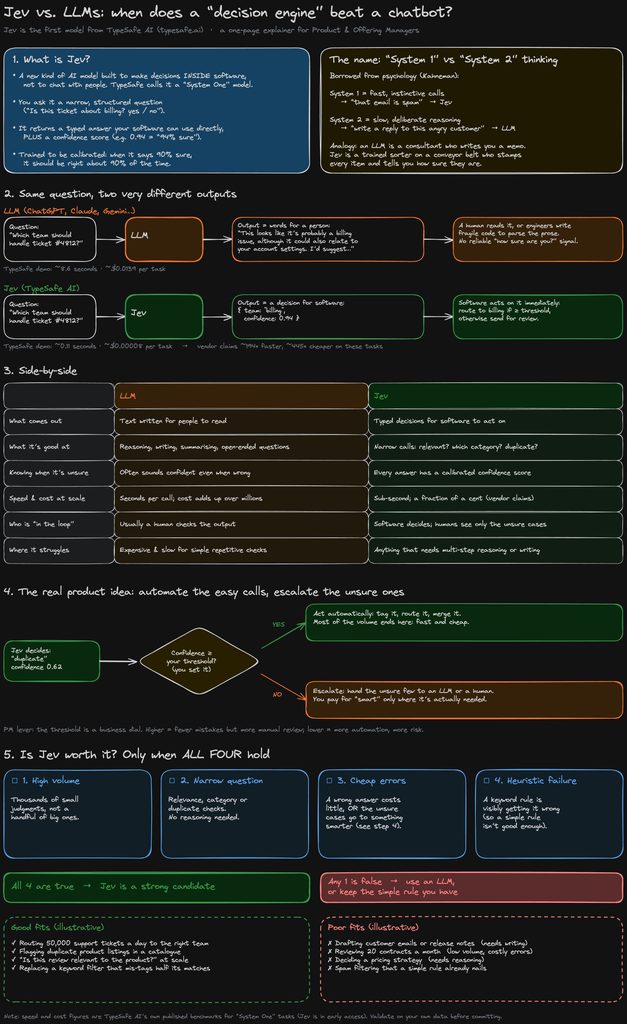
TypeSafe summarizes its pitch as “LLMs produce words for people. Jev produces typed decisions and is more like code.” In practice, that means Jev behaves less like a colleague you consult and more like a function your software calls. typesafe
The economics are the headline
The speed and cost claims are what got people’s attention. Jev answers in 70 to 500 milliseconds, at $0.042 per million input tokens with output free. On its homepage, TypeSafe claims Jev is 193.6x faster and 444.6x cheaper, based on workflows for System One tasks. devtypesafe
The strategic point matters more than the exact multiples. As one practitioner guide puts it, the bet is that most decisions inside software are System 1 judgments (“which bucket is this?”, “is this urgent?”) and we have been renting System 2 to make them. Many companies pay reasoning-model prices to answer yes/no questions. When a decision costs a fraction of a cent and returns faster than a page loads, the list of things worth automating gets much longer. dev
What “zero hallucinations” really means
TypeSafe markets Jev as having zero hallucinations. The claim is technically accurate but narrow, and anyone responsible for a product decision should understand exactly how narrow.
TypeSafe is using a software-oriented definition: Jev cannot invent an off-schema answer or malformed tool call because its possible outputs are fixed. Schema compliance does not guarantee a correct decision. Jev can still select the wrong allowed answer. runtimewire
In other words, Jev eliminates the class of error that comes from output formatting, and does nothing at all about the class that comes from judgment. That is still valuable. A made-up category name or a broken data structure can crash an automated pipeline, and Jev rules those out. But choosing the wrong one of your allowed options remains entirely possible. orcarouter
The benchmark caveats are real
The coverage has been sober, and it’s worth taking seriously.
The first issue is how accuracy was measured. TypeSafe’s workflow benchmark uses the average of GPT-6 Astra and Claude Fable 5.1 as the reference answer. That measures agreement with two frontier models, not correctness. On the company’s own chart, Jev ties Sonnet 5 at 67.8 per cent. To TypeSafe’s credit, its own launch post is candid. The company says its shorter inputs can favor Jev, its workflow authors may have introduced bias, and the advertised gains probably sit near the high end of what users should expect. Substackruntimewire
The first independent tests support that caution and add a useful lesson. In a reproducible benchmark, Jev scored 62.6% on a 2,000-email phishing test when asked one question, against Claude Haiku 4.5’s 81.3%. Split into five narrow questions, with weights fitted on 1,000 labelled examples, it reached 95.0% on the other 1,000. The same test found its probabilities came out overconfident on some question types and underconfident on others. beriberi
The takeaway is that the accuracy is something you build, not something you buy. Jev doesn’t reward you for asking one big vague question. It rewards you for breaking a judgment into several small, sharp questions and combining the answers in code. That makes the work closer to product design than to prompt writing. beri
One more limitation matters for regulated industries: Jev returns probabilities but no natural-language rationale, which reviewers flag as a real constraint for debugging and for audits in regulated domains. If your compliance team needs to know why an application was scored a certain way, a confidence number alone won’t satisfy them. datacamp
The real product idea: a confidence dial
What I find most promising is not the price but the operating model it makes possible. Because Jev returns typed decisions with calibrated probabilities, you can set the thresholds for when it acts autonomously and when it asks for review. typesafe
That turns AI deployment into a business setting you can tune. Above the threshold, the system acts automatically: it tags, routes, merges, or approves. Below it, the case goes to a more capable LLM or to a person. A higher threshold means fewer errors and more manual review. A lower one means more automation and more risk. That is a decision product and operations leaders can own, rather than something buried in model internals.
It also points to a sensible architecture. In one analysis, Jev classifies and routes cheaply, deterministic code handles what it can, and a frontier model takes the hard minority. The value is fewer expensive LLM calls and a clear, auditable boundary between “the machine decided” and “a person should” look. eigent
When Jev is worth it: the four-condition test
Jev is not a replacement for your LLM. It’s a specialist tool, and a narrow one. My rule of thumb is that it’s only worth using when all four of these conditions hold.
High volume. You’re making thousands of small judgments, not a handful of big ones. At twenty contract reviews a month, the savings round to zero.
A narrow question. The task is a relevance, category, or duplicate check that needs no reasoning. If a knowledgeable person couldn’t make the call in a few seconds, it isn’t a System One question.
Cheap errors. A wrong answer costs little, or the uncertain cases are routed to something smarter. The confidence dial exists for exactly this situation.
Heuristic failure. A keyword rule is visibly getting it wrong. If a simple rule already works, keep the rule. It’s free, transparent, and fully predictable.
If any one of these fails, use an LLM or stay with what you have. Good candidates include routing tens of thousands of support tickets a day, flagging duplicate listings in a product catalogue, or replacing a keyword filter that mis-tags half its matches. Poor candidates include drafting customer emails, reviewing a small number of high-stakes contracts, or anything where someone needs to read an explanation.
What leaders should do now
Jev is early. It’s a proprietary model served from TypeSafe’s own hosted API, currently behind an early-access waitlist, with no published weights and no on-prem option today. European organizations in particular will want to look closely at data residency before sending anything sensitive through it. truefoundry
The low cost makes a practical first step easy. The recommended move is a shadow eval on your own labelled decision log, which costs cents, before a single production decision moves. Take a high-volume decision your team already makes. Run Jev in parallel with your current process without letting it act, then compare its answers and confidence scores against what actually happened. Within a few weeks, you’ll know from your own data whether the numbers hold up. beri
The bigger lesson goes beyond one startup. The AI industry has spent years assuming the smartest model is the right model. Jev is a reminder that fit matters more than peak intelligence. Most of the decisions inside a business are quick, repeated, and dull, and for those, a fast, cheap, well-calibrated gut call may be worth more than an eloquent essay.
Speed, cost, and accuracy figures are TypeSafe AI’s own published numbers unless otherwise attributed; independent evaluation is still at an early stage.
Products Worth Considering

Jackery Explorer 300 Portable Power Station, 292Wh

Logitech MX Master 4 Ergonomic Wireless Mouse with Haptic Feedback, Graphite

Apple iPad 11-inch (A16 Chip, 128GB, Wi-Fi, Pink)
As an affiliate, we earn on qualifying purchases.