
Introduction
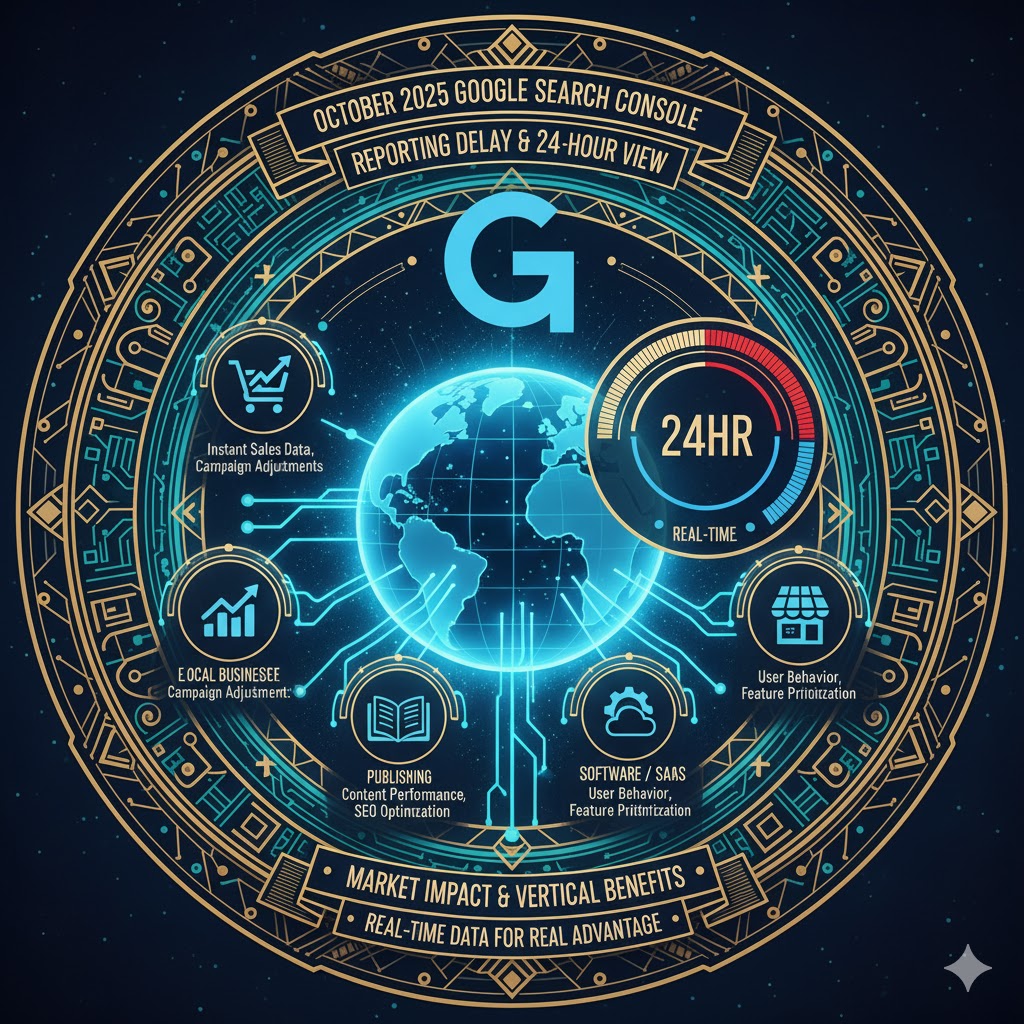
Google Search Console (GSC) is an indispensable tool for website owners and marketers. Its performance report tracks search visibility metrics—clicks, impressions, average click‑through rate (CTR) and average position—and allows users to analyze traffic trends over time, identify queries, and compare mobile and desktop performancesupport.google.com. In late 2024 Google added a “24‑hour” view that shows the last available 24 hours of data with only a few hours of delay; this view retains the usual metrics and offers hourly granularity in the site owner’s local time zonedevelopers.google.com. The 24‑hour view provides near‑real‑time insights, which digital marketers can use for rapid decision‑making and reportingorangeglobal.in.
On 19 October 2025, GSC’s performance report stopped updating data. Reports for 7‑day, 28‑day or longer windows froze at 19 October, while the 24‑hour view continued to display new data. Google acknowledged this as a reporting‑pipeline issue and said the data would “catch up” in the coming dayssearchengineland.com. The delay has created uncertainty because many businesses depend on GSC metrics to plan SEO and evaluate campaigns. This report examines the market impact, how different industry verticals can benefit from the 24‑hour view, and how the disruption influences competition.
Top picks for "market impact vertical"
Open Amazon search results for this keyword.
As an affiliate, we earn on qualifying purchases.
Impact of the October 2025 Data Freeze
Nature of the outage
Search Engine Land and Search Engine Roundtable reported that the performance report stopped updating after 19 October 2025, affecting all sites—not just specific accountssearchengineland.comseroundtable.com. Google’s Daniel Waisberg confirmed that data is being collected and the freeze is limited to reporting; he assured users that the issue is being fixed and the back‑logged data will catch upsearchengineland.com. The 24‑hour view still shows recent data, so search visibility and rankings themselves remain unaffectedseroundtable.com. Consequently, site owners should not modify websites, disavow links or change tracking code; instead they should rely on alternative analytics tools (e.g., GA4) and annotate reports with the issueeliteseoconsulting.com.
Short‑term market disruption
- Decision‑making delays: Many SEO strategies rely on trending data. Without updated metrics, marketers may delay product launches, promotional campaigns or site optimizations. While the 24‑hour view offers hourly data, some organizations are still unfamiliar with this feature, so the freeze could slow down their reactions.
- Reporting uncertainty: Agencies preparing weekly or monthly reports must explain the data gap, potentially affecting client confidence. This may strain agency–client relationships and require careful communication to avoid misinterpretation or over‑reactioneliteseoconsulting.com.
- Increased reliance on alternative data: Marketers might temporarily depend more on GA4, server logs, paid‑search platforms and rank‑tracking tools to verify performance. For organizations with robust analytics, this is manageable, but smaller businesses may lack redundant measurement systems.
- Competitive pressures: During the freeze, competitors who quickly adapt by using the 24‑hour view or alternative data sources could gain an informational advantage, particularly in verticals where timing is critical (e.g., retail promotions or news publishing). Those that continue to make decisions based on stale data risk being outpaced.
Vertical‑Specific Benefits and Challenges
E‑commerce and Retail
E‑commerce sites rely heavily on search visibility to drive sales. GSC helps identify which products attract traffic and conversions and which keywords customers useralfvanveen.com. The 24‑hour view enables merchants to:
- React to daily fluctuations: They can monitor the impact of promotions or flash sales almost immediately and adjust bids, pricing or stock levels accordingly. OrangeGlobal notes that near‑real‑time data improves communication with clients and supports proactive campaign adjustmentsorangeglobal.in.
- Identify technical issues quickly: If a product page drops from SERPs due to indexing problems, the 24‑hour view reveals the sudden drop in clicks or impressions. This rapid signal allows teams to fix crawling issues, preventing lost sales.
During the reporting freeze, e‑commerce businesses may delay optimization decisions because 7‑day and 28‑day windows show no change. Competitors who leverage 24‑hour data or alternative analytics can detect and exploit trends faster, potentially capturing market share.
Local Businesses and Service Providers
Local businesses depend on being found for “near me” searches. Statistics show that 98 % of consumers search online for nearby companies, 76 % of “near me” mobile searches lead to a store visit within 24 hours, and 28 % of local searches result in a purchasewiserreview.com. GSC can reveal which queries drive these visits and help fix findability issuesralfvanveen.com. The 24‑hour view benefits local businesses by:
- Monitoring daily foot‑traffic drivers: They can see which queries bring customers today (e.g., “plumber open now”) and adjust business hours or on‑site messaging accordingly.
- Measuring impact of local events: When a festival or local promotion occurs, near‑real‑time data reveals search interest spikes. Owners can adapt inventory or staffing based on this insight.
During the freeze, local businesses risk misjudging weekly performance and may cut budgets prematurely. Those who adopt the 24‑hour view and cross‑reference with local search statistics maintain more accurate insights and stay competitive.
News Publishers and Content Creators
For news sites and blogs, GSC identifies which articles perform well and which queries drive trafficralfvanveen.com. Timeliness is critical: trending topics can generate significant traffic if quickly optimized. The 24‑hour view provides:
- Rapid feedback on breaking news: Publishers can gauge the popularity of a breaking story within hours and decide whether to expand coverage or change headlines.
- Optimization of emerging queries: They can see new search terms and adjust content to capture traffic before competitors.
The reporting delay may disrupt editorial strategies if teams rely solely on 7‑day metrics. Publishers using the 24‑hour view or third‑party analytics gain an advantage, particularly during news cycles where minutes matter.
Corporate/B2B Websites
Corporate sites use GSC to ensure pages display correctly and to improve rankings for brand or product namesralfvanveen.com. They also monitor performance of content marketing assets (white papers, case studies). The 24‑hour view helps B2B marketers by:
- Detecting indexing issues quickly: Large websites with many product pages or support articles can find and fix crawl errors within hours.
- Assessing campaign launches: When launching a new product, real‑time search data helps marketing teams understand early user queries and refine messaging.
The freeze may delay performance evaluations of recent campaigns. Competitors who leverage the 24‑hour view or other analytics tools can refine messaging faster.
Nonprofit and Educational Organizations
Nonprofits need to understand how potential donors or volunteers find them online; GSC shows which search terms lead to site visitsralfvanveen.com. The 24‑hour view assists nonprofits by:
- Monitoring fundraising campaigns: During a fundraising drive, near‑real‑time data shows whether outreach efforts prompt search interest, enabling messaging tweaks.
- Identifying trending cause‑related terms: Organizations can quickly create content around emerging topics to capture interest.
During the data freeze, resource‑constrained nonprofits may struggle to assess the impact of their campaigns. Those adopting the 24‑hour view remain better informed and competitive for donor attention.
SEO and Digital Marketing Agencies
Agencies rely on GSC performance data to measure success and communicate value to clients. The 24‑hour view benefits agencies by:
- Offering real‑time decision‑making: Faster data supports agile optimization and proactive recommendationsorangeglobal.in.
- Improving reporting frequency: Agencies can provide more frequent updates to clients, strengthening relationships and justifying budgetsorangeglobal.in.
- Early error detection: Anomalies in clicks or impressions appear quickly, allowing agencies to fix technical issues before they harm rankingsorangeglobal.in.
However, daily data can lead to over‑emphasis on short‑term trends, potential misallocation of resources, and requires cross‑verification due to slight discrepanciesorangeglobal.in. Agencies must balance the use of near‑real‑time data with longer‑term patterns to avoid reacting to noise.
Competitive Dynamics and Opportunities
The 24‑hour view and the October 2025 freeze together create both challenges and opportunities across verticals:
- Information asymmetry: Organizations familiar with the 24‑hour view or alternative analytics will have fresher data during the freeze, giving them an edge over competitors relying solely on standard reports. This asymmetry may temporarily alter rankings if one party adjusts content or bids faster.
- Adoption of more granular monitoring: The freeze highlights the fragility of single‑source reporting. Businesses may adopt more granular monitoring practices using 24‑hour data, GA4, and rank trackers. For example, OrangeGlobal notes that real‑time data enables more frequent reports and proactive adjustmentsorangeglobal.in. Over time this could raise the competitive bar for SEO, requiring businesses to respond to search signals more quickly.
- Shift toward qualitative insights: As GSC data gets more granular, marketers must be careful not to chase short‑term fluctuations. The caution from OrangeGlobal about over‑emphasis on daily trendsorangeglobal.in suggests that winning strategies will combine near‑real‑time analytics with long‑term SEO fundamentals.
- Client education and transparency: Agencies and consultants need to educate clients about the reporting delay and the value of the 24‑hour view. Transparent communication builds trust and differentiates agencies from those who may ignore or misinterpret the data gap.
Recommendations for Businesses and Agencies
- Leverage the 24‑hour view: Ensure team members know how to access and interpret the 24‑hour view. This feature provides up‑to‑date data with only a few hours delaydevelopers.google.com and is critical during reporting disruptions.
- Use alternative data sources: Complement GSC with Google Analytics 4, server logs, and rank‑tracking tools. Cross‑reference multiple data sources to validate trendseliteseoconsulting.com.
- Annotate reports and educate stakeholders: Clearly note the reporting delay in internal and client‑facing dashboards. Explain that the freeze affects data visibility but not rankingssearchengineland.com. This reduces misinterpretation and panic.
- Prioritize long‑term patterns: While near‑real‑time data can aid quick decisions, maintain focus on longer‑term trends and KPIs to avoid knee‑jerk reactionsorangeglobal.in.
- Invest in technical resilience: Establish processes to monitor site performance using multiple tools. Encourage cross‑training so teams can adapt quickly when one system fails.
- Stay informed: Follow official Google communications and SEO communities for updates on the issue. Historically, similar GSC delays have been resolved within 3–10 dayseliteseoconsulting.com. Knowing this timeline helps plan accordingly.
Conclusion
The October 2025 Google Search Console performance‑report delay underscores both the importance and fragility of search analytics. While the freeze caused short‑term uncertainty, it also accelerated adoption of the 24‑hour view and alternative analytics tools. Vertical‑specific analysis shows that e‑commerce, local businesses, news publishers, B2B websites, nonprofits and agencies can all benefit from near‑real‑time data—provided they interpret it wisely. The competitive landscape may shift toward more agile SEO practices and deeper technical resilience. By combining the 24‑hour view with long‑term strategy and transparent communication, organizations can not only mitigate the impact of reporting disruptions but also gain a strategic edge in an increasingly dynamic search environment.