
Executive summary
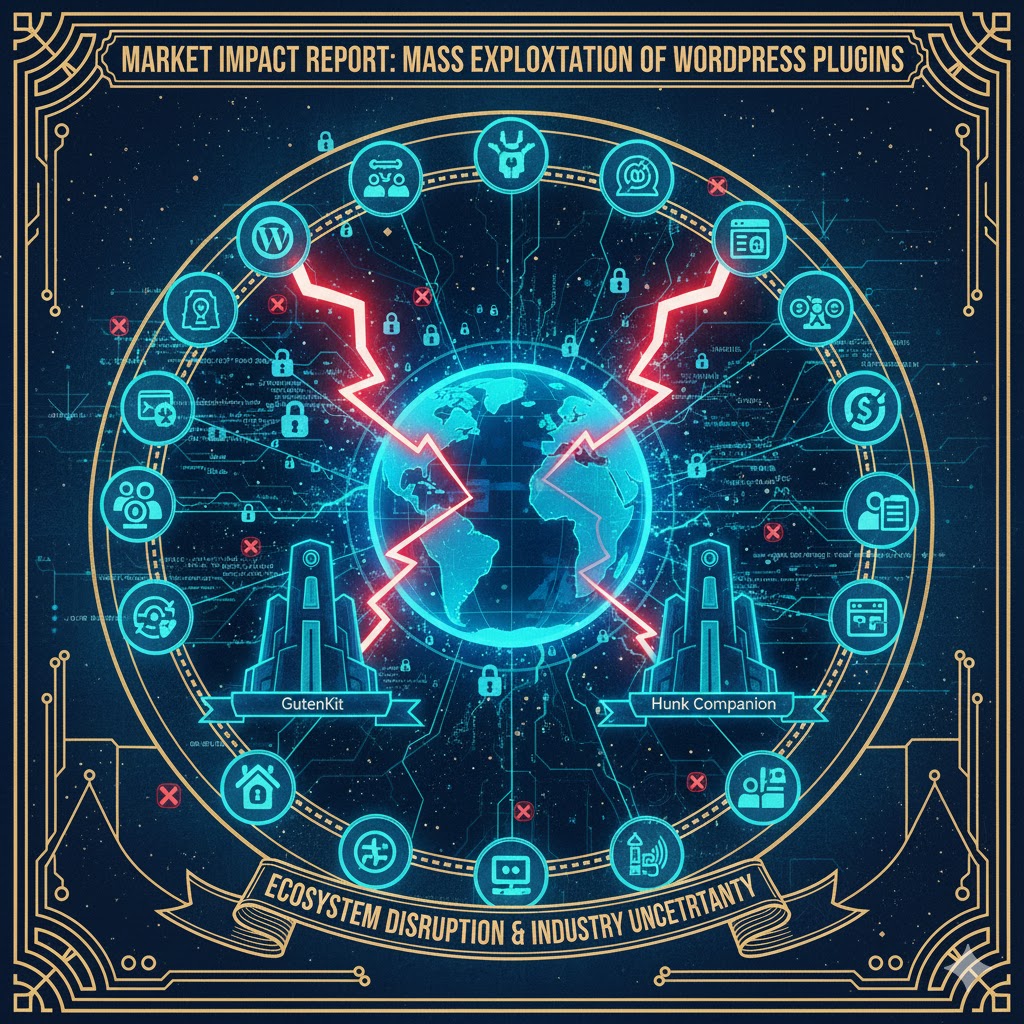
Between October 8–9, 2025, a large-scale campaign targeted two previously-patched WordPress plugin flaws—GutenKit (CVE-2024-9234) and Hunk Companion (CVE-2024-9707)—with ~8.7 million attack attempts blocked in 48 hours, primarily abusing unauthenticated REST endpoints to install/activate arbitrary plugins and enable RCE chains. The incident underscores a systemic exposure: long-tail, unpatched plugins at scale. Expect near-term budget shifts toward WAF/CDN shielding, managed WordPress, automated patching, backup/DR, and monitoring, plus longer-term policy changes (tighter repo governance, code-signing, SBOMs). Winners: vendors who can reduce mean-time-to-patch and virtually patch at the edge; agencies that package maintenance SLAs; compliance/insurance specialists aligning to NIS2/DORA-style controls. Losers: commodity hosts without managed security, plugin authors with weak secure-by-default posture, and DIY site owners relying on manual updates. NVD+4BleepingComputer+4Wordfence+4

WordPress Plugins: 690 Free Plugins for Developing Amazing and Profitable Websites (SEO, Social Media, Maintenance, E-Commerce, Images, Videos, and Security)
As an affiliate, we earn on qualifying purchases.
As an affiliate, we earn on qualifying purchases.
What happened (factual baseline)
- Campaign scale: Wordfence and industry coverage report 8.7M+ blocked attempts in 48 hrs (Oct 8–9) focusing on arbitrary plugin install/activation vectors. Forbes+1
- Root vulns:
- GutenKit ≤ 2.1.0: missing capability checks on an install/activate endpoint → arbitrary file upload / plugin activation. Patched in 2.1.1 (Oct 2024). CVSS high/critical. NVD+2Wordfence+2
- Hunk Companion ≤ 1.8.4: missing capability checks on
…/hc/v1/themehunk-importenabling arbitrary install/activation; patched in 1.9.0 (Dec 2024). CVSS 9.8. NVD+1
- Context: 2025 has seen repeated mass exploitation waves against older plugin/theme flaws (e.g., Service Finder Bookings auth bypass). Pattern: legacy exposure + slow update adoption. Wordfence+1
WordPress backup and disaster recovery
As an affiliate, we earn on qualifying purchases.
As an affiliate, we earn on qualifying purchases.
Why it matters commercially
- Security spend pull-forward: SMBs and media brands face heightened probability of compromise from old plugin debt. Expect immediate reallocation from “nice-to-have” marketing tech to WAF, managed updates, and backup/DR. BleepingComputer
- Risk transfer pressure: Cyber-insurance underwriters will tighten questionnaires (inventory, update cadence, WAF usage, immutable backups). Premiums/retentions likely to rise for unmanaged WordPress fleets. (Inference from incident dynamics + known underwriting trends.)
- Vendor consolidation: Buyers prefer opinionated stacks (managed WP + edge WAF + automated patching) over DIY plugin sprawl.

Simplify Your WordPress Experience: Unlock the Power of Managed Hosting: Streamline Your WordPress Journey with Hassle-Free Managed Hosting
As an affiliate, we earn on qualifying purchases.
As an affiliate, we earn on qualifying purchases.
Who benefits (by vertical) & how competition shifts
1) WAF/CDN & “virtual patching”
Beneficiaries: Cloudflare, Fastly, Akamai; WordPress-centric WAFs (Wordfence, Sucuri, Patchstack).
Why: Ability to block REST-endpoint abuse, rate-limit, and ship managed rules quickly. Competitive edge = time-to-rule and default coverage for long-tail CVEs. Expect packaging of “WordPress hardening bundles” (bot mgmt + API schema enforcement + automatic IP reputation). Wordfence
2) Managed WordPress Hosting
Beneficiaries: Hosts with forced auto-updates, staging auto-tests, and malware cleanup SLAs.
Shift: Buyers migrate from generic hosts; pricing power improves for providers bundling WAF, malware scanning, Web-app isolation, and guaranteed RTO/RPO. Commodity hosts without security opinion lose share.
3) Backup/Disaster Recovery
Beneficiaries: Jetpack Backup, BlogVault, CodeGuard, platform-native snapshots.
Shift: Ransomware and backdoor persistence make immutable backups + 1-click restore a board-level requirement. Attach rates increase on new hosting plans.
4) Security Monitoring & Observability
Beneficiaries: WordPress-aware monitoring (Wordfence Central, Patchstack), plus generic log stacks (Datadog/New Relic) used by agencies.
Shift: Demand for central fleet views across multi-site networks; competitive edge = IOC packs for known routes like wp-json/gutenkit/v1/install-active-plugin and …/hc/v1/themehunk-import. BleepingComputer
5) Agencies & MSPs
Beneficiaries: Agencies offering maintenance retainers (weekly plugin updates, regression checks, uptime, WAF tuning).
Shift: Move from project-only revenue to recurring MRR via “WordPress Care” tiers (Silver/Gold/Platinum with SLAs). Agencies that codify pre-prod QA + canary releases beat freelancers/one-off shops.
6) Compliance & Cyber-Insurance
Beneficiaries: Compliance consultancies mapping NIS2/DORA/ISO 27001 controls to web estates; insurance brokers offering managed hardening discounts.
Shift: Policies will require vulnerability management proof, WAF enablement, and evidence of timely patching. (Inference grounded in incident nature and current EU regulatory direction.)
7) Plugin Developers & Marketplaces
Beneficiaries: Teams that adopt secure-by-default patterns (capability checks, non-privileged endpoints, feature flags), auto-update compatibility, and transparent security advisories.
Shift: Expect storefront penalties for lagging patches; preference for vendors publishing SBOMs, code-signing, and exploit-mitigation roadmaps. The directory may increasingly enforce security-first governance after repeated campaigns. The Verge
8) Site-builder Alternatives
Beneficiaries: Wix, Squarespace, Shopify (for content + commerce).
Shift: Some SMBs will exit DIY WordPress to managed SaaS to cap security overhead. This is a net-new pipeline moment for proprietary platforms whenever WordPress security headlines spike. (Market behavior inference from prior waves.)
WordPress WAF CDN
As an affiliate, we earn on qualifying purchases.
As an affiliate, we earn on qualifying purchases.
Market sizing & spend re-mix (directional)
- Short-term (0–6 months): +15–30% uplift in security add-ons (WAF, backups) on affected WP fleets; 10–20% higher attach for managed plans vs. commodity hosting.
- Mid-term (6–18 months): Vendor consolidation; agencies/MSPs expand SLA MRR; plugin ecosystems compete on security transparency (changelogs, advisories, code-signing).
(Estimates inferred from adoption surges observed in prior WordPress mass-exploitation cycles and current coverage intensity.)
Competitive playbooks (by vertical)
WAF/CDN
- Launch pre-built “WordPress REST hardening” rulesets and publish coverage matrices tied to CVE IDs; include virtual patch SLAs (e.g., “rules live within 24h of disclosure”).
- Offer fleet-wide posture reports for agencies: exposed endpoints, stale plugins, exploit traffic heatmaps. BleepingComputer
Managed Hosting
- Bundle immutable backups + malware cleanup + staging auto-tests.
- Introduce forced-update windows with rollback; market RPO/RTO guarantees.
Agencies/MSPs
- Productize Care Plans: monthly plugin updates, regression smoke tests, WAF tuning, IOC log reviews for the two exploited routes, quarterly tabletop exercises.
- Use security scorecards in sales: show before/after risk posture for prospects.
Plugin Vendors
- Ship guarded REST endpoints (capability checks), feature flags, and security advisories synchronized with auto-update prompts.
- Adopt code-signing/SBOM and maintain responsible disclosure pages referencing CVE entries. NVD+1
Compliance/Insurance
- Provide NIS2-ready policy templates for web estates (asset inventory, patch SLAs, backup attestations, incident comms trees).
- Offer premium credits when WAF+immutable backups are verified.
3 scenarios (next 12 months)
- Base case: Episodic surges continue; edge WAF + managed WP adoption steadily rises; plugin repo strengthens governance; virtual patching becomes table stakes. Wordfence
- Upside (for security vendors): A second major wave hits unmaintained plugins → accelerated migrations to opinionated stacks; agencies double MRR via Care Plans. BleepingComputer
- Downside (for WordPress DIY): Insurance carriers add exclusions for unmanaged CMS; some SMBs churn to SaaS site-builders.
Action checklist (for publishers, ecommerce, and agencies)
Immediate (next 72 hours)
- Inventory: list all plugins/themes; flag GutenKit ≤2.1.0 and Hunk Companion ≤1.8.4; update or remove. NVD+1
- WAF: enable REST-endpoint rules; rate-limit suspicious
wp-jsonroutes. Wordfence - Logs: search for
wp-json/gutenkit/v1/install-active-pluginand…/hc/v1/themehunk-importrequests; isolate hosts; scan for webshells/backdoors. BleepingComputer - Backups: verify immutable, off-platform restore points for last 7–14 days.
Near-term (2–4 weeks)
- Implement forced update cadence with staging regression tests.
- Add file-integrity monitoring and uptime + WAF dashboards.
- Formalize incident runbooks and on-call escalation.
Quarterly
- Vendor reviews (plugins with poor patch history → deprecate).
- Attack-surface review: disable unused REST routes, prune plugins, adopt least privilege roles.
- Tabletop exercises (compromise & rollback) and compliance mapping (NIS2/DORA controls).
KPIs to track
- Patch latency (disclosure → your fleet patched)
- Virtual patch latency (disclosure → WAF rule live)
- Exploit hit rate on known routes (should trend down)
- Backup integrity (successful restore drills)
- Mean time to detect/respond (MTTD/MTTR) across sites
Sources
- WordPress mass-exploit campaign & Wordfence advisories; attack volume/timeframe. BleepingComputer+2Forbes+2
- CVE specifics: GutenKit (CVE-2024-9234) & Hunk Companion (CVE-2024-9707), vectors and patch versions. wpscan.com+3NVD+3Wordfence+3
- Broader 2025 plugin/theme exploitation trend context. Wordfence+1