If SAP owns the data and Siemens owns the factory, Mistral is betting on the thing neither of them wants to build: the model itself — European, open-weight, and sovereign. It is the continent’s answer to the question of whether the world will accept only two American frontier labs, and Europe has decided to fund a champion to prove it won’t.

Get business pricing on tech for your team
- Business-only prices and quantity discounts
- Tax-exempt purchasing
- Multiple users, one account, clear invoices
This is a profile of that bet — the money, the strategy, the genuine wedge, and the uncomfortable questions the sovereignty narrative would rather not answer.
Europe’s sovereignty bet,
priced at $14B and climbing.
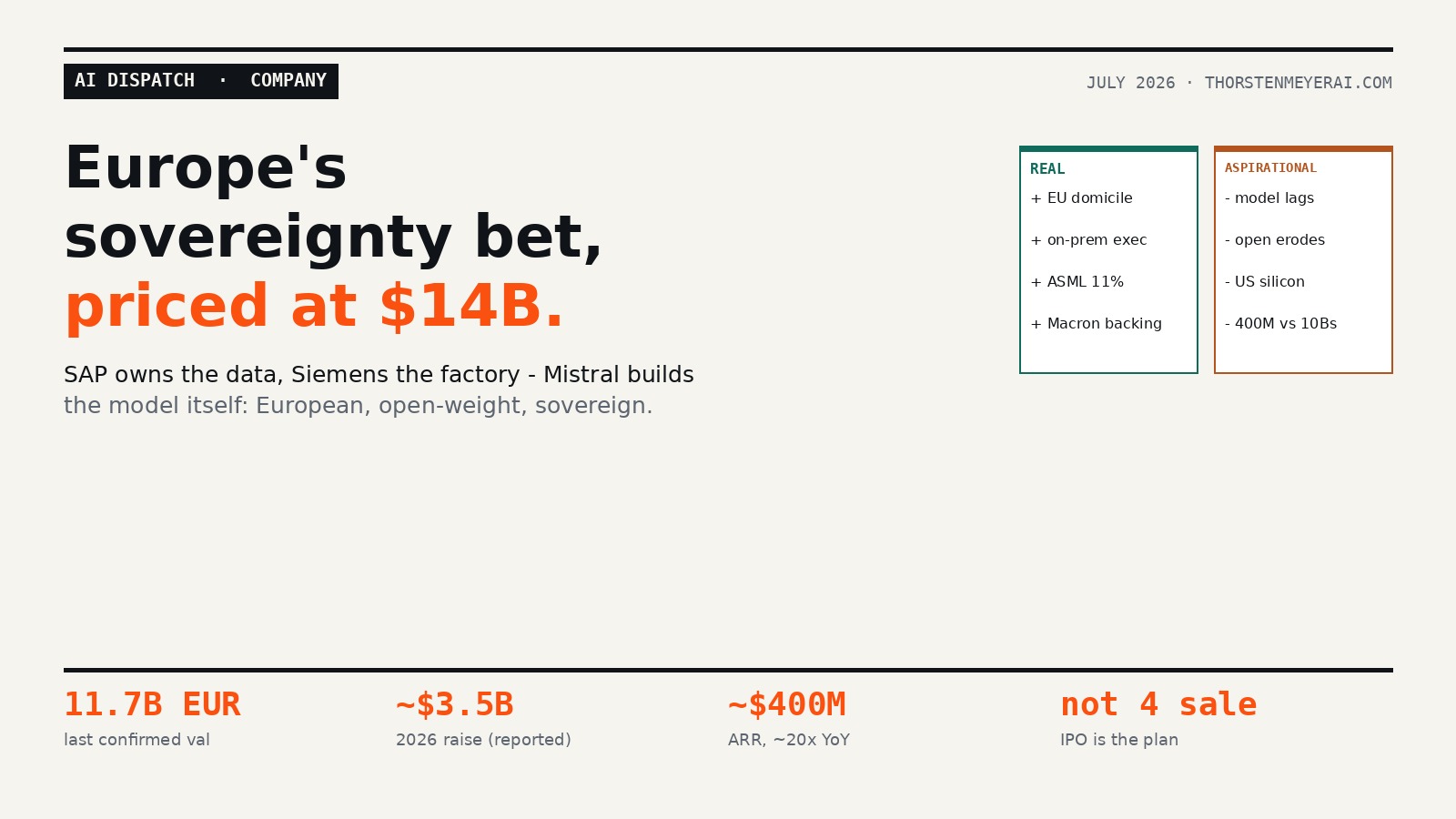
If SAP owns the data and Siemens owns the factory, Mistral builds the thing neither wants: the model itself — European, open-weight, sovereign. The continent’s answer to a world with only two American frontier labs.
The wedge: real where structural, weak where aspirational
✓ Real (structural)
- EU domicile = procurement advantage for regulated + public sector
- Split control/data-plane: execution inside the customer’s environment
- ASML’s ~11% stake ties it to Europe’s tech-industrial core
- Macron endorsement, €109B French AI commitments — industrial policy
⚠ Weak (aspirational)
- Model quality lags frontier — ~3rd on the OCR leaderboard, not 1st
- “Sovereignty via openness” erodes as US + Chinese open models proliferate
- Runs on NVIDIA silicon + Azure distribution — partial independence
- ~$400M ARR vs rivals’ tens of billions
Sovereignty buys procurement preference. It does not suspend the capability race.
Confirmed mark is the ASML-led round; the 2026 raise and ARR are reported/estimated. Figures dated.
The single question: is “European and sovereign” a durable advantage enough to sustain a frontier lab against far better-capitalized rivals — or a procurement preference that erodes as capable open models arrive from every direction? Mistral is not for sale; the plan is IPO. Europe has bet $14B+ that it’s the former.
As an affiliate, we earn on qualifying purchases.
The money, dated
Mistral’s financials are the loudest part of the story. Its last confirmed valuation was €11.7 billion (~$13.5B), set by a €1.7 billion Series C in September 2025 led by ASML — the Dutch lithography giant taking roughly an 11% stake as largest shareholder, an extraordinary signal that ties Mistral to the heart of Europe’s tech-industrial complex. Reporting through mid-2026 describes a further raise around $3.5 billion at a ~$20B+ valuation, in talks or closing depending on the source — treat that as reported, not confirmed.
Revenue growth is real and steep: Sacra estimates ARR reached ~$400 million by early 2026, up from roughly $20M a year earlier — a ~20× expansion — with CEO Arthur Mensch targeting $1 billion by end of 2026. The revenue mix is the strategy in miniature: pay-per-token API on La Plateforme, enterprise and on-premise contracts tied to data residency, and paid Le Chat consumer tiers.
open-weight AI model for enterprise
As an affiliate, we earn on qualifying purchases.
As an affiliate, we earn on qualifying purchases.
The strategy: sovereignty as a wedge, not a slogan
Mistral’s differentiation is structural, and where it’s real, it’s genuinely hard for US rivals to copy.
European domicile is a procurement advantage. For EU governments and regulated enterprises that cannot or will not depend on US labs, Mistral’s jurisdiction is the product. The split control-plane/data-plane architecture lets execution run inside a customer’s own environment — a direct answer to the data-residency requirement that disqualifies hyperscaler-hosted alternatives for some buyers. This is the same logic this site applies to local inference, at company scale.
Infrastructure independence. Mistral is building Mistral Compute — a GPU cloud with NVIDIA and Bpifrance, backed by a reported €4B data-center strategy across France and Sweden, some of it nuclear-powered — explicitly framed as European AI infrastructure independent of US clouds. It acquired infrastructure firm Koyeb to strengthen the stack.
Open weights as adoption engine. Many Mistral models ship open-weight to drive developer adoption, then funnel serious usage into paid API and enterprise contracts — the same open-core motion that produced this week’s OCR story, where Mistral shipped OCR 4 as a paid API atop an open-model ecosystem.
Political capital. Macron has publicly recommended Le Chat over ChatGPT; France has anchored €100B+ in AI investment commitments around the “third way” between US and Chinese AI. Mistral is as much industrial policy as venture bet, and the ASML round is the proof.
AI development hardware NVIDIA silicon
As an affiliate, we earn on qualifying purchases.
As an affiliate, we earn on qualifying purchases.
The uncomfortable questions
Sovereignty is a compelling story. It is also one with real holes, and an honest profile names them.
The model-quality gap. Third-party evaluations through 2026 consistently place Mistral’s flagship models behind the frontier — slower and less capable than the best US models, and increasingly matched or beaten on open benchmarks by Chinese open-weight labs. This site’s own OCR coverage found Mistral’s document model strong but roughly third on the public leaderboard, not first. Sovereignty buys procurement preference; it does not suspend the capability race.
“Sovereignty via openness” is eroding. Mistral’s original wedge — open weights plus European data — is less unique every month, because US and Chinese labs now ship open, high-performing models too. When everyone’s weights are open, “open” stops being a differentiator and the question reverts to: whose model is better? That’s not the axis Mistral wins on.
The independence is partial. Mistral runs substantially on NVIDIA chips and, via its Azure distribution deal, American cloud — complicating the clean sovereignty narrative. A European champion whose compute and hardware are American is a more honest description than the marketing allows. Real sovereignty at the data and jurisdiction layer; considerable dependence at the silicon and infrastructure layer.
The scale asymmetry. ~$400M ARR against OpenAI’s and Anthropic’s tens of billions is the brutal arithmetic. Mistral doesn’t have to win globally — but it does have to own Europe’s regulated and public sector decisively, and that market, while real, is finite and slower-moving than consumer AI.
As an affiliate, we earn on qualifying purchases.
The bull case, fairly
Mensch’s stated mission is that everyone should access the best AI “outside of centralized control exercised by states or corporations” — and there’s a serious argument that a world with only two frontier labs is fragile, that Europe’s regulated and public sectors are a large defensible base, and that ASML’s backing signals this is a durable industrial commitment rather than a hype-cycle flare. Mistral is explicitly not for sale — Mensch has ruled out acquisition and named an IPO as the plan, which for a sovereignty play is the strategically coherent answer: being bought by an American company would defeat the entire premise. If Europe genuinely wants technological autonomy in AI, Mistral is the only continental-scale vehicle for it, and “the only one” has real strategic weight.
Bottom line
Mistral is the purest expression of the European AI thesis: that sovereignty is worth funding a frontier lab to secure. The wedge is real where it’s structural — jurisdiction, data residency, on-prem deployment, political backing — and weak where it’s aspirational — raw model capability and genuine infrastructure independence. The company’s fate turns on a single question: is “European and sovereign” a durable enough advantage to sustain a frontier lab against far better-capitalized rivals, or is it a procurement preference that erodes as open, capable models proliferate from every direction? Europe has placed a $14-billion-and-climbing bet that it’s the former. The next twenty-four months, and whether ARR actually reaches $1B, will start to answer it.
Sources
- Sacra, “Mistral revenue, funding & news” (2026) — ARR ~$400M early 2026 (from ~$20M a year prior), ~20× growth, $1B 2026 target; control-plane/data-plane architecture; Pixtral/Voxtral multimodal; Mistral Compute JV with NVIDIA/Bpifrance; reported $3.5B raise at ~$20B (June 2026)
- ValueAdd VC, “Mistral AI: Revenue, Funding & Valuation (2026)” — €11.7B last confirmed valuation, ASML-led €1.7B Series C (~11% stake), reported higher round “in talks” not confirmed closed; open-core monetization; scale asymmetry framing
- AI Business, “Mistral Pioneers Sovereign AI in Europe” (March 2026) — Series C investor list, ~$13.7B valuation reports, Davos $1B revenue target
- Bitcoinworld, “Mistral AI: The French AI Powerhouse” (July 2026) — Mensch mission quote, reported ~$3.5B raise at ~$23.15B, Microsoft/NVIDIA/Accenture/IBM/ASML partnerships, “not for sale”/IPO stance
- CloudSummit.eu, “Mistral AI’s $14 billion valuation marks Europe’s AI turning point” — Macron endorsement, €109B French AI commitments, Mistral Compute with NVIDIA Grace Blackwell, EU AI Act alignment
- Whalesbook, “Mistral AI Valuation Hits $13.8 Billion Amid Enterprise Push” (July 2026) — €4B France/Sweden data-center strategy, Koyeb acquisition, enterprise-integration focus, Azure distribution
- Cornford and Cross, “Mistral’s AI Leadership: A Threat To European Sovereign Tech?” (July 2026) — model-quality lag, eroding open-weight differentiation, US-hardware/cloud dependence critique
- ThorstenMeyerAI.com, “Signal: The 24-Hour Coincidence” (July 21, 2026) — Mistral OCR 4 positioning and benchmark placement
Confirmed valuation is the September 2025 Series C mark; the 2026 raise and higher valuation are reported and not confirmed closed. ARR figures are third-party estimates. Model-capability critiques are drawn from third-party evaluations and dated.
Halloween Picks
halloween
As an affiliate, we earn on qualifying purchases.