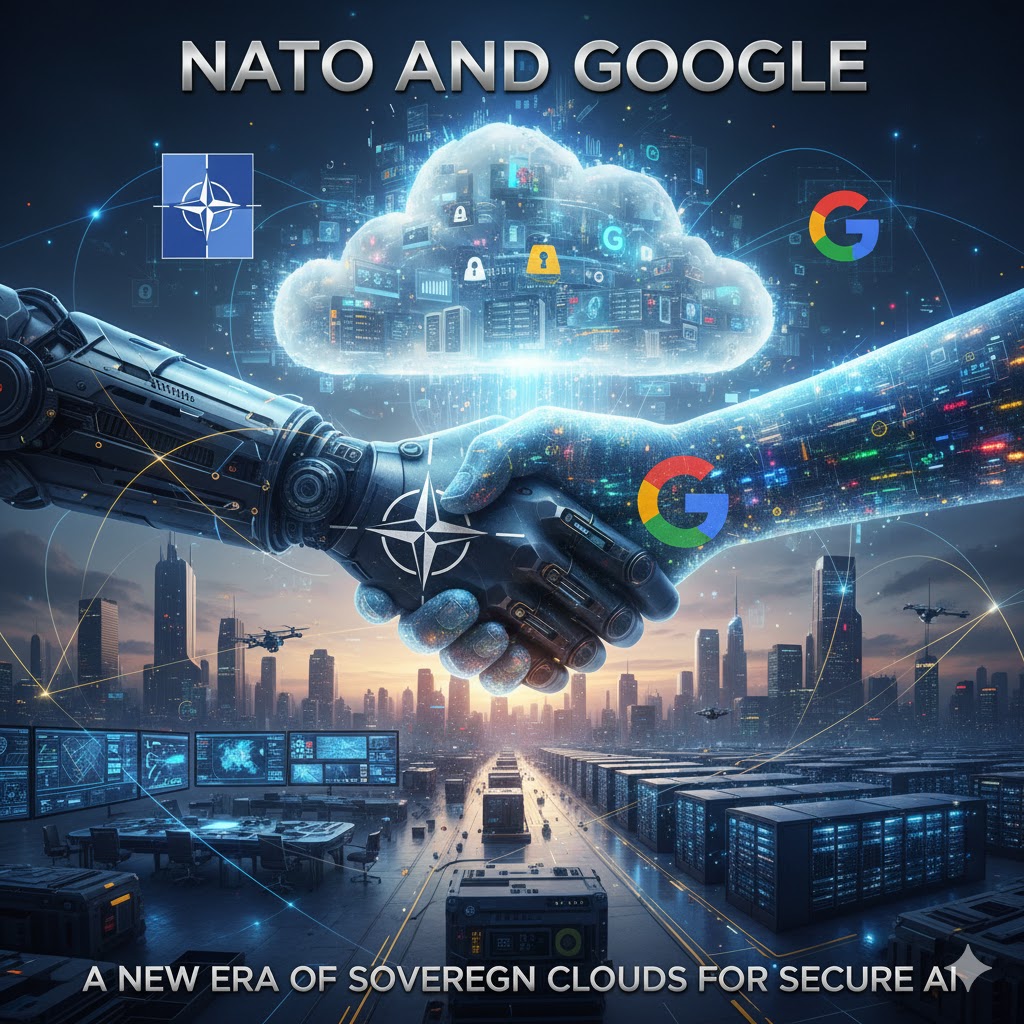

In one of the most strategically significant cyber announcements of the decade, NATO awarded Google Cloud a multi-million-pound contract to build a sovereign, air-gapped cloud environment for its most sensitive data and AI workloads.

Get business pricing on tech for your team
- Business-only prices and quantity discounts
- Tax-exempt purchasing
- Multiple users, one account, clear invoices
This partnership is more than a procurement deal—it signals a seismic shift in how governments and militaries will handle the rise of AI.
What “Sovereign, Air-Gapped Cloud” Really Means
The infrastructure, based on Google Distributed Cloud (GDC), provides:
- Complete isolation from the public internet
- Dedicated hardware clusters physically separated from global networks
- Local data residency within NATO jurisdictions
- Secure AI model execution inside classified environments
- Offline operations for mission-critical contexts
This type of system is essentially the AI equivalent of a bunker—designed for scenarios where even a theoretical remote breach is unacceptable.
As an affiliate, we earn on qualifying purchases.
Why NATO Needs This Now
1. AI Is Now a Core Defense Capability
Defense operations increasingly require:
- Simulation
- Logistics prediction
- Threat detection
- Intelligence analysis
- Cyber defense
- Autonomous systems management
2. Sensitive Data Cannot Leave Jurisdiction
Military datasets—from satellite feeds to intelligence signals—must remain under national or organizational sovereignty.
3. Traditional Cloud Cannot Handle Classified Data
Standard public clouds cannot meet the isolation, auditability, and physical separation requirements demanded by NATO.
sovereign cloud computing hardware
As an affiliate, we earn on qualifying purchases.
As an affiliate, we earn on qualifying purchases.
Implications for Global Enterprises
This deal sets a template for regulated industries:
- Healthcare
- Finance
- Aviation
- Energy
- Critical infrastructure
All will begin demanding:
- Sovereign clouds
- Air-gapped AI compute
- Dedicated tenancy
- Localized model evaluation zones
- Zero-trust access frameworks
private cloud data center equipment
As an affiliate, we earn on qualifying purchases.
As an affiliate, we earn on qualifying purchases.
The Long-Term Impact
Google’s partnership with NATO demonstrates a new frontier: AI infrastructure as a geopolitical asset. The next decade of global power structures will be shaped not only by physical military capabilities but also by the control, governance, and sophistication of sovereign AI platforms.
As an affiliate, we earn on qualifying purchases.
Fall Picks
fall essentials
As an affiliate, we earn on qualifying purchases.