
By Thorsten Meyer

Get business pricing on tech for your team
- Business-only prices and quantity discounts
- Tax-exempt purchasing
- Multiple users, one account, clear invoices
Most model launches hand you a finished product and ask you to be impressed. Alibaba’s Qwen team just did something stranger and, if you build on these models, more useful: it open-sourced the architecture of its next generation before that generation’s flagship has even been named. Qwen3.8-Flash-Next, released today under open weights, isn’t the main event — it’s an early, runnable preview of the design that will underpin the whole Qwen4 family. Qwen is letting the community pull apart the engine of the next car before the car ships.
That’s an unusual and revealing move, and it’s worth understanding on its own terms before the benchmark arguments start. Here’s what actually shipped, what’s genuinely new in it, and where to keep your skepticism.
What shipped
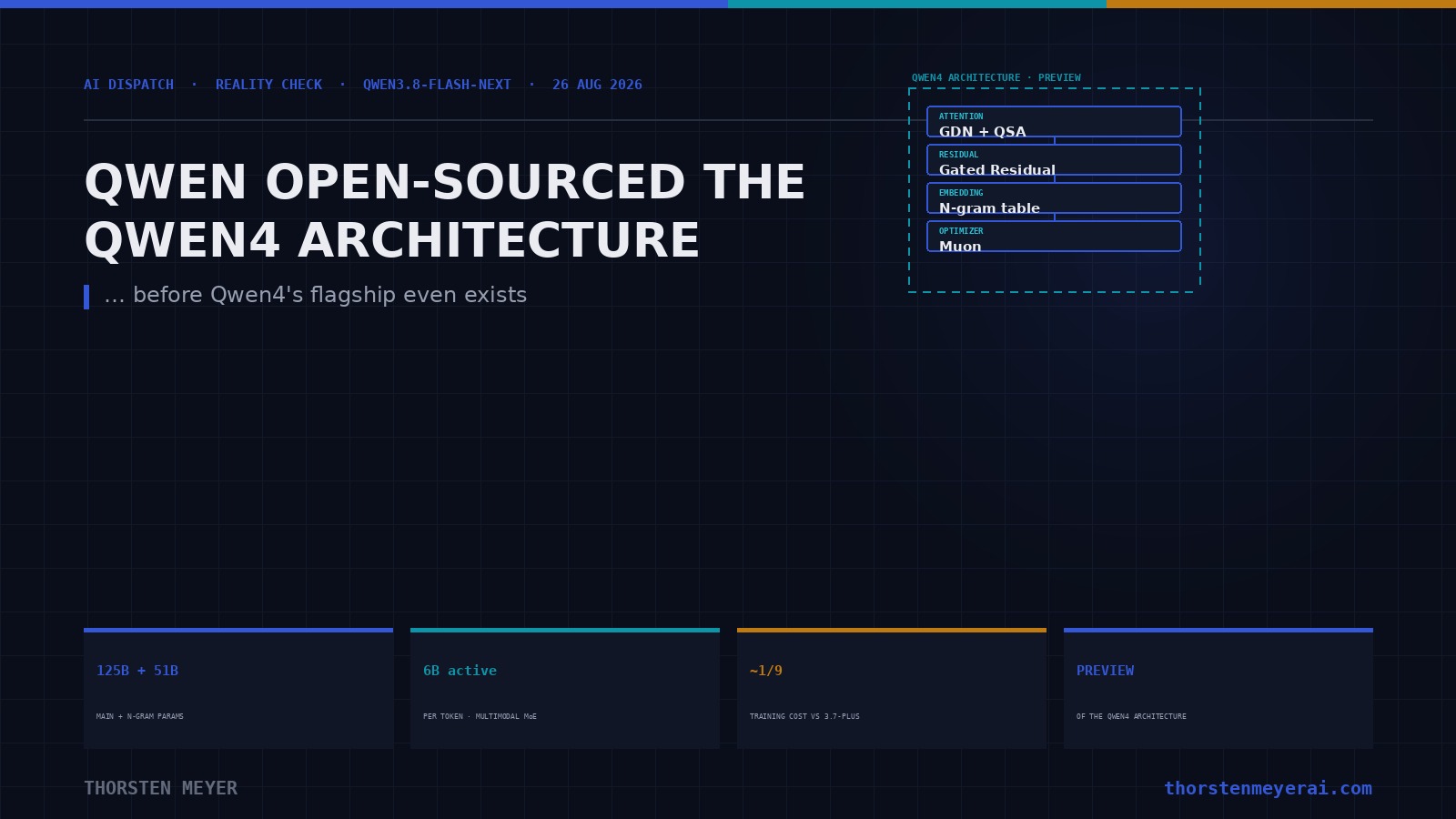
Qwen3.8-Flash-Next is a multimodal mixture-of-experts model with open weights on Hugging Face and ModelScope, GGUF builds for llama.cpp, and day-one support across the usual serving stacks. Its configuration is the first thing to get right, because the coverage garbled it: it’s a 125-billion-parameter main model, plus an additional 51 billion parameters of N-gram embeddings, with 6 billion parameters active per token. So the numbers floating around — 125B, “125B + 51B,” even 176B — are all describing the same model from different angles. The important shape is: a 125B-class MoE that fires only 6B per token, with a large auxiliary embedding table bolted on.
Not the flagship — an open, runnable preview of the design the whole Qwen4 family will run on. Aimed, in Qwen’s own words, at ultimate cost-efficiency.
Qwen is explicit that this is a preview, not a flagship. It frames Flash-Next as playing the same role Qwen3-Next played for Qwen3.5 — a deliberate early release of architectural changes so the ecosystem can examine and adopt them before the full Qwen4 line is built on top. The blog's own title says the quiet part out loud: a new architecture, aimed at ultimate cost-efficiency.
multimodal AI model development kit
As an affiliate, we earn on qualifying purchases.
As an affiliate, we earn on qualifying purchases.
The four things that are actually new
The reason to care isn't a leaderboard score; it's the architecture, which Qwen upgraded along four axes. Stripped of the jargon, here's what each one is doing.
Attention: a GDN + QSA hybrid. Gated DeltaNet compresses the history of a long sequence efficiently, while Qwen Sparse Attention uses a lightweight compressed indexer to pick out just the important context at fine granularity. Together they attack the thing that makes long context expensive — the cost of attending over everything — by attending over less, more cleverly. This is the heart of the efficiency claim.
Residual: a Gated Residual. The residual stream — the highway that carries information between layers — is widened into four branches with a dynamic gate controlling what's read and written. In practice this is about stronger cross-layer information flow and, notably, training stability, which is where a lot of these efficiency plays quietly die.
Embedding: an N-gram table. This is the clever one, and it's why there's a separate 51B of parameters. Instead of buying capacity by making the whole model bigger and more expensive to run, Qwen looks up a table keyed on local context — scaling the model's capacity with very little extra compute. Crucially, that big table can be offloaded to host memory and prefetched asynchronously, so it doesn't have to sit on the GPU. That's a genuine mitigation of the usual "bigger means heavier" tradeoff, and I'll come back to why it matters.
Optimization: the Muon optimizer. A refined training recipe — new optimizer, retuned scaling laws — that lets the whole thing train more efficiently and stably.
Put together, Qwen's headline claim is the one that should get a builder's attention: Flash-Next reportedly takes only about one-ninth the training cost of Qwen3.7-Plus while beating it at coding and office tasks. That's a training-efficiency claim, not just an inference one, and if it holds it's the more consequential number, because training cost is what gates how fast a lab can iterate.
large language model training hardware
As an affiliate, we earn on qualifying purchases.
As an affiliate, we earn on qualifying purchases.
Read it honestly
Now the skepticism, because this is a preview and previews are where enthusiasm outruns evidence.
It's a preview, by Qwen's own admission — not a finished flagship. The point of the release is the architecture, not a claim to be the best model available today. Treating "Qwen open-sourced something" as "Qwen won" is a category error the download-count crowd makes constantly.
The benchmarks are the vendor's, and unreproduced. The model card publishes figures — strong numbers on a software-engineering benchmark, a hard science-QA set, and others — but as of now none of it has been independently verified, and different harnesses produce different results. The early independent reads are encouraging for the size, not evidence of a quiet leap past the frontier. Take the table as a claim to check.
And the "6B active" framing needs the same asterisk I keep flagging. Six billion active parameters does not make this a 6B model you run on a laptop. You still host a 125B-class MoE — all those weights have to be available. The honest wrinkle here, and credit where it's due, is that the 51B N-gram table can live in host memory rather than GPU VRAM, which genuinely softens the storage burden relative to a naive 176B model. But "softens" isn't "eliminates." This is still fleet-grade infrastructure, not a free local brain. The efficiency is real and it's about cost-to-serve and cost-to-train, not about shrinking what you have to own.
As an affiliate, we earn on qualifying purchases.
Why the way they shipped it matters
Here's the part I find most interesting through my own lens, as someone who cares about ownable, sovereign infrastructure. Releasing the architecture early — ahead of the flagship, ahead of competitors — is a strategy, not just a courtesy. It gets the new design battle-tested by the community before Qwen bets its flagship on it. It compresses the painful weeks where inference libraries, quantizers, and local runners scramble to support a new architecture, because those teams get a head start. And it builds real goodwill in the open ecosystem at a moment when that ecosystem is the battleground.
For anyone maintaining a pipeline or a product on Qwen, this preview is a gift with a purpose: it's your early look at where the entire next generation is heading, so you can prepare the tooling now instead of after the flagship drops. And for the broader open-model race, it's another data point in the argument I keep making — that 2026's competition is being won on the efficiency frontier, not on raw parameter count. A 125B-class model that trains for a ninth of the cost and serves cheaply, released open so the whole community can build on its architecture, is a more strategic move than another giant closed flagship. Whether it delivers is a question for the independent evals. That it's the right bet on where value is going, I'm fairly confident about.
As an affiliate, we earn on qualifying purchases.
Where I land
Qwen3.8-Flash-Next is best understood not as a model to rank but as an architecture to study — an open, runnable preview of the design decisions behind Qwen4, shipped early on purpose. The technical ideas are real and interesting: cheaper long-context attention, capacity bought through an offloadable embedding table rather than raw size, a training recipe that reportedly cuts cost to a ninth. The caveats are equally real: it's a preview, the benchmarks are unverified, and "6B active" is a serving-and-training efficiency story, not a run-it-anywhere one.
If you build on open models, the move to make isn't to crown it or dismiss it — it's to pull the architecture apart now, because whatever Qwen4's flagship turns out to be, this is the engine it'll run on. I'd rather have that early look, honestly caveated, than wait for the marketing. Next, the other half of this release: the cheap, served face of it, and the open-weight price war it's actually a weapon in.
Analysis and opinion from a builder, founder, and post-labor economist running a local-first inference operation. Specifications (125B main + 51B N-gram embedding, 6B active per token, multimodal MoE, GDN+QSA attention, Gated Residual, N-gram embedding, Muon optimizer, ~1/9 training cost vs Qwen3.7-Plus, open weights, Qwen4-architecture-preview framing) are verified at time of writing against Qwen's official Qwen3.8-Flash-Next repository and announcement; all benchmark figures are Qwen's own reported results, not yet independently reproduced. This is analysis, not investment advice. Point-in-time as of 26 August 2026.
Columbus Day / Indigenous Peoples' Day Picks
long weekend sales
As an affiliate, we earn on qualifying purchases.