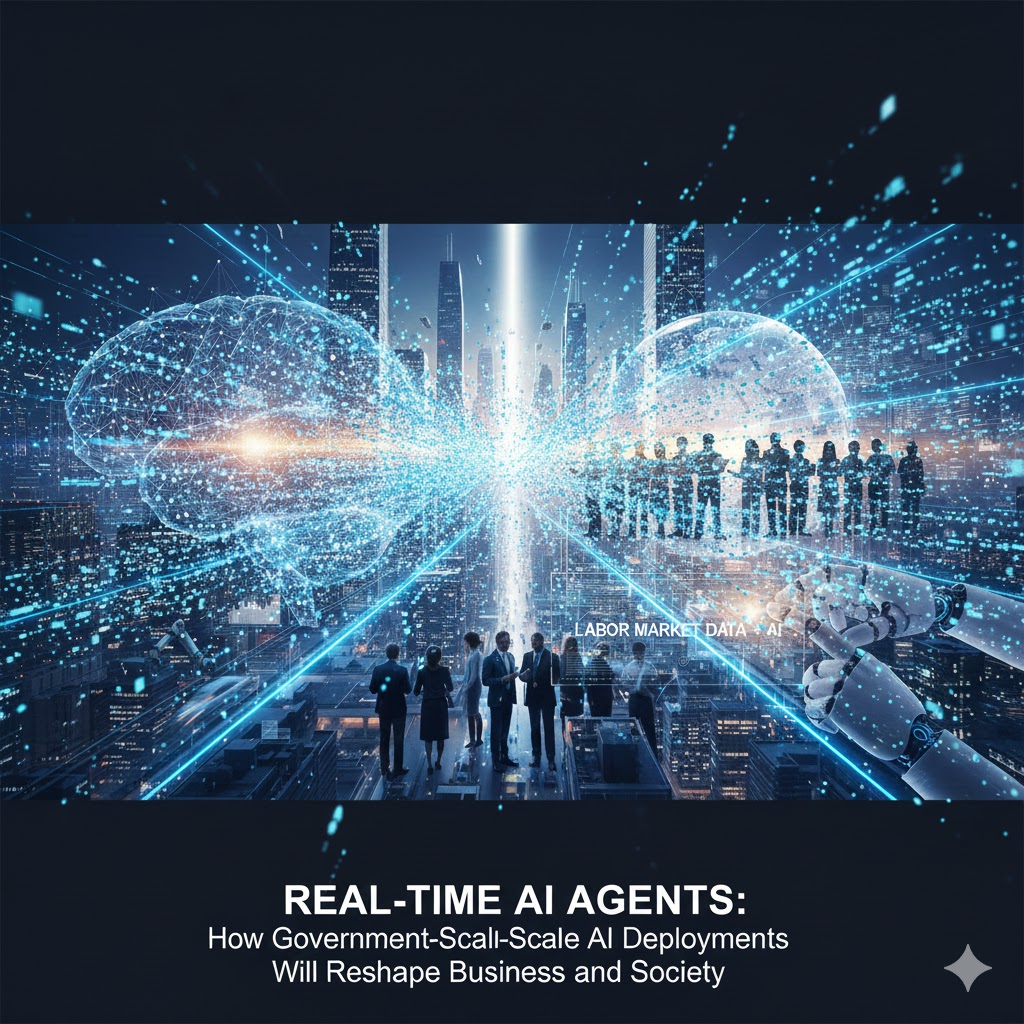

The latest generation of AI infrastructure marks a quiet but decisive shift: AI agents are moving from turn-based tools to continuously interactive participants. With the introduction of bi-directional streaming runtimes—most notably through Amazon Web Services’ AgentCore runtime inside Amazon Bedrock—AI systems can now listen, respond, and adapt in real time. This capability has deep implications not just for enterprise software, but for labor, productivity, and human–machine relationships across society.
This article analyzes what changes when conversational latency collapses, and why this transition matters far beyond technical convenience.
From Turn-Based AI to Continuous Interaction
Until recently, most AI systems operated in a request–response loop: a user speaks or types, the system processes, then replies. This model introduced pauses, friction, and unnatural interaction patterns—acceptable for chat, but limiting for voice, support, and collaborative work.
Bi-directional streaming—typically delivered via persistent connections such as WebSocket—changes the interaction model entirely. AI agents can now:
- Process partial input before a user finishes speaking
- Interrupt, clarify, or confirm in real time
- Maintain conversational context continuously rather than per request
- Coordinate multiple modalities (voice, text, vision, events) simultaneously
This is not an incremental UX upgrade. It is a shift in how digital systems participate in workflows.

Mastering Akka: Advanced Patterns for Data Streaming, Real-Time Events, and AI Agent Integration
As an affiliate, we earn on qualifying purchases.
As an affiliate, we earn on qualifying purchases.
Business Impact: What Changes for Organizations
1. Customer Interaction Becomes Event-Driven
Customer service is the most immediate beneficiary. Real-time agents can listen, respond, and resolve issues during the interaction itself—without forcing customers into rigid menus or long waits.
For businesses, this means:
- Lower average handling time
- Higher first-contact resolution rates
- Reduced staffing pressure without reducing service availability
AI stops being a fallback channel and becomes a primary interface.
2. Internal Workflows Shift From Tools to Teammates
Inside organizations, streaming agents act less like software utilities and more like embedded collaborators:
- Monitoring systems continuously
- Flagging anomalies as they emerge
- Conversing with operators while work is underway
In operations, DevOps, logistics, and finance, AI moves upstream—from post-hoc analysis to live decision support.
3. Time-to-Market Collapses for Conversational Products
Previously, building low-latency conversational agents required months of custom infrastructure work: audio pipelines, streaming protocols, state management, failover logic.
With managed runtimes handling these layers, teams can:
- Prototype production-grade agents in days
- Focus on domain logic instead of infrastructure
- Rapidly experiment with new agent-based products
This lowers the barrier to entry while raising competitive pressure across industries.
bi-directional streaming AI runtime
As an affiliate, we earn on qualifying purchases.
As an affiliate, we earn on qualifying purchases.
Economic Implications: Productivity Without Headcount Growth
Real-time AI agents amplify output per worker rather than simply replacing roles. One human operator can now supervise multiple AI-assisted workflows simultaneously.
This creates a familiar but accelerating pattern:
- Productivity gains accrue faster than wages
- Firms scale output without proportional hiring
- Value shifts toward capital and system ownership
The result is structural efficiency—and growing tension around how gains are distributed.

The Definitive Guide to Conversational AI with Dialogflow and Google Cloud: Build Advanced Enterprise Chatbots, Voice, and Telephony Agents on Google Cloud
The Definitive Guide to Conversational AI with Dialogflow and Google Cloud: Build Advanced Enterprise Chatbots, Voice, and Telephony…
As an affiliate, we earn on qualifying purchases.
As an affiliate, we earn on qualifying purchases.
Societal Impact: When Machines Speak Like Participants
1. Normalization of Machine Presence
As AI agents speak fluidly and respond instantly, users stop perceiving them as tools. They are experienced as actors in conversations, meetings, and decisions.
This normalization raises subtle questions:
- Who is responsible for outcomes suggested by AI?
- How transparent must machine participation be?
- Where does accountability sit in mixed human-AI teams?
2. Cognitive Load and Trust Dynamics
Real-time agents reduce friction—but they also compete for attention. Continuous suggestions, alerts, and interjections risk overwhelming users unless carefully designed.
Society will need new interaction norms:
- When should AI interrupt?
- When should it remain silent?
- How much autonomy is appropriate in live systems?
3. The Labor Transition Accelerates
Streaming agents make automation viable in roles once protected by interaction complexity—support, coordination, supervision.
This does not eliminate work, but it reshapes it:
- Fewer routine conversational roles
- More oversight, judgment, and escalation responsibilities
- Increased demand for people who design, train, and govern agents
The challenge is not job disappearance—but job redefinition at scale.
low latency AI chatbot development kit
As an affiliate, we earn on qualifying purchases.
As an affiliate, we earn on qualifying purchases.
Strategic Reality: AI Becomes Infrastructure, Not Advantage
As streaming agent runtimes commoditize real-time interaction, differentiation shifts upward:
- From model quality to workflow integration
- From intelligence to orchestration
- From tools to systems of trust and governance
The winners will not be those with the “best AI,” but those who embed AI most effectively into human systems.
Conclusion: A New Interface to the Economy
Real-time AI agents mark the beginning of a new interface layer between humans and digital systems. When machines can listen, respond, and act continuously, they stop being passive software and start shaping how work, service, and collaboration function.
For businesses, this is an opportunity—and a test of strategic maturity.
For society, it is a reminder that technological progress now moves faster than institutional adaptation.
The question is no longer whether AI will participate in real-time human activity—but how deliberately we choose to design that participation.