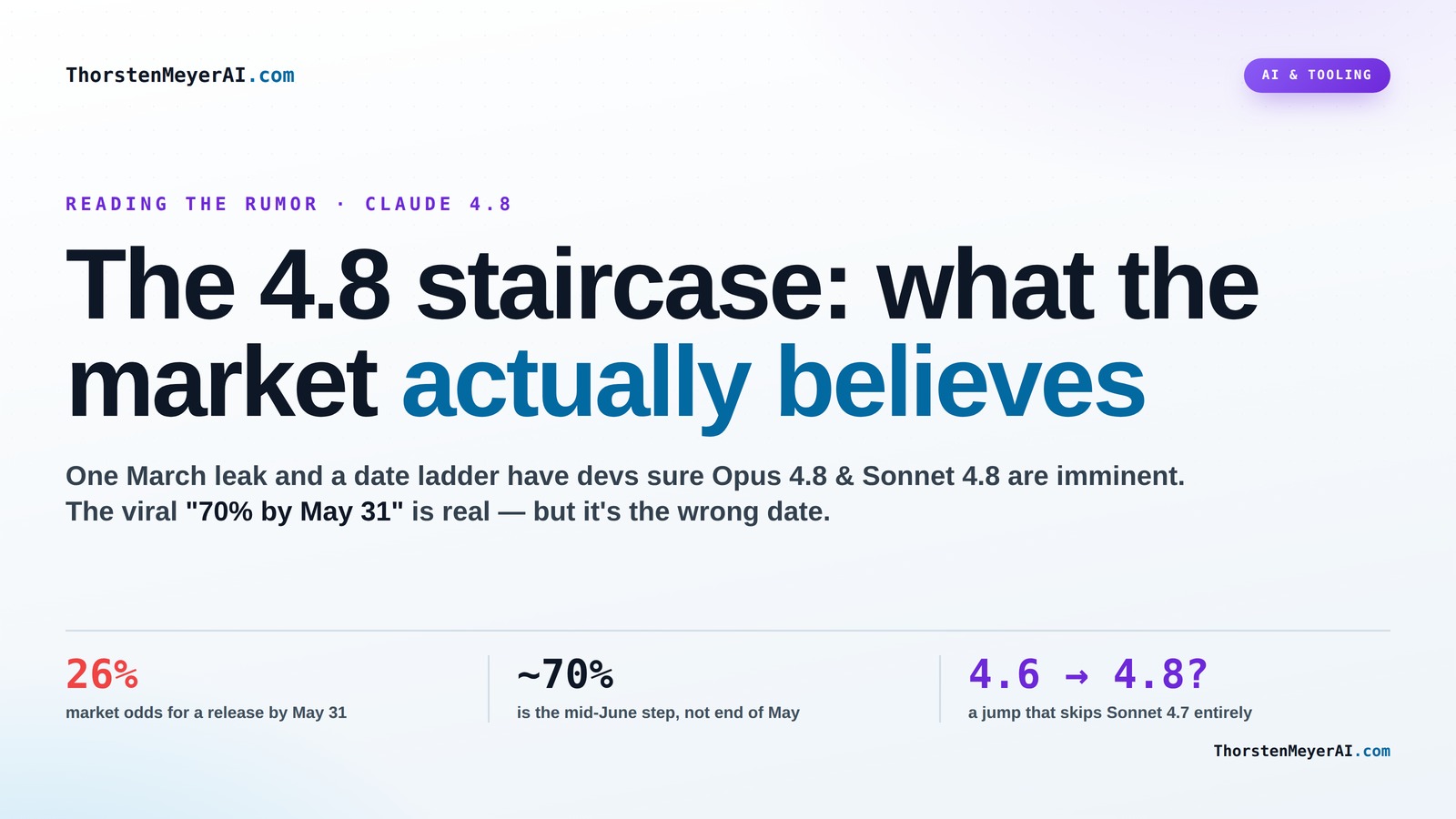

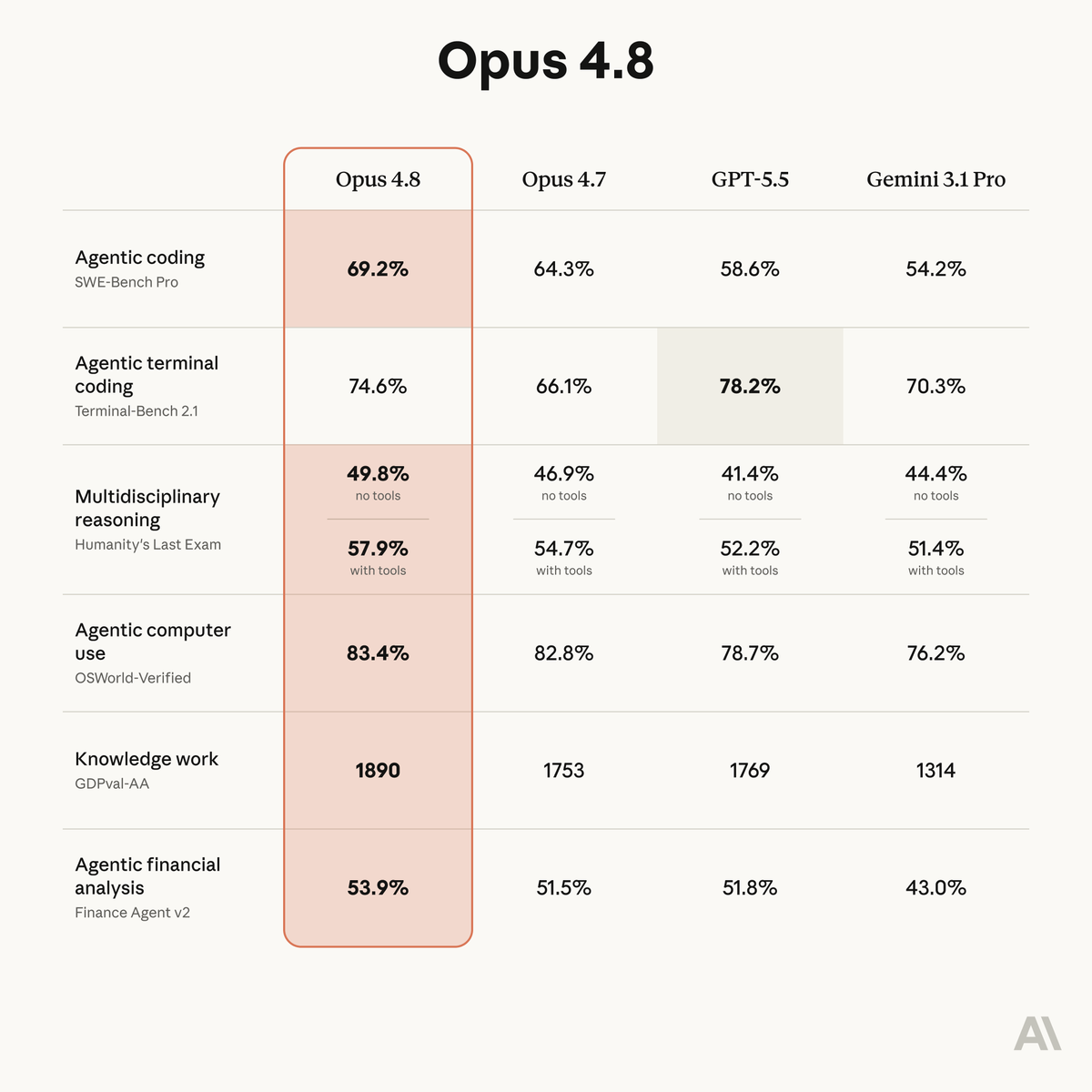
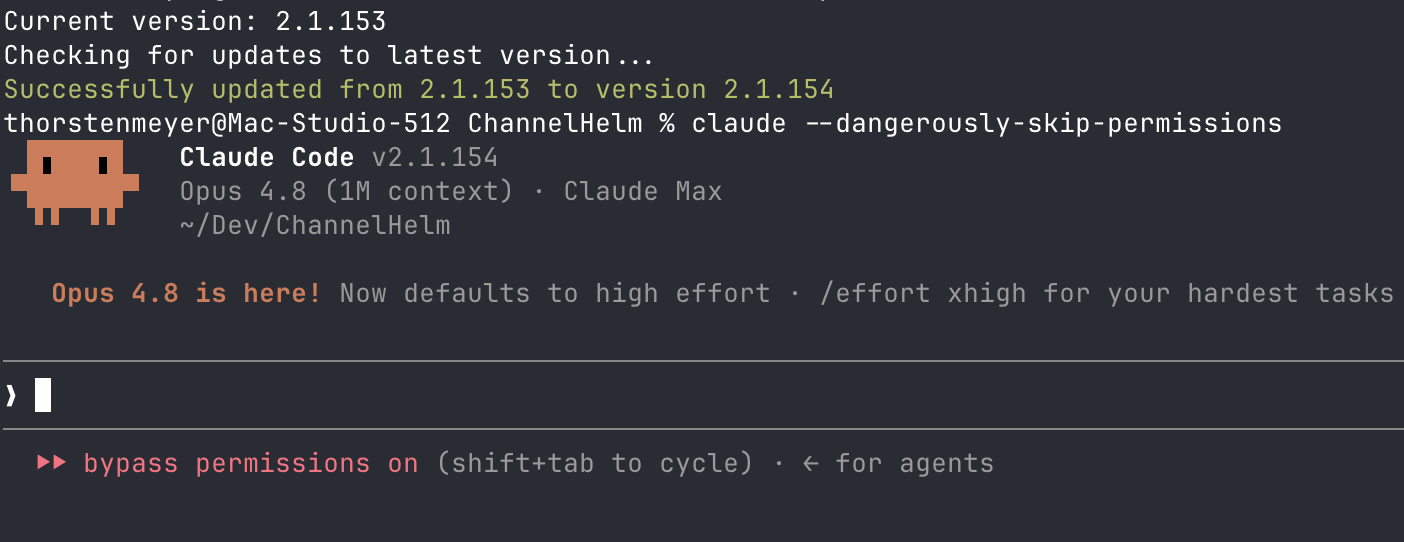
There’s a rumor with a very specific shape going around the developer world right now: Anthropic is about to ship Claude Opus 4.8 and Sonnet 4.8, and a prediction market supposedly puts the odds at 70% for a release by the end of May. The energy is real. The 70% number is real. But the two have been welded together wrong — and untangling them turns out to be a more useful story than the rumor itself.

Get business pricing on tech for your team
- Business-only prices and quantity discounts
- Tax-exempt purchasing
- Multiple users, one account, clear invoices
Let me do this the way I’d want it done for me: confirmed facts first, speculation clearly labeled as speculation, and an honest look at the one detail most of the coverage is skating past.
The 4.8 staircase: what the market actually believes
One March leak, a steady cadence, and a prediction-market date ladder have devs convinced Claude Opus 4.8 & Sonnet 4.8 are imminent. Here’s what’s confirmed, what’s speculation, and the pattern break almost nobody is flagging.
Confirmed vs rumored
Separate the two cleanly and the hype gets quieter. One column is fact; the other is interpretation built on a single leaked string.
$5/$25 per MTok · 1M context · the current flagship$3/$15 per MTok · 1M context · the balanced workhorsesonnet-4-8 string in a Mar 31 Claude Code source-map, inside a “forbidden model names” filter listsonnet-4-8 ever ships under that name at allAs an affiliate, we earn on qualifying purchases.
The “70%” is real — but it’s the wrong date
The Polymarket event isn’t one bet, it’s a ladder of dates, each with its own odds that climb as dates get later. Tap a step to see what it means.
“Claude 4.8 released by…?” — implied probability by date
Read it as a staircase, not a headline: probably not by end of May, more likely than not by mid-June, very likely by end of July.
As an affiliate, we earn on qualifying purchases.
A 4.6 → 4.8 jump skips Sonnet 4.7 entirely
Anthropic has paired Opus & Sonnet minor versions consistently. There’s been no Sonnet 4.7 at all — so jumping straight to 4.8 would break the pattern. That cuts both ways.
As an affiliate, we earn on qualifying purchases.
What to run today — stop waiting for 4.8
The rumor’s been circulating eight weeks; the end-of-May line is at 26%. Decisions made against a model that doesn’t exist are decisions deferred. Run the model you can call.
AI developer prediction market platform
As an affiliate, we earn on qualifying purchases.
As an affiliate, we earn on qualifying purchases.
Bigger gains than any point release
The largest available wins right now aren’t in the model — they’re in the workflow scaffolding that’s already shipping and mostly free to learn.
Prompting
Highest-leverage skill: be specific, give +/− examples, ask for step-by-step reasoning and structured output. Beats a point release.
Skills
Package reusable instructions & capabilities so you stop re-explaining your conventions every single session.
Projects
Keep context, files & history together so the assistant works from your actual material, not a cold start.
Artifacts
Turn outputs into editable, reusable deliverables instead of disposable chat text you copy-paste once.
Steady ~141-day Sonnet cadence + the leaked string + a rising date ladder. Opus 4.7’s vision leap would make a $3/$15 Sonnet 4.8 a serious enterprise upgrade for screenshots, tables & PDFs.
Zero official signal. May 31 sits at 26%, the market is thinly traded, and a “forbidden model name” is weak evidence it ships. The rumor’s been live eight weeks with nothing delivered.
What is actually confirmed
Start with the floor — the things that are not in dispute.
Claude Opus 4.7 is real and shipping. It launched on April 16, 2026, sits at $5 per million input tokens and $25 per million output, and carries a 1-million-token context window. It’s Anthropic’s current flagship, and it’s genuinely strong on the things the company has optimized for: large-scale refactoring, deep multi-step reasoning, and agentic coding work.
Claude Sonnet 4.6 is the current Sonnet. It launched February 17, 2026, at $3 / $15 per million tokens, also with a 1-million-token context window in beta — the balanced speed-and-intelligence workhorse most coding-agent traffic actually runs on.
There was a leak. On March 31, 2026, a source-map file shipped by accident with the Claude Code npm package, and inside it researchers found a string: sonnet-4-8. It appeared in what looks like a security filter — a list of “forbidden” model names that internal builds of Claude Code must not surface to users. The same list reportedly included opus-4-7 (which then shipped two weeks later, on schedule) and mythos. That single string is the entire evidentiary basis for the 4.8 rumor.
And that’s it. That is the whole confirmed picture. As of late May 2026, there is no Anthropic announcement, no claude-opus-4-8 or claude-sonnet-4-8 API identifier, no model card, and no published benchmarks. Everything beyond the list above is interpretation.
The staircase: what the market really says
Here’s where the 70% number comes from — and why it doesn’t mean what the rumor claims.
The Polymarket event “Claude 4.8 released by…?” isn’t a single yes/no bet. It’s a ladder of dates, each with its own probability, and the prices climb as the dates get later. As of May 27, the ladder reads roughly like a staircase: about 26% for a release by May 31, 71% by June 15, 76% by June 30, and 94% by July 31.
So the famous “70%” is real — but it belongs to the June 15 step, not May 31. The end-of-May line the rumor leans on is sitting at roughly a quarter, not two-thirds. Somewhere along the way, the highest comfortable number on the board got attached to the nearest exciting date, and the staircase collapsed into a single misleading headline.
Read correctly, the market is actually saying something measured: probably not by end of May, more likely than not within a few weeks of that, and very likely by the end of July. That’s not the breathless “it’s dropping any day” story. It’s a market pricing in a release that’s plausible-soon but not imminent — which, notably, is exactly how you’d price an iterative point release from a company with a steady cadence and no announced date.
It’s also worth keeping prediction markets in proportion. This particular event is thinly traded — volume in the hundreds of dollars, not the millions that make political markets sharp. Thin markets move on vibes as much as information. The staircase is a useful sentiment gauge; it is not a leaked roadmap.
The pattern break almost nobody is flagging
Now the part I find genuinely interesting, and that most of the hype skips.
Anthropic has been remarkably consistent about pairing its Opus and Sonnet minor versions. The families move together. So a jump straight from Sonnet 4.6 to Sonnet 4.8 would mean skipping 4.7 entirely — and there has been no Sonnet 4.7 at all, even though Opus 4.7 has now been out for over a month. That’s a real break in the pattern, and it cuts two ways.
The bullish reading: the leaked sonnet-4-8 string is evidence Anthropic is deliberately re-syncing the numbering, jumping Sonnet forward to land it on a shared 4.8 line alongside a new Opus — a coordinated dual release. The bearish reading: version strings in a security filter list are exactly the kind of thing that appears for internal, defensive, or contingency reasons and never ships under that name. A “forbidden model name” is, almost by definition, a name the company doesn’t want surfaced — which is weak evidence that it’s a product and strong evidence that someone wanted it kept quiet, for any number of reasons.
Both readings are defensible from the same fact. That’s the tell that we’re in speculation territory, and it’s why the responsible move is to hold both rather than pick the exciting one.
What a 4.8 might bring — clearly labeled as guesswork
If you want the community’s projected profile, here it is with the asterisk it deserves: none of this is confirmed.
The most grounded projection extrapolates from Opus 4.7’s real gains. Opus 4.7 reportedly made a large jump in vision capability — community analysis cites a leap in visual-acuity scoring and support for higher-resolution image input, on the order of 3.75 megapixels. If a Sonnet 4.8 inherited that vision foundation at the $3 / $15 price point, it would be a meaningful upgrade for the unglamorous-but-valuable enterprise work: UI-screenshot analysis, table scanning, multi-page PDF parsing. On coding, the community’s extrapolation lands a hypothetical Sonnet 4.8 somewhere in the low-80s on SWE-Bench Verified, which would put it roughly at parity with the strongest open-weight models and competitive with rivals. One credible caveat from the same analysis: a new tokenizer could raise token usage noticeably, which matters for anyone counting cost per task.
Every one of those figures is a target the community has drawn, not a delivered capability. Anthropic’s own version increments aren’t even monotonic — some minor revisions improve coding while regressing slightly on reasoning, or the reverse. Until a model card and independent benchmarks land, treat all of it as a hypothesis.
The more useful question: what should you run today?
Speculation is fun; shipping is better. If your roadmap has been waiting for 4.8 to make a decision, the honest advice is to stop waiting. The rumor has been circulating for eight weeks, we’re at the end of May, and the end-of-May market line is at 26%. Decisions made against a model that doesn’t exist are decisions deferred, not decisions made.
So, the practical fork. For most everyday coding-agent work, Sonnet 4.6 is the right default — it’s the balanced option on speed, cost, and quality, and it’s what the majority of agent traffic already runs on. When you hit genuinely hard problems — large-scale refactors, deep reasoning chains, the tasks where a weaker model spins — escalate to Opus 4.7. It costs more and it exists today, which is the entire point. Run your eval set against the model you can actually call.
Claude Code versus Codex — the agent debate underneath it all
There’s a reason the 4.8 speculation runs so hot among developers specifically, and it’s that the model is only half the tool now. The other half is the agent wrapped around it.
Claude Code is Anthropic’s command-line agent: it lives in your terminal, reads and writes files directly, runs commands, and works through multi-step tasks against your actual repository. OpenAI’s Codex occupies the same conceptual space from the other side. The debate between them is the live one in developer circles — file-accessing terminal agent versus terminal agent — and it matters more than which underlying model is a point or two ahead on a benchmark, because the agent’s ergonomics, permissions model, and reliability on long tasks are what you feel every day. A frontier model inside a clumsy harness loses to a slightly weaker model inside a great one. That’s the part of the “4.8 will change everything” excitement that’s actually well-founded: a better Sonnet inside Claude Code would compound, because the harness is already good.
It’s worth naming the tradeoff honestly rather than picking a side. A terminal agent that can touch your files is powerful precisely because it can touch your files — which is also the thing to be deliberate about. Permissions, sandboxing, and reviewing what an agent actually did are not optional niceties at this capability level; they’re the cost of the power, on either platform.
The free layer most people underuse
Here’s the genuinely actionable closer, and it has nothing to do with which version number drops next. The largest available gains for most people right now aren’t in the model — they’re in the workflow scaffolding that’s already shipping and mostly free to learn.
Four things repay the time immediately. Prompting remains the highest-leverage skill: being specific, giving positive and negative examples, asking for step-by-step reasoning, and requesting structured output formats will do more for your results than a point release will. Skills let you package reusable instructions and capabilities so you’re not re-explaining your conventions every session. Projects keep context, files, and history together so the assistant works from your actual material instead of a cold start. And Artifacts turn outputs into editable, reusable deliverables rather than disposable chat text. There’s a steady stream of free community workshops on all four, and they pay off no matter which model you’re calling underneath.
That’s the quiet truth behind all the version-number drama. The next model will arrive when it arrives — maybe by mid-June if the staircase is right, maybe later, maybe under a different name entirely. Meanwhile the people getting the most out of these tools aren’t the ones refreshing the leak threads. They’re the ones who got good at the workflow layer that’s already here.
The honest bottom line
Confirmed: Opus 4.7 (April 16, $5/$25, 1M context) and Sonnet 4.6 (Feb 17, $3/$15, 1M context) are what exist, plus one leaked string from March 31. Speculation: the date staircase (26% by May 31, ~70% by mid-June, 94% by end of July), the projected benchmarks, and the whole 4.8 narrative. Unprecedented if true: the 4.6→4.8 skip. And the actually-useful move regardless of any of it: run Opus 4.7 or Sonnet 4.6 today, pick your agent harness deliberately, and invest in the prompting-Skills-Projects-Artifacts layer that’s already paying off.
The staircase will resolve itself soon enough. The workflow gains don’t have to wait for it.
Figures current as of May 28, 2026, and moving fast. Confirmed model details from Anthropic; date-ladder probabilities from the thinly-traded Polymarket “Claude 4.8 released by…?” event; leak and benchmark projections from third-party developer analysis and explicitly unconfirmed. This is commentary on public speculation, not insider information.
Halloween Picks
halloween
As an affiliate, we earn on qualifying purchases.