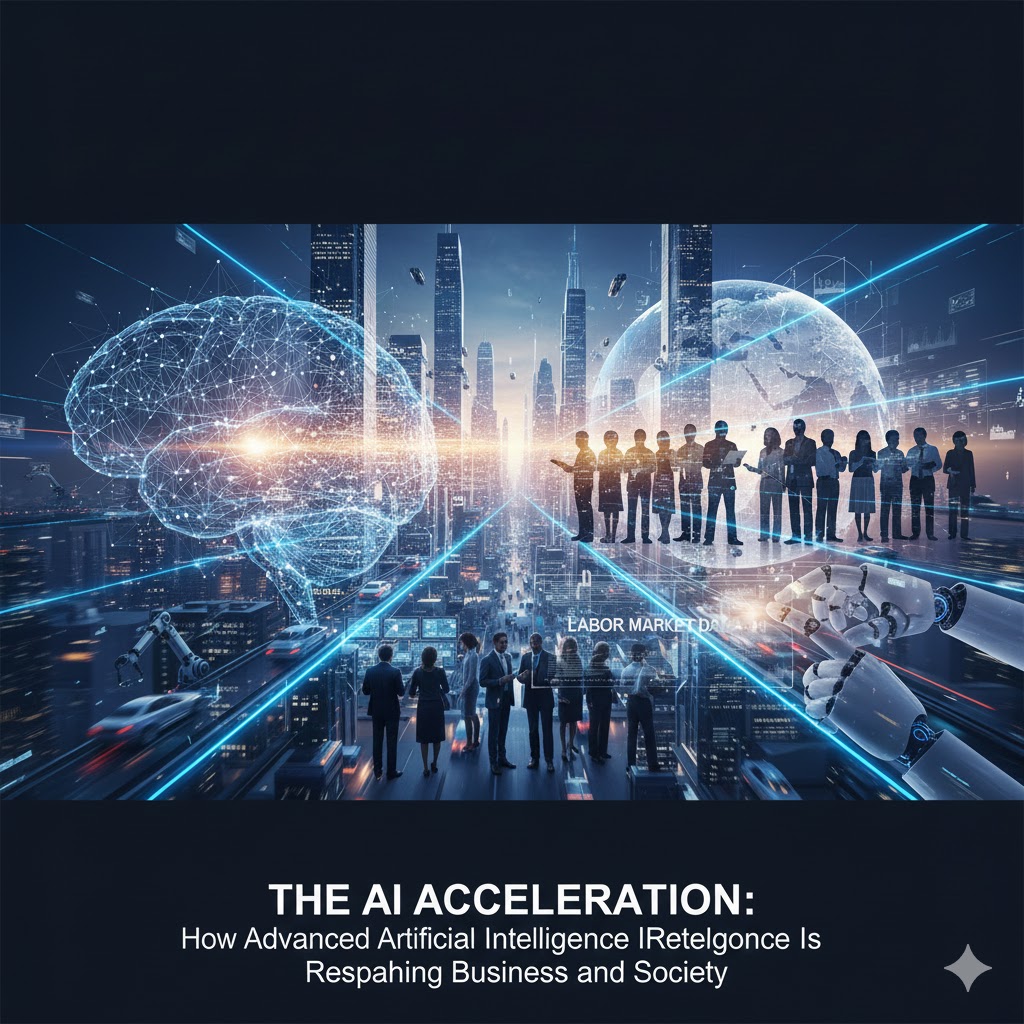

Artificial intelligence has moved decisively from experimentation to infrastructure. What was once confined to research labs is now embedded across supply chains, software platforms, and everyday decision-making. The acceleration driven by foundation models, multimodal systems, and agentic workflows is changing not only how companies operate, but how value, labor, and power are distributed across society. This transformation is neither purely technological nor purely economic—it is structural.
1. Impact on Businesses: From Competitive Advantage to Survival Requirement
AI as Core Infrastructure
For businesses, AI is no longer a differentiator; it is becoming table stakes. Large language models, vision systems, and speech interfaces are now integrated into productivity software, customer service, marketing, and operations. Providers such as OpenAI, Google, and Microsoft offer models that can be swapped via APIs, pushing AI toward a utility-like role similar to cloud computing.
This commoditization shifts advantage away from model ownership toward workflow integration, data control, and distribution. Companies that embed AI deeply into proprietary processes gain leverage; those that treat it as a bolt-on feature risk rapid obsolescence.
Productivity Gains and Cost Compression
AI systems dramatically reduce the marginal cost of cognitive work: drafting, coding, analysis, translation, and design. In the short term, firms experience productivity spikes and margin expansion. In the medium term, competitive pressure forces those gains to be passed on to customers as lower prices, compressing margins across entire sectors. This dynamic mirrors previous automation waves—but at a much faster pace.
Organizational Restructuring
AI adoption flattens hierarchies. Tasks once reserved for specialists can now be handled by smaller teams augmented by AI agents. Middle-management and coordination roles face pressure, while demand grows for system architects, domain experts, and operators who can supervise AI-driven workflows. The firm evolves from a labor-heavy organization into a capital- and software-intensive system.
Top picks for "acceleration advanc artificial"
Open Amazon search results for this keyword.
As an affiliate, we earn on qualifying purchases.
2. Labor Markets: Job Displacement Without Job Disappearance
AI does not eliminate work uniformly; it unbundles jobs into tasks. Routine cognitive tasks are automated first, while judgment, accountability, and human interaction persist longer. The result is not immediate mass unemployment, but role erosion—jobs shrink until they are no longer economically viable.
Wages in exposed professions stagnate or decline as AI substitutes increase labor supply. At the same time, high-leverage roles—those who design, deploy, or control AI systems—capture disproportionate value. This widens income inequality within and across countries.
Institutions such as the OECD have already noted that AI exposure correlates strongly with education and income, reinforcing existing social stratification unless countered by policy.
3. Societal Effects: Inequality, Power, and Trust
Concentration of Power
AI development favors scale. Training large models requires capital, data, and compute, concentrating power in a small number of global firms and cloud providers. Smaller companies and governments become dependent on external platforms, raising concerns about digital sovereignty and economic resilience.
Cultural and Cognitive Shifts
As AI systems generate text, images, music, and video at scale, the boundary between human and machine creativity blurs. This abundance challenges traditional notions of authorship, originality, and expertise. Trust becomes fragile: if any artifact can be synthetically produced, verification and provenance grow more important than production itself.
Social Contracts Under Strain
Modern societies are built around a labor-for-income contract. As AI weakens the link between human labor and economic output, this contract frays. Without mechanisms to redistribute productivity gains—through taxation, public investment, or new ownership models—social instability becomes a real risk.
4. Strategic Responses: What Comes Next
For businesses, resilience lies in:
- Owning differentiated data and distribution.
- Designing AI-native processes, not AI-assisted replicas.
- Treating workforce transition as a strategic investment, not a cost.
For governments and society, priorities include:
- Updating education and training for lifelong adaptability.
- Building governance frameworks that ensure transparency and accountability.
- Exploring new economic models—such as capital participation or universal dividends—to decouple human dignity from traditional employment.
Conclusion: A Structural Transition, Not a Passing Trend
AI is not just another productivity tool; it is a general-purpose technology reshaping the foundations of economic and social organization. For businesses, the challenge is to adapt before efficiency gains become existential threats. For society, the task is to ensure that intelligence abundance translates into shared prosperity rather than concentrated power.
The choices made in this decade—about ownership, governance, and distribution—will determine whether AI becomes a force for broad human advancement or a catalyst for deeper inequality.