Two days after a federal jury dismissed Elon Musk’s charitable-trust case against OpenAI on procedural grounds, the structural question the verdict did not resolve has an obvious comparison case sitting one block over in the AI industry. Anthropic was founded in April 2021 by Dario and Daniela Amodei and a group of researchers who had just left OpenAI, structured from its first day as a Public Benefit Corporation with a Long-Term Benefit Trust layered on top.
Open a free Amazon Business account
Business pricing, bulk buying and tax-exempt orders.
Create a free accountAs an affiliate, we earn on qualifying purchases.
There was no nonprofit to convert. There were no charitable assets to value, transfer, or allegedly misappropriate. There is no California Attorney General charitable-trust oversight, no coalition of fifty foundations petitioning to halt a conversion, no Lessig amicus brief, no $300 billion charitable-asset valuation hanging over a restructure. On the single dimension that dominated three weeks of testimony in Oakland — whether a charitable trust can lawfully convert into a for-profit at scale — Anthropic’s structure simply does not present the question.
That is the clean side. The other side is that Anthropic’s structure presents a different governance question that public equity markets have, historically, disliked at least as much. The Long-Term Benefit Trust is an independent body of five financially disinterested trustees holding a special class of voting stock, with the authority to elect and ultimately remove a majority of Anthropic’s board, and a mandate to prioritize the company’s safety-and-public-benefit mission over shareholder returns when the two conflict.
No investor can override the Trust — not Google with its roughly 14% stake, not Amazon, not the GIC-and-Coatue-led syndicate that put $30 billion into the February 2026 Series G at a $380 billion post-money valuation. When Anthropic files an S-1, that Trust becomes the most-debated feature of the prospectus — the way OpenAI’s charitable-trust-conversion history will be the most-debated feature of theirs.
The structural argument I want to make: Anthropic did not eliminate the governance discount that the AI labs carry into public markets. It relocated it. OpenAI’s question is whether the conversion lawfully extracted charitable value; Anthropic’s question is whether the mission trust will subordinate shareholder returns, and by how much.
Both are governance-discount questions. They sit at different layers of the cap table, they invite different regulatory and litigation exposure, and underwriters will price them differently — but neither company arrives at the public markets with the clean, founder-controlled, profit-maximizing structure that public investors are most comfortable paying full price for.
This essay walks the two structures side by side, the conversion Anthropic never had to make, the anatomy of the Long-Term Benefit Trust and how its control escalates, the disclosure-profile contrast between the two S-1s, the financial backbone that makes Anthropic the cleaner-burn IPO candidate, the governance-discount question that public markets apply to trust-controlled companies, and the structural reading of what it means that the two largest AI labs are both entering the public-company era carrying mission-governance structures that no company at this scale has tested before.
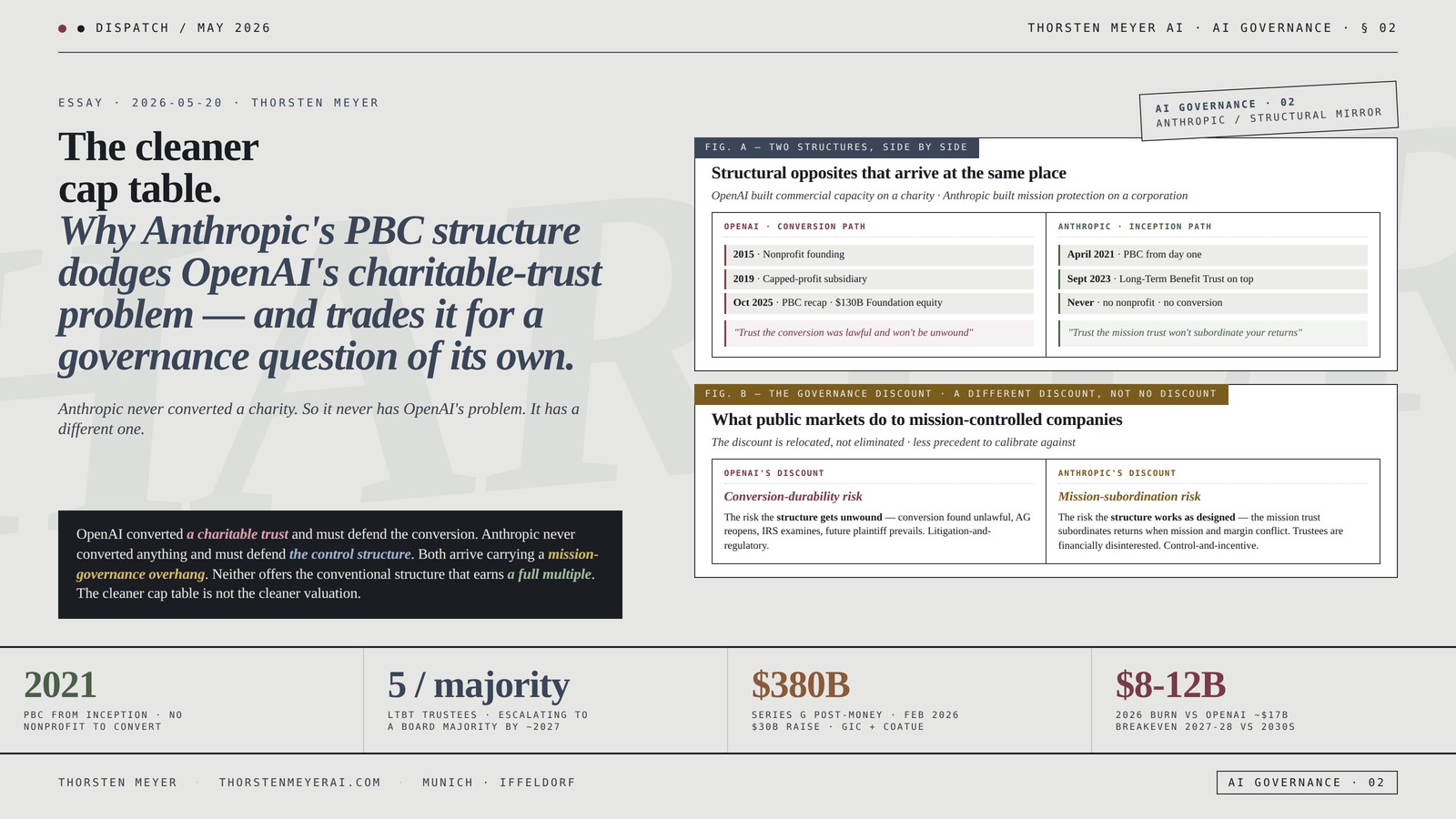
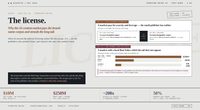
The cleaner cap table.
Why Anthropic’s public-benefit
structure dodges OpenAI’s
charitable-trust problem —
and trades it for a governance
question of its own.
to convert · no charitable trust
board majority within ~4 years
$30B raise · GIC + Coatue led
breakeven 2027-28 vs 2030s
- Conversion history · nonprofit → capped-profit → PBC · $130B Foundation equity + control
- The litigation · Musk case dismissed on timing, on appeal · underlying theory unreached
- Regulatory overhang · AG settlement + oversight · IRS conversion review · future plaintiffs
- Microsoft entanglement · AGI clause · $38B revenue-share cap · 27% equity · access through 2032
- The Long-Term Benefit Trust · Class T voting · escalating board control · mission-balancing mandate
- Hyperscaler concentration · Google ~14% / $40B · Amazon $25B · much in credits · antitrust at IPO
- Compute dependency · AWS / GCP reliance · SpaceX 300MW / 220,000 GPUs · unit-economics proof
- Mission-vs-margin tension · ad-free pledge · Pentagon dispute cost a contract OpenAI won
The cleaner cap table is not the cleaner valuation. Anthropic dodged the exact problem that consumed three weeks of OpenAI’s litigation — by adopting a structure that introduces a governance question public markets have never priced at this scale. It is a different discount, not no discount.Thorsten Meyer · The Cleaner Cap Table · AI Governance 02
By Thorsten Meyer — May 2026
This is the second dispatch in the AI Governance and Corporate Structure track, and it is the direct structural mirror of the first. The Calendar Technicality piece walked what the Musk verdict did and did not settle about OpenAI’s nonprofit-to-for-profit conversion. This piece walks the company that never had to make that conversion — and asks whether being structurally clean on the charitable-trust dimension actually delivers a clean public-market profile, or whether it just moves the governance question to a different part of the structure. The honest answer is the second thing. Anthropic is genuinely cleaner where OpenAI is most exposed, and genuinely exposed where OpenAI is comparatively conventional.
The structural argument I want to make: Anthropic was built, deliberately and from the founding documents, to avoid the exact structural failure mode that the Musk litigation alleged at OpenAI. The Amodeis left OpenAI in 2021 over disagreements about safety and commercial pressure, and they encoded their answer into the corporate form itself — a Public Benefit Corporation, which legally permits directors to balance mission against profit, paired with a Long-Term Benefit Trust that holds the structural power to enforce that balance even against investor pressure. This is the cleanest possible answer to “can a mission survive commercial scale?” at the level of corporate design. But the public markets do not reward mission-protection structures with premium valuations. They discount them. The same Trust that makes Anthropic immune to the charitable-trust-conversion challenge is the feature institutional investors will scrutinize hardest, because it explicitly subordinates their economic interest to a mission mandate they do not control. OpenAI carries a conversion-history overhang into its S-1. Anthropic carries a mission-trust overhang into its S-1. The market prices both as governance discounts. The question for each company is which discount is smaller — and that is not yet a settled question.
The headline integrative finding: The two AI labs that will most plausibly define the first wave of AI public listings are arriving at the market from opposite structural directions and converging on the same problem. OpenAI converted a charitable trust into a for-profit and now must convince public investors that the conversion was lawful and durable. Anthropic never converted anything and now must convince public investors that its mission trust will not destroy shareholder value. Neither is the clean, founder-controlled, profit-maximizing structure the public markets pay full multiple for. OpenAI’s overhang is litigation-and-regulatory: the Musk case is dismissed but the AG oversight, the IRS conversion review, and the future-plaintiff channel remain open. Anthropic’s overhang is governance-and-control: the Long-Term Benefit Trust’s escalating board authority and mission-balancing mandate have no precedent at public-market scale, and the comparison set public investors will reach for — Snap, Lyft, and other trust-or-dual-class structures that traded at governance discounts — is not encouraging. The structural significance is that the AI industry is about to run a live, public-market experiment on whether mission-governance structures can hold under quarterly-earnings pressure, with two different designs tested simultaneously. The cleaner cap table is not the same as the cleaner valuation. Those are different things, and only one of them is now visible.
This essay walks the two structures side by side and what the difference actually is (Section I), the conversion Anthropic never had to make and why that matters post-verdict (Section II), the anatomy of the Long-Term Benefit Trust and how its control escalates over time (Section III), the disclosure-profile contrast between the two companies’ S-1s (Section IV), the financial backbone that makes Anthropic the cleaner-burn candidate (Section V), the governance-discount question that public markets apply to mission-controlled companies (Section VI), and the structural reading of what it means for two untested mission-governance structures to enter the public-company era at once (Section VII).
I · Two structures, side by side · what the difference actually is
The structural-contrast crystallization. The two companies are routinely described as rivals building similar products with similar capital from overlapping investors. At the level of corporate form, they are nearly opposite. The difference is not cosmetic; it determines what each company has to defend.
OpenAI · the conversion path
The structural history: founded December 2015 as a nonprofit. Created a capped-profit subsidiary (OpenAI LP) in 2019 to raise capital and attract researchers. Completed a recapitalization in October 2025 converting the for-profit into OpenAI Group PBC while keeping the nonprofit — now the OpenAI Foundation — in control, with the Foundation holding equity valued at approximately $130 billion at conversion.
The structural object: a Public Benefit Corporation that was converted into existence out of a nonprofit, with the nonprofit Foundation retaining a controlling interest and equity stake. The charitable-trust question — whether the conversion lawfully valued and dispositioned the assets the nonprofit held in trust for the public — is intrinsic to this path because there was a charitable trust, and it was converted.
The exposure this creates: every regulatory and litigation channel that examines whether the conversion was lawful. The Musk case (dismissed on timing). The California AG oversight (settled October 2025 with concessions). The IRS conversion review (discretionary). Future plaintiffs (available). The S-1 disclosure of all of it (mandatory at filing).
Anthropic · the inception path
The structural history: founded April 2021 as a Public Benefit Corporation from the first day. Introduced the Long-Term Benefit Trust in September 2023 as an additional governance layer. Has never been a nonprofit, has never converted, has never held charitable assets in trust for the public.
The structural object: a Public Benefit Corporation that was incorporated as one, with a mission-protection trust built on top rather than a controlling nonprofit underneath. The charitable-trust question does not arise because there is no charitable trust — the public-benefit obligation is a feature of the corporate charter, not a converted asset.
The exposure this creates: the governance question of whether the Long-Term Benefit Trust’s escalating board control and mission-balancing mandate are compatible with public-shareholder economics. Different question, different channel, but a governance question nonetheless.
The difference stated precisely
OpenAI’s structure asks the public market: “trust that the conversion of a charitable trust into this for-profit was lawful and will not be unwound.” This is a litigation-and-regulatory assurance.
Anthropic’s structure asks the public market: “trust that the mission trust controlling this company’s board will not subordinate your returns in a way you cannot prevent.” This is a governance-and-control assurance.
Both are asks. Neither company offers the public market the default reassurance — a founder-or-board-controlled company whose directors owe undivided fiduciary duty to maximize shareholder value. OpenAI’s directors sit under a Foundation with a charitable mission. Anthropic’s directors sit under a Trust with a safety mission. The public market reaches for a discount in both cases; the only question is the size.
The side-by-side observation
The companies are structural opposites that arrive at the same place. OpenAI built commercial capacity on top of a charitable foundation and now must defend the conversion. Anthropic built mission protection on top of a commercial corporation and now must defend the control structure. The Musk verdict cleared one specific challenge to OpenAI’s path. It said nothing about Anthropic’s path, because Anthropic’s path raises a different question that no court and no S-1 has yet tested.
As an affiliate, we earn on qualifying purchases.
II · The conversion that never happened · why inception structure matters after the verdict
The counterfactual crystallization. The most useful way to read Anthropic’s structure right now is as the counterfactual to everything the Musk trial examined. Every contested step in OpenAI’s history has a corresponding non-event in Anthropic’s.
The point-by-point mirror
The 2019 for-profit subsidiary: at OpenAI, the creation of OpenAI LP was the alleged moment the nonprofit began shifting personnel and intellectual property into a commercial entity. At Anthropic, there was no nonprofit to shift anything out of. The commercial entity was the original entity.
The asset-transfer question: Musk’s theory was that OpenAI moved assets held in charitable trust into for-profit ownership without adequate consideration to the public. At Anthropic, there were never charitable-trust assets to transfer. The capital came in as venture investment from the start, with no charitable-purpose restriction attached.
The “no charitable trust to enforce” defense: OpenAI’s attorney argued in closing that Musk’s donations “came with no strings attached,” meaning he had “no charitable trust to enforce.” This was a contested factual claim about OpenAI’s donor agreements. At Anthropic, the equivalent claim is structurally unambiguous: investors put in venture capital expecting equity returns, not charitable contributions held in trust. There is no analogous theory available to a hypothetical Anthropic plaintiff.
The conversion-valuation question: OpenAI’s October 2025 PBC conversion required valuing the nonprofit’s assets and allocating $130 billion in equity to the Foundation — a valuation the coalition of foundations argued was inadequate and the AG settled. At Anthropic, there was no conversion to value. The cap table has always been a cap table.
What this means for the IPO
OpenAI’s S-1 will need a risk-factor section addressing: the Musk litigation and appeal · the California AG settlement and continuing oversight · the potential for IRS examination of the conversion’s fair-market-value compliance · the possibility of future charitable-trust challenges from differently-situated plaintiffs · the AGI clause in the Microsoft partnership · the Foundation’s controlling interest and how it interacts with public-shareholder rights.
Anthropic’s S-1 will not need any of those, because none of those facts exist in its history. What it will need instead: a risk-factor section addressing the Long-Term Benefit Trust’s voting rights, the escalating board control, the mission-balancing mandate, and the hyperscaler-concentration and compute-dependency questions that are commercial rather than structural.
The honest qualification
This does not make Anthropic “safer” in any total sense. It makes Anthropic cleaner on one specific dimension — the charitable-trust-conversion dimension — that happens to be the one the Musk trial spent three weeks on and the one that dominates the public conversation about AI-lab corporate structure right now. Anthropic carries its own commercial and governance risks that OpenAI carries less of, which the later sections address. The point is narrow and precise: on the conversion question, Anthropic does not present the issue at all.
The counterfactual observation
Anthropic is the working example of the structure OpenAI’s critics say OpenAI should have had. The Amodeis left OpenAI partly over the commercialization trajectory and encoded a different answer into the corporate form. Whether that answer produces a better company is unknowable and not the question here. What is knowable is that the answer produces a cleaner charitable-trust profile — and a more complicated control profile. The verdict that cleared OpenAI’s specific litigation did nothing to resolve the control question that Anthropic’s structure raises, because that question lives in a different part of corporate law entirely.
corporate governance books for AI companies
As an affiliate, we earn on qualifying purchases.
As an affiliate, we earn on qualifying purchases.
III · The Long-Term Benefit Trust · anatomy and escalation
The mission-governance crystallization. The Long-Term Benefit Trust is the structural feature that makes Anthropic immune to the conversion challenge and exposed to the control challenge. Understanding it precisely is necessary to understand both.
What the Trust is
The composition: an independent body of five financially disinterested members. “Financially disinterested” means the trustees hold no Anthropic equity and cannot profit from decisions that increase the company’s valuation. Their sole mandate is the company’s mission — the development and maintenance of advanced AI for the long-term benefit of humanity.
The instrument: the trustees hold a special class of Anthropic stock (Class T common stock) that carries board-election rights rather than economic rights. The Class T shares are the mechanism through which the Trust exercises control.
The power: authority to select and remove a portion of Anthropic’s board of directors — a portion that grows over time. Per Anthropic’s own description, the Trust’s authority will “grow over time (ultimately, a majority of our Board).” Sources tracking the structure describe the escalation as reaching a board majority within approximately four years of the Trust’s establishment — which, from a September 2023 founding, points to roughly 2027.
The escalation mechanism
The design logic: the Trust’s control increases as the company grows and as the stakes of its decisions rise. Early in the company’s life, the Trust elects a minority of the board. As capability and commercial scale increase — and as the externalities of the company’s decisions grow — the Trust’s board control escalates toward a majority.
The structural consequence: by the time Anthropic is a large public company (which is precisely when shareholder pressure for profit-maximization is highest), the Trust is designed to control a majority of the board. This is the opposite of the typical public-company trajectory, where founder or insider control dilutes over time as public shareholders accumulate. Anthropic’s mission control is designed to concentrate over exactly the period when public-shareholder economic pressure intensifies.
The trustee roster
Current and recent trustees (the body has rotated): Richard Fontaine, CEO of the Center for a New American Security, joined in 2025. Mariano-Florentino “Tino” Cuéllar, President of the Carnegie Endowment for International Peace, joined in January 2026. Earlier trustees who have stepped down include Jason Matheny (December 2023, to preempt RAND Corporation conflicts), Paul Christiano (April 2024, to lead AI safety at the U.S. AI Safety Institute), and two others who departed in January 2026 for nonprofit and philanthropic work. The roster skews toward national-security, policy, and AI-safety expertise rather than commercial or financial backgrounds — consistent with the mission mandate, and a signal to public investors about whose judgment will control the board.
The criticisms
The “untested and possibly toothless” critique: critics argue the Trust has no direct Silicon Valley precedent, that its enforcement power is unproven, and that it could prove toothless if the company faces severe commercial pressure ahead of or after an IPO. The Trust has never been tested in a genuine mission-versus-balance-sheet conflict.
The “governance discount” critique: public investors generally dislike trust-controlled and dual-class governance structures because they dilute shareholder control. The comparison set — Snap and Lyft, which went public with founder-control or dual-class structures and traded at governance discounts — is the reference point underwriters and institutional investors will reach for.
The countervailing view: supporters argue the Trust’s mere existence creates a structural check that most AI companies lack entirely, that the safety-first governance is a risk-mitigation feature rather than a constraint, and that in an era of rising regulatory scrutiny the transparent mission structure is a more digestible narrative for institutional investors than a “move fast” culture.
The Trust observation
The Long-Term Benefit Trust is simultaneously Anthropic’s strongest structural protection against the OpenAI-style conversion challenge and its single largest public-market governance question. It is the feature that makes the charitable-trust theory inapplicable to Anthropic, and it is the feature that public-market investors will scrutinize hardest. The same design choice does both things. That is the structural mirror in a single mechanism: the protection and the discount are the same object viewed from two directions.
public benefit corporation legal guides
As an affiliate, we earn on qualifying purchases.
As an affiliate, we earn on qualifying purchases.
IV · The disclosure-profile contrast · two S-1s, two different hardest sections
The prospectus crystallization. When each company files its S-1, the risk-factors section is where the structural difference becomes legible to public investors. The two companies will have entirely different hardest paragraphs.
OpenAI’s hardest disclosures
The conversion history: the full nonprofit-to-capped-profit-to-PBC path, the October 2025 recapitalization, the $130 billion Foundation equity allocation, and the Foundation’s continuing control.
The litigation: the Musk case (dismissed on statute-of-limitations grounds, on appeal), and the disclosure of the underlying charitable-trust theory that the verdict did not reach on the merits.
The regulatory overhang: the California AG settlement and continuing oversight, the potential IRS examination of the conversion’s fair-market-value compliance, and the possibility of future charitable-trust challenges.
The Microsoft entanglement: the AGI clause that reportedly voids the partnership if OpenAI achieves AGI, the $38 billion revenue-share cap through 2030, the 27% Microsoft equity stake, and the model-access terms through 2032.
The structural read for investors: OpenAI’s hardest disclosures are about whether its corporate existence is durable and lawful. These are existential-structure questions.
Anthropic’s hardest disclosures
The Long-Term Benefit Trust: the Class T voting shares, the escalating board control toward a majority, the mission-balancing mandate, and the limitation it places on public-shareholder control. This will be, per multiple analysts, “the single most-debated feature of any S-1.”
The hyperscaler concentration: Google’s roughly 14% stake and up-to-$40 billion in commitments, Amazon’s second-largest position and up-to-$25 billion, much of it in cloud credits rather than cash, and the antitrust-review exposure that turning those private positions into liquid public holdings would trigger. The compute-dependency question — whether Anthropic continues depending on AWS and GCP for the bulk of its compute post-listing — is a commercial-risk disclosure with structural implications.
The mission-versus-margin tension: the PBC’s explicit mission-balancing requirement, the ad-free Claude pledge (versus competitors monetizing through advertising), and the Pentagon dispute over autonomous-weapons and surveillance usage restrictions that cost Anthropic a contract OpenAI won. These are cases where the mission mandate has already produced commercially costly decisions — useful evidence for the “the Trust has teeth” argument and worrying evidence for the “the mission will subordinate returns” concern, depending on which way the investor reads it.
The structural read for investors: Anthropic’s hardest disclosures are about whether its mission governance will subordinate shareholder economics. These are control-and-incentive questions.
The symmetry
OpenAI must convince investors its structure is durable. Anthropic must convince investors its structure is profitable. OpenAI’s risk is that the structure gets unwound. Anthropic’s risk is that the structure works as designed — that the mission trust actually does subordinate returns when mission and margin conflict. The cruel symmetry is that Anthropic’s governance is most concerning to investors precisely to the extent that it is most effective at its stated purpose.
The disclosure observation
Both S-1s will carry governance discounts; the discounts have different causes. OpenAI’s discount is for structural-durability risk. Anthropic’s discount is for mission-subordination risk. An investor who believes mission-governance is theater will discount Anthropic less (the Trust is toothless, so it won’t hurt returns) and discount OpenAI more (the conversion might unwind). An investor who believes mission-governance is real will discount Anthropic more (the Trust will subordinate returns) and OpenAI less (the conversion is done and defended). The two discounts are inversely correlated with the same belief. That is an unusual and underappreciated feature of the comparison.
AI company governance structure models
As an affiliate, we earn on qualifying purchases.
As an affiliate, we earn on qualifying purchases.
V · The financial backbone · the cleaner-burn candidate
The capital-efficiency crystallization. Structure aside, the reason Anthropic is frequently described as the cleanest IPO candidate of the AI labs is financial: it burns less, breaks even sooner, and earns a higher share of its revenue from enterprise customers who renew.
The revenue ramp
The trajectory: approximately $9 billion annualized revenue run-rate at the end of 2025, ramping to roughly $14 billion by mid-February 2026, and reported to have reached approximately $30 billion run-rate by early April 2026 — one of the fastest publicly reported revenue ramps in enterprise-software history. The earlier internal targets discussed were $20-26 billion for full-year 2026; the run-rate figures suggest the company is tracking at or above the top of that range.
The revenue mix: approximately 80% enterprise, versus OpenAI’s more consumer-heavy mix. Eight of the Fortune 10 are Claude customers. More than 1,000 business customers spend at least $1 million annually. The enterprise-weighted mix is the load-bearing element of the valuation argument — enterprise revenue renews, expands, and carries higher gross margins than consumer subscriptions, and it is less exposed to the advertising-monetization questions that consumer-AI products face.
The capital position
The Series G: $30 billion raised in February 2026 at a $380 billion post-money valuation, led by GIC and Coatue, with Microsoft and NVIDIA portions rolled in — the second-largest private tech round on record after OpenAI’s.
The hyperscaler commitments: up to $40 billion from Google and up to $25 billion from Amazon in late April 2026, much of it structured as cloud credits rather than pure cash.
The secondary-market signal: illiquid secondary trades and new-round talks imply valuations approaching $850-900 billion to $1 trillion — though these are reported figures, not confirmed primary valuations, and the confirmed Series G figure remains $380 billion.
The burn comparison
Anthropic’s implied operating burn: in the $8-12 billion range for 2026, with consensus modeling placing operating breakeven in 2027 or 2028.
OpenAI’s projected burn: approximately $17 billion for 2026 (with some estimates higher), and breakeven not until approximately 2030 per the renegotiated Microsoft terms.
The structural read: the narrower burn and earlier breakeven are the single biggest reasons Anthropic is treated as the cleanest IPO candidate of the AI labs on financial grounds. A company that reaches breakeven in 2027-2028 presents a fundamentally more legible valuation case to public investors than one that does not turn cash-flow positive until the 2030s.
The compute dependency
The constraint: Anthropic’s aggressive compute procurement — including a May 2026 SpaceX agreement reported to provide more than 300 megawatts of capacity and over 220,000 NVIDIA GPUs — is the real IPO setup. The company is converting compute scarcity into enterprise revenue and must do so before public investors demand audited proof of the unit economics. The compute-dependency and hyperscaler-concentration questions are the commercial risks that offset the structural cleanliness.
The financial observation
On financial grounds, Anthropic is the cleaner candidate; on structural grounds, it is cleaner on conversion and more complicated on control. The two assessments point the same direction on the charitable-trust question and diverge on the governance question. The financial strength is what would let Anthropic command a premium valuation — if the governance discount does not eat the premium. Whether it does is the question Section VI addresses.
VI · The governance discount · what public markets do to mission-controlled companies
The market-precedent crystallization. The decisive question for Anthropic’s eventual valuation is how much the public market discounts a company whose board is controlled by a mission trust rather than by its shareholders. The precedent is not encouraging, and the scale is unprecedented.
The precedent set
Snap: went public in 2017 with non-voting shares for public investors, retaining control with the founders. Traded at a persistent governance discount; the structure was widely criticized and excluded from certain indices.
Lyft, Google/Alphabet, Meta, and others: dual-class structures that concentrate voting control with founders or insiders. These have traded with governance discounts of varying magnitude, sometimes offset by strong performance, sometimes not.
The pattern: public markets accept founder-control structures when performance is strong enough to overwhelm the governance concern, and punish them when performance falters. The governance discount is latent during good times and acute during bad times — exactly when mission-versus-margin conflicts are most likely to surface.
Why Anthropic’s case is different in kind
The control is not founder control; it is mission control. Snap’s founders, even with concentrated voting power, are economically aligned with shareholders — they own equity and benefit from the share price. Anthropic’s Long-Term Benefit Trust is, by design, financially disinterested. The trustees hold no equity and cannot profit from a higher share price. Their mandate is explicitly the mission, not the stock.
The structural implication: a founder-controlled company can be trusted, at minimum, to want the stock to go up. A mission-trust-controlled company cannot be assumed to share that preference when mission and margin conflict. This is a categorically different governance structure from anything public markets have priced at this scale, and the comparison set understates the novelty.
The escalation problem
The control concentrates over time. Most founder-control structures dilute as the company matures and insiders sell. Anthropic’s mission control escalates toward a board majority over roughly the period the company would be going and being public. A public investor buying at the IPO is buying into a structure where the mission trust’s control is increasing, not decreasing — the opposite of the usual dilution-of-insider-control trajectory that public markets count on.
The countervailing case
The safety-first premium: in an era of rising regulatory scrutiny, some institutional investors view the mission governance as a risk-mitigation feature. A company structurally committed to safety may face less regulatory and reputational tail risk than one optimizing purely for growth.
The enterprise-trust argument: Anthropic’s enterprise customers — the 80% of revenue that renews — may value the safety-and-reliability positioning that the mission governance underwrites. The governance structure and the commercial positioning are connected; weakening one could weaken the other.
The framing question: how Anthropic frames the Trust in its S-1 — “particularly how it aligns mission stability with shareholder value” — will materially shape reception. The company will argue the Trust is a feature. Some investors will agree. Others will perceive reduced voting influence as a discount. The valuation will land somewhere between those two readings.
The governance-discount observation
Anthropic trades the conversion-durability discount that OpenAI carries for a mission-subordination discount that no company at this scale has been priced for. The precedent set (Snap, Lyft, dual-class structures) suggests the market applies meaningful governance discounts to control structures it does not like — and the Long-Term Benefit Trust is more unusual, more concentrated-over-time, and more explicitly non-economic than any of those precedents. The cleaner cap table on the charitable-trust dimension does not translate into a cleaner valuation. It translates into a different discount, applied for a different reason, with less precedent to calibrate against.
VII · The structural reading · two untested mission-governance structures enter the public-company era
The synthesis crystallization. The Musk verdict was framed as a moment of resolution — the litigation cleared, the IPO runway open. The structural reality is that the two largest AI labs are both about to test mission-governance structures that have never operated at public-market scale, in opposite configurations, at the same time.
Observation 1 · The conversion question is OpenAI’s; the control question is Anthropic’s; both are unresolved
The empirical signal: OpenAI’s conversion was challenged, defended on procedural grounds, and remains subject to AG, IRS, and future-plaintiff review. Anthropic’s Long-Term Benefit Trust has never been tested in a genuine mission-versus-margin conflict and has no public-market precedent at scale.
The forward shape: both companies will spend their early public-company years demonstrating that their respective structures hold. OpenAI must show the conversion is durable through SEC review and any successor litigation. Anthropic must show the mission trust is compatible with shareholder returns through actual quarters of public reporting. Neither demonstration is complete; both will play out in public, in real time, with the AI industry’s two flagship labs as the test cases.
Observation 2 · The governance discount is unavoidable; only its form is chosen
The empirical signal: OpenAI carries conversion-durability risk into its valuation. Anthropic carries mission-subordination risk into its valuation. Public markets discount both.
The forward shape: there is no version of the AI-lab IPO that arrives at the public market with a clean, conventional, profit-maximizing governance structure. The labs that matter were all built with mission-protection features — that is part of why they exist. The public market will discount those features. The question for each company is not whether it carries a governance discount but which discount the market applies and how large it is. Anthropic’s bet is that the mission-control discount is smaller than OpenAI’s conversion-durability discount. OpenAI’s bet is the reverse. The market will adjudicate.
Observation 3 · The structures are inversely correlated with the same belief
The empirical signal: an investor’s view of whether mission-governance is real determines which company they discount more. If the Trust is toothless, Anthropic is cheap to own and OpenAI’s conversion is the bigger risk. If the Trust has teeth, Anthropic’s returns are at risk and OpenAI’s defended conversion is the safer bet.
The forward shape: the two stocks, if both list, will be a paired bet on whether AI-lab mission-governance is theater or substance. This is an unusual market structure — two large, comparable companies whose relative valuations encode opposite answers to the same question. Sophisticated investors will trade the spread. The relative pricing of the two will be one of the cleanest available market signals on whether the public markets believe AI-safety governance is real or performative.
Observation 4 · The precedent each sets is larger than either company
The empirical signal: if Anthropic IPOs with the Long-Term Benefit Trust intact, it sets the first precedent for how a Public Benefit Corporation with a mission trust operates at public-market scale. If OpenAI IPOs with its converted structure intact, it sets the precedent for how a charitable-trust conversion survives public-market scrutiny.
The forward shape: the next generation of mission-driven companies — in AI and beyond — will look to whichever structure the public markets reward. If Anthropic’s mission trust trades at an acceptable discount, the PBC-with-trust model becomes a template. If it trades at a punishing discount, the model becomes a cautionary tale. The same is true for OpenAI’s conversion path. The two companies are not just raising capital; they are running the live experiment that determines whether mission-governance structures can survive public markets at all.
What this is not
It is not a claim that Anthropic’s structure is better. It is a claim that Anthropic’s structure is cleaner on the conversion dimension and more complicated on the control dimension. Whether that nets to “better” depends entirely on which discount the market applies, which is not yet known.
It is not a claim that the Musk verdict helps Anthropic. The verdict was about OpenAI’s specific litigation and said nothing about Anthropic. If anything, the verdict’s narrowness — clearing OpenAI procedurally without resolving the underlying law — leaves both companies’ structures equally untested on the deeper questions.
It is not a prediction of which IPO prices higher. Anthropic has the cleaner burn and the cleaner conversion profile; OpenAI has the larger revenue base, the more conventional control structure once the conversion is accepted, and a head start on the IPO calendar. The valuations will reflect a tangle of structural, financial, and timing factors that no single dimension resolves.
The synthesis observation
The cleaner cap table is not the cleaner valuation, and the AI industry is about to prove it in public. Anthropic dodged the exact problem that just consumed three weeks of OpenAI’s litigation calendar — and it did so by adopting a structure that introduces a governance question public markets have never priced at this scale. OpenAI converted a charitable trust and must defend the conversion. Anthropic never converted anything and must defend the control structure. Both arrive at the public markets carrying a mission-governance overhang. Neither offers the conventional structure that earns a full multiple. The two companies are inverse images of the same underlying tension: that the labs built to be careful with transformative technology were, necessarily, built with governance features that public markets discount.
There is no single answer. Anyone offering one is selling something. What is unambiguous is that the structural question the Musk verdict did not resolve — can a mission survive commercial scale — is about to be tested twice, simultaneously, by two companies that answered it in opposite ways, in front of the most demanding audience either has faced: public-market investors pricing the spread between mission and margin in real time.
That is the structural editorial question the cleaner cap table is sitting on top of. It is conversion-clean and control-complicated. It is a different discount, not no discount. It is the mirror image of OpenAI’s problem, not the absence of one. And it is the layer where the next phase of AI-industry corporate governance gets decided — not in a courtroom this time, but in the order book, where the public markets will price whether the mission trust that protects Anthropic from OpenAI’s problem is worth more than it costs.
About the Author
Thorsten Meyer is a Munich-based futurist, post-labor economist, and recipient of OpenAI’s 10 Billion Token Award. He spent two decades managing €1B+ portfolios in enterprise ICT before deciding that writing about the transition was more useful than managing quarterly slides through it. He runs StrongMocha News Group, a network of more than 450 niche WordPress magazines built on the DojoClaw editorial engine. More at ThorstenMeyerAI.com.
Related Reading · the AI Governance & Corporate Structure track
This dispatch
- This piece · The cleaner cap table · structural reading of why Anthropic’s PBC-from-inception structure dodges OpenAI’s charitable-trust problem and trades it for a mission-trust governance question · structural-slate dominant, alternative-sage and labor-rose balance
The track
- The calendar technicality · AI Governance 01 · why the Musk v. Altman verdict dismissed on timing, not substance, and what it did and did not settle about OpenAI’s conversion · structural-slate register · the direct predecessor to this piece
- Forthcoming · The S-1 disclosure burden · how OpenAI’s prospectus will need to address the conversion history, the AG settlement, the Lessig amicus, and the AGI clause · transition-bronze register
- Forthcoming · The IRS nonprofit-conversion review · the parallel federal track and what Blue Cross / Highmark charitable-conversion precedents suggest · empirical-clay register
- Forthcoming · The institutional-plaintiff channel · who can bring future charitable-trust challenges with valid standing and timing · labor-rose register
- Forthcoming · The AGI clause forensic · the Microsoft-OpenAI partnership’s AGI-voids-the-deal provision and what triggering it would mean for the public-company structure · synthesis-deep register
Adjacent tracks
- The CFO’s new operating system · Enterprise Reorg 01 · Anthropic’s May 4-14 launch sequence and the $1.5B Blackstone + H&F + Goldman JV that sits inside the clean structure analyzed here
- The bank account in the chat · Agentic Commerce 01 · OpenAI’s consumer-side play running on the same IPO calendar
- The gigawatt gap · AI Energy & Infrastructure 01 · the compute-and-power infrastructure underwriting both labs’ valuations
Sources
Anthropic corporate structure and the Long-Term Benefit Trust
- Anthropic · The Long-Term Benefit Trust — official description · five financially disinterested trustees · authority to select and remove a portion of the board that grows over time, ultimately a majority · paired with PBC status · trustee roster including Richard Fontaine (2025) and Mariano-Florentino Cuéllar (January 2026); earlier departures Matheny (Dec 2023), Christiano (April 2024) · anthropic.com/news/the-long-term-benefit-trust
- Longterm Wiki · Anthropic Long-Term Benefit Trust — Class T common stock · escalating board control to a majority within ~four years of establishment · financially disinterested trustees · amendment and composition detail · longtermwiki.com
- RevenueMemo · Who owns Anthropic — PBC + LTBT structure designed to prevent single-investor control even after an IPO · economic vs operational ownership distinction · Amazon/Google strategic interests · LTBT can override certain corporate decisions on mission drift · revenuememo.com
- Founding history — Anthropic founded April 2021 by Dario and Daniela Amodei (siblings) and other ex-OpenAI researchers · departures coincided with OpenAI’s nonprofit-to-capped-profit transition and Microsoft relationship · PBC structure from inception
Anthropic IPO preparation and financials
- TechMarketBriefs · Anthropic IPO 2026 analysis — Series G February 12 2026 · $30B raise · $380B post-money · led by GIC and Coatue · ARR $9B end-2025 → $14B mid-Feb → ~$30B early April 2026 · ~80% enterprise revenue · Google up to $40B + Amazon up to $25B late April · The Information October 2026 target reporting · Wilson Sonsini engaged · gross-margin target ~50% (2026) → ~77% (2028) · techmarketbriefs.com
- BearBull · Anthropic IPO 2026 deep-dive — no S-1 on file as of late April 2026 · Google ~14% largest outside stake · Amazon second · operating burn $8-12B 2026 vs OpenAI ~$17B · breakeven 2027-2028 vs OpenAI “2030s” · LTBT as “single most-debated S-1 feature” · Snap/Lyft governance-discount comparison · antitrust exposure on hyperscaler stakes · bearbull.io
- TECHi · Anthropic IPO — $380B confirmed Series G valuation · ~$30B+ run-rate · SpaceX compute agreement May 6 (300+ MW, 220,000+ NVIDIA GPUs) · eight of Fortune 10 are Claude customers · 1,000+ business customers spending $1M+ annually · PBC + LTBT governance as fourth risk · reported $850-900B secondary-market valuation caveated as reports · techi.com
- Medium / Nalynelima · Anthropic’s 2026 IPO Path — single-class common for public buyers + Class T retained by LTBT · escalating board-election rights · blue-chip syndicate logic (Goldman, Morgan Stanley, J.P. Morgan) · “biggest one-two IPO sequence in AI history” framing · medium.com
- TMB · Anthropic IPO 2026 — three structural differences (PBC + LTBT, 80% enterprise vs OpenAI consumer-heavy, ad-free Claude pledge) · Pentagon dispute over autonomous-weapons/surveillance usage restrictions · revenue 10x annual growth three consecutive years · techmarketbriefs.com
OpenAI structure comparison (companion-piece backbone)
- The calendar technicality · Thorsten Meyer · AI Governance 01 · the Musk verdict, the statute-of-limitations dismissal, the $130B Foundation equity allocation, the October 2025 AG settlement, the AGI clause, and what the verdict did and did not settle
- OpenAI conversion history — December 2015 nonprofit founding · 2019 capped-profit subsidiary · October 2025 PBC recapitalization · $130B Foundation equity · 27% Microsoft equity · $38B revenue-share cap through 2030 · Q4 2026 / 2027 IPO target at $852B-$1T
Governance-discount precedent
- Public-market governance precedent — Snap (2017 non-voting public shares, governance discount, index exclusion) · Lyft / Alphabet / Meta dual-class structures · the pattern of latent-in-good-times, acute-in-bad-times governance discounts on founder- and trust-controlled companies
- The financially-disinterested distinction — founder control retains equity alignment with shareholders; the LTBT’s financially-disinterested trustees hold no equity, making the mission-control structure categorically different from dual-class founder control
Key Piece reference figures crystallized
- Anthropic structure: PBC from inception (April 2021) · Long-Term Benefit Trust (September 2023) · five financially disinterested trustees · Class T common stock · escalating board control to majority within ~four years
- The conversion that never happened: no nonprofit · no charitable assets in trust · no conversion to value · no AG charitable-trust oversight · no analogous Musk-style theory available
- Financials: Series G $30B at $380B post-money (Feb 2026, GIC + Coatue) · ARR $9B → $14B → ~$30B (end-2025 to early April 2026) · ~80% enterprise · 8 of Fortune 10 · 1,000+ customers at $1M+ · burn $8-12B 2026 · breakeven 2027-2028
- Hyperscaler position: Google ~14% / up to $40B · Amazon second / up to $25B · much in cloud credits · antitrust exposure at IPO
- Compute: SpaceX agreement May 2026 · 300+ MW · 220,000+ NVIDIA GPUs
- IPO status: Wilson Sonsini engaged · The Information October 2026 target reported · Anthropic “has not decided when or even if” · no S-1 on file · prediction markets favor 2027 · secondary trades imply $850B-$1T (reported, not confirmed)
- The governance discount: Snap / Lyft / dual-class precedent · the financially-disinterested distinction · escalating-control-over-time problem · safety-first-premium countervailing case
- The structural mirror: OpenAI carries conversion-durability risk; Anthropic carries mission-subordination risk; both are governance discounts; they are inversely correlated with the same belief about whether mission-governance is real
Evergreen bestsellers Picks
bestsellers
As an affiliate, we earn on qualifying purchases.