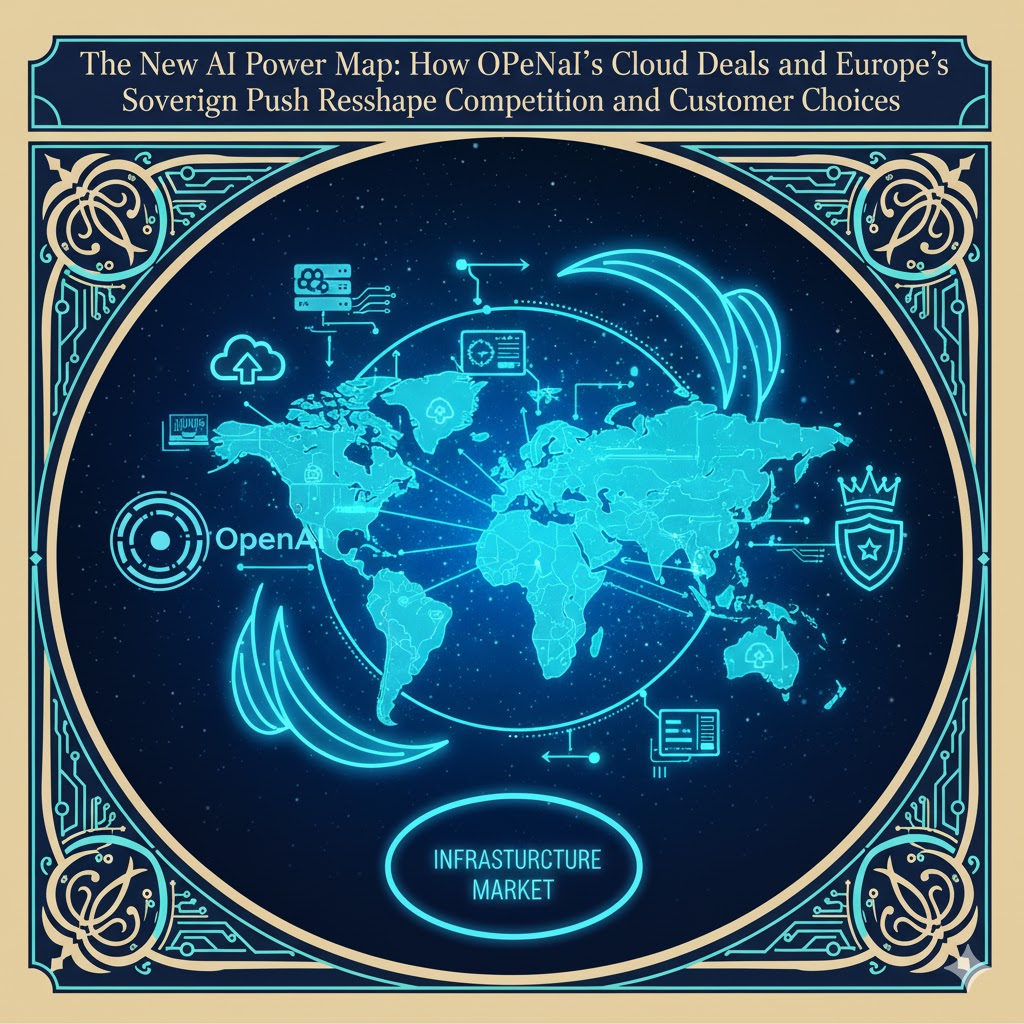

The global AI infrastructure race has entered its consolidation phase. In just a few months, OpenAI inked multi-billion-dollar agreements with AWS ($38 billion) and Oracle ($300 billion), Walmart launched “ChatGPT Instant Checkout” for conversational shopping, Germany opened its NVIDIA-powered “sovereign AI factory,” and the EU funded its RAISE (Resource for AI Science in Europe) initiative.

Get business pricing on tech for your team
- Business-only prices and quantity discounts
- Tax-exempt purchasing
- Multiple users, one account, clear invoices
Together, these moves are redrawing the boundaries between hyperscalers, retailers, and governments—creating new competition models and reshaping customer expectations across industries.
1. OpenAI’s Multi-Cloud Gambit: From Dependency to Dominance
For years, OpenAI’s operations lived almost entirely inside Microsoft Azure. The new seven-year, $38 billion AWS deal radically changes that. OpenAI will gain access to hundreds of thousands of NVIDIA GB200 and GB300 GPUs on Amazon’s EC2 UltraServers, while continuing to run workloads on Microsoft and Oracle infrastructure.
Competitive impact
- Microsoft: Loses its exclusive grip on OpenAI compute but remains a core strategic partner through the Office / Copilot ecosystem.
- AWS: Reclaims relevance in frontier AI hosting, using OpenAI as a proof point that its infrastructure can run the world’s largest models.
- Google Cloud: Becomes the odd one out—its TPU-based stack must now compete against an emerging NVIDIA-standard multi-cloud model.
Customer implications
- Model resilience and uptime: Multi-cloud distribution means fewer global slowdowns like those seen during ChatGPT traffic spikes.
- Enterprise flexibility: Businesses integrating OpenAI APIs will gain more predictable latency and pricing stability across regions.
- Cost dynamics: Competition among hyperscalers may finally start to pressure GPU pricing, benefiting downstream AI customers.
As an affiliate, we earn on qualifying purchases.
2. Walmart + OpenAI: Agentic Commerce Comes to Life
Walmart’s October 2025 rollout of ChatGPT Instant Checkout marks the first real-world fusion of conversational AI and e-commerce. Shoppers can now chat, compare, and buy products directly inside ChatGPT.
Competitive impact
- Retail: Walmart gains first-mover advantage in conversational retail—Amazon’s Alexa commerce remains fragmented, and Target lacks a similar integration.
- Tech: OpenAI becomes a new commerce layer, not just a model provider. That threatens Google Shopping, traditional search ads, and affiliate networks built on keyword intent.
Customer implications
- Frictionless shopping: Users skip logins, carts, and redirects—AI handles selection and payment within the chat.
- Personalized discovery: ChatGPT’s long-term memory and user context could transform “search results” into proactive, preference-based recommendations.
- Privacy tension: As AI intermediates transactions, shoppers will expect transparency over what data is shared between retailer, payment processor, and model provider.
As an affiliate, we earn on qualifying purchases.
3. Europe’s Sovereign AI Factories: Germany’s Answer to Hyperscaler Dependence
Deutsche Telekom and NVIDIA’s €1 billion “Industrial AI Cloud” in Munich aims to secure sovereign compute for European industry. The facility, powered by 10 000 Blackwell GPUs, will enable German manufacturing, robotics, and automotive firms to train and deploy models without leaving EU jurisdiction.
Competitive impact
- For hyperscalers: A credible local alternative threatens to peel enterprise clients off U.S. cloud contracts, especially in regulated sectors.
- For NVIDIA: Deepens its monopoly on high-performance AI chips—European sovereignty is still, ironically, built on U.S. silicon.
Customer implications
- Compliance confidence: Companies bound by GDPR or defense export rules gain access to compliant, high-end compute.
- Latency and reliability: Domestic AI centers reduce dependence on trans-Atlantic data flows.
- Cost trade-offs: Sovereign infrastructure typically costs more than hyperscaler capacity, at least initially.
enterprise AI compute infrastructure
As an affiliate, we earn on qualifying purchases.
As an affiliate, we earn on qualifying purchases.
4. RAISE and the Public-Sector Compute Revolution
The European Commission’s €107 million RAISE pilot signals a policy shift: from regulating AI to actively funding it. By pooling compute, datasets, and training programs under a single virtual institute, the EU hopes to democratize access to frontier-class AI infrastructure.
Competitive impact
- Academia vs. Big Tech: RAISE creates a public option for researchers and startups locked out of commercial GPU scarcity.
- Ecosystem multiplier: Expect national research centers and startups to tap RAISE credits as a cheaper on-ramp to LLM and simulation projects.
Customer implications
- Scientific acceleration: Climate modeling, genomics, and materials research gain priority access to compute.
- Reduced barriers: Startups may avoid early capital drains by leveraging shared infrastructure rather than buying cloud credits.
As an affiliate, we earn on qualifying purchases.
5. Oracle’s $300 Billion Bet: Risky, But Transformative
Oracle’s contract with OpenAI—roughly $300 billion over five years—is the largest cloud commitment in history. It positions Oracle as a major player in AI compute almost overnight.
Competitive impact
- Oracle Cloud: Gains prestige but also concentration risk; analysts note up to 40 % of its future revenue could hinge on one client.
- OpenAI: Locks in capacity at multiple vendors, mitigating supply bottlenecks while pushing hyperscalers into bidding wars.
- Microsoft and AWS: Forced to match Oracle’s aggressive pricing or risk losing future AI expansion phases.
Customer implications
- Cheaper AI-as-a-service: Oracle’s pricing pressure could lower API costs for developers and enterprise clients.
- More global access: OpenAI’s expanded compute footprint will reduce regional downtime and latency for customers outside North America.
Sector-by-Sector Outlook
| Vertical | Winners | Emerging Risks | Customer Benefit |
|---|---|---|---|
| Cloud & Compute | AWS, Oracle, NVIDIA | Over-capacity, rising energy costs | Lower latency, diverse deployment options |
| Retail & Commerce | Walmart, Shopify (copycats soon) | Data privacy scrutiny | Personalized shopping via chat |
| Enterprise SaaS | Microsoft (Copilot ecosystem) | Margin compression as compute costs rise | Seamless multi-cloud integrations |
| Public Sector & Research | EU RAISE participants | Bureaucratic delays | Democratized access to compute |
| Chipmakers | NVIDIA (dominant), AMD (catch-up) | Supply chain bottlenecks | Rapid hardware innovation cycles |
The Bottom Line
2025 marks the beginning of compute pluralism—a world where no single cloud, company, or country owns the AI stack.
For competitors, the challenge is strategic: differentiate not just by model quality, but by sovereignty, latency, and ecosystem reach.
For customers, the payoff is practical: faster AI, broader access, and (eventually) lower cost per token.
The new competition isn’t only about who trains the biggest model—it’s about who controls the supply chain that makes intelligence possible.
Fall Picks
fall essentials
As an affiliate, we earn on qualifying purchases.