
Start with what is not in dispute.
Get ready for Prime Big Deal Days — try Prime free
Exclusive member deals on October 6–7, plus fast free delivery. Cancel anytime.
Start your free trialAs an affiliate, we earn on qualifying purchases.
On 23 July 2026, a Russian Su-57 — the fifth-generation fighter Vladimir Putin called the best in the world just weeks earlier — crashed in the Moscow region during what Russian state media described as a routine training flight. The pilot ejected. The jet came down in an uninhabited area. Russia’s Ministry of Defence attributed it to a technical malfunction.
Everything past that sentence is contested, and this piece is going to keep the two apart carefully — because the claim layered on top is one of the most consequential things anyone has alleged about this war, and consequential claims deserve more skepticism, not less, when they flatter the side making them.
The claim: a Ukrainian volunteer intelligence collective, InformNapalm, says the crash was not an accident. It says Ukraine spent weeks mapping a specific Russian air-defence unit — its training footage, its software, its procedures, its blind spots — and then, through a combined human-intelligence and cyber operation, manipulated that unit into engaging its own aircraft.
If it’s true, Ukraine didn’t destroy a $50-million airframe. It attacked something harder to replace: the trust between a sensor and the human reading it.
Let me be equally clear about the other half. There is no independent verification. Russia says malfunction. The account is directly contested, single-sourced, and comes from a group that openly cooperates with the Ukrainian military. Hold both of those in your head for the rest of this. The interesting analysis doesn’t require the claim to be true — it requires understanding why it’s plausible enough to take seriously, and what that plausibility says about where warfare is going.
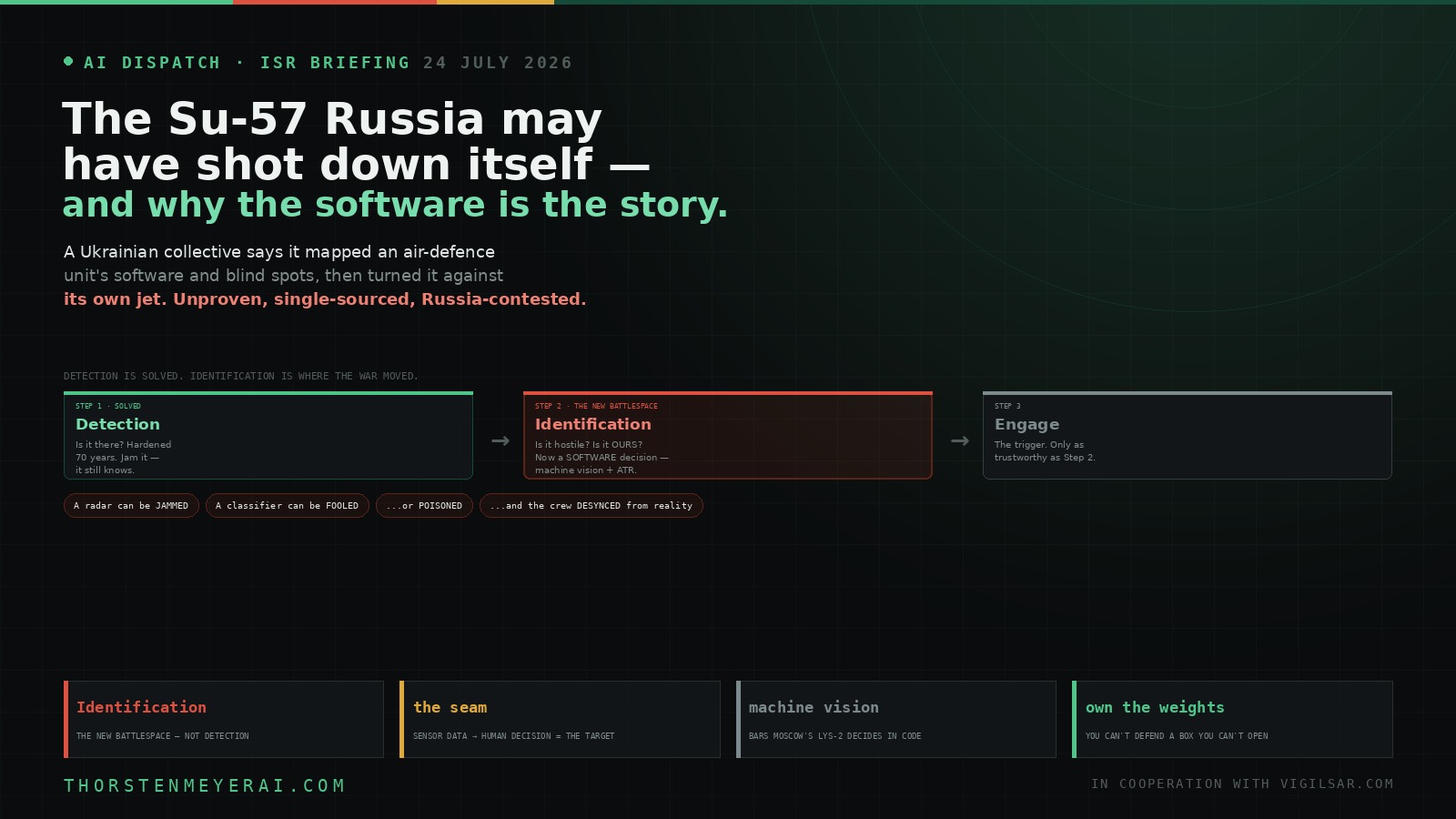
The Su-57 Russia may have shot down itself — and why the software is the story
A fifth-gen fighter Putin called “the best in the world” crashed near Moscow on 23 July. A Ukrainian collective says it spent weeks mapping an air-defence unit’s footage, software and blind spots — then turned it against its own jet. Unproven, single-sourced, Russia-contested. The analysis doesn’t need it to be true.
Su-57 crashed 23 July, Moscow region, pilot ejected. Russian MoD: “technical malfunction.” And — the key corroboration — Russian pro-military Telegram floated “friendly fire” before Ukraine published. An admission-against-interest in Russian space.
A combined HUMINT + CYBINT op. By 17 July, intercepted live training-ground video of “BARS Moscow” crews. A report systematizing the unit’s training, software/hardware, algorithms & vulnerabilities, passed to Ukrainian forces.
The causal link between the recon and the crash. Whether “manipulation” = intrusion, spoofed track, corrupted ID, or human error under engineered conditions. They showed the reconnaissance, and asserted the result.
- Can’t inspect the decision logic
- Can’t retrain on your own captured imagery — or your own aircraft’s signatures
- Can’t audit a friendly-fire incident — the weights aren’t yours
- Can’t air-gap from an update pipeline that is itself an attack surface
- Inspect what the classifier learned
- Retrain on your signatures — teach it what “friend” looks like in your fleet
- Red-team it against poisoning & evasion — you can see inside
- Run it fully air-gapped; audit the weights, not a support ticket
Whether or not Ukraine reached into BARS Moscow, the frontier moved — from the airframe to the algorithm, from “can you hit the target” to “can you corrupt the decision about what the target is.” Detection is solved. Identification is the new battlespace — and it runs on software that can be fooled, poisoned, or turned. The most valuable target in modern air defence is no longer the radar or the missile. It’s the seam where sensor data becomes a human decision — defended worst precisely where it’s automated most. And you cannot defend, audit, or harden a decision layer you cannot open. In a war fought at the identification layer, the side that can open its own black box holds terrain the side renting a sealed one cannot buy back.
in cooperation with VIGILSAR.COM
What’s established, what’s claimed
Established. The Su-57 crashed on 23 July near Moscow. Pilot ejected. Russia’s MoD says technical malfunction. Russian pro-military Telegram channels — not Ukrainian sources — independently floated “friendly fire” before InformNapalm published in detail. That last point is the single most important piece of corroboration, because it’s an admission-against-interest circulating in Russian space, not a Ukrainian talking point.
Claimed, by InformNapalm. That the loss resulted from a combined HUMINT + CYBINT operation. That as early as 17 July, the group had processed intercepted data including live training-ground video streams of the “BARS Moscow” air-defence crews rehearsing against Ukrainian drones. That its analysts produced a report systematizing the unit’s personnel training, software-and-hardware complex, combat-operation algorithms, and vulnerabilities, and passed it to Ukrainian forces. And that this let them “use a system created by Russians against the Russians themselves.”
Unverified, and worth stating plainly. The causal link between the intelligence work and the crash. Whether “manipulation” means a technical intrusion, a spoofed track, a corrupted identification process, or simply human error under conditions Ukraine helped create. InformNapalm has not shown the mechanism — it has shown the reconnaissance, and asserted the result.
That gap between “we mapped the system” (evidenced) and “we made it shoot the jet” (asserted) is the whole epistemic ballgame, and no honest read closes it.
As an affiliate, we earn on qualifying purchases.
Why the target matters more than the trophy
The Su-57 is the headline. BARS Moscow is the story.
Per the InformNapalm material, BARS Moscow is a volunteer air-defence formation tasked with protecting Moscow, Kaluga, Ryazan and Tula against Ukrainian strike drones. Its primary interception asset is described as the Lys-2 — a small interceptor UAV launched from a reusable catapult, carrying an ~0.8 kg fragmentation warhead, and — this is the load-bearing detail — equipped with machine vision and automatic target acquisition.
Read that again. The unit at the centre of this story isn’t a legacy S-400 battery run by conscripts. It’s a software-defined, volunteer, machine-vision counter-drone unit — exactly the kind of improvised, rapidly-fielded, code-first formation that both sides have thrown together to cope with the drone war. It has training pipelines that stream over networks. It runs target-recognition software. It has an identification logic that decides friend or foe partly in code.
And that is precisely why it’s attackable in the way InformNapalm describes. You cannot socially engineer an S-400’s radar horn. You can, in principle, attack the perception and identification layer of a system that decides what it’s looking at using software — by corrupting its training, poisoning its reference data, spoofing the signatures it keys on, or degrading the crew’s trust in their own screens until they make the call the attacker wants.
Whether Ukraine actually did that here is unproven. That it is possible in this class of system is not.
air defense system training simulator
As an affiliate, we earn on qualifying purchases.
As an affiliate, we earn on qualifying purchases.
The real vulnerability: the identification layer
Here’s the conceptual core, and it holds regardless of what happened on 23 July.
Every air-defence engagement is two problems, not one. Detection — is something there? And identification — is it hostile, and is it ours? Detection has been hardened for seventy years. Identification is where the war is now being fought, because identification is increasingly a software decision, and software decisions have attack surfaces that hardware doesn’t.
When identification runs through machine vision and automatic target recognition, the failure modes change completely. A radar can be jammed. A classifier can be fooled — fed inputs engineered to sit on the wrong side of its decision boundary. It can be poisoned — trained, subtly, on data that teaches it the wrong thing. And the humans supervising it can be desynchronized from reality — shown a picture, or a history of pictures, that makes the catastrophic call look like the correct one.
InformNapalm’s own framing is unusually precise about this. It didn’t claim to have blown something up. It claimed a “cognitive and cyber” operation — an attack on how the crew perceived and decided, not just on the machine. That distinction is the sophisticated part, and it’s the part worth taking seriously even while doubting the specific result.
The trophy was a jet. The target was the identification layer — the seam where sensor data becomes a human decision. That seam is now the most valuable real estate in air defence, and the least protected.
military drone surveillance equipment
As an affiliate, we earn on qualifying purchases.
As an affiliate, we earn on qualifying purchases.
Where open weights enter — the honest version
This is where the story connects to something this publication has been circling for weeks, and I want to make the connection carefully, because it’s easy to overclaim.
The counter-drone systems proliferating on both sides — the Lys-2 and its cousins — increasingly run on machine-vision models for target recognition. Those models have to be built, trained on the right imagery, tuned to local conditions, updated as the enemy changes tactics, and — critically — audited when something goes catastrophically wrong. A unit that shoots down its own flagship fighter needs to be able to open the box and ask why did the classifier do that?
There are two ways to build that capability, and the war is quietly demonstrating why one of them wins.
The closed way: buy a target-recognition system as a black box from a vendor. You get whatever the vendor trained, you cannot inspect the decision logic, you cannot retrain it on your own captured imagery without going back to the vendor, you cannot audit a friendly-fire incident because the weights aren’t yours, and you cannot air-gap it from an update pipeline that is itself an attack surface. Every one of those limitations is a vulnerability in exactly the layer this incident targeted.
The open way: build on open-weight models you hold, on hardware you control. You can inspect what the classifier learned. You can retrain it on your own signatures — including, crucially, your own aircraft’s signatures, so the model that decides friend-or-foe has actually been taught what “friend” looks like in your fleet. You can red-team it against exactly the poisoning and evasion attacks described above, because you can see inside it. You can run it fully disconnected, closing the update-pipeline attack surface entirely. And when something goes wrong, you can audit the weights rather than file a support ticket with a foreign vendor.
I’m not going to claim open weights would have prevented this incident — nobody can know that, and the incident itself is unconfirmed. The honest claim is narrower and stronger: the identification layer is now the decisive battlefield, and you cannot defend a layer you cannot inspect. Ownership of the model isn’t an ideological preference here. It’s the precondition for auditing, hardening, and air-gapping the exact system that just — allegedly — turned on its owner.
The open-weight argument this publication has made about sovereignty and cost turns out to have a battlefield form: in a war fought at the identification layer, the side that can open its own black box has an advantage the side renting a sealed one cannot buy back.
cybersecurity training kits for military
As an affiliate, we earn on qualifying purchases.
As an affiliate, we earn on qualifying purchases.
The caveats, restated because they matter
I don’t want the analysis above to launder the uncertainty, so let me put the skepticism back in the foreground where it belongs.
This may not have happened as described. A fifth-generation fighter can crash in training for entirely mundane reasons; the Su-57 programme has had reliability questions for years, and “technical malfunction” is sometimes just true. InformNapalm has a demonstrated capability — its 2025 OKBMLeaks operation really did leak documents from a Russian manufacturer of Su-57 components, translated into thirteen languages and picked up internationally — which cuts both ways: it establishes the group is real and capable, and it establishes a track record of sophisticated information operations, which is exactly the skill set you’d want if you were amplifying a friendly-fire accident into a cyber triumph.
Attribution in cyber is notoriously slippery, and “we mapped the system and then the system failed” is a claim structure that survives whether or not the two events are causally linked. Post hoc is not propter hoc, even when the reconnaissance is genuine.
And the incentives are loud. Ukraine benefits enormously from Russia believing its own air defences can be turned against it — the psychological effect on Russian crews is valuable whether or not the technical claim is true. That doesn’t make the claim false. It does mean the claim would be worth making even if it were false, which is precisely when you slow down.
The responsible position: plausible, unproven, and strategically revealing regardless of its truth.
The take
Whether or not Ukraine reached into BARS Moscow and turned its hand, the incident marks something real. The frontier of this war has moved from the airframe to the algorithm — from can you hit the target to can you corrupt the decision about what the target is. Detection is a solved problem. Identification is the new battlespace, and identification now runs on software that can be fooled, poisoned, or turned.
Two things follow, and they hold even if the Su-57 crashed for boring reasons.
First, the most valuable target in modern air defence is no longer the radar or the missile. It’s the seam where sensor data becomes a human decision — the identification layer — and that seam is defended worst precisely where it’s automated most.
Second, you cannot defend, audit, or harden a decision layer you cannot open. The counter-drone systems deciding friend-from-foe over Moscow and Kyiv are increasingly machine-vision models, and whoever owns those models — the weights, the training data, the hardware, the air-gap — can inspect and armor the exact surface this operation targeted. Whoever rents them as a black box is trusting a vendor with the one decision that can shoot down their own best fighter.
That’s the durable lesson, and it survives the uncertainty. The trophy was a jet Putin called the best in the world. The target, if the claim holds, was the trust between a machine and the person reading it. In the wars now arriving, that trust is the terrain — and you hold it by owning the software that produces it, not by hoping the vendor got it right.
Sources: the Su-57 crash (23 July 2026, Moscow region, pilot ejected, Russian MoD’s “technical malfunction” account) and the InformNapalm claim of a combined HUMINT+CYBINT operation against the “BARS Moscow” air-defence unit via UNITED24 Media, Militarnyi, EUobserver, Tom’s Hardware, Yahoo/news.com.au, UA.News, Censor.NET and Charter97 — all reporting the same single originating source, InformNapalm, and most noting explicitly that there is no independent verification and that Russia contests the account; the BARS Moscow unit description, its area of responsibility, and the Lys-2 interceptor’s machine-vision and automatic-target-acquisition capabilities per the InformNapalm analytical material as reported by Militarnyi and EUobserver; the prior OKBMLeaks operation (2025) and its international pickup per Yahoo/news.com.au and Tom’s Hardware; Russian pro-military Telegram “friendly fire” speculation preceding the InformNapalm publication per UA.News and Charter97. This is analysis of a contested, unverified claim in an active war; the causal link between the reconnaissance and the crash is asserted by one interested party and has not been independently established. Nothing here should be read as confirmation. The open-weight/identification-layer analysis is the author’s, argued as a general principle about software-defined air defence and not as a claim about the specific systems involved. Not investment advice.
Fall Picks
fall essentials
As an affiliate, we earn on qualifying purchases.