A roadmap is only useful if the thing that updates it and the thing that reads it agree on where it lives. That sounds trivial until you notice that almost every roadmap tool answers the question the same way: the roadmap lives inside our database, behind our API, accessible on our terms. Your plan becomes a hostage of the tool you happened to pick.
Threlmark makes a deliberately different bet, and it’s the whole product in four words: disk is the contract.
The roadmap is a plain JSON file sitting on your own disk. That’s it. The kanban board you look at is just a view over that file. Your other tools can read it. Your agents can write to it. Nothing has to ask permission from a SaaS API, because there is no SaaS API — there’s a file, and a shared agreement about its shape. It’s open source under MIT, at threlmark.com, and the full deep-dive covers the internals. This is the short version of why that one decision matters.
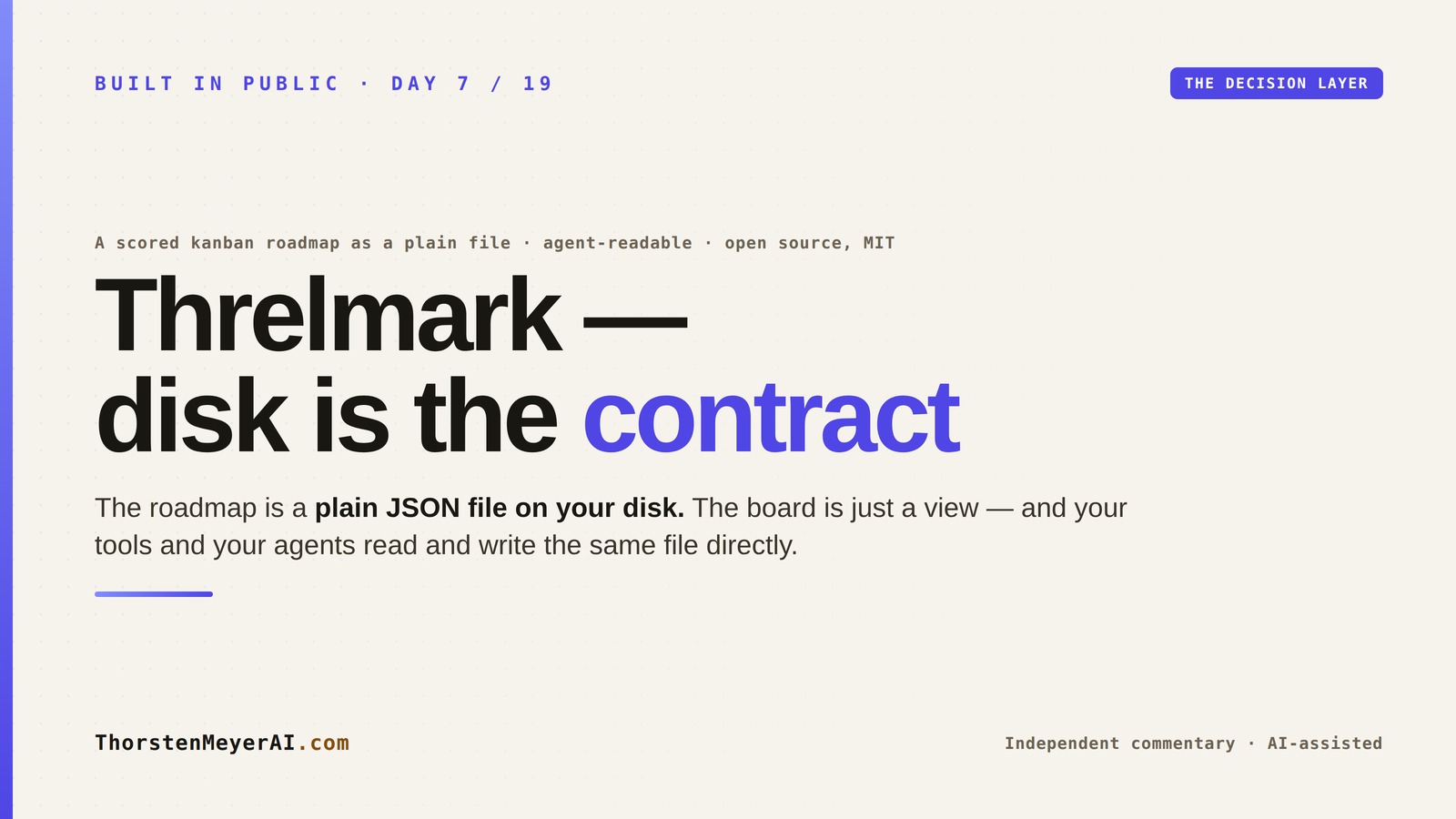
Threlmark — disk is the contract
The roadmap is a plain JSON file on your disk. The board is just a view over it — and your tools and your agents read and write the same file directly.
Independent commentary, produced with AI assistance under human editorial oversight. The views are the author’s own and may change. Threlmark is open source under MIT, provided “as is” without warranty; see the repository LICENSE. Automated agents that read and write the roadmap file may introduce errors — treat agent writes as changes to review, not facts to trust. Product and company names are trademarks of their respective owners; mention does not imply endorsement.
What “disk is the contract” actually buys
When the roadmap is a file with a known structure, that structure is the integration point. Any program that can read JSON can read your roadmap; any program that can write JSON can update it. There’s no SDK to learn, no webhook to configure, no rate limit, no auth dance — the contract is the file format, and honoring it is trivial for anything you’d want to connect.
In business terms, this is interoperability by default and durability for free. Your roadmap isn’t trapped inside a vendor that can change its pricing, deprecate its API, or disappear. It’s a text file you own, that any future tool can pick up, that you could read with nothing fancier than a text editor in ten years. The most underrated property a piece of operational data can have is outliving the tool that created it — and a plain file on disk has that property by construction.
It’s the same anti-lock-in instinct that runs through the whole portfolio, applied to the one artifact you least want to lose: the plan itself.
JSON file editor for project management
As an affiliate, we earn on qualifying purchases.
As an affiliate, we earn on qualifying purchases.
Scored, so it ranks itself
Threlmark isn’t just a place to list work — it’s a scored kanban. Every item carries a priority score, which means the board isn’t a flat pile of equally-shouting cards; it’s a ranked one. The top of the list is the top of the list for a reason you can see.
This is where it connects to the rest of the decision layer. The verdicts that come out of IdeaClyst‘s council don’t evaporate into a Slack message — they land here, as scored items on the roadmap. That’s today’s constellation move: IdeaClyst → Threlmark. The council decides what’s worth doing; Threlmark is where “worth doing” becomes an ordered, actionable plan.
And scoring enforces the series’ favorite discipline: subtraction. A roadmap where everything is “high priority” is a roadmap with no priorities. Forcing every item to carry a score forces the uncomfortable question — is this actually more important than that? — and what doesn’t score well doesn’t get done. The board makes the trade-offs visible instead of letting them hide.
version control tools for JSON files
As an affiliate, we earn on qualifying purchases.
As an affiliate, we earn on qualifying purchases.
The agent-loop
Here’s the part that makes “disk is the contract” more than a tidy engineering preference. Because the roadmap is a file that agents can read and write, the roadmap becomes a shared workspace for humans and agents alike.
An agent can read the top-scored item, do the work, and write the result straight back into the file — moving a card, updating a status, appending a note — with no special integration, because writing JSON to disk is something any agent can already do. The loop closes: plan in, work out, plan updated. The roadmap stops being a static document you maintain for the agents and becomes the live coordination layer they participate in.
That’s a genuinely different posture from “AI that helps you fill in a project board.” Here the board is the protocol, and humans and agents are just two kinds of client reading and writing the same contract. For an operator running a lot of automated work, having a single, plain, mutually-agreed file as the source of truth is exactly the kind of boring decision that makes everything downstream simpler.
local JSON roadmap management software
As an affiliate, we earn on qualifying purchases.
As an affiliate, we earn on qualifying purchases.
Local-first, provider-agnostic — naturally
Threlmark barely has to try to satisfy the portfolio’s thesis; the architecture is the thesis. Local-first, because the roadmap is literally a file on your machine. Provider-agnostic, because the contract is a file format, not a vendor — any agent, any model, any tool that speaks JSON is a first-class client. There’s nothing to be locked into, because the most lock-in-prone artifact has been reduced to the least lock-in-prone thing there is.

Program Management for Open Source Projects: How to Guide Your Community-Driven, Open Source Project
As an affiliate, we earn on qualifying purchases.
As an affiliate, we earn on qualifying purchases.
The honest bear case
The simplicity has a price, and it’s worth being plain about it. A file is not a multi-user real-time database. “Disk is the contract” trades away the things SaaS roadmap tools are genuinely good at — concurrent editing by a large team, conflict resolution, presence, permissioning, audit trails at scale. If twelve people need to edit the same roadmap simultaneously across three offices, a JSON file on a disk is the wrong tool, and pretending otherwise would be dishonest. This is built for an operator (or a small team) and their agents, not for an enterprise’s program-management org.
Two more honest caveats. A score is only as good as how it’s set — a ranked board built on bad scores just ranks the wrong things confidently, the same trap the decision layer keeps warning about. And letting agents write to your roadmap is power and risk in the same gesture: an agent that mis-writes the contract can quietly corrupt your plan, so the loop needs guardrails and review, not blind trust. Agent-writable is a feature you have to manage, not just enjoy.
The bull case, plainly
With the limits acknowledged: Threlmark is radical simplicity where it counts most. It makes your roadmap a thing you own rather than rent, interoperable with anything that reads JSON, durable beyond any single tool, and natively shared between you and the agents doing the work. It’s where the council’s decisions become an ordered plan, and where that plan stays legible to humans and machines alike.
It won’t run a hundred-person program office. But for the operator model this whole series is built around — one person, a lot of automation, and a refusal to be locked in — making the roadmap a plain file on disk isn’t a limitation. It’s the most honest contract you can sign.
Threlmark is open source under MIT and provided “as is,” without warranty; see the repository LICENSE. This article was produced with AI assistance and reviewed under human editorial oversight — it is independent commentary and analysis, and the views are the author’s own and may change. Automated agents that read and write the roadmap may introduce errors; treat agent writes as changes to review, not facts to trust. Product and company names are trademarks of their respective owners; mention does not imply affiliation, sponsorship, or endorsement. © 2026 Thorsten Meyer · Powered by Thorsten Meyer AI. See Imprint/Impressum and Privacy Policy.