For about a hundred years, an ordinary life ran on a simple deal. You contributed work. You received a paycheck. The paycheck bought security — a home, food, the ability to plan past the end of the month.
That deal is quietly coming apart, and the people who should be explaining why are too busy doing one of two things: predicting the apocalypse, or selling you the rapture.

So I wrote the book I kept looking for and couldn’t find. It’s called After the Paycheck, and it’s now available — serialized chapter by chapter here in the Post-Labor Economics section, and as a complete e-book. This is the honest version of where the economy is heading as AI does more of the work, and what we can actually do about it.
Here’s why I think you should read it.
After the
Paycheck
For a century the deal was simple: you work, you earn, you’re safe. AI is breaking the middle link — and the honest question isn’t whether machines do the work. It’s who owns them.
It isn’t the work. It’s the ownership.
AI doesn’t take a job all at once. It peels off the tasks one at a time, so the title survives while the work thins out. And the value it creates flows to whoever holds the models, the data, and the compute — ownership concentrated in remarkably few hands.
You can lose your wage to automation and still be fine — if you own a piece of what replaced you. Almost no one does. That’s the whole problem.

AI for Gig Workers, Freelancers & 1099 Income: Smart Tax Solutions for the Self-Employed (AI Personal Taxes)
As an affiliate, we earn on qualifying purchases.
As an affiliate, we earn on qualifying purchases.
The menu, honestly priced

On a Monday Morning: A Practical Roadmap for Reinventing Your Career, Building Financial Resilience, and Thriving in the Age of Artificial Intelligence
As an affiliate, we earn on qualifying purchases.
As an affiliate, we earn on qualifying purchases.
No single fix. A portfolio.
Income without ownership leaves concentration intact. Ownership without a floor leaves people exposed. Skills without either is a bridge to an eroding shore. The weights between them aren’t a technical answer hiding in a spreadsheet — they’re a political choice.
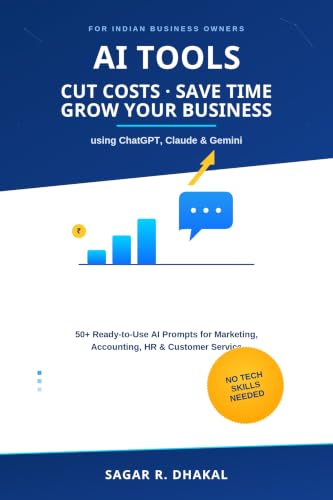
AI Tools for Business Owners: Cut Costs, Save Time & Grow Your Business Using ChatGPT — No Tech Skills Needed: 50+ AI Prompts for Marketing, Accounting, Customer Service, HR & Operations | Work
As an affiliate, we earn on qualifying purchases.
As an affiliate, we earn on qualifying purchases.
The two stories everyone is selling — and why both are wrong
Open any feed and you’ll get one of two takes on AI and jobs.
The first is doom: the machines take everything, mass unemployment, collapse. The second is the dream: abundance arrives, work becomes optional, everyone’s free. Both stories sell well. Both pick their ending before the evidence is in. And both age badly, because real technology never arrives the way either camp expects — it shows up slowly, unevenly, through budgets and habits and lawsuits, and then all at once in some corner nobody was watching.
I’ve spent thirty years watching new tools enter the real world, and now I build with AI every single day. That vantage point is exactly why I distrust the tidy endings. After the Paycheck refuses both of them. It does the harder, more useful thing: it lays every serious response on the table and prices each one honestly — the real case for it, the real case against, grounded in data instead of hope or fear.

AI and the Future of Work: A Comprehensive Guide to Thriving in the age of Intelligent Machines
As an affiliate, we earn on qualifying purchases.
As an affiliate, we earn on qualifying purchases.
The one idea that reframes everything
If you take nothing else from the book, take this.
The problem was never really that machines do the work. The problem is who owns the machines. As AI improves, the value it creates flows to whoever holds the models, the data, and the computing power — and that ownership is concentrated in a startlingly small number of hands.
You can lose your wage to automation and still be fine, if you own a piece of what replaced you. The trouble is that almost nobody does. That single shift — from earning to owning — is the hinge the whole book turns on, and it’s the part of the conversation that the doom-and-dream crowd keeps skipping.
What’s actually inside
The book moves in four stages, and I tried to make each one a genuinely useful read on its own.

First, the diagnosis: how AI reaches a job not by swallowing it whole but by peeling off its tasks one at a time, so the work gets thinner and more precarious long before anyone is formally replaced. This is why the disruption is so easy to miss — and why some of the sharpest early evidence shows young workers, the new graduates trying to get on the first rung, taking the hit first while everyone debates whether anything is happening at all.
Then the responses, which is the heart of it. They sort into three families:
- Income — basic income, a job guarantee. These hand people money and go straight at the most urgent need. Necessary as a floor. But they replace the wage without touching who owns the upside.
- Ownership — employee equity, sovereign wealth funds. These go at the root. The evidence that they build real wealth is genuinely strong — and so are their risks. One of them builds wealth beautifully while pointing at exactly the wrong place for the AI age. Another gave the world both Norway’s national fortune and the fund that got looted into a superyacht. Same design, opposite outcomes.
- Skills — reskilling. The response everyone reaches for first and oversells most. The honest evidence is two-sided: generic retraining has a poor record, but the right kind, tied to real demand, is among the most effective things a society can do. The catch is structural, and I don’t flinch from it.
Then a chapter on honesty itself — how to read any “AI is killing jobs” headline without being fooled, including the awkward fact that two of the most respected research teams looked at the same labor market and reached opposite conclusions. I give you the five questions that separate evidence from spin.
And finally the synthesis: what a serious answer looks like once you accept that no single fix is enough — a floor, a stake, and a bridge, with the weights between them being a political choice, not a technical one.
My bias, stated plainly
I’ll tell you where I stand, because you’ll read more honestly knowing it. I am not neutral. I make my living from these tools. I benefit from the very technology whose consequences I spend the book worrying about.
I think that makes the book more useful, not less — I’ve seen up close what these systems can and can’t do — but it also gives me a stake, and I say so on the page. I’ve tried to be as hard on the positions I’m sympathetic to as on the ones I’m not. If a book arguing that the gains of AI should be more widely shared comes from someone who would, in narrow self-interest, prefer you didn’t think about it too hard, maybe it’s worth a little more.
Who this is for
You don’t need an economics degree. You don’t need to care about AI for its own sake. You need to care about how you and the people you love will earn, live, and own things in a world where machines do more of the work.
If you’re an anxious knowledge worker wondering whether your field is next, a parent watching the entry-level rung your kids are about to step on, a builder or investor trying to see past the hype cycle, or just someone who wants a map instead of a mood — this was written for you.
What you won’t get is a stock tip, a tidy prediction, or the comfort of being told it’ll all work out on its own. What you’ll get is the understanding to judge the choices ahead for yourself — and the realization that the future after the paycheck isn’t being forecast. It’s being decided, right now, mostly by default, mostly in favor of whoever already owns the most.
It doesn’t have to be decided that way. But changing the draft starts with understanding it.
Read After the Paycheck — chapter by chapter here on the site, or the full e-book — and start reading the future instead of just bracing for it.
After the Paycheck is available now: as a complete e-book from major retailers. Approximately 26,000 words.