The map closes where modern social policy partly began.

Get business pricing on tech for your team
- Business-only prices and quantity discounts
- Tax-exempt purchasing
- Multiple users, one account, clear invoices
Long before “cash transfer” became a fashionable answer to inequality, Brazil built the template. In 2003, President Lula consolidated a set of earlier schemes into Bolsa Família — a program that pays poor families a monthly cash transfer on one condition: keep your children in school and take them for their vaccinations and health checkups. It was not the very first conditional cash transfer in Latin America, but it became the largest and the most influential in the world.
The idea is deceptively simple and quietly radical. Don’t just relieve poverty today; pay families to invest in their children, so the next generation climbs out of poverty for good. Cash in one hand, a condition in the other — relief now, human capital later.
Two decades on, Bolsa Família reaches roughly 46 million people — about a quarter of the country — and Brazil has paired it with Pix, the central bank’s free instant-payment rail that 93% of Brazilian adults now use. Between the payment model and the rail, Brazil holds both halves of the delivery puzzle. On the Matrix, it lands in almost exactly the same place as India — thin but broad — and it completes the map: row ten of ten.
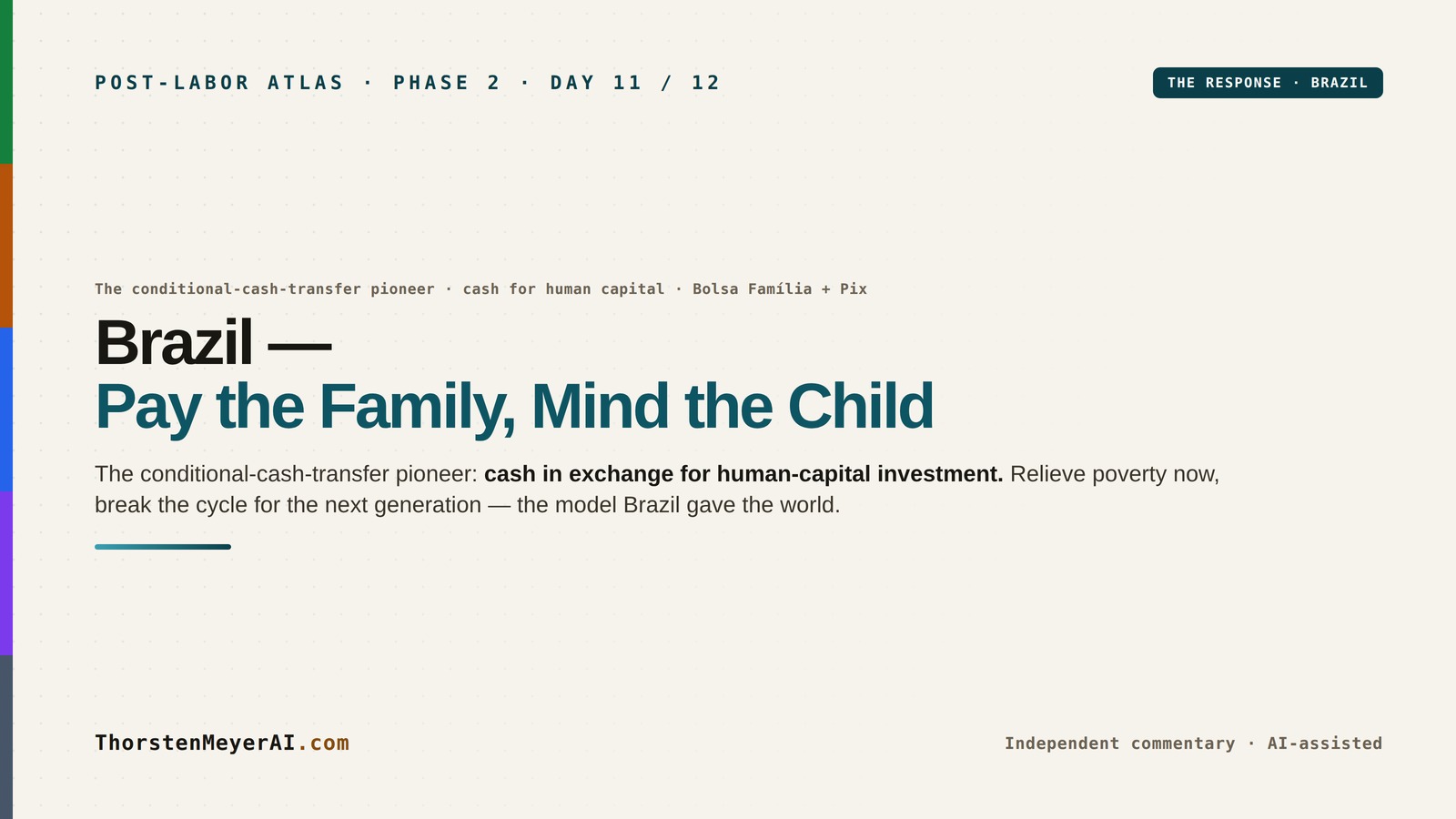
Pay the Family, Mind the Child
The conditional-cash-transfer pioneer: cash in exchange for human-capital investment. Relieve poverty now, break the cycle for the next generation — the model Brazil gave the world.
- a monthly cash transfer
- targeted via the CadÚnico registry
- delivered via Pix (instant, free)
- children enrolled & attending school
- vaccinations kept current
- regular health checkups
Independent commentary, produced with AI assistance under human editorial oversight. The views are the author’s own and may change. This is analysis, not policy, economic, investment, or legal advice. Descriptions of Bolsa Família and its conditionalities, the Cadastro Único, the BPC benefit, and Pix reflect publicly reported information as of mid-2026 and may change; figures are indicative and several are official or institutional estimates. This phase maps differing approaches and endorses none; characterizations of contested arrangements present competing views, not a verdict. Country, program, and company names are referenced for analysis and imply no affiliation.
The model’s logic
Bolsa Família is one of the most studied social programs in history, and the reason is that it worked, on its own terms and cheaply.
The mechanism is conditionality. A family living in poverty receives a modest monthly payment, but only while its children stay enrolled and attend school and keep up with health visits. That single design choice does two things at once. It relieves immediate hardship — putting cash in the hands of the poorest, who spend it locally — and it nudges an investment in the next generation’s schooling and health that those families might not otherwise be able to afford. The explicit target is intergenerational poverty: the cycle in which the very poor stay very poor because their children can’t get the education to escape.
The numbers behind the reputation are real. Researchers credit Bolsa Família with a meaningful share of Brazil’s decline in inequality over its first decade, and the World Bank has estimated that extreme poverty would be dramatically higher without it — all at a cost of roughly 0.6 to 1.5% of GDP. It became, in effect, an export: more than 40 countries now run conditional cash transfers modeled on the Brazilian and Latin American pioneers, and at one point delegations were arriving by the dozen to study how it was done.
The bet, in one line: targeted, conditional cash, delivered through a democracy, can relieve poverty now and break its cycle for the next generation.
As an affiliate, we earn on qualifying purchases.
The signature: the conditional bargain
The signature is the exchange itself, and it’s worth seeing as a two-sided deal.
On one side, the state gives: a monthly payment, targeted using the Cadastro Único — a unified registry of low-income families that decides who qualifies — and, increasingly, delivered through Pix, the instant rail that settles in seconds and reaches even informal merchants and the previously unbanked. On the other side, the family commits: children enrolled and attending school, vaccinations kept current, health checkups attended. And the payoff sits underneath both: relieve poverty in the present and build the next generation’s human capital, so the ladder out of poverty actually gets climbed.
It’s a different innovation from the one in the row just above it. India’s contribution to this map is the rails — the cheap, scalable plumbing that delivers anything to anyone. Brazil’s is the payment — the question of what to pay, to whom, and on what condition, answered decades earlier and refined into the world’s most copied template. India built the pipes; Brazil designed what flows through them and why. Between them, the two great democracies of the Global South contributed the two halves of the puzzle that the rich world is now, belatedly, studying.
school supplies for low-income families
As an affiliate, we earn on qualifying purchases.
As an affiliate, we earn on qualifying purchases.
The levers it pulls
Brazil’s row is, strikingly, the same shape as India’s — thin but broad. Income floor: partial — Bolsa Família is the most developed cash floor in the Global South, backed by the BPC benefit for the elderly and disabled poor, but it remains targeted, conditional, and modest, and Brazil is still among the world’s most unequal societies. Capital and ownership: minimal — no sovereign fund, no dividend, thin broad ownership. Work and time: partial — a real formal labor code and meaningful minimum-wage gains, set against a large informal sector. Skills and transition: partial — the school conditionality is itself a human-capital lever, alongside vocational programs, though adult-transition support is weak. Institutions: partial — and here Brazil’s CadÚnico registry and the central bank’s Pix rail are genuine institutional innovations, layered on democratic foundations, with AI-era worker guardrails still nascent.
That it lands in the same cell pattern as India isn’t a coincidence to gloss over — it’s a finding. Two large, poor-by-rich-world-standards democracies, working the problem independently, converged on the same answer: do a little of everything, reach almost everyone, and lead with the thing you can actually afford.
cash transfer program for families
As an affiliate, we earn on qualifying purchases.
As an affiliate, we earn on qualifying purchases.
The honest read
The achievement is real, and so are its limits.
The first is that Brazil is still deeply unequal. Bolsa Família reduced inequality and poverty; it did not transform the underlying structure, and a society can run the world’s most admired cash transfer and remain near the top of the global inequality tables. A targeted, conditional, modest floor relieves the worst of poverty without rewriting who ends up where.
The second is the double edge of conditionality itself. The conditions are clever, but they can also burden or exclude the very poorest — the families least able to keep a child in a distant school or make every clinic appointment are sometimes the ones who fall off the rolls — and there is a long-running debate about whether attaching strings to survival is empowering or paternalistic. That debate matters more, not less, in a post-labor frame: if the worry is that there simply isn’t enough work to go around, conditions tied to school and health still make sense, but conditions tied to work would not — and some argue the logical destination is an unconditional transfer, which Brazil’s own targeting registry and Pix rails are already capable of delivering. The human-capital payoff, meanwhile, is genuine but measured: careful studies find that children raised under the conditions do better than their older siblings who weren’t, but the effect sizes are modest, not transformative.
The third is fiscal. A heavy pension burden, commodity dependence, and tight budgets all cap how far the floor can be scaled, no matter the political will.
And the deepest worry is the one this whole half of the Atlas keeps circling. Bolsa Família is built to push people up an opportunity ladder — educate the children so they can get the good jobs their parents couldn’t. That logic is impeccable in an economy that has good jobs waiting at the top. If automation thins those jobs before this generation’s children arrive, a model premised on climbing faces a hard question: what happens to a brilliantly educated cohort if the rungs they were trained for have been removed? The conditionality assumes a ladder. The post-labor transition is, in part, about the ladder getting shorter.
educational savings accounts for children
As an affiliate, we earn on qualifying purchases.
As an affiliate, we earn on qualifying purchases.
What travels
The CCT template is among the most exportable ideas on the entire map — proof of concept that targeted, conditional cash works, delivered cheaply, in a democracy, and already adapted by dozens of countries. Pix adds a second exportable lesson: a central bank can build a free, instant, inclusive payment rail as a public good and reshape a whole economy’s plumbing in a few years.
The portable insight is that the payment model and the delivery rail are separable problems, and you can lead with whichever you can manage first — Brazil led with the payment, India led with the rail, and each is now building the other half. The cautionary lesson is the ladder problem: a transfer designed to move people toward work is only as good as the work it’s moving them toward.
Row ten
Brazil is the conditional-cash-transfer pioneer — the original, most-copied proof that you can relieve poverty and invest in the next generation with targeted cash and a simple condition, now riding one of the world’s best payment rails. Its floor is the Global South’s most developed, and still modest, conditional, and set in a stubbornly unequal society.
It proved that direct cash works. It has not yet proved it can be generous enough for a genuine post-labor shock, nor that the opportunity ladder it is built to help people climb will still be standing when they reach it. Row ten — the last jurisdiction on the map.
With it, the Matrix is finally complete: ten jurisdictions, five levers, every cell filled. The next and final piece of this Atlas stops adding rows and does the thing the whole grid was built for — it reads across. Who pulled which lever, what the columns reveal that the rows can’t, and what, if anything, ten very different answers have in common. The menu, at last — not the verdict.
Independent commentary, produced with AI assistance under human editorial oversight; the views are the author’s own and may change. This is analysis, not policy, economic, investment, or legal advice. Descriptions of Bolsa Família and its conditionalities, the Cadastro Único, the BPC benefit, Pix, and Brazil’s AI and labor policy reflect publicly reported information as of mid-2026 and may change; figures are indicative and several are official or institutional estimates. This phase maps differing approaches and endorses none; characterizations of contested arrangements present competing views rather than a verdict. Country, program, and company names are referenced for analysis and imply no affiliation. © 2026 Thorsten Meyer · Powered by Thorsten Meyer AI. See Imprint/Impressum and Privacy Policy.
Fall Picks
fall essentials
As an affiliate, we earn on qualifying purchases.