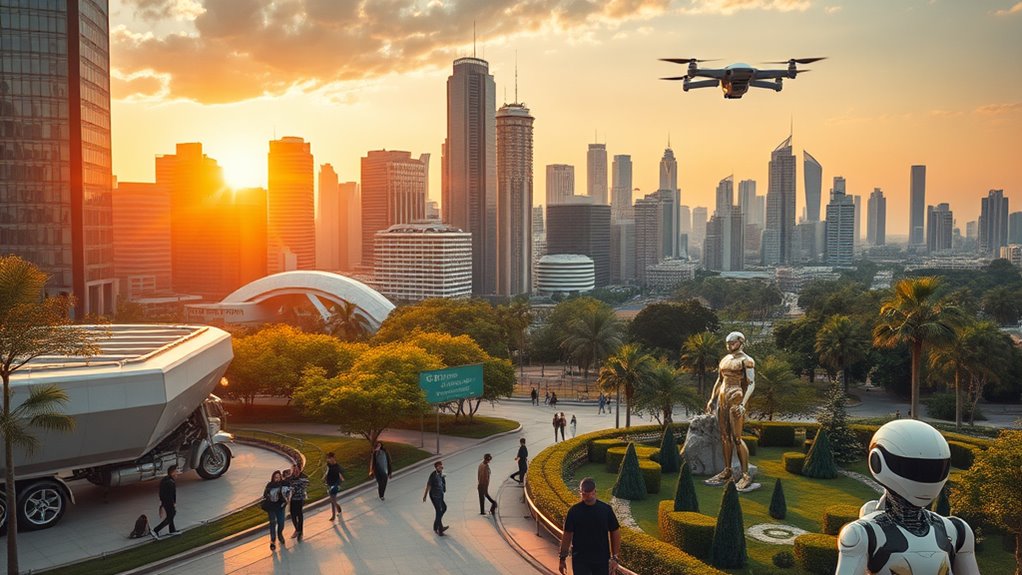

In a post-labor society, robots and AI handle nearly all essential work, radically shifting your daily life, economy, and social roles. Automation boosts efficiency but also causes job displacement, income inequality, and societal changes. Your routines might involve more leisure, personal development, and community engagement as traditional careers fade. Advanced technology transforms homes, connectivity, and identities, raising ethical questions. To understand how society adapts and what this future holds, keep exploring these transformative shifts.
Key Takeaways
- Automation could lead to widespread job displacement, prompting shifts toward universal basic income and resource redistribution.
- Society may prioritize personal development, community, and well-being over traditional work roles.
- Daily life would be highly connected with AI-driven tools managing routine tasks and enhancing personal efficiency.
- New social values might emerge, emphasizing creativity, empathy, and human connection in a highly automated world.
- Governance and ethical frameworks will be vital to ensure equitable benefits and address societal and psychological impacts.

FancyDove AI Assistant Device Powered by ChatGPT, No Subscription Needed, Standalone AI Chatbot Translator, AI Tutor for Learning, Writing & Homework, Portable AI Gadget for Students & Travel Black
No Subscription & Lifetime Access – Pay Once, Use AI Forever: Enjoy powerful AI chat, writing, translation, and…
As an affiliate, we earn on qualifying purchases.
As an affiliate, we earn on qualifying purchases.
The Surge of Automation and Robotics Worldwide

The surge of automation and robotics worldwide is transforming industries at an unprecedented pace. You’ll notice factories in China nearly doubling their industrial robot populations by 2033, signaling rapid adoption. Robots are expanding globally, with projections indicating a quadrupling of their numbers by 2025. As these machines become more integrated, workplaces see about one robot for every 71 humans in manufacturing. This surge accelerates the shift toward fully automated processes in sectors like retail, where up to 65% of jobs could be automated. AI technologies are also revolutionizing tasks, modifying 60% of U.S. jobs by 2030. This relentless growth of automation and robotics is reshaping industries, increasing efficiency, but also raising concerns about employment and economic stability. Additionally, advances in Jeep Tuning demonstrate how customization and performance enhancements continue to evolve, reflecting broader technological trends across various fields.

ROPVACNIC Robot Vacuum Cleaner Robot Vacuum and Mop Combo with 5200Pa Suction, Personalized Cleaning Adjustments, Self-Charging Robotic Vacuum Cleaner, Advanced Obstacle Avoidance
【2-in-1 Mopping and Vacuuming】 The ROPVACNIC Robot S1 integrates advanced electronically controlled mopping technology, significantly enhancing both cleaning…
As an affiliate, we earn on qualifying purchases.
As an affiliate, we earn on qualifying purchases.
Transformations in the Global Workforce and Employment Patterns

As automation reshapes industries, you’ll notice shifts in employment structures, with many traditional roles disappearing and new positions emerging. You need to adapt to changing skill demands, focusing on technological proficiency, creativity, and empathy. These transformations also lead to global job redistribution, requiring you to stay informed about evolving opportunities across different regions and sectors. Staying aware of juice detox trends can also provide insights into health-conscious behaviors that may influence future workplace wellness initiatives.
Shifts in Employment Structures
Transformations in the global workforce are accelerating as automation and AI reshape employment patterns worldwide. You’ll notice traditional job roles shifting or disappearing as machines take over repetitive tasks in manufacturing, retail, and administrative sectors. As robots become more prevalent—there’s about one for every 71 workers in factories—workplaces adapt to new operational models. The nature of employment is evolving from stable, long-term jobs to more flexible, project-based roles. Freelancing and gig work are expanding, driven by digital platforms connecting workers with opportunities. Companies prioritize automation and digital technologies, which often lead to wage pressures and job displacement in certain sectors. Meanwhile, new roles emerge in tech development, maintenance, and oversight, creating a dynamic, yet uncertain, employment landscape. The integration of automation technology continues to accelerate, further transforming the employment landscape and workforce dynamics.
New Skill Demands
With automation reshaping employment patterns worldwide, workers now face a rapidly evolving landscape that demands new skills. You need to develop technological proficiency, especially in areas like AI, robotics, and digital tools. Critical thinking and creativity become more valuable as routine tasks decline, requiring you to solve complex problems and innovate. Emotional intelligence and interpersonal skills will also grow in importance, facilitating collaboration with humans and machines alike. Lifelong learning becomes essential, so you must continuously update your knowledge and adapt to new roles. Emphasizing STEM education and technical training helps you stay relevant in a job market where traditional roles fade and new opportunities emerge. Additionally, cultivating Cultural Intelligence can enhance your ability to collaborate effectively across diverse teams and global markets. Ultimately, your ability to learn, adapt, and collaborate will determine your success in the transformed workforce.
Global Job Redistribution
Automation is rapidly reshaping employment patterns across the globe, redistributing jobs in ways that challenge traditional economic and social structures. You’ll notice shifts in where work happens, with manufacturing, retail, and administrative roles shrinking due to automation. Meanwhile, new opportunities emerge in tech, AI, and robotics, shifting employment to sectors requiring advanced skills. Countries like China and the U.S. see uneven impacts, intensifying global economic disparities. Jobs move across borders as companies seek cheaper or more skilled labor, creating a complex web of employment flows. Many workers face displacement, but new roles focusing on human creativity, strategic thinking, and machine collaboration will rise. This redistribution demands adaptive policies, reskilling efforts, and international cooperation to manage economic inequality and ensure a balanced global workforce.

Building Smart Home Automation Solutions with Home Assistant: Configure, integrate, and manage hardware and software systems to automate your home
As an affiliate, we earn on qualifying purchases.
As an affiliate, we earn on qualifying purchases.
Economic Shifts: Wages, Inequality, and Wealth Distribution

As robots become more prevalent in the workforce, their impact on wages and economic inequality becomes increasingly clear. You might feel the strain as wages decline, with each robot added causing a 0.42% drop in earnings. The gap between rich and poor widens, leaving many questioning their future. Here are four stark realities:
- Millions face job losses as automation replaces roles in support and administration.
- Wealth concentrates among the few who own or control automation technologies.
- Income disparities deepen, risking social unrest and instability.
- The middle class shrinks, making economic mobility harder than ever.
- The distribution of wealth becomes more skewed, further exacerbating social divides.
These shifts threaten your financial security, forcing you to rethink work, wealth, and the society you live in.

The AI Productivity Blueprint: 10X Yor Efficiency and Reclaim Your Time in Just 30 Days (AI For Beginners)
As an affiliate, we earn on qualifying purchases.
As an affiliate, we earn on qualifying purchases.
Technological Innovations Reshaping Daily Life
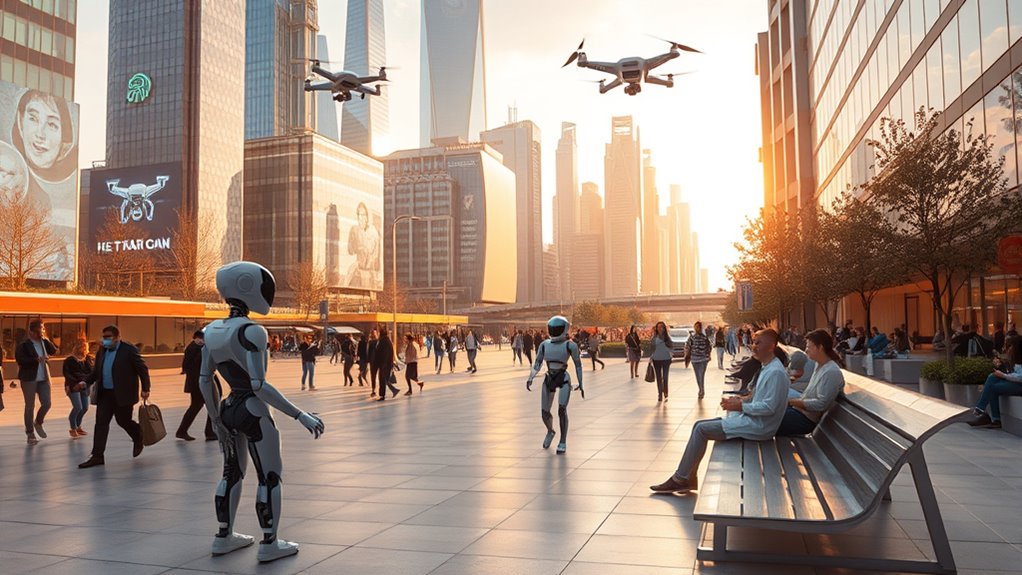
You interact with smart homes and automation every day, from voice-activated assistants to automated appliances that save time. AI now handles many daily tasks, making your routines more efficient and less labor-intensive. With digital connectivity everywhere, you’re constantly linked to information and services that reshape how you work and relax. As AI’s role expands, AI security becomes increasingly important to ensure these systems remain safe and trustworthy.
Smart Homes and Automation
Smart homes are transforming daily life by integrating advanced technology into everyday routines, making tasks more efficient and convenient. You no longer need to worry about forgetting to turn off the lights or adjust the thermostat; everything is automated to suit your preferences. Imagine waking up to a house that has already prepared your coffee and adjusted the room temperature. You gain more time for what truly matters, free from mundane chores. Additionally, creating the perfect farmhouse bedroom ambience can be seamlessly incorporated into smart home designs, blending rustic charm with modern automation for a cozy, personalized retreat.
Here are four ways this innovation touches your life:
- Enhanced Comfort: Personalized environments that adapt instantly to your mood.
- Increased Security: Smart locks and cameras keep your home safe and accessible remotely.
- Energy Efficiency: Automated systems reduce waste and lower utility bills.
- Peace of Mind: Seamless control, ensuring your home is always just right.
AI in Daily Tasks
Technological innovations powered by artificial intelligence are fundamentally transforming how you handle daily tasks, making routines more efficient and less time-consuming. Smart assistants like voice-activated devices help manage your schedule, answer questions, and control home environments effortlessly. Automated grocery shopping and meal planning save you time, while AI-powered cleaning robots keep your home tidy without manual effort. Personalized recommendations tailor entertainment, clothing, and even health routines to your preferences. Smart thermostats optimize energy use, lowering costs and environmental impact. AI-driven traffic apps provide real-time updates, reducing commute times. These innovations free you from mundane chores, allowing you to focus on more meaningful activities. As AI integrates further into daily life, your routines become smoother, more personalized, and less burdensome. Incorporating skincare patches into your routine exemplifies how targeted, minimally invasive solutions can improve health and appearance with ease.
Digital Connectivity Everywhere
As digital connectivity becomes increasingly embedded in everyday life, innovations like 5G networks, ubiquitous Wi-Fi, and the Internet of Things (IoT) are transforming how you interact with the world around you. You can control your home, monitor health, and stay connected in real-time from almost anywhere. This constant connection brings both empowerment and vulnerability. Advances in artificial intelligence are further enhancing these technologies, enabling smarter devices and more intuitive interactions. Here are four ways it affects you: 1. Instant access to information and services, making life more efficient. 2. Seamless integration of devices, creating a smart environment tailored to your needs. 3. Increased surveillance possibilities, raising privacy concerns. 4. Dependence on connectivity, risking disruptions that can halt daily routines. This hyper-connected world shapes your experiences, blending convenience with new challenges to navigate.
Societal Changes and the Redefinition of Identity and Purpose

When automation reaches a point where nearly all labor is performed by machines, society faces profound shifts in how you perceive your roles and purpose. With work no longer defining your identity, you might seek meaning outside traditional employment. Your sense of worth could shift from productivity to personal development, relationships, or creative pursuits. Social structures may evolve, emphasizing community, leisure, and self-fulfillment. You may question the value of work itself and redefine success based on well-being and contribution rather than economic output. As automation diminishes the need for human labor, you’ll need to find new ways to establish purpose, connecting with others and pursuing passions that machines cannot replicate. This transformation challenges long-held beliefs, prompting a fundamental reevaluation of what it means to live a meaningful life. Additionally, the societal impact of automation extends to wealth distribution, potentially reshaping economic hierarchies and access to resources.
Challenges and Opportunities in Skills Development and Education
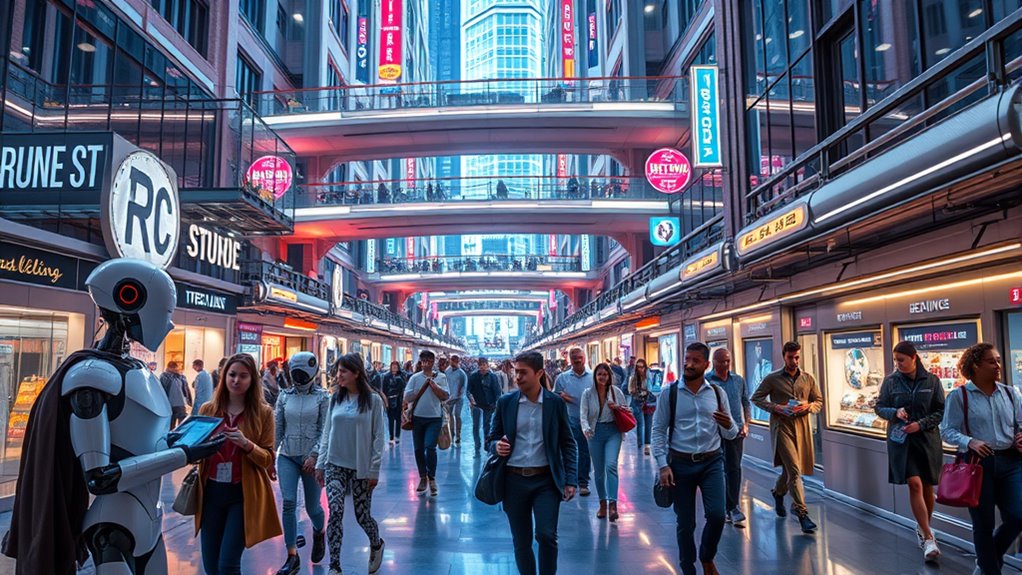
To thrive in a post-labor society, you’ll need to focus on reskilling for emerging roles and embracing lifelong learning. As automation transforms industries, staying adaptable becomes essential for maintaining relevance. By proactively developing new skills, you can turn challenges into opportunities for growth and innovation.
Reskilling for Future Roles
Reskilling for future roles presents both significant challenges and promising opportunities in skills development and education. You’ll need to adapt quickly amid rapid technological change, facing uncertainty about which skills will remain valuable. However, new pathways will open for those willing to learn and evolve.
Consider these critical aspects:
- *Embrace lifelong learning* to stay ahead as industries transform and new roles emerge.
- *Develop digital and STEM skills* to meet the increasing demand for technological proficiency.
- *Cultivate soft skills* like creativity, empathy, and problem-solving to complement automation.
- *Seek accessible education opportunities* that support continuous growth and resilience in the job market.
Your ability to reskill will determine your relevance and success in this evolving landscape.
Promoting Lifelong Learning
As automation continues to reshape the job market, promoting lifelong learning becomes essential for individuals to stay relevant and competitive. You’ll need to continuously update your skills, especially in technology, to adapt to new roles. The rapid pace of change makes traditional education insufficient alone, so embracing ongoing learning is crucial. Opportunities include online courses, workshops, and industry certifications that help you acquire in-demand skills like AI literacy, data analysis, and digital communication. Challenges involve access disparities, motivation, and staying current amid evolving technologies. You must develop a mindset of adaptability and curiosity to thrive in this environment. Governments, businesses, and educational institutions play vital roles in supporting lifelong learning, ensuring that workers remain empowered and resilient as automation advances.
Reimagining Social Structures and Governance in a Post-Work Era
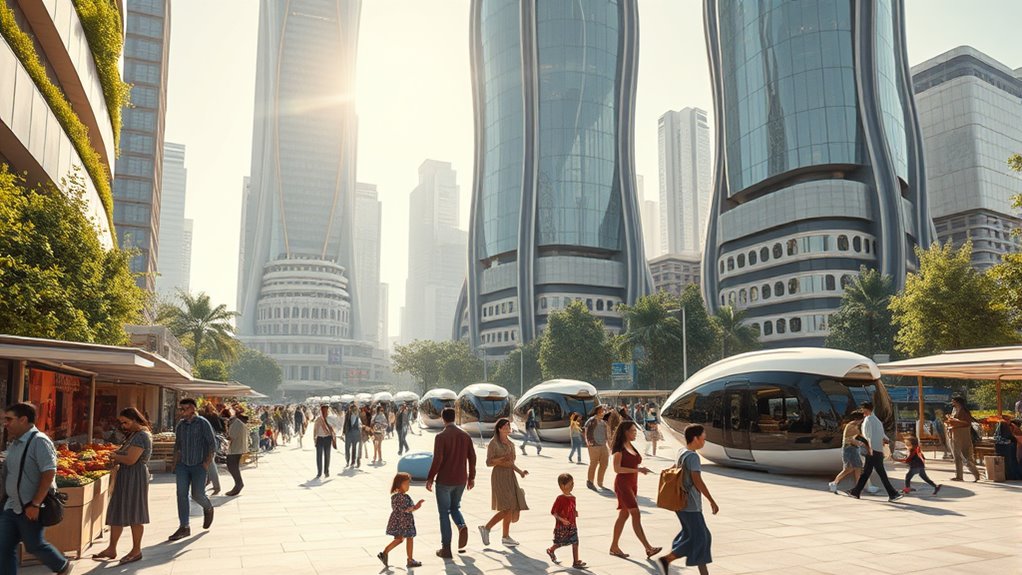
In a post-work era where automation handles the majority of labor, societal structures and governance models must fundamentally transform to maintain stability and equity. You’ll need new systems that prioritize resource sharing, collective well-being, and participatory decision-making. Imagine policies that ensure everyone benefits from abundance, rather than a few controlling wealth.
- Universal Basic Income: Guaranteeing financial security, freeing individuals from survival struggles.
- Decentralized Governance: Empowering communities to make decisions that reflect their needs.
- Resource Redistribution: Fairly sharing technological gains to reduce inequality.
- Focus on Well-Being: Prioritizing mental health and social cohesion over productivity.
This transformation demands your active engagement and innovative thinking to create a fair, resilient society.
Ethical Dilemmas and Policy Responses to Automation
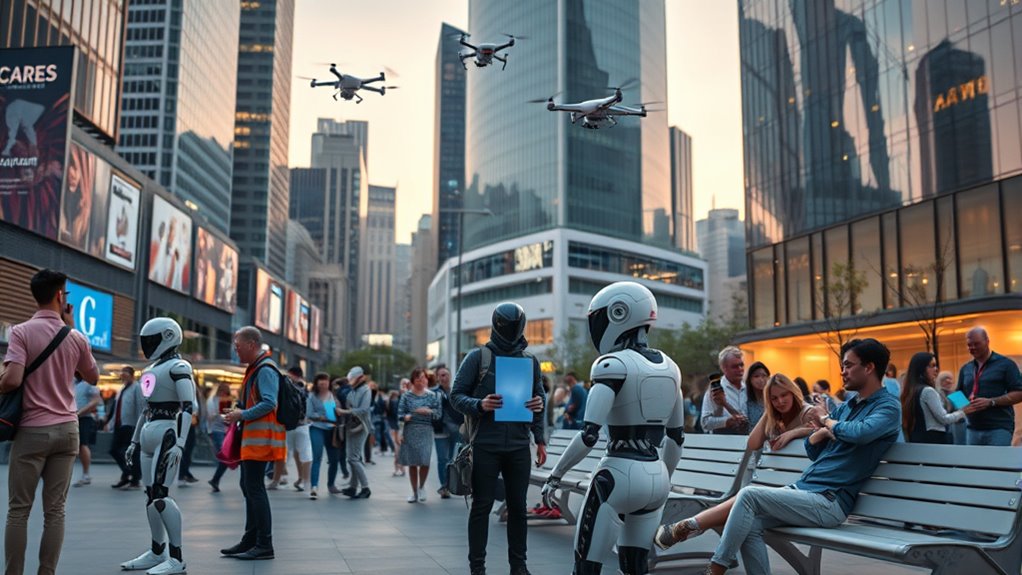
Are policymakers prepared to address the ethical challenges posed by widespread automation? As robots and AI transform industries, you must consider questions about fairness, privacy, and accountability. Who’s responsible when autonomous systems malfunction or cause harm? How do you guarantee that automation benefits everyone and not just the wealthy or tech-savvy? Policies need to balance innovation with protections for displaced workers and vulnerable populations. You’ll need regulations that prevent bias in AI algorithms, safeguard personal data, and promote transparency. Implementing universal basic income or similar social safety nets might become vital to address economic inequality. Ultimately, your challenge is to craft policies that foster technological progress while maintaining societal values and human dignity in a rapidly changing landscape.
Psychological and Cultural Impacts of a Highly Automated Society
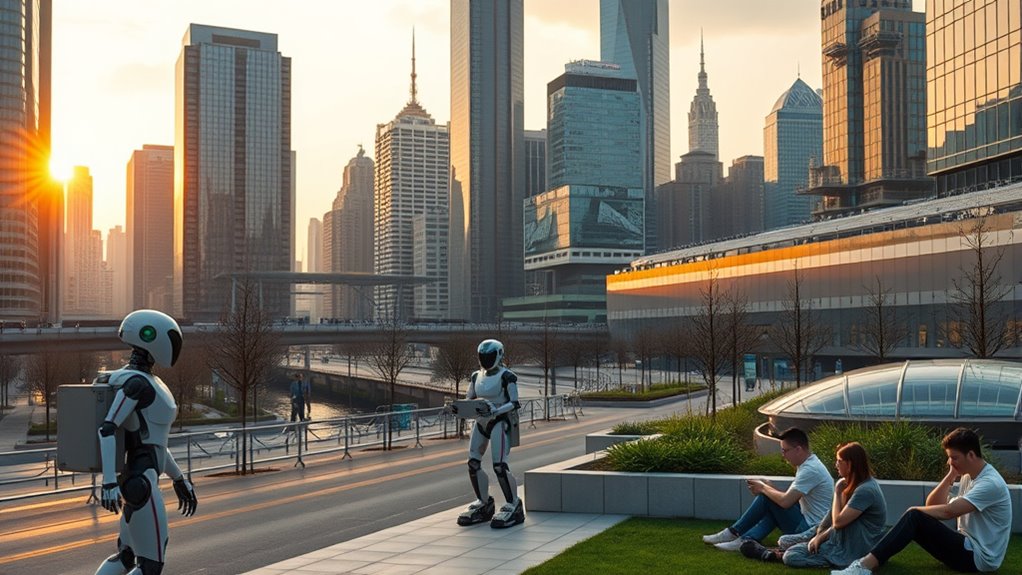
The rapid advancement of automation fundamentally alters the way you find meaning and connect with society. You may start questioning your purpose beyond work, feeling lost or disconnected. As robots handle most tasks, traditional roles fade, risking a sense of identity loss. You might experience increased anxiety about the future, or feel that societal bonds weaken.
Consider these emotional impacts:
- Alienation—feeling detached from your community and purpose.
- Anxiety—worrying about job security and economic stability.
- Isolation—reducing human interactions as digital and robotic replacements grow.
- Disconnection—struggling with a diminished sense of belonging in a society that no longer revolves around work.
These shifts challenge your mental health and cultural values, urging you to redefine what it means to be part of society.
Preparing for a Future of Abundant Resources and Human-Machine Collaboration
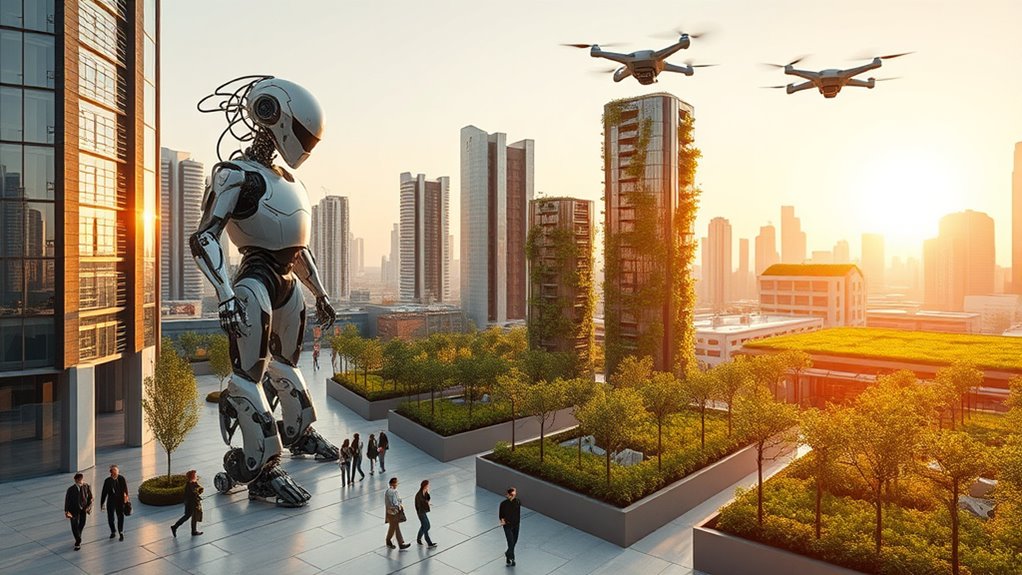
Preparing for a future of abundant resources and human-machine collaboration requires proactive planning and adaptation. You’ll need to rethink how resources are distributed, ensuring wealth generated by automation benefits everyone. As robots handle most production, societies must develop new systems for sharing prosperity, like universal basic income or resource redistribution. Embracing human-machine collaboration means acquiring new skills that complement automation, such as creative thinking, emotional intelligence, and strategic planning. You should focus on lifelong learning to stay relevant in evolving roles. Infrastructure must adapt to support seamless integration of AI and robotics, enabling efficient resource management. Policymakers, businesses, and individuals must work together to create frameworks that foster innovation while safeguarding social cohesion, ensuring that abundance benefits all, not just a few.
Frequently Asked Questions
How Will Universal Basic Income Be Implemented in a Post-Labor Society?
You’ll see universal basic income (UBI) implemented through government programs providing regular, unconditional payments to everyone. Governments might fund UBI with taxes on automation, robots, or wealth. You’ll likely experience streamlined distribution via digital platforms, ensuring easy access. As automation reduces job availability, UBI becomes essential for financial security, allowing you to focus on personal growth, creativity, or community engagement without the fear of unemployment or economic hardship.
What Role Will Human Creativity and Art Play Without Traditional Jobs?
Like a phoenix rising from ashes, human creativity and art will become our soul’s sanctuary in a world with no traditional jobs. You’ll craft new meaning through innovative expression, transforming emotion into vibrant masterpieces beyond mere survival. Art will be your compass, guiding society’s moral and cultural evolution. In this rebirth, your imagination will forge the essence of identity, a proof to the enduring power of human spirit amid the machines’ silent reign.
How Will Legal Systems Adapt to AI and Robotic Decision-Making Authority?
Your legal systems will need to evolve quickly to address AI and robotic decision-making authority. You’ll see new laws defining AI accountability, liability, and ethical use, ensuring humans retain oversight. Regulations will establish clear boundaries for autonomous systems, protecting individual rights and public safety. Courts will interpret these laws, balancing innovation with ethical standards, so you’ll need to stay informed and adapt legal frameworks to keep pace with technological advancements.
What Measures Can Ensure Equitable Wealth Distribution in Abundance?
Imagine wealth as a flowing river, and your goal is to keep it from flooding or drying up. To guarantee equitable distribution, you can support progressive taxation, implement universal basic income, and foster policies that promote social safety nets. You should also advocate for accessible education and skill development, so everyone can benefit from automation’s abundance, turning a potential deluge of wealth into a tide that lifts all boats equally.
How Can Societies Preserve Cultural Identity Amid Widespread Automation?
You can preserve cultural identity by actively promoting local traditions, languages, and arts through education and community events. Encourage storytelling and storytelling platforms that reflect your culture’s values. Support local artisans and cultural institutions to keep heritage alive. Use technology thoughtfully to share and celebrate your culture globally. By prioritizing these efforts, you guarantee your cultural identity remains vibrant and resilient, even as automation transforms everyday life.
Conclusion
As you step into this future where robots tend the fields and cities hum with innovation, remember that your choices now shape a new world. Just like the pioneers of the Renaissance, you hold the power to redefine purpose and community amid endless abundance. Embrace the challenge, harness technology thoughtfully, and forge a society where human spirit and machine work hand in hand—creating a tomorrow brighter than the dawn of the printing press.