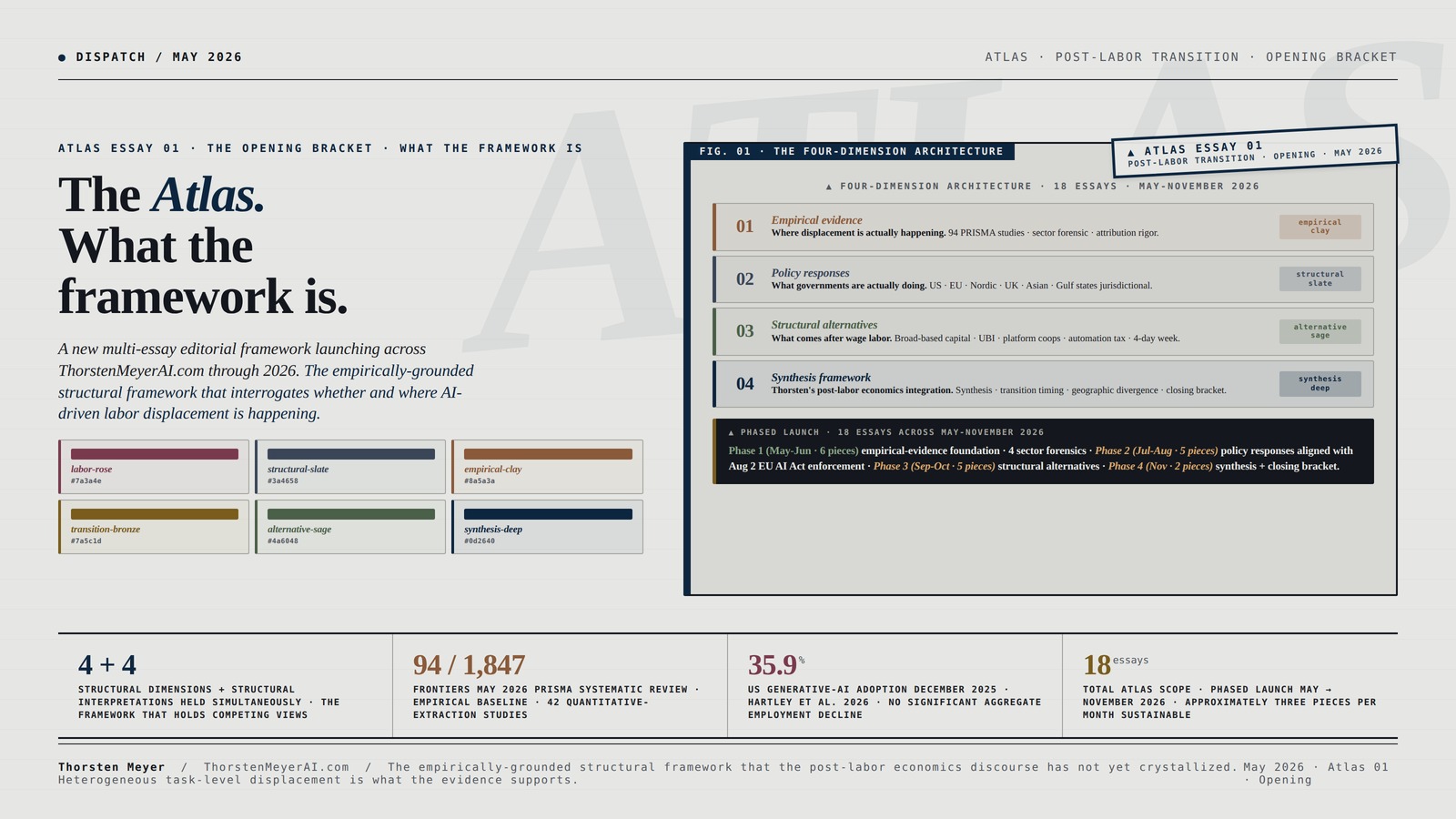

The Post-Labor Transition Atlas is the empirically-grounded structural framework that interrogates whether and where AI-driven labor displacement is happening, what the policy responses are operationally, what the structural alternatives look like, and what the synthesis framework produces. It is not the post-labor utopian thesis. It is not the AI-doomerism counter-narrative. It is the framework that holds the empirical evidence (94 systematic-review studies from 1,847 records through early 2026 · 35.9% US generative-AI adoption · ~3 percentage point unemployment increase for 20-30-year-olds in tech-exposed occupations · ~0.5pp Goldman Sachs aggregate transition projection · 55,000 US jobs directly impacted in 2025 · 350,000 emerging AI-specific roles) alongside the competing structural interpretations (transition not arriving · arriving slowly · arriving fast with structural alternatives unrecognized · arriving fast with structural alternatives operationally available). The empirical evidence is more substantial than the techno-optimist or techno-pessimist narratives admit; the structural interpretations diverge significantly; the policy responses are operationally distinct across jurisdictions. The Atlas crystallizes all three dimensions.
Open a free Amazon Business account
Business pricing, bulk buying and tax-exempt orders.
Create a free accountAs an affiliate, we earn on qualifying purchases.
By Thorsten Meyer — May 2026
This is the opening bracket of the Post-Labor Transition Atlas — a new multi-essay editorial framework launching across the ThorstenMeyerAI.com publication through 2026. The framework operates parallel to but structurally distinct from the European sovereign-LLM essay track that closed at eleven essays earlier this month. Where the European track documented institutional answers to a specific strategic-positioning question, the Atlas documents the empirical labor-market evidence, policy responses, and structural alternatives across the post-labor transition’s four operational dimensions.
The structural argument I want to make in this opening: the Post-Labor Transition Atlas is the empirically-grounded structural framework that the post-labor economics discourse has not yet crystallized. The empirical evidence is substantial — the May 2026 Frontiers systematic review covered 94 studies from 1,847 records, with 42 quantitative-extraction studies. The empirical literature is dense, sectorally heterogeneous, and operationally distinct from the public discourse around AI labor displacement. The Atlas integrates the empirical evidence with policy-response analysis and structural-alternative interrogation across four dimensions — and produces the synthesis framework the post-labor transition discourse needs.
The headline framing finding: the post-labor transition is empirically real at the task-displacement level (35.9% US generative-AI adoption · 20-30-year-old unemployment in tech-exposed occupations up ~3pp · ~55,000 US jobs directly impacted by AI-driven automation in 2025) but operationally bounded by structural factors the techno-optimist and techno-pessimist narratives both obscure (the exposure-vs-displacement distinction · legal + verification + regulatory frictions · the bifurcated augmentation-vs-replacement reality across sectors · the geographic + demographic heterogeneity). The Atlas operates on the structural argument that the empirical evidence supports neither the AI-utopian “transition is arriving at scale” framing nor the AI-doomerist “mass unemployment is imminent” framing. What the empirical evidence supports is structurally more interesting: heterogeneous task-level displacement that produces differentially distributed labor-market outcomes across sectors, demographics, geographies, and policy regimes.
The Atlas operates across four structurally distinct dimensions. Each dimension serves a different operational requirement; together they produce the integrative framework the post-labor transition discourse needs. This opening bracket names what each dimension covers, what the editorial framing is, what the chromatic system signals, and what Phase 1 specifically produces.
The Atlas.
What the
framework is.
A new multi-essay editorial framework launching across ThorstenMeyerAI.com through 2026. The empirically-grounded structural framework that interrogates whether and where AI-driven labor displacement is happening — and what the policy responses and structural alternatives look like operationally.
This is the opening bracket of the Post-Labor Transition Atlas — a new multi-essay editorial framework operating parallel to but structurally distinct from the European sovereign-LLM essay track that closed at eleven essays earlier this month. The Atlas operates across four structurally distinct dimensions. Dimension 1 · Empirical evidence (where labor displacement is actually happening). Dimension 2 · Policy responses (what governments are actually doing). Dimension 3 · Structural alternatives (what comes after wage labor). Dimension 4 · The synthesis framework (Thorsten’s post-labor economics integration). The Atlas is not the post-labor utopian thesis. It is not the AI-doomerist counter-narrative. It is the framework that holds the empirical evidence alongside competing structural interpretations.
Four dimensions. Four registers.
The Atlas operates across four structurally distinct dimensions. Each dimension has a specific operational scope, a specific evidence base, and a specific chromatic register. Together they produce the integrative framework the post-labor transition discourse needs.
clay
slate
sage
deep
AI labor displacement analysis software
As an affiliate, we earn on qualifying purchases.
As an affiliate, we earn on qualifying purchases.
Four interpretations. Held simultaneously.
The empirical evidence as of mid-2026 supports four structurally distinct interpretations of the post-labor transition. The framework holds all four simultaneously — the editorial discipline is not to pick one but to crystallize the evidence each interpretation relies on.
in discourse
dominant
evidence
consequential
workforce automation impact reports
As an affiliate, we earn on qualifying purchases.
As an affiliate, we earn on qualifying purchases.
Six registers. New palette.
The Atlas operates on a new chromatic palette structurally distinct from the European sovereign-LLM track. The visual signaling logic communicates that the Atlas is a structurally distinct editorial framework. Synthesis-deep is preserved as the integrative-register continuity signal across both frameworks.
policy response analysis tools for AI
As an affiliate, we earn on qualifying purchases.
As an affiliate, we earn on qualifying purchases.
Four phases. 18 essays.
The phased launch the Atlas operates on. Phase 1 establishes the framework as a credible editorial enterprise before committing to the full 18-essay scope. Each phase produces structurally complete output before committing to the next phase. The Atlas can be paused, redirected, or extended based on operational evidence at each phase boundary.
The Post-Labor Transition Atlas is the empirically-grounded structural framework that the post-labor economics discourse has not yet crystallized. The empirical evidence is more substantial than the techno-optimist or techno-pessimist narratives admit. The structural interpretations diverge significantly. The policy responses are operationally distinct across jurisdictions. The structural alternatives are operationally tested but not at scale. The Atlas crystallizes all three dimensions plus the synthesis framework — across four phases through November 2026.
AI task displacement assessment tools
As an affiliate, we earn on qualifying purchases.
As an affiliate, we earn on qualifying purchases.
I · The four-dimension architecture
The structural framework the Atlas operates across. Each dimension has a specific operational scope, a specific evidence base, and a specific chromatic register.
Dimension 1 · Empirical evidence · where labor displacement is actually happening
The forensic data-driven essays. Each one documents a specific sector’s empirical labor-market evidence as of mid-2026 — not the discourse claims, the actual measured data. The structural distinction is being rigorous about attribution: how much displacement is AI-driven vs. cyclical, vs. globalization-continuing, vs. demographic, vs. cohort-specific.
The empirical evidence base is substantial. The May 2026 Frontiers systematic review covered 1,847 initial records and retained 94 studies meeting PRISMA inclusion criteria, with 42 studies for quantitative extraction. Goldman Sachs models project approximately 300 million full-time jobs worldwide will be affected. The Federal Reserve Bank of Dallas reviewed wage and employment data through early 2026. The WEF Future of Jobs Report 2025, the SHRM 2025 Automation/AI Survey, the Bureau of Labor Statistics occupational employment data, and the PwC 2025 AI Jobs Barometer establish the empirical baseline.
Sectoral coverage planned: software engineering (the canonical case · most-documented · attribution rigor) · white-collar professional services (Tier 1 displacement · legal · paralegal · entry-level consulting · accounting · investment banking analyst roles) · customer service + BPO (operational-scale displacement · India + Philippines + Eastern Europe geographic distribution) · creative industries (bifurcated augmentation-vs-replacement reality · graphic design · copywriting · translation · video · music) · healthcare administration + radiology + pathology (the regulated-industry case) · skilled trades (the structural non-displacement sector · wage premium dynamics).
Chromatic register: empirical-clay — the data-evidence register · forensic, grounded, attribution-rigorous.
Dimension 2 · Policy responses · what governments are actually doing
The jurisdictional policy-framework essays. Each documents how a specific jurisdiction is operationally responding to AI-driven labor displacement — not the policy discourse, the actually implemented policy + the empirical evidence on its operational effects.
The jurisdictional coverage planned: the US response (bipartisan workforce-development framing · state-level UBI experiments · federal AI workforce framework · the absence of broad-based capital-ownership policy) · the EU response (EU AI Act + Digital Markets Act labor provisions · German Kurzarbeit + Bürgergeld · French universal-income experiments · Spain’s Ingreso Mínimo Vital · the European social-protection framework as structural baseline) · the Nordic model empirical update (Finland’s UBI experiment retrospective · Sweden + Denmark + Norway social-protection frameworks · the structural sustainability question) · the UK response (Labour government framework · the AI workforce strategy · regional-development policy · post-Brexit labor-market dynamics) · the Asian response divergence (Japan’s automation-positive framework · South Korea’s chaebol labor adjustment · Singapore’s SkillsFuture program · China’s social-credit + labor management · the structural differences from Western responses) · the Gulf states sovereign-wealth model (UAE + Saudi Arabia + Qatar · the structural alternative where capital ownership is already concentrated and distributed via sovereign wealth).
Chromatic register: structural-slate — the policy-framework register · institutional, jurisdictional, operationally distinct.
Dimension 3 · Structural alternatives · what comes after wage labor
The theoretical-framework essays. Each documents a specific structural alternative to wage-labor income in the post-labor transition.
The structural-alternative coverage planned: the broad-based capital ownership framework (the policy mechanisms · sovereign wealth funds · employee stock ownership plans · citizen dividends · land value taxation · automation tax + UBI hybrid models · the empirical evidence on each) · the platform-cooperative alternative (Stocksy United · Mondragon · the structural differences from venture-capital platform extraction · the scale question) · the taxation-reform landscape (automation tax proposals · wealth tax · land value taxation · the political-economy reality) · the shorter working week movement (Iceland’s four-day week trial retrospective · UK 4-Day Week Foundation data · the structural relationship between productivity gains and working-hours reduction) · the job-guarantee alternative (the MMT framework · Pavlina Tcherneva · the empirical evidence on Argentina’s Jefes y Jefas program · the structural relationship to UBI).
Chromatic register: alternative-sage — the structural-alternative register · theoretical, integrative, policy-mechanism-focused.
Dimension 4 · The synthesis framework · Thorsten’s post-labor economics integration
The integrative synthesis essays. Each crystallizes the framework across the empirical-policy-alternative evidence.
The synthesis coverage planned: the post-labor economics synthesis (the theoretical framework crystallized: broad-based capital ownership + market mechanisms + AI-driven productivity gains as the policy response to automation) · the transition-timing question (when does the post-labor transition arrive at scale empirically? · the structural argument for why “scale” is the operative question, not “if” · the policy implications of slow vs. fast transition) · the geographic-divergence framework (how different jurisdictions are operating on different post-labor trajectories · the structural implications for migration, capital flows, and political economy) · the closing-bracket retrospective (what the Atlas covers and what comes next · structurally parallel to Essay 11 of the European sovereign-LLM track).
Chromatic register: synthesis-deep — carried over from the European sovereign-LLM track · editorial continuity register · integrative.
II · The editorial framing · the framework that holds competing views
The structural editorial decision the Atlas operates on. The Atlas is not the post-labor utopian thesis. It is not the AI-doomerist counter-narrative. It is the framework that holds the empirical evidence alongside competing structural interpretations.
Four structural interpretations the framework holds simultaneously
The empirical evidence as of mid-2026 supports four structurally distinct interpretations of the post-labor transition. The framework holds all four simultaneously — the editorial discipline is not to pick one but to crystallize the evidence each interpretation relies on.
Interpretation 1 · Transition is not arriving at scale. The aggregate-unemployment evidence does not show structural displacement. The Federal Reserve Bank of Dallas wage and employment data through early 2026 found wages were not uniformly declining in jobs with significant AI exposure. Hartley, Jolevski, Melo, and Moore (2026) report 35.9% US generative-AI adoption with small positive wage effects and no statistically significant declines in job openings or employment in exposed occupations. Bharat Chandar’s (2025) Current Population Survey analysis similarly finds no aggregate employment decline. This is the structurally credible interpretation that the discourse underweights.
Interpretation 2 · Transition is arriving slowly with heterogeneous effects. The Goldman Sachs models project ~0.5pp transition unemployment increase before stabilizing at a new equilibrium. The empirical evidence shows demographic heterogeneity — Goldman Sachs found unemployment among 20-30-year-olds in tech-exposed occupations rose by ~3 percentage points since early 2025. The Frontiers systematic review documents “suggestive signals” of displacement in hiring patterns for younger workers in highly exposed occupations. This is the empirically dominant interpretation as of mid-2026.
Interpretation 3 · Transition is arriving fast with structural alternatives unrecognized. The 55,000 US jobs directly impacted by AI-driven automation in 2025 is operationally significant at the firm-level data. The 350,000 emerging AI-specific roles (WEF 2025) is the creation side. The structural-alternative discourse (UBI, broad-based capital ownership, platform cooperatives, automation tax) operates on the assumption that the transition is arriving faster than the aggregate-unemployment evidence shows. This interpretation operates on micro-evidence + structural-alternative policy implications.
Interpretation 4 · Transition is arriving fast with structural alternatives operationally available. The Gulf states sovereign-wealth model + Nordic social-protection framework + Finland’s UBI experiment retrospective + Iceland’s four-day week trial + Argentine Jefes y Jefas program produce operationally-tested alternative-income frameworks. The structural alternatives exist at policy-implementation scale; the political-economy question is whether they scale faster than the displacement. This is the structurally most consequential interpretation if it is correct — and the framework should integrate the empirical evidence on which alternatives operationally work.
The framework’s editorial discipline
The Atlas does not pick one interpretation. Each empirical-evidence essay crystallizes the sectoral data that informs the interpretation question. Each policy-response essay crystallizes the operational policy framework that addresses the interpretation question. Each structural-alternative essay crystallizes the policy mechanism that responds to the interpretation question. The synthesis framework integrates the evidence across all four interpretations.
This editorial framing is structurally distinct from both AI-utopianism and AI-doomerism. The post-labor economics thesis (Thorsten’s theoretical framework) is operationally credible — but the empirical evidence does not unambiguously support it at the timeline the AI-utopian discourse claims. The Atlas crystallizes both the empirical evidence and the structural-alternative policy mechanisms; the synthesis framework produces the integrative observations the discourse needs.
III · The chromatic system · the new register framework
The visual signaling framework the Atlas uses. The chromatic system is structurally distinct from the European sovereign-LLM track to signal editorial distinction.
The six new chromatic registers
The Atlas operates on a new chromatic palette designed to signal post-labor economics editorial register distinct from European sovereign-AI policy editorial register:
- labor-rose (#7a3a4e) · the labor-economics framing · dominant for sector forensic essays that interrogate wage-labor income and displacement specifically
- structural-slate (#3a4658) · the policy-framework register · dominant for jurisdictional essays documenting government responses
- empirical-clay (#8a5a3a) · the data-evidence register · dominant for empirical-forensic essays grounded in measured labor-market data
- transition-bronze (#7a5c1d) · the forward-looking register · dominant for forecast and timing essays
- alternative-sage (#4a6048) · the structural-alternative register · dominant for theoretical-framework essays on policy mechanisms
- synthesis-deep (#0d2640) · carried over from the European track · editorial-continuity register · dominant for integrative synthesis essays
The visual signaling logic: the new registers communicate that the Atlas is structurally distinct editorial framework from the European sovereign-LLM track. Synthesis-deep is preserved as the integrative-register continuity signal across both frameworks. The chromatic system itself is part of the editorial argument — the post-labor transition operates across distinct dimensions that the visual system makes legible.
IV · Phase 1 specifically · what the next five essays produce
The phased launch the Atlas operates on. Phase 1 establishes the framework as a credible editorial enterprise before committing to the full 18-essay scope.
Phase 1 scope · six pieces total
- Essay 01 (this piece) · The Atlas opening · what the framework is
- Essay 02 · Software engineering · the canonical case · empirical-clay register · attribution rigor on the most-documented sector
- Essay 03 · White-collar professional services · the Tier 1 displacement · labor-rose register · legal · paralegal · entry-level consulting · accounting · investment banking analyst roles
- Essay 04 · Customer service + BPO · the operational-scale displacement · empirical-clay register · India + Philippines + Eastern Europe geographic distribution
- Essay 05 · Creative industries · the bifurcated reality · labor-rose register · graphic design · copywriting · translation · video · the augmentation-vs-replacement distinction
- Essay 06 · Phase 1 synthesis · what the four sectors crystallize · synthesis-deep register · cross-sector structural findings
The Phase 1 editorial discipline
Phase 1 establishes the empirical-evidence foundation before committing to the policy-response and structural-alternative dimensions. The four sector essays span the displacement spectrum: most-documented (software engineering) · Tier 1 white-collar · operational-scale (BPO) · bifurcated creative. The synthesis essay crystallizes the cross-sector findings.
The structural argument Phase 1 makes: the empirical-evidence base across the four sectors supports the heterogeneous-effects interpretation (Interpretation 2 above) more than the aggregate-no-effect interpretation (1) or the fast-transition interpretations (3 + 4). The Atlas operates on this evidence-base finding through Phases 2-4.
What Phase 1 does not yet cover
The Phase 1 scope is intentionally constrained. The Phase 1 essays do not document:
- Policy responses · Phase 2 (July-August 2026) covers the four jurisdictional essays · operationally aligned with the August 2 EU AI Act enforcement window
- Structural alternatives · Phase 3 (September-October 2026) covers the four theoretical-framework essays · the policy-mechanism deep-dives
- Closing-bracket synthesis · Phase 4 (November 2026) covers the integrative-framework retrospective
The phased structure preserves editorial discipline. Each phase produces structurally complete output before committing to the next phase. The Atlas can be paused, redirected, or extended based on the operational evidence available at each phase boundary.
V · The closing-opening argument · what the Atlas crystallizes
The integrative observation the opening bracket produces. The Post-Labor Transition Atlas is the empirically-grounded structural framework that the post-labor economics discourse has not yet crystallized.
The structural editorial argument: the empirical evidence on AI-driven labor displacement as of mid-2026 is substantial (94 systematic-review studies · 35.9% US generative-AI adoption · ~3pp 20-30-year-old unemployment increase in tech-exposed occupations · ~55,000 US jobs directly impacted in 2025 · 350,000 emerging AI-specific roles · ~300M global FTE Goldman Sachs projection · ~0.5pp transition unemployment increase Goldman Sachs aggregate model). The evidence supports neither the AI-utopian “transition arriving at scale” framing nor the AI-doomerist “mass unemployment imminent” framing. What the evidence supports is structurally more interesting: heterogeneous task-level displacement producing differentially distributed labor-market outcomes across sectors, demographics, geographies, and policy regimes.
The Atlas operates on this empirical foundation. The four dimensions (empirical evidence · policy responses · structural alternatives · synthesis framework) crystallize the structural framework the post-labor transition discourse needs. The Phase 1 scope (six essays · four sector forensic pieces + opening and synthesis brackets) establishes the empirical-evidence foundation. Phases 2-4 (twelve additional essays through November 2026) extend the framework to policy responses, structural alternatives, and the integrative synthesis.
For the post-labor economics discourse specifically:
- The empirical-evidence base is more substantial than the public discourse acknowledges. The May 2026 Frontiers systematic review + Goldman Sachs + WEF + SHRM + Federal Reserve Bank of Dallas + PwC + Brookings + IMF + BLS evidence base supports rigorous sectoral attribution analysis. The Atlas crystallizes this evidence base across four sectors in Phase 1.
- The exposure-vs-displacement distinction is the analytically rigorous frame. Roles AI can technically perform (exposure) diverge substantially from roles society will actually allow AI to fill (displacement). The empirical literature operates on this distinction; the public discourse often conflates the two.
- Demographic and geographic heterogeneity matter operationally. 20-30-year-olds in tech-exposed occupations face structurally different labor-market dynamics than mid-career workers in non-exposed occupations. Geographic distribution (US vs. EU vs. Asian vs. Gulf states) produces structurally different policy responses. The Atlas crystallizes both dimensions.
- The structural alternatives are operationally tested but not at scale. Finland’s UBI experiment + Iceland’s four-day week trial + Argentine Jefes y Jefas program + Nordic social-protection framework + Gulf states sovereign-wealth model are operationally credible. The political-economy question is whether they scale faster than the displacement does — which is the Phase 3 question.
- The post-labor economics synthesis is the integrative-framework register the discourse needs. Broad-based capital ownership + market mechanisms + AI-driven productivity gains as the policy response to automation is structurally credible at policy-mechanism level — and the empirical evidence on each mechanism is what the synthesis essay (Phase 4) crystallizes.
That’s the read on the Post-Labor Transition Atlas as it launches at mid-May 2026 — twelve weeks before the August 2 EU AI Act enforcement window opens and approximately six months before the Phase 4 synthesis-bracket retrospective ships. The work is real across the post-labor economics discourse. The empirical evidence is substantial. The policy responses are operationally distinct across jurisdictions. The structural alternatives are operationally tested. The framework that holds all three dimensions alongside the competing structural interpretations is what the discourse needs — and is what the Atlas crystallizes.
The four-dimension architecture is structurally sound. The phased launch preserves editorial discipline. The new chromatic system signals editorial distinction from the European sovereign-LLM track. Phase 1 produces six pieces over approximately three weeks. The empirical-evidence foundation is what the next five essays crystallize.
About the Author
Thorsten Meyer is a Munich-based futurist, post-labor economist, and recipient of OpenAI’s 10 Billion Token Award. He spent two decades managing €1B+ portfolios in enterprise ICT before deciding that writing about the transition was more useful than managing quarterly slides through it. More at ThorstenMeyerAI.com.
Related Reading · the Post-Labor Transition Atlas framework
- This piece · Atlas Essay 01 · The opening bracket · what the framework is
- Forthcoming · Atlas Essay 02 · Software engineering · the canonical case
- Forthcoming · Atlas Essay 03 · White-collar professional services · the Tier 1 displacement
- Forthcoming · Atlas Essay 04 · Customer service + BPO · the operational-scale displacement
- Forthcoming · Atlas Essay 05 · Creative industries · the bifurcated reality
- Forthcoming · Atlas Essay 06 · Phase 1 synthesis · what the four sectors crystallize
Related prior frameworks
- The European sovereign-LLM essay track · eleven-essay structurally complete framework · closed May 2026 · the editorial track that precedes the Atlas
Sources
Empirical-evidence base for the Atlas opening
- Frontiers in Human Dynamics · Creation, validation, obsolescence: observed evidence of AI-driven labor market displacement, 2020–2025 · May 7, 2026 PRISMA systematic review · 94 studies retained from 1,847 records · 42 quantitative-extraction studies
- Smart Humain · AI Job Displacement Data 2026 · 55,000 US jobs directly impacted in 2025 · Goldman Sachs 300M global FTE projection · ~0.5pp transition unemployment increase aggregate
- International Center for Law & Economics · AI, Productivity, and Labor Markets: A Review of the Empirical Evidence · Hartley/Jolevski/Melo/Moore (2026) 35.9% US generative-AI adoption · Bharat Chandar (2025) CPS analysis · no aggregate employment decline through 2024-2025
- The World Data · AI Job Displacement Statistics 2026 · Goldman Sachs 20-30-year-old tech-exposed occupation unemployment +3pp since early 2025 · WEF Future of Jobs 2025 · SHRM 2025 Automation/AI Survey · Brookings + BLS evidence base
- ALM Corp · AI Job Displacement Statistics 2026-2030: 60+ Data Points · WEF 350,000 emerging AI-specific roles · Veritone Q1 2025 AI job openings +25.2% YoY · PwC 2025 AI Jobs Barometer · Federal Reserve Bank of Dallas wage and employment data through early 2026
- Innovative Human Capital · AI Displacement Risk in the Labor Market · Massenkoff & McCrory (2026) observed-exposure measure · exposure-vs-displacement distinction · legal/verification/regulatory frictions analysis
- Wiley · Navigating AI-Induced Job Displacement and Skill Demands: Insights From an Emerging Market Perspective · Ly 2026 · routine employment reduction 20-30% in manufacturing/logistics · proportional growth in high-skill AI occupations · Southeast Asia automation polarization
- Click Vision · AI Job Displacement Statistics (2026 Data & Trends) · sector-level displacement data · cross-validated global organizations + academic research + labor market analyses
Key reference figures crystallized
- Frontiers systematic review (May 7, 2026) · 1,847 initial records · 94 retained studies · 42 quantitative-extraction studies · PRISMA 2020 guidelines · six academic databases searched
- Goldman Sachs projection · ~300 million full-time jobs worldwide affected · ~0.5pp transition unemployment increase before stabilizing at new equilibrium
- US-specific direct impact 2025 · 55,000 jobs directly impacted by AI-driven automation
- US generative-AI adoption December 2025 · 35.9% of workers (Hartley et al. 2026)
- 20-30-year-old tech-exposed unemployment increase · ~3 percentage points since early 2025 (Goldman Sachs)
- WEF emerging AI-specific roles · approximately 350,000
- Veritone Q1 2025 AI job openings · 35,445 in US · +25.2% YoY · median pay $156,998
- AI/ML engineer roles growth · 41.8% annually
- AI engineer roles year-over-year demand surge · 143.2%
- Manufacturing/logistics routine employment reduction · 20-30% (Ly 2026)
- Federal Reserve Bank of Dallas finding · wages not uniformly declining in jobs with significant AI exposure (early 2026 data)
- Four-dimension architecture · empirical evidence · policy responses · structural alternatives · synthesis framework
- Phased launch · Phase 1 (6 pieces · May-June 2026) · Phase 2 (5 pieces · July-August 2026) · Phase 3 (5 pieces · September-October 2026) · Phase 4 (2 pieces · November 2026) · 18 total
- Six chromatic registers · labor-rose · structural-slate · empirical-clay · transition-bronze · alternative-sage · synthesis-deep
- Four structural interpretations held simultaneously · transition not arriving · arriving slowly · arriving fast with alternatives unrecognized · arriving fast with alternatives operationally available
NFL season / tailgating Picks
team gear
As an affiliate, we earn on qualifying purchases.