
By Thorsten Meyer

Get business pricing on tech for your team
- Business-only prices and quantity discounts
- Tax-exempt purchasing
- Multiple users, one account, clear invoices
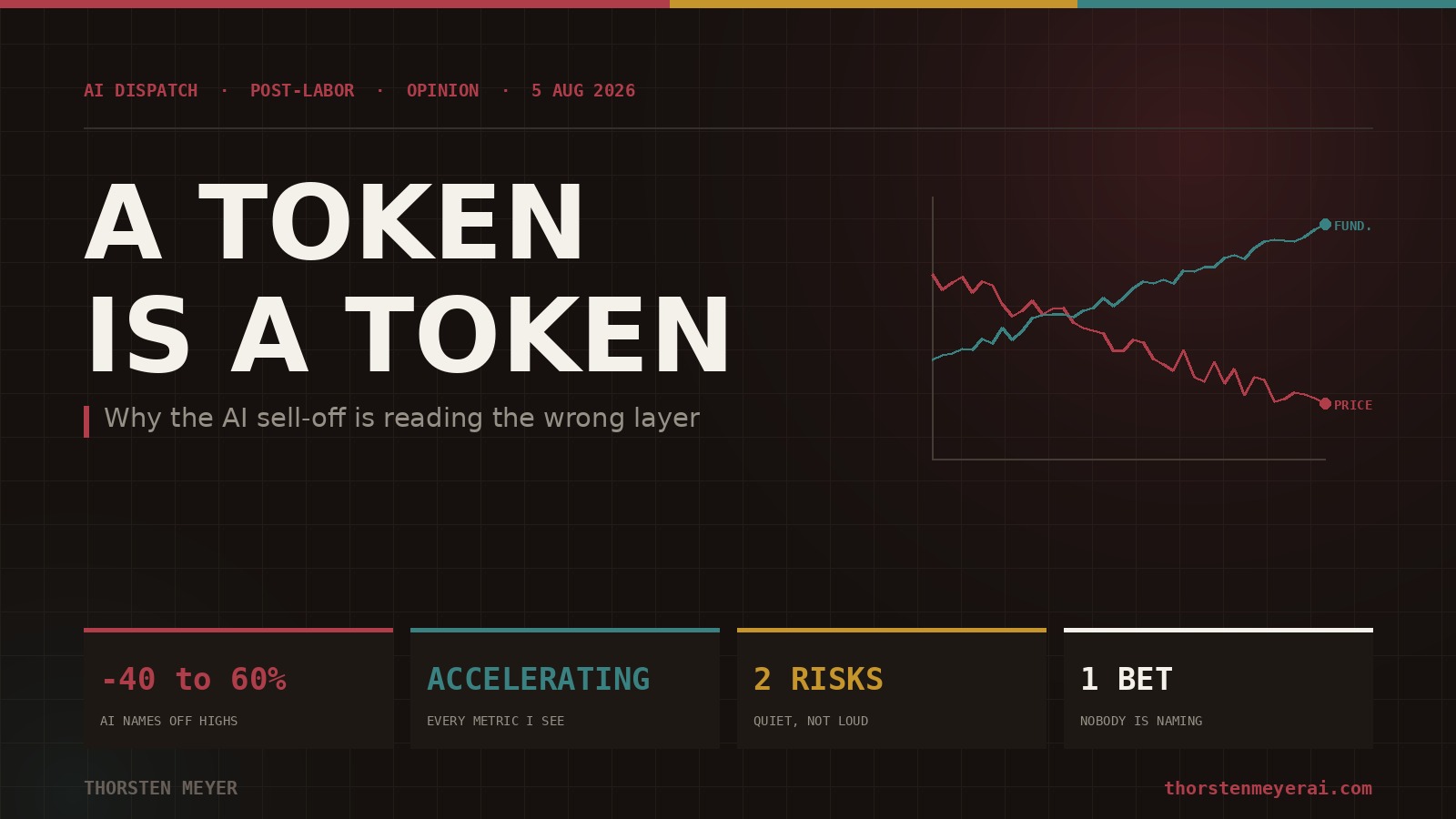
The AI names fell hard this past month — call it 40 to 60 percent from their highs for the more speculative ones, in something close to a straight line. And in the same weeks, from where I sit, every fundamental I can actually measure accelerated. Not held. Accelerated.
That divergence is the most interesting thing in the market right now, and I want to lay out plainly why I think the sell-off is reading the wrong layer of the stack. This is my opinion, not a forecast, and I hold it with the humility the month deserves — but I hold it.
I am not a public-markets investor. I am a builder who runs a local-first inference fleet, publishes across a large portfolio, and watches open-weight models land on a weekly cadence. That seat gives me line of sight into exactly the part of this industry the equity market cannot price — and once you can see that part, the panic looks misdirected.
The speculative AI names fell 40–60% from their highs in a month. Every fundamental I can measure accelerated in the same weeks. My view: the market is selling a layer of the stack it was never able to see — and panicking about the two risks that matter least.
▲ Opinion & analysis · not investment adviceOpen source taking share spooked the market as demand destruction. That’s backwards. Producing a token costs the same compute whoever emits it — so open weights don’t destroy demand, they move margin and grow the pie.
The acceleration is happening where public equities have almost no telemetry. You infer the layer from its gravitational pull on the gauges you can read.
- A handful of listed hyperscalers
- The chipmakers
- Quarterly filings, weeks late
- Private frontier labs
- Open-source inference clouds monetizing served tokens
- Its pull: GPU scarcity, rising rents, memory spot, token growth — none on a balance sheet
The two things everyone panicked about are the two I worry about least. The risks worth respecting are quieter.
For the buildout to pay for itself, trillions in new operating cash flow must appear. It can come from exactly two places.
The truth, as usual, is still getting its boots on.
A token is a token
Start with the thing that spooked everyone: open source taking share. Kimi K3, GLM, the Qwen line, DeepSeek — a genuine capability leap in open weights, and a visible shift of volume away from expensive frontier tokens toward cheap open ones. The market read this as demand destruction. I think that is close to exactly backwards.
Here is the physical fact underneath it. A token is a token. Producing one takes the same floating-point operations, the same memory bandwidth, the same watts, the same cooling — whether it came from a frontier model billed at ninety-percent margins or an open-weight model you serve yourself at cost. The compute does not know or care which model emitted it.
So what actually happens when open source takes share is not that demand for compute falls. It is that margin moves. It comes out of the frontier-model layer — the two or three labs charging oligopoly prices — and it redistributes. Some flows to the infrastructure layer, the clouds and chips that charge everyone the same for flops regardless of whose model runs on them. And crucially, because the token got cheaper, more of them get consumed. Cheaper tokens do not suppress demand; they induce it. The elasticity is real, and it points the opposite way from the fear.
I watch this in my own operation every week. When I move work from a hosted frontier endpoint to a quantized open model on my own hardware, my spend per token collapses — and my total token consumption goes up, because suddenly I can afford to throw the model at things I would never have paid frontier rates for. The bill shrinks; the compute grows. Anyone reading the shrinking bill as shrinking demand has the sign wrong.
As an affiliate, we earn on qualifying purchases.
The dark-matter layer
The deeper reason the market is mispricing this is structural: the acceleration is happening where public equities cannot see it.
The visible AI economy is a handful of listed hyperscalers and chipmakers. But the fastest-growing demand right now is in two places the public market has almost no telemetry into — the private frontier labs, and the open-source inference clouds that monetize served tokens. This is the dark matter of the AI economy. You cannot measure it from a 10-K. You infer its existence from its gravitational pull on everything you can measure: GPU availability that never loosens, rental prices that keep climbing, memory spot prices, aggregate token growth. Every one of those gauges says the same thing, and none of them is on a public balance sheet.
When a market cannot see a layer, it prices the layer to zero and then gets whipsawed every time the layer's effects leak into the numbers it can see. That is, I think, a large part of what just happened. The fundamentals did not deteriorate. The market simply lost the plot on a layer it was never equipped to observe — and sold the confusion.
As an affiliate, we earn on qualifying purchases.
The router future makes the pie bigger, not smaller
The other thing being misread as bearish is the rise of the multi-model router. The pattern is now well established at the frontier of serious builders: take an open-weight model, fine-tune or RL it on your own proprietary data, put it behind a router, let it handle the bulk of the work, and reserve a frontier model to plan the hard parts and check the output. Better results, often, at a fraction of the cost.
"A fraction of the cost" reliably triggers the demand-destruction reflex. Again: wrong layer. The user's cost fell because the margin on the tokens fell — from ninety percent down to something like thirty — not because fewer tokens were produced. If anything the router increases total token volume, because orchestration is itself token-hungry and because cheaper inference invites more of it.
And there is a second-order effect I find genuinely elegant. If you have a fleet of cheap, capable, slightly-behind-the-frontier open models doing the labor, the value of the one truly frontier model that orchestrates them goes up, not down. A workshop full of competent journeymen makes the master more valuable, not less. The cheap tokens inflate the worth of the expensive orchestrating token rather than commoditizing it. This is the shape I am building toward in my own systems, and it is the opposite of the zero-sum story the market told itself.
As an affiliate, we earn on qualifying purchases.
The honest bear case, part one: credit
I do not want to sound like a man who cannot find a risk. There are two that I take seriously, and the first is the one the panic is mostly not about, which is exactly why it deserves respect.
It is credit. This buildout is enormous, and the question that actually matters is how much of it gets funded out of operating cash flow versus how much gets funded with debt. If it is mostly cash flow, the industry can absorb a lot of disappointment and keep building. If it is mostly debt, we are in the classic capital cycle — and debt-financed buildouts are fragile in a specific, dangerous way: they demand repayment on a schedule that does not care about your utilization. Get supply and demand even slightly out of phase and a debt-heavy structure unwinds fast and hard. That is roughly the mechanism that turned the late-1990s network buildout into a bust.
My read is that the repricing of the installed compute base actually works against this risk. A great deal of today's compute is locked into long contracts signed when everyone assumed GPU prices would fall. Instead the price of even older accelerators has gone vertical. As those cheap legacy contracts roll off and the compute reprices to the current market, operating cash flow rises — which means less of the forward buildout needs credit, not more. The improving fundamentals ease the financing risk rather than deepening it. But I hold this loosely. If operating cash flow does not keep accelerating and the buildout tips toward debt, that is the scenario that would genuinely change my mind.
As an affiliate, we earn on qualifying purchases.
The honest bear case, part two: the monoculture I actually worry about
The second risk is one I care about more than most market commentators, because it sits at the intersection of everything I work on — and it is a risk to the market's own function, not just to a sector.
We are building an epistemic monoculture. Increasingly, every participant — retail, institutional, and everyone in between — feeds the same news through the same two or three frontier models and acts on a near-identical probabilistic interpretation of it. The model becomes a kind of single anchor for the market's read on reality, the way a single trusted broadcaster once was before media fragmented. Except this anchor is applied to a probabilistic, Bayesian problem where diversity of interpretation is not a nicety — it is the mechanism that makes markets work at all.
When everyone interprets the same signal the same way, the disagreement that produces orderly price discovery collapses. Diversity of belief is what keeps a market from moving as one animal. Remove it and you get violent, compressed cycles — a full boom-and-bust in a sector playing out in weeks instead of years, before the actual fundamentals have even arrived. I have watched exactly this happen to whole sub-industries this year: a three-year cycle run in six weeks, driven not by facts on the ground but by the homogeneity of the interpretation.
This is, incidentally, the strongest argument I know for why open weights and model plurality matter — and why they are worth defending on grounds that have nothing to do with cost. A world with two dominant models charging ninety-percent margins is not just economically extractive; it is epistemically fragile. Many models, many interpretations, is not only better for competition and for sovereignty. It is better for the stability of the systems that run on top of them. This is a sovereignty argument dressed as a market-structure argument, and I mean both halves of it.
The bet nobody is naming
Underneath the whole debate is a question the market keeps circling without saying out loud, and as someone who thinks about post-labor economics for a living, I will say it plainly.
For this buildout to pay for itself, an enormous amount of new operating cash flow has to appear — trillions of dollars of it. That money can come from exactly two places. Either AI drives genuinely faster economic growth through productivity, and the pie gets bigger for everyone. Or it comes from labor substitution — value that used to be paid to humans as wages, now captured as margin on tokens.
At the most aggressive adopters, spend on tokens is already climbing toward a double-digit percentage of what they used to spend on people. Point that at the roughly twenty-five trillion dollars of global knowledge work and the arithmetic gets very large very fast. The uncomfortable truth is that the confident bull case is, quietly, a bet on labor substitution at civilizational scale — and almost everyone making it desperately hopes it turns out to be productivity growth instead.
I hope so too. It matters more than any stock. A world where AI expands the pie is a fundamentally different and better place than one where it merely reassigns the existing pie from wages to capital. And what I notice on the ground gives me some real hope: the founders closest to this are mostly not laying people off. They are hiring fewer new humans while their revenue per employee goes vertical, which reads more like a productivity story than a pure-substitution one — for now. But this is the question I would watch above all others, because it is the one that determines whether the buildout is a foundation or a bubble, and whether the society on the other side of it is one worth living in.
The one thing that actually scares me
If you ask what would genuinely flip me from cautious optimism to fear, it is not open source, and it is not China closing the lithography gap — that is a real phase transition but a slow, learning-by-doing one that cannot be teleported through, and the market wildly overreacts to it each time.
It is regulation, and specifically regulation driven by a narrative that has already outrun the facts. The story taking hold among ordinary people — that data centers will raise your power bill, drain your water, and take your job — is mostly false, and in several places precisely inverted. And it is winning anyway, because the industry has done a genuinely poor job of telling its own story, and because a lie travels the world before the truth has its boots on. A single overstated figure in a single book can propagate for decades after being debunked; we still believe things about spinach that were a decimal-point error eighty years ago.
Here in Europe the failure mode has its own flavor — a reflex to regulate the technology thoroughly before really using it, which risks legislating from a position of inexperience. I say that as someone who operates entirely inside the European framework and takes its legitimate aims seriously. The recent reshaping of the AI Act showed the rules can be made sharper and more proportionate rather than merely heavier; that is the direction that keeps Europe in the game. But the broader political risk is real, and it is the one I would insure against first, because it is the bullet you do not see — the plausible, ridiculous-feeling narrative — that tends to be the one that actually gets you.
Where I land
So here is my position, held honestly. The fundamentals I can see are improving, the sell-off is mostly pricing a layer of the stack it was never able to observe, and the two things everyone panicked about — open source and China — are the two I worry about least. A token is a token; open weights redistribute margin and grow the pie; the router future makes compute demand larger, not smaller.
The risks worth respecting are quieter: whether this gets funded with cash or with debt, whether we let our interpretation of the world collapse into a monoculture, and whether the whole thing turns out to be productivity or substitution. Those are the questions I am actually watching. Everything else is noise moving faster than the truth can dress itself — and the truth, as usual, is still getting its boots on.
This is opinion and analysis, not investment advice, and reflects my own read from the perspective of a local-first founder and post-labor economist rather than any single data source. Figures are directional and represent my assessment of orders of magnitude, not audited statistics; the market is fast-moving and my view is held provisionally. Point-in-time as of 5 August 2026.
Fall Picks
fall essentials
As an affiliate, we earn on qualifying purchases.