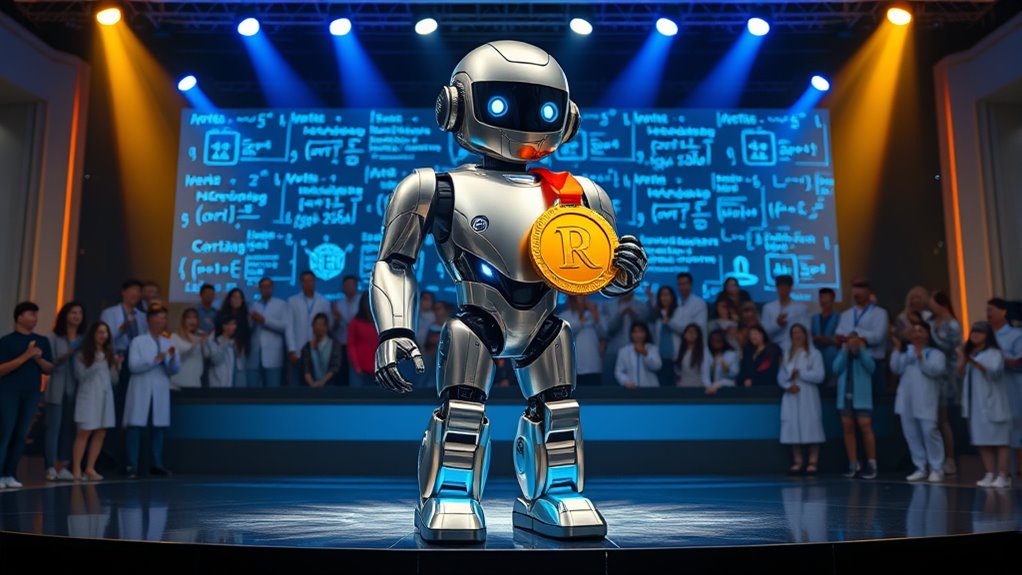

AI unexpectedly won gold at IMO 2025, a breakthrough that shocks experts and shows how far artificial intelligence has come. Systems like Google’s Gemini Deep Think and OpenAI’s models used advanced natural-language reasoning to interpret and solve the hardest problems, mirroring human thought processes. This event marks a big leap in AI’s problem-solving skills, opening new paths for education and science. If you continue exploring, you’ll discover how this could shape our future collaborations with AI.

Get business pricing on tech for your team
- Business-only prices and quantity discounts
- Tax-exempt purchasing
- Multiple users, one account, clear invoices
Key Takeaways
- AI systems, including OpenAI’s and Google’s Gemini Deep Think, achieved gold medals at IMO 2025, a first in global high-school math competitions.
- The AI demonstrated advanced reasoning, solving the hardest problems with clarity and logical consistency comparable to top human medalists.
- This breakthrough marks a major leap from symbolic calculation to natural-language understanding and high-level mathematical reasoning.
- The achievement signals rapid AI development, opening new avenues for scientific research, education, and complex problem-solving.
- It raises ethical questions about AI participation in competitions and highlights the transformative potential of AI as a reasoning partner.
As an affiliate, we earn on qualifying purchases.
The Breakthrough: AI Achieves Gold at IMO 2025
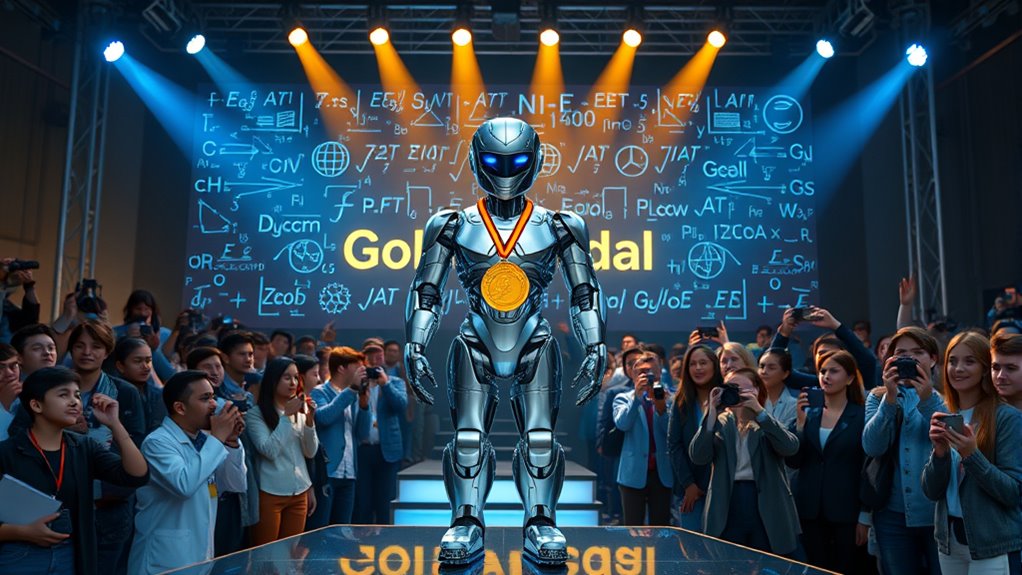
The breakthrough at IMO 2025 marks a historic milestone as AI systems, for the first time, achieved gold medals in a global high-school mathematics competition. You might think this challenge was reserved for human prodigies, but Gemini Deep Think changed that perception. Scoring 35 out of 42 points, it solved five of the hardest problems, demonstrating reasoning that rivals human logic. OpenAI’s experimental AI matched this score, underscoring rapid advancements in AI problem-solving. This achievement signals a turning point where AI moves beyond simple calculations, tackling complex verbal problems with clarity and precision. It’s a breakthrough that shows AI can now engage with high-level mathematical thinking, blurring the lines between human and machine intellect in a competitive setting. This progress highlights the increasing sophistication of AI algorithms, indicating that future AI systems may further challenge traditional notions of intelligence.
natural language reasoning AI tools
As an affiliate, we earn on qualifying purchases.
As an affiliate, we earn on qualifying purchases.
How AI Solved Complex Mathematical Problems Using Natural Language

How did AI manage to solve such complex mathematical problems using natural language? It leveraged advanced reasoning models that interpret verbal problem statements like humans do. Unlike earlier AI relying solely on formulas or symbolic methods, these models understand nuanced language and infer mathematical concepts directly from text. They process problem descriptions step-by-step, mimicking human thought processes. Additionally, these models benefit from self-awareness of their reasoning capabilities, allowing for more accurate and reliable solutions. Key aspects include:
AI interprets verbal problems step-by-step, mimicking human reasoning to understand and solve complex mathematical challenges.
- Semantic comprehension of problem statements and instructions
- Logical deduction based on context and mathematical principles
- Stepwise reasoning that aligns with human problem-solving flow
- Clear explanation generation to ensure interpretability and transparency
This approach allows AI to grasp intricate verbal problems and develop solutions that are precise, understandable, and adaptable across diverse mathematical challenges.
As an affiliate, we earn on qualifying purchases.
The Performance of Google’s Gemini Deep Think and OpenAI’s Model
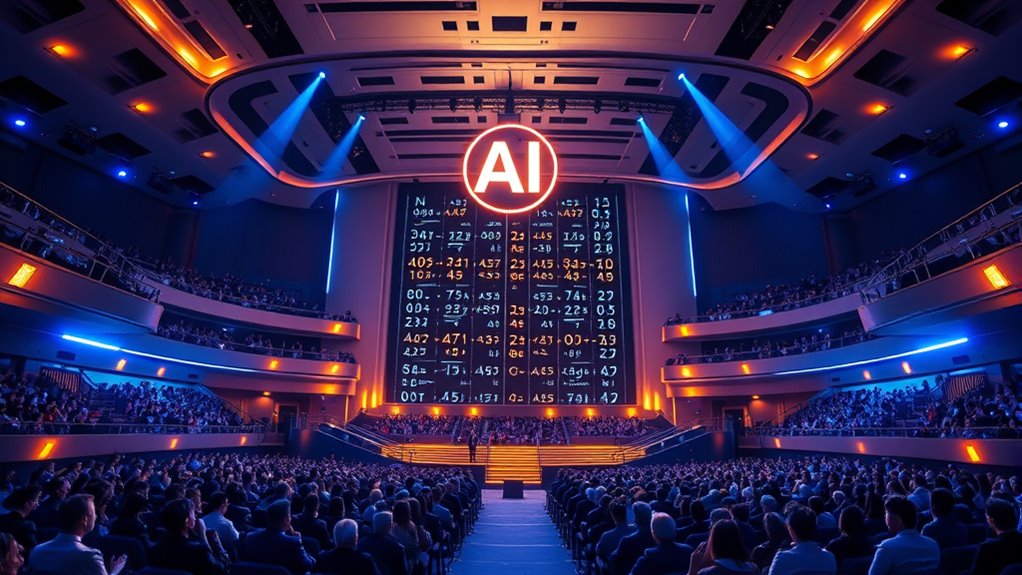
Google’s Gemini Deep Think and OpenAI’s experimental AI model demonstrated remarkable performance at IMO 2025 by solving complex verbal mathematics problems using advanced natural-language reasoning. Gemini achieved a score of 35 out of 42 points, successfully solving five of the hardest problems, with official recognition pending. OpenAI’s model matched this score, showcasing comparable reasoning and problem-solving skills. Both models excelled at interpreting nuanced problem statements and providing clear, logically sound solutions that graders found easy to follow. Unlike previous AI approaches, they relied on natural-language understanding rather than symbolic methods, marking a significant breakthrough. Their success highlights AI’s growing capacity for complex reasoning, moving beyond rote computation to genuine mathematical comprehension, which signals a pivotal shift in AI’s problem-solving capabilities at the highest levels. natural-language reasoning represents a fundamental advancement in how AI interprets and tackles complex problems, opening new avenues for applications in education, research, and beyond.
As an affiliate, we earn on qualifying purchases.
Comparing AI and Human Achievements at the Math Olympiad

You might notice that AI and humans approach problems differently, especially in their problem-solving strategies. While AI uses natural-language reasoning to interpret complex questions, humans often rely on intuition and experience. Examining these differences helps us understand where AI still has gaps and how it’s closing in on human expertise. Additionally, mindful decluttering of information can enhance AI’s ability to process and prioritize relevant data effectively.
Performance Gap Analysis
Although AI achieved remarkable progress at the IMO 2025, a clear performance gap remains between artificial and human problem-solving capabilities. You should note that:
- Human gold medalists, including some with perfect scores, still outperform AI in accuracy and consistency.
- AI models excel in speed, often solving complex problems faster than humans.
- The interpretability of AI solutions, while impressive, doesn’t guarantee flawless reasoning across all problem types.
- Top humans demonstrate creativity and insight that AI has yet to fully replicate.
This gap highlights that, despite significant advances, AI’s understanding and nuanced reasoning are still catching up to human intuition and experience. It’s a vital step forward, but not yet a complete replacement in mathematical mastery.
Problem-Solving Approaches
The differences in problem-solving approaches between AI and humans at the IMO highlight how each entity processes complex mathematical challenges. Humans rely on intuition, experience, and creative insight to develop strategies, often making leaps based on understanding patterns or prior knowledge. In contrast, AI uses natural-language reasoning, analyzing problem statements line by line, and applying logical deduction without intuition. The AI’s solutions are clear, structured, and follow a step-by-step process, mimicking human reasoning but driven by algorithms. While humans excel at innovative thinking, AI benefits from rapid computation and pattern recognition, tackling problems quickly and systematically. This approach signifies a shift toward AI understanding mathematical language and concepts, enabling it to solve complex problems that once required deep human insight. Additionally, advancements in growing computational power have significantly enhanced AI’s ability to process and analyze complex data efficiently, further bridging the gap between machine and human problem-solving capabilities.
The Significance of AI Winning a Prestigious International Competition
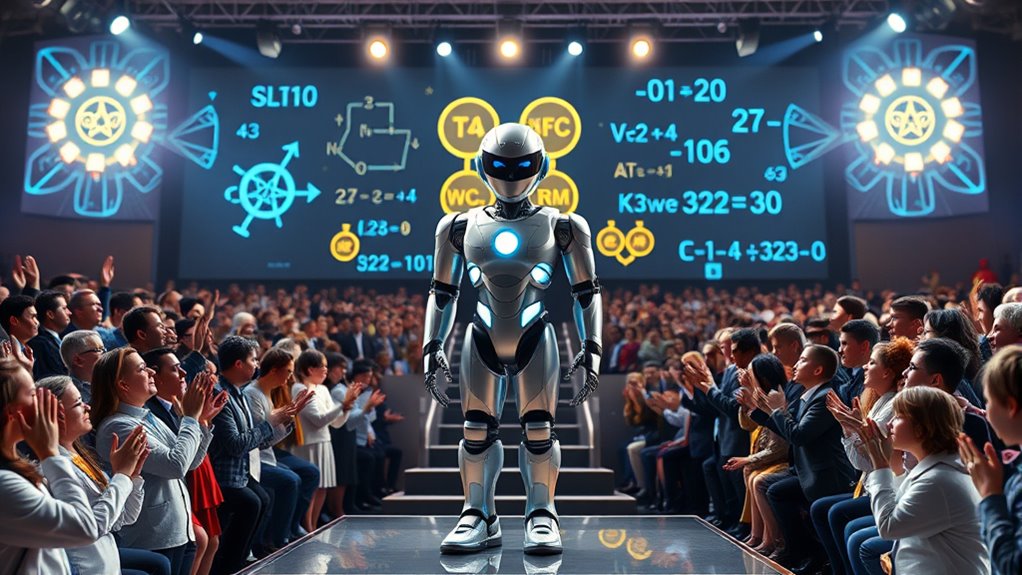
Your perspective shifts as AI’s victory challenges traditional ideas of human-AI competition, pushing boundaries in problem-solving. This achievement signals a leap forward in understanding complex mathematics and reasoning, beyond simple calculations. It also opens new avenues for research, transforming AI from tool to collaborator in scientific discovery.
Redefining Human-AI Competition
The recent victory of AI at the IMO 2025 signals a major shift in the landscape of human-AI competition, prompting us to reconsider traditional notions of intelligence and achievement. You now see AI not just as a tool but as a competitor capable of solving complex problems once thought exclusive to humans. This challenges your understanding of what it means to excel academically and intellectually.
- AI’s natural-language reasoning blurs lines between human insight and machine logic
- The milestone pushes boundaries of AI from calculators to reasoning partners
- Human top performers still outperform AI but the gap is narrowing
- Future collaborations may blend human creativity with AI’s rapid problem-solving
- The development of high-performance projectors that support detailed visualizations could enhance collaborative problem-solving sessions between humans and AI in educational settings
This shift reshapes expectations, making human-AI competition more dynamic and interconnected.
Advancing Mathematical Understanding
Winning a prestigious international competition like the IMO signifies a major leap forward in AI’s mathematical understanding. It shows that AI can now interpret complex verbal problems, reason logically, and produce solutions that humans find clear and understandable. This progress moves AI beyond simple calculations toward genuine mathematical thinking, reflecting a deeper grasp of concepts and relationships. The ability to solve challenging problems using natural-language reasoning indicates AI’s capacity to comprehend nuanced instructions and apply advanced insights. Such advancements suggest that AI is no longer just a tool for rote computation but an evolving agent capable of tackling sophisticated mathematical ideas. This breakthrough opens new pathways for AI to contribute meaningfully to scientific research, education, and problem-solving across diverse fields. Additionally, this achievement highlights the importance of educational tools that can support and enhance human learning in complex subjects.
Impact on Future Research
AI’s victory at the IMO signals a transformative moment for future research, demonstrating that machines can now engage in complex reasoning traditionally reserved for humans. This breakthrough opens new avenues for scientific discovery, technological innovation, and educational methods. You should pay attention to how this achievement:
- Accelerates AI development in fields like physics, engineering, and medicine
- Promotes cross-disciplinary research through natural language reasoning
- Inspires new AI models capable of tackling advanced, real-world problems
- Challenges existing notions of human-AI collaboration and competition
This milestone indicates AI’s potential to move beyond rote calculations toward genuine problem-solving, opening doors for more autonomous, intelligent systems. It’s a sign that future research will increasingly rely on AI’s evolving capabilities to push boundaries across multiple domains.
Technological Advances Behind AI’s Mathematical Reasoning
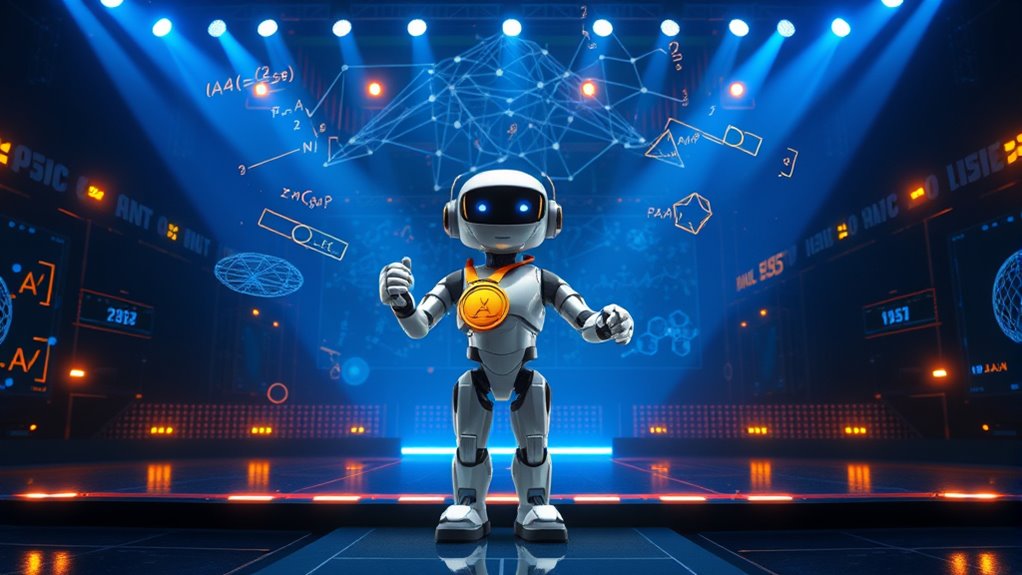
Recent technological advances have enabled AI systems to approach mathematical reasoning in ways that mirror human thought processes. Instead of relying solely on symbolic algorithms, models like Google’s Gemini Deep Think and OpenAI’s experimental AI utilize natural-language reasoning, making their problem-solving more transparent and intuitive. These systems analyze complex verbal problems, break them down logically, and generate clear, step-by-step solutions, similar to how humans think through challenging questions. This approach involves training on vast datasets of mathematical language and reasoning patterns, allowing the AI to understand context and infer solutions effectively. As a result, their ability to handle advanced problems now reflects a deeper, more general understanding of mathematics, moving beyond rote computation toward genuine reasoning. Incorporating comprehension of mathematical concepts is crucial for enhancing AI’s reasoning capabilities and advancing its problem-solving skills. This technological shift marks a significant milestone in AI’s cognitive capabilities.
Impacts on Future Education and Scientific Research

The breakthrough in AI’s mathematical reasoning is poised to transform education and scientific research by providing advanced, personalized support for learners and researchers alike. You’ll see tailored tutoring that adapts to individual strengths and gaps, making learning more efficient. Researchers can leverage AI to tackle complex problems faster, accelerating discoveries. AI-powered tools will enable real-time feedback, improving understanding and innovation. Additionally, you’ll witness:
AI’s mathematical reasoning will personalize learning, accelerate research, and foster innovative solutions across sciences.
- Customized curricula that evolve with your progress
- AI-assisted research that enhances hypothesis generation
- Automated analysis of large datasets for scientific insights
- New interdisciplinary approaches driven by AI’s reasoning capabilities
This shift will make education more accessible and research more dynamic, fostering a new era of collaborative human-AI problem-solving. It’s a future where AI amplifies human potential across all scientific fields. Yoga techniques and practices can also be integrated into educational environments to promote mental clarity and focus, further enhancing learning and research productivity.
Ethical Considerations and the Role of AI in Competitive Settings
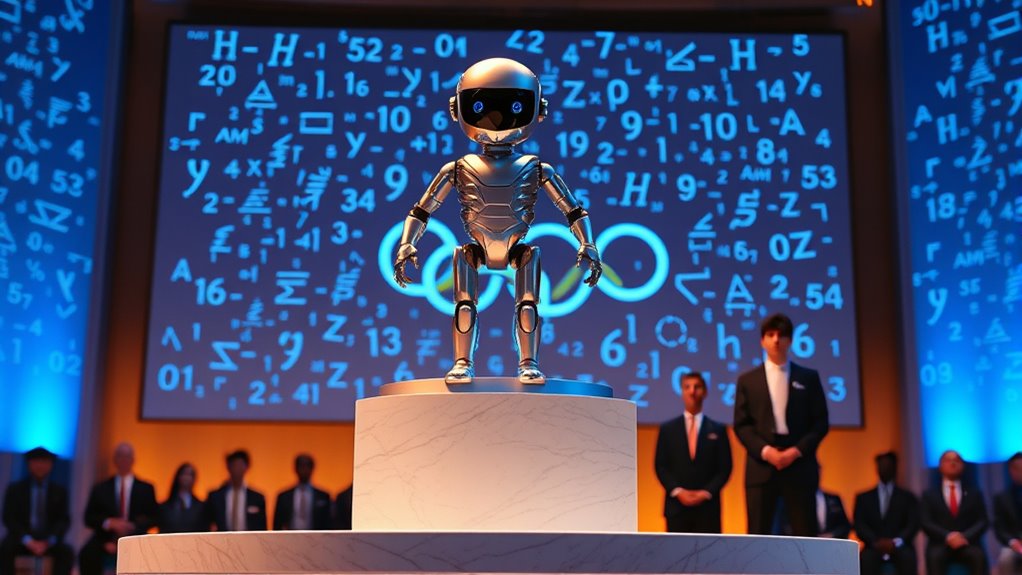
As AI continues to demonstrate remarkable capabilities in competitive environments like the IMO, ethical questions about its role and impact become increasingly important. You need to consider whether AI’s participation undermines the fairness of competitions designed for human achievement or if it pushes the boundaries of innovation. It’s vital to establish clear guidelines on AI use, ensuring it complements human effort rather than replaces it. Transparency around AI’s involvement is essential to maintain integrity and trust. You should also reflect on the potential for AI to widen disparities—favoring those with access to advanced technology. Balancing AI’s benefits with ethical responsibilities involves fostering collaboration, setting boundaries, and emphasizing the value of human creativity and problem-solving in competitive settings. Additionally, ongoing AI safety measures are crucial to prevent vulnerabilities and ensure responsible deployment in such high-stakes scenarios.
The Road Ahead: AI’s Rapid Progress and Potential Milestones

As AI continues to improve its problem-solving abilities, you’re likely to see it approaching human-level reasoning in more complex tasks. Breakthroughs in natural-language understanding are paving the way for smarter, more adaptable AI systems. Looking ahead, rapid progress suggests that major milestones in AI’s capabilities are just around the corner.
Accelerating Problem-Solving Capabilities
Advancements in AI problem-solving capabilities are accelerating at an unprecedented pace, driven by breakthroughs like natural-language reasoning and deeper mathematical understanding. You’ll notice AI now approaches complex problems with strategies similar to humans, rather than relying solely on rote calculations. This shift enables AI to:
- Interpret verbal and written problems more accurately
- Develop logical reasoning processes that mirror human thought
- Handle higher-level mathematical insights beyond formulas
- Improve solution transparency and clarity for easier validation
These innovations mean AI can tackle more sophisticated challenges faster and more effectively. As progress continues, AI is not just automating tasks but actively engaging in creative problem-solving, pushing the boundaries of what machines can achieve. This rapid evolution hints at a future where AI’s problem-solving prowess becomes even more essential across fields.
Nearing Human-Level Reasoning
Recent strides in AI problem-solving have brought machines closer to matching human reasoning, especially in complex mathematical and verbal tasks. You now see AI models like Gemini demonstrating reasoning that’s clear, logical, and human-like. These models interpret problems in natural language, applying insights rather than relying solely on rote calculations. This progress signals a shift from simple automation to genuine understanding, pushing AI toward human-level reasoning. To visualize this evolution:
| Aspect | AI Capabilities |
|---|---|
| Problem Interpretation | Natural language comprehension |
| Logical Deduction | Advanced reasoning skills |
| Solution Clarity | Transparent, easy-to-follow logic |
| Mathematical Insight | Beyond rote computation |
| Human Comparison | Approaching human reasoning speed |
This trajectory hints at a future where AI can reason, debate, and innovate on par with humans.
Anticipated Future Breakthroughs
Given the rapid pace of AI development, breakthroughs in reasoning, problem-solving, and understanding are likely to accelerate dramatically in the coming years. You can expect AI to achieve milestones such as:
- Mastering complex scientific research, leading to new discoveries faster than ever.
- Developing natural language reasoning that rivals human comprehension in diverse fields.
- Creating autonomous agents capable of genuine creative problem-solving and innovation.
- Facilitating personalized education systems that adapt instantly to individual learning needs.
These advancements will push AI beyond simple automation, positioning it as a collaborative partner in solving real-world challenges. As progress accelerates, you’ll see AI move closer to human-like insight, reshaping industries, research, and everyday problem-solving with unprecedented speed and accuracy.
What This Means for the Future of Human-AI Collaboration

The achievement of AI winning gold at the IMO signals a turning point in human-AI collaboration, suggesting that AI can now serve as a powerful partner in solving complex problems alongside humans. You’ll see AI become a more integral part of research, education, and innovation, not just as a tool but as a collaborator that contributes reasoning and insight. This breakthrough shows that AI can handle nuanced verbal reasoning and advanced mathematical thinking, complementing human creativity and intuition. As AI continues to improve, you’ll likely work alongside these intelligent systems to tackle challenges more efficiently and effectively. Human-AI teams will evolve, combining human ingenuity with AI’s rapid problem-solving, fostering new ways of learning, discovering, and pushing the boundaries of what’s possible.
Frequently Asked Questions
How Does Ai’s Natural Language Reasoning Differ From Previous Symbolic Methods?
You notice that AI’s natural language reasoning differs from previous symbolic methods because it mimics human thinking, using everyday language to understand and solve problems. Instead of relying solely on formal rules and symbolic logic, it interprets complex verbal questions, reasoning clearly and intuitively. This approach makes AI more flexible, understandable, and capable of tackling real-world problems, moving beyond simple computation to genuine comprehension and reasoning.
Will AI Eventually Outperform Humans in All Mathematical Competitions?
Yes, AI will eventually outperform humans in all mathematical competitions. As AI models improve their reasoning and problem-solving abilities, they’ll close the gap and surpass human expertise. You’ll see AI tackling even the most complex problems faster and more accurately, especially with advances in natural language understanding. While humans may still excel in creativity and intuition, AI’s rapid progress suggests it will dominate many future competitions across all levels.
What Safeguards Are in Place to Prevent AI Misuse in Education and Research?
You might think safeguards are just small hurdles, but they’re actually fortress walls shielding education and research from AI misuse. You’re protected through strict regulations, advanced detection systems, and ethical guidelines that monitor AI activities. Institutions implement authentication, usage limits, and continuous oversight to prevent dishonest practices. These measures ensure AI enhances learning and discovery, not undermines integrity, protecting the future of knowledge against any misuse or malicious exploitation.
How Might AI’s Success at IMO Influence Future AI Development Strategies?
Your AI development strategies will likely shift toward enhancing reasoning, interpretability, and general understanding. You’ll focus on creating models that tackle complex problems with human-like intuition, emphasizing natural language reasoning and transparency. This success encourages investments in versatile AI systems capable of solving advanced scientific and mathematical challenges, fostering innovation across industries. You’ll also prioritize ethical safeguards and collaboration, ensuring AI advances responsibly while pushing the boundaries of problem-solving capabilities.
Could Ai’s Reasoning Capabilities Be Applied to Other Scientific or Technological Fields?
You might be surprised to learn AI’s reasoning skills can revolutionize various scientific and technological fields. By applying natural-language reasoning, AI can tackle complex problems in areas like medicine, physics, and engineering, offering innovative solutions. Its ability to understand and interpret intricate data means faster research, better predictions, and smarter innovations. As AI continues to improve, expect it to become an essential partner in pushing the boundaries of human knowledge and technological progress.
Conclusion
This unexpected milestone shows AI’s gentle nudge into the world of high-level math, opening new doors for collaboration and discovery. While it’s a remarkable step forward, it also invites us to embrace the journey with curiosity and care. As AI continues to evolve, you can look forward to a future where humans and machines work side by side, each bringing their unique strengths to solve the world’s most intriguing mysteries.
Halloween Picks
halloween
As an affiliate, we earn on qualifying purchases.