By Thorsten Meyer | November 19, 2026 | ThorstenMeyerAI.com

Get business pricing on tech for your team
- Business-only prices and quantity discounts
- Tax-exempt purchasing
- Multiple users, one account, clear invoices
Reality check · Economy and work. This article explains what officials and official data say. It is not a forecast of the Fed’s decision and not investment advice.
Central bankers usually choose their words so that nobody is surprised. On Wednesday morning, November 18, 2026, Federal Reserve Governor Christopher Waller did the opposite. In a live interview on CNBC’s “Squawk Box” about inflation, he said: “You might need to, like, shock people.”
His proposed shock: raise the Fed’s key interest rate by half a percentage point at the next meeting, on December 8-9, unless the Fed clearly signals that another increase will follow in January. A rate hike of that size would make borrowing more expensive for households, for companies that hire, and for the firms that are borrowing heavily to build AI data centres. Here is what Waller said, why he says it, what his colleagues say, and what it could mean for work.
Key takeaways
- The proposal. Waller told CNBC that if the Fed does not signal “very clearly” that it is “going in January”, then “you have to go 50 [basis points] in December”. 50 basis points is half a percentage point.
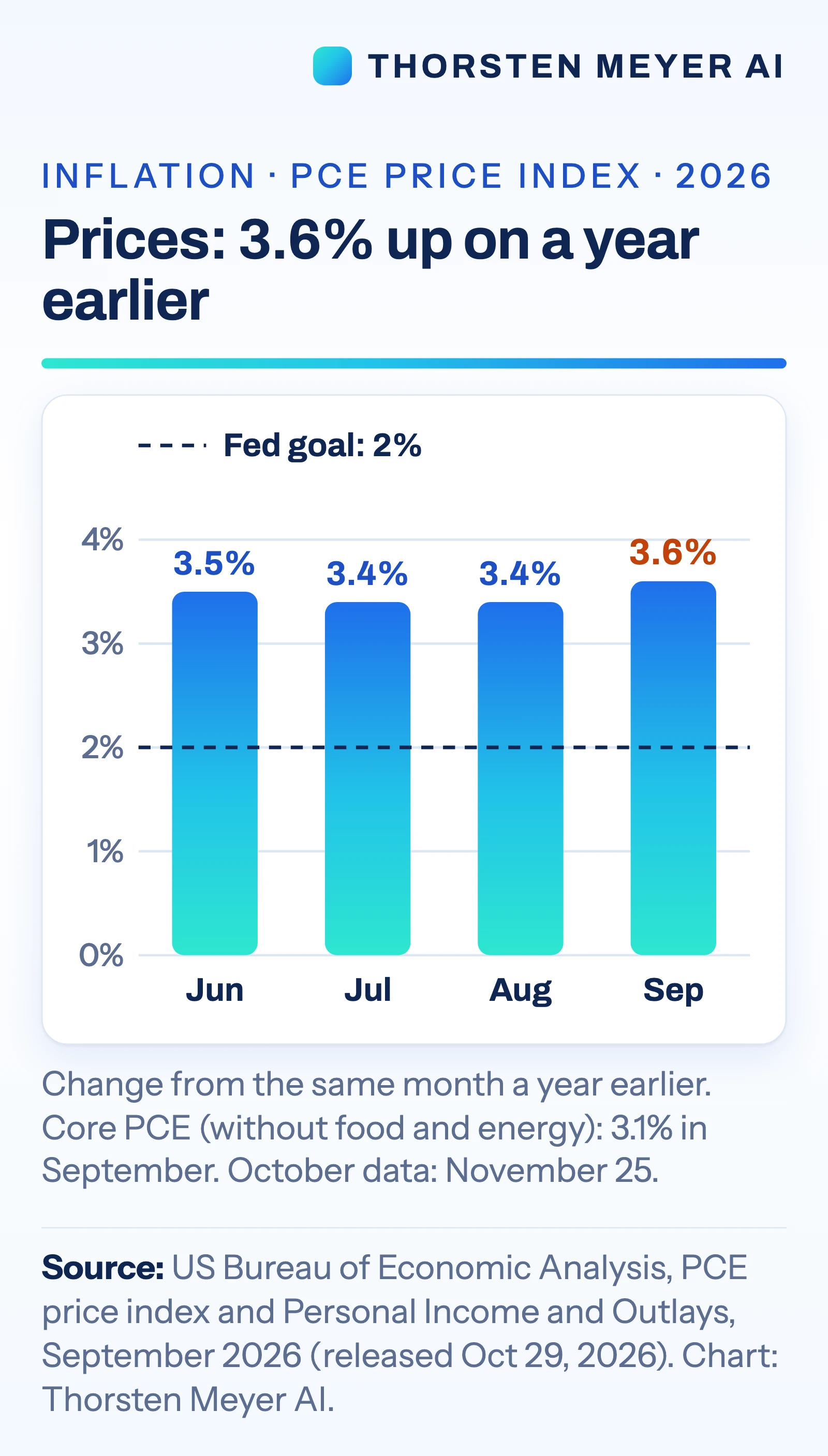
- His reason is inflation. “I’m very, very concerned about inflation. It’s kind of headed in the wrong direction, and it’s spreading out,” he told CNBC on November 18. In September, prices measured by the PCE index, the gauge the Fed targets, were 3.6% higher than a year earlier, against a goal of 2%.
- He set the trigger himself. In a speech on November 10, published on the Fed’s website, he said a 50 basis point hike “should be considered” if core consumer prices rose around 0.3% in October. Hours later, core CPI rose 0.3%, according to CNBC’s report of Bureau of Labor Statistics data.
- He is not alone, but he is at the edge. In the minutes of the October meeting, “a couple of participants” said more than 25 basis points “could warrant consideration” if inflation data were unfavorable. New York Fed President John Williams said: “I don’t think the situation calls for dramatic action.”
- Jobs look stable but not dynamic. Unemployment was 4.1% in October. Waller and the minutes describe a “low hire, low fire” labor market, in which people who lose a job take longer to find the next one.
- AI financing is in the line of fire. Fed Vice Chair for Supervision Michelle Bowman says AI-related debt “is on track to exceed $800 billion this year” and that higher rates already “appear to be holding back investment” at newer and medium-sized AI firms.
- Nothing is decided. The Fed decides at its meeting on December 8-9. Before that come the October PCE inflation data on November 25 and the November jobs report.
Fed rate hike · how it travels
From the Fed’s rate to your job, in five steps
What Waller wants to speed up, and where AI and hiring sit in the chain.
- 1+50 basis pointsWaller’s proposal for December 8-9: half a percentage point
- 2Borrowing costs riseBanks, bonds and private credit charge more, and lenders get choosier
- 3Firms invest and hire lessOfficials say higher rates already hold back newer and medium-sized AI firms
- 4Spending coolsFewer projects, slower hiring, a little less demand
- 5Price rises slowToward the 2% goal, from 3.6% in September
The trade-off: the same step that cools prices also lands on hiring, which is already slow, and on the debt that pays for AI data centres.
Sources: Federal Reserve, Governor Waller (speech, Nov 10, 2026) and Vice Chair for Supervision Bowman (speech, Nov 10, 2026); FOMC minutes, Oct 27-28, 2026; Bureau of Economic Analysis, PCE price index, September 2026; Waller interview, CNBC, Nov 18, 2026.
Graphic: Powered by Thorsten Meyer AI
Products Worth Considering

Bose QuietComfort Wireless Bluetooth Noise-Cancelling Headphones, Cypress Green

DJI Mini 4K Camera Drone Combo with 2 Batteries

Bose Home Speaker 500 Smart Speaker with Alexa, Black
As an affiliate, we earn on qualifying purchases.
What Waller told CNBC, and what he did not say
Waller spoke in a live interview with CNBC’s Steve Liesman on November 18. The quotes in this section are as reported by CNBC; the Fed’s list of speeches, checked on November 19, has no text for this interview. His written reasoning is in a speech of November 10, published on federalreserve.gov, which the next sections rely on. According to CNBC, he said a half-point increase is probably necessary at the December 8-9 meeting of the Federal Open Market Committee (FOMC), the group of Fed officials that sets the rate.
He offered one way out. The Fed could raise the rate by a quarter point in December and signal another move in January. “If you’re not going to signal this very clearly to markets, you’re going in January, my view is then you have to go 50 [basis points] in December to put it in place and get it done,” he said. CNBC notes that Fed Chairman Kevin Warsh has been against that kind of forward guidance because it ties policymakers’ hands.
Waller also looked further ahead. “First of all, you’ve got to take back the three insurance cuts we put in last year,” he said, referring to the three quarter-point cuts the Fed made in 2025. “So we may have to go above … three hikes plus maybe some more to get it to start actually coming back down.”
What he did not claim: that the committee will follow him. Waller is one of twelve voters, and his speeches carry the Fed’s standard line: “The views expressed here are my own and are not necessarily those of my colleagues on the Federal Reserve Board or the Federal Open Market Committee.”
Basis points, hikes and cuts, in plain words
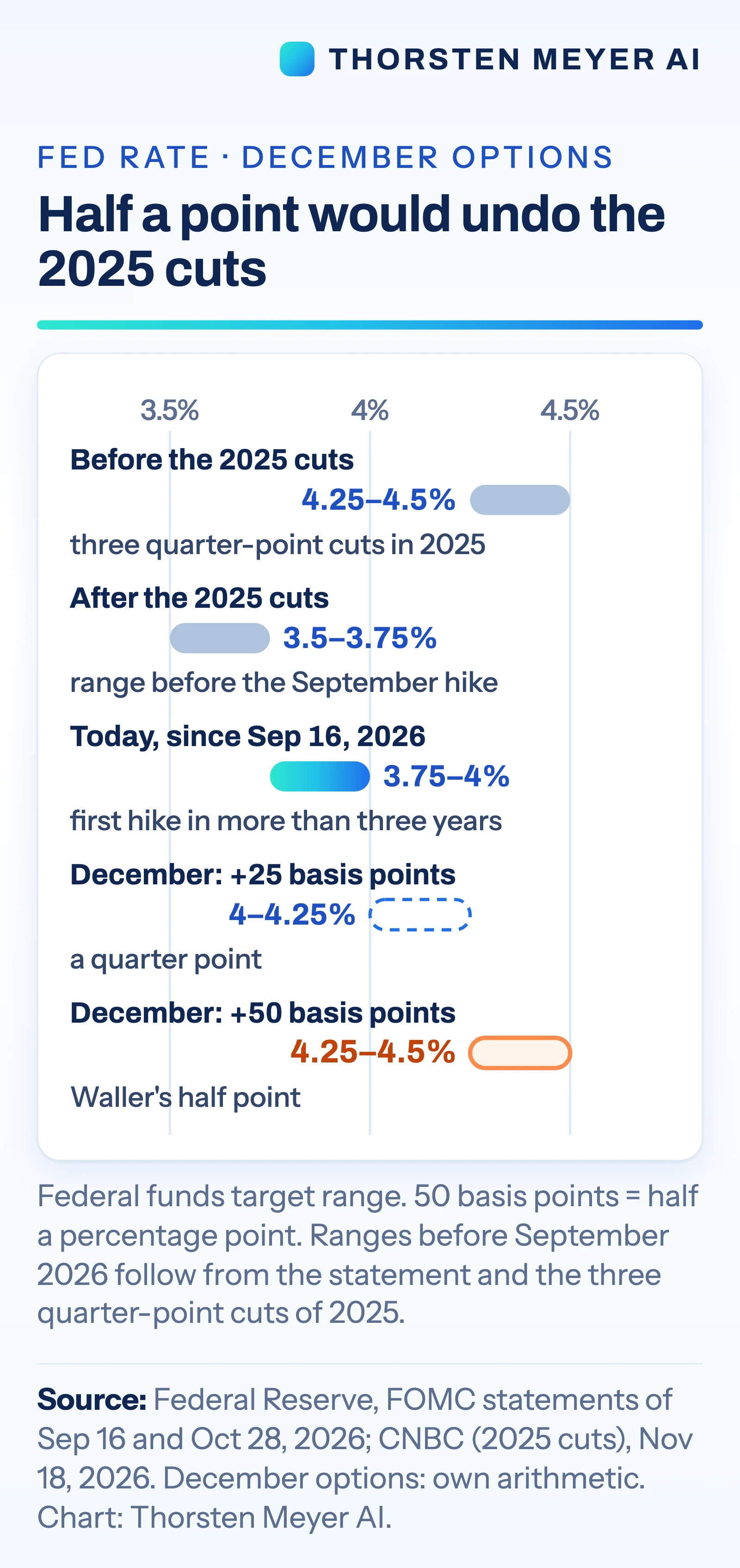
- The rate in question is the federal funds rate, the rate banks charge each other overnight. The Fed sets a target range for it. Since September 16, 2026, that range is 3-3/4 to 4 percent, or 3.75% to 4%.
- A basis point is one hundredth of a percentage point. 25 basis points are a quarter point; 50 basis points are half a point.
- A hike raises the range and makes borrowing more expensive across the economy, over time. A cut lowers it. The Fed cut three times in 2025, then raised the range by a quarter point in September 2026, its first hike in more than three years, according to CNBC. In October it held.
- What December could look like: a quarter-point hike would move the range to 4% to 4.25%. Waller’s half point would move it to 4.25% to 4.5%. That is where the range stood before the three cuts of 2025.
- A simple example: on a $100,000 loan whose rate moves by the full half point, the interest bill rises by about $500 a year. Many loans do not move one for one, and fixed-rate loans do not move at all until they are renewed.
Why he argues for it: his November 10 speech and the inflation data
Waller laid out his reasons in a speech in London on November 10, published on the Fed’s website. “Let’s just say it. September’s inflation data were bad. There was no silver lining,” he said.
- Prices are rising faster than the goal. The Bureau of Economic Analysis (BEA) reports that the PCE price index rose 0.5% in September and 3.6% from a year earlier. It had been 3.5% in June and 3.4% in July and August. Without food and energy, the “core” index rose 0.3% in the month and 3.1% over the year. The Fed’s goal is 2%.
- The increases are spreading. Waller said: “More than 70 percent of the components of core PCE service prices saw 12-month increases above 3 percent in September.”
- AI hardware and energy feed into it. Waller said he would watch “whether high-tech goods prices related to the AI buildout continue to rise at the very high rate of recent months.” Bowman said tariffs, energy and AI-related price pressures “each accounted for roughly one-fourth of above-target core PCE inflation over the 12 months ending in September.”
- October did not bring relief. On November 10, consumer prices rose 0.4% in October and core prices 0.3%, according to CNBC’s report of the data from the Bureau of Labor Statistics. Economists had expected 0.3% and 0.2%. The bureau did not publish a yearly rate for October, because last year’s government shutdown left it without comparable data for October 2025, CNBC reported.
- Five years above target. Fed staff named the risk that longer-run inflation expectations “could have become unanchored after five years’ worth of elevated inflation”. That is the point of Waller’s “shock”: to convince people that 2% still means 2%.
Waller had tied his December vote to exactly this data. In London he said he would support a 25 basis point increase anyway. But “if the October CPI inflation data out later today are similar to the past two monthly readings—with core CPI inflation around 0.3 percent or even higher—then a stronger policy move may be needed. In that case, I believe a 50 basis point hike in the policy rate should be considered at the December meeting. Hiking only 25 basis points would put our credibility at risk, a risk I am not eager to take.”
What other officials say
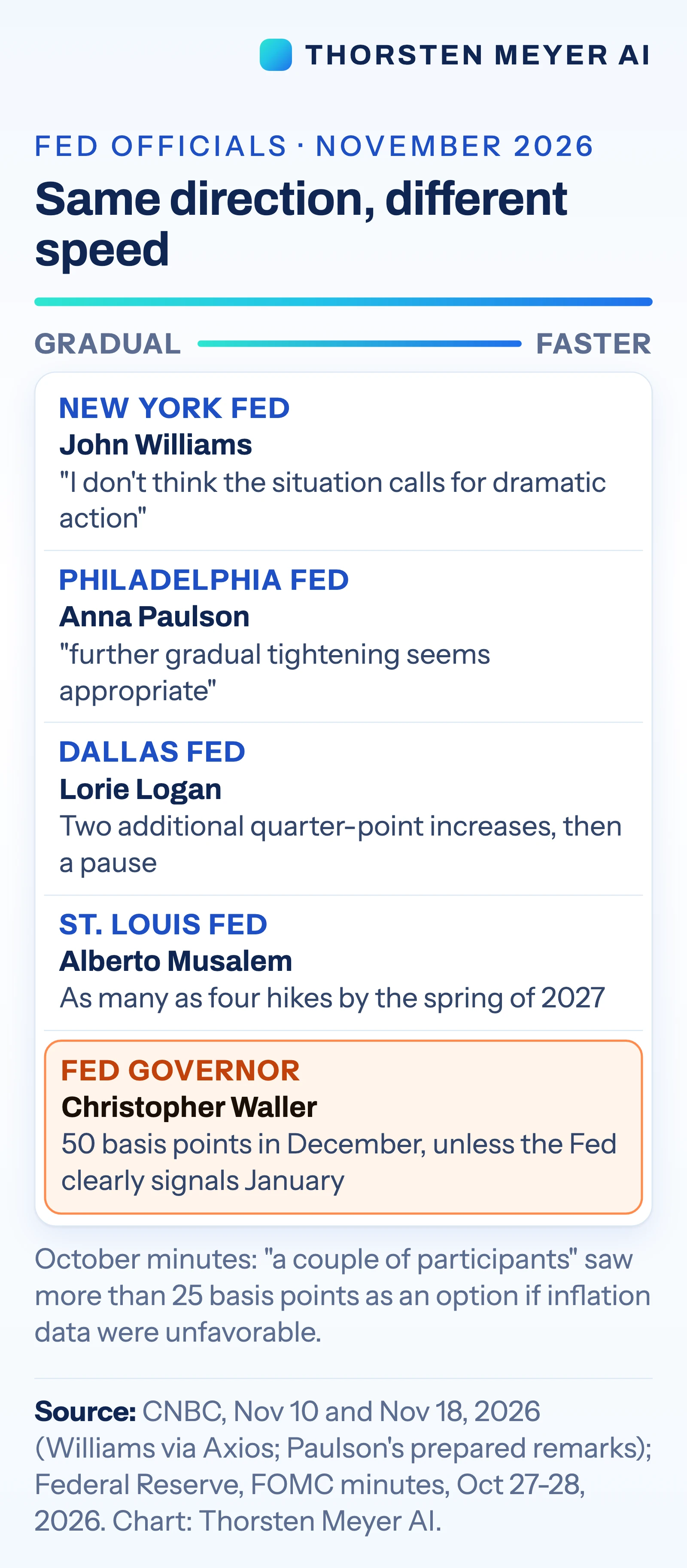
The Fed is not split on the direction. It is split on the speed.
- The October minutes, released on November 18: “almost all participants judged” that further rate increases “would likely be appropriate”. Only “a couple of participants noted that an increase of more than 25 basis points could warrant consideration at the next meeting if incoming inflation data were unfavorable.” Others argued that “a gradual approach to policy firming would give businesses and households time to adjust to higher interest rates.”
- The October vote was 10 to 2 to hold. Governor Lisa Cook and Cleveland Fed President Beth Hammack voted against; both “preferred to raise the target range” by a quarter point.
- Dallas Fed President Lorie Logan sees a need for two additional quarter-point increases, CNBC reported. She said: “It may be possible to move more rapidly this winter than the [Federal Open Market Committee] has moved so far this fall.” After two more increases, “it would make sense in my view to pause and examine economic and financial developments”.
- St. Louis Fed President Alberto Musalem suggested as many as four hikes by the spring of 2027, according to CNBC.
- Philadelphia Fed President Anna Paulson: “For now, further gradual tightening seems appropriate,” according to her prepared remarks as quoted by CNBC.
- New York Fed President John Williams, in a conversation with Axios quoted by CNBC: “I don’t think the situation calls for dramatic action.”
- Vice Chair for Supervision Michelle Bowman said “there is still work to do to bring inflation closer to 2 percent”, but that “the benefit of additional policy tightening has to be carefully weighed against its costs for interest-rate-sensitive sectors.”
What a hike of that size would mean for jobs, hiring and wages
A rate hike works by making borrowing more expensive, so households and companies spend and invest a little less, and price increases slow. The cost shows up in jobs, usually with a delay. Here is what the Fed’s own texts say about the labor market it would hit.
- Stable, but not lively. Unemployment was 4.1% in October, and employers added 165,000 jobs that month, Waller said in his November 10 speech. Over six and twelve months, job gains averaged “closer to 80,000 jobs a month”. The minutes call the labor market “stable and close to maximum employment”.
- Low hire, low fire. “What is unusual today, and may be unprecedented, is the extent to which both firing and hiring are now so low,” Waller said. He asked: “Does a stable labor market necessarily mean it’s a healthy labor market?”
- Who feels it first. The share of unemployed people looking for work for more than six months climbed from around 18 percent at the end of 2022 to more than 27 percent through September 2026, according to Waller’s speech. New entrants, typically young, are “having a harder time finding jobs.” When hiring is already slow, a rate shock that slows it further lands on these groups first.
- AI is part of the hiring story. Waller cited the Fed’s Beige Book: “several Fed Districts reported firms had delayed hiring or anticipate less job creation after investing in AI.” Bowman said “about 25 percent of businesses and roughly 10 percent of workers” report using AI every day, and “there is a risk that some workers will be displaced as firms adopt this technology, even as others see their productivity—and wages—rise.”
- Wages. “Most judged that aggregate nominal wage growth remained moderate,” the minutes say, so officials do not see wages as the main source of inflation. One exception: “shortages of skilled workers needed for data center construction and related industries had contributed to sizable wage premiums in those industries.”
What the sources do not give is a number for how many jobs a 50 basis point hike would cost. No official quoted here has published one. Our earlier explainer on what the Fed has to do with your job covers the mechanism in more depth.
What it would mean for the money behind AI data centres
This is where the debate touches AI most directly. The AI buildout runs on borrowed money, and borrowed money gets more expensive when the Fed raises rates.
- The size of the debt. Bowman: “AI-related debt has been rising rapidly, with notable gains in corporate bonds, private credit, and project finance, and is on track to exceed $800 billion this year.” Potential payments on other obligations, such as long-term leases, “are estimated at more than three times the amount of debt.”
- Rates already bite. Bowman said that “in certain segments of AI-intensive sectors, particularly among newer and medium-sized firms, higher interest rates appear to be holding back investment and purchasing decisions.” And “as investors see an increased risk in these investments, the cost of financing has been rising notably.”
- Financing conditions have tightened. A majority of officials noted “wider credit spreads for some higher-risk and AI-related borrowers”, the minutes say, and many judged “that greater market discipline over highly leveraged projects could temper investment demand.”
- The risk officials discuss. Fed staff warned that “off-balance-sheet leasing commitments and circular financing arrangements among AI-related firms could amplify losses if returns on AI investment were to disappoint.” Bowman described the scenario: if AI revenues “fall short of sharply rising costs”, there could be “higher financing costs, and reduced access to credit”, which “would likely slow the AI buildout and soften both economic activity and inflation.”
- But AI is also a reason to hike. The same buildout pushes prices up. Bowman: prices of “memory chips, semiconductors, computers, and other electronic products have increased sharply this year”, “as demand from data centers has outpaced supply.”
On November 16, Chairman Warsh presented three staff scenarios for what he calls “super intelligence”, and stressed that they are “illustrative scenarios, not forecasts”. In one, gains are “shared broadly across labor and the owners of capital.” In another, “widespread automation, combined with labor market frictions, could push the jobless rate above levels consistent with full employment.” In the third, AI could “disappoint”, leading “to an economic slowdown and a more notable rise in unemployment.” The rate decision in December does not choose between these paths, but the cost of money shapes how fast the buildout behind them can go. In an earlier piece we covered how AI came out on top of the Fed’s financial stability risk survey.
The independence backdrop
The debate runs alongside a political fight over the Fed itself. Governor Lisa Cook, one of the two officials who voted for a hike in October, has declined through her lawyers to appear next month before a White House committee that is considering whether she should be fired, Al Jazeera reported on November 17. The administration wants her to address allegations of mortgage fraud in 2021, before she joined the Fed. She denies them and has not been charged with any crime. In June, the Supreme Court blocked her removal while the litigation continues, writing that “the fact of independence but also the appearance of independence is key to the Federal Reserve’s design”. Her lawyer, Abbe David Lowell, wrote that the panel “appears to be a facade designed to obscure a predetermined decision to fire Governor Cook”. There is no indication in the sources that the case is linked to Waller’s proposal. It matters as context: the Fed is debating a tighter policy while its independence is being contested.
What is not known
- The decision. The Fed decides at the FOMC meeting on December 8-9. Most officials who have spoken want a hike; none of the sources says whether it will be a quarter or a half point.
- The next data. The BEA publishes October PCE inflation on November 25. Bowman noted that the November employment report also comes before the meeting.
- Whether the Fed will signal January. Waller’s offer only works if the committee says clearly that another move is coming. CNBC reports that Warsh has opposed that kind of guidance. The next meeting after December is on January 26-27, 2027.
- How much a half point would cost in jobs. No official estimate exists in the sources.
- How much AI investment depends on the rate. Bowman sees an effect at newer and medium-sized firms; how large it is across the buildout is not measured.
- Energy. Officials tie part of the inflation to the conflict in the Middle East and the oil price. Waller said energy prices are “still quite elevated relative to the start of the year.”
What it means
For businesses: borrowing costs are more likely to rise than to fall in the coming months, and the open question is how fast. Companies that finance AI projects, data centres or equipment with debt should expect lenders to look harder, as the minutes describe. Companies that compete for skilled trades around data-centre construction already pay “sizable wage premiums”.
For workers: the labor market is stable today, but hiring is slow, and slow hiring is what makes a job search long. A sharper rate rise would aim at prices, not at jobs, but officials themselves describe the costs for “interest-rate-sensitive sectors”. If you are early in your career or between jobs, the Fed’s own data say you are the group to watch.
For everyone: a hike is meant to bring inflation down from 3.6% toward 2%. Fed staff expect inflation of “about 2 percent in 2028”, and Waller’s argument is that moving harder now is the way to get there.
The bottom line
Waller is not predicting a crisis. He is arguing that a central bank which has missed its target for five years must be believed again, and that a single bigger step does that better than a slow series of small ones. Most of his colleagues prefer the slow series. Either way, the price of money is going up, and that price reaches the job market and the AI buildout at the same time.
Further reading: Inflation, Interest Rates and Central Banks: What the Fed Has to Do With Your Job and AI Tops the Fed’s Risk Survey at 87%.
I’m Thorsten Meyer. The full sources are below, and more reality checks are at thorstenmeyerai.com.
Sources
- Federal Reserve Board: Christopher J. Waller, “The Economic Outlook and Some Thoughts on Labor Market Dynamism”, speech, London, November 10, 2026, federalreserve.gov
- Federal Reserve Board: Michelle W. Bowman, “The U.S. Economy and Considerations for Monetary Policy”, speech, Council on Foreign Relations, Washington, D.C., November 10, 2026, federalreserve.gov
- Federal Reserve Board: Kevin Warsh, “Opening Remarks”, Productivity and Jobs Task Force Conference, San Francisco, November 16, 2026, federalreserve.gov
- Federal Reserve: Minutes of the Federal Open Market Committee, October 27-28, 2026, released November 18, 2026
- Federal Reserve: FOMC statements of September 16, 2026 and October 28, 2026
- Federal Reserve: FOMC meeting calendar 2026 and revised tentative schedule for 2027 (press release of November 12, 2026)
- Bureau of Economic Analysis: Personal Income and Outlays, September 2026 (October 29, 2026) and PCE price index page (retrieved November 19, 2026)
- CNBC: “Fed’s Waller says central bank may need to ‘shock people’ with half-point rate hike”, November 18, 2026
- CNBC: “Consumer prices rose 0.4% in October, more than expected, complicating Fed’s inflation fight”, November 10, 2026 (report of Bureau of Labor Statistics data; the BLS release page refused our request and is not cited directly)
- Al Jazeera: “US Fed’s Lisa Cook refuses to attend White House hearing”, November 17, 2026
Researched and drafted with AI assistance, including Anthropic’s Claude. No official or institution named here reviewed or sponsored this article. Our own text and graphics contain no affiliate links; offer and product boxes added by the site may contain Amazon affiliate links. This article is for information only; it is not financial, investment, legal or tax advice, and it makes no prediction about financial markets. Statements as published by the Federal Reserve and the BEA, and as reported by the outlets above, as of 06:00 UTC on November 19, 2026. Images: AI-generated illustration (Runware) and graphics by Thorsten Meyer AI; our own images show no real people or logos. Boxes added by the site may show product photos or people.