By Thorsten Meyer | November 11, 2026 | ThorstenMeyerAI.com

Get business pricing on tech for your team
- Business-only prices and quantity discounts
- Tax-exempt purchasing
- Multiple users, one account, clear invoices
For two decades, a business that wanted to be found went to Google first: claim the listing, fix the opening hours, answer the reviews, buy the ad. On Tuesday, November 10, OpenAI started building the same machinery inside ChatGPT. Businesses can now claim a profile, feed in their products and watch how often the chatbot mentions them. On the same day, OpenAI picked up a small AI travel agent called Odessia, and reports put the company’s third-quarter revenue at about $10 billion.
Three separate pieces of news. Read together, they describe one direction: ChatGPT as the place where people find, compare and eventually buy, and as a place businesses pay to be present. TechCrunch put it in its headline: the new profiles make ChatGPT “just a little bit more like Google.”
Here is what is confirmed, what is only reported, what it means for businesses and for users, and what nobody has said yet.
In brief
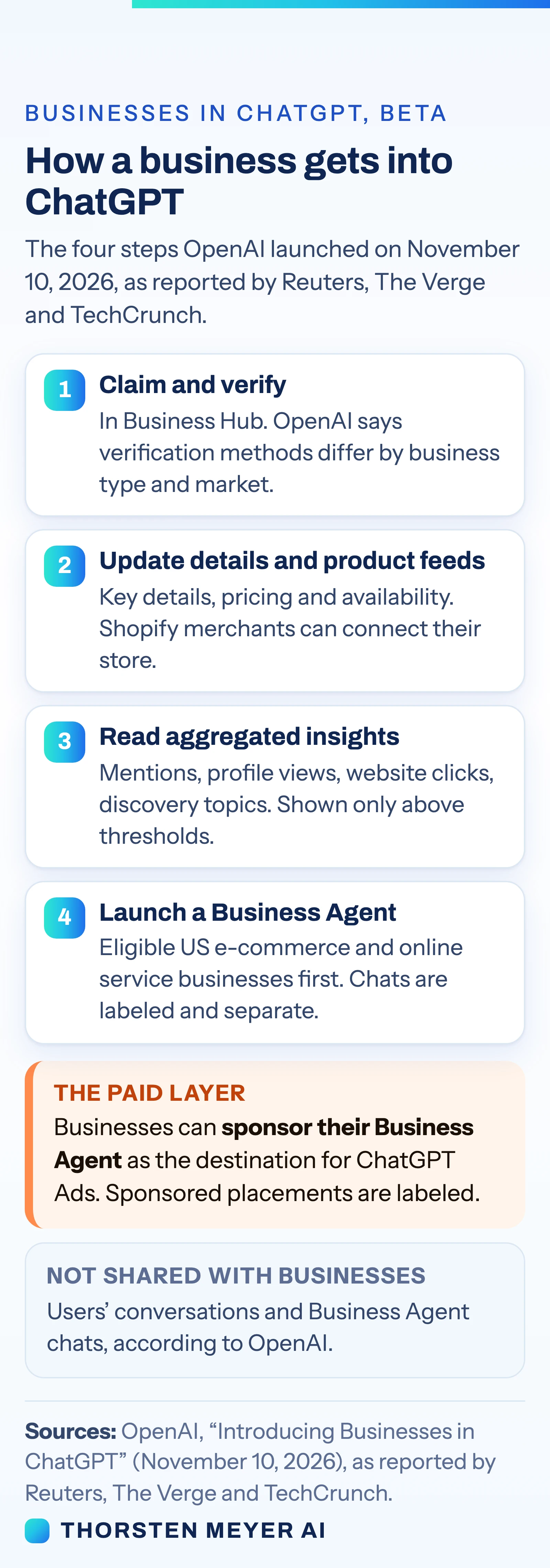
- Business profiles: OpenAI launched Businesses in ChatGPT in beta on November 10. Companies can claim and verify a profile in a Business Hub, update their details, add product feeds with pricing and availability, and see aggregated insights such as mentions, views and website clicks, according to OpenAI as reported by Reuters.
- Business Agents: Eligible e-commerce and online service businesses in the US can launch an AI agent that answers questions about their products inside ChatGPT. These chats are labeled and separate, and a business can sponsor its agent as the destination for ChatGPT Ads.
- Odessia: Founder Francis Davidson announced that OpenAI acquired his AI travel agent startup and that he is joining OpenAI. Terms were not disclosed. An OpenAI spokesperson confirmed the hire to TechCrunch.
- Revenue: The Information first reported that OpenAI’s revenue reached $10 billion in the third quarter. Bloomberg reported growth of nearly 50% over the prior quarter, citing a person familiar with the matter. OpenAI has not published financial statements, but CFO Sarah Friar discussed the quarter in an interview with Yahoo Finance.
- The catch: According to the Wall Street Journal, as reported by Reuters, OpenAI’s operating losses widened to $10.9 billion in the same quarter.
Products Worth Considering

Kindle Paperwhite Signature Edition 32GB E-Reader, 7-Inch Display, Seaglass Green

DJI Mini 3 Drone with DJI RC and 3-Axis Gimbal

Anker SOLIX C1000 Gen 2 Portable Power Station with 200W Solar Panel
As an affiliate, we earn on qualifying purchases.
What OpenAI actually launched
OpenAI’s own announcement is titled “Introducing Businesses in ChatGPT.” Its summary line: “Manage your business information, get insights about how your business shows up, and turn interest into action in ChatGPT.”
Based on OpenAI’s statements as reported by Reuters, The Verge and TechCrunch, the beta has two parts.
Business Hub. A company claims its business in ChatGPT and, once verified, can update key details and add product feeds with pricing and availability. The Hub shows aggregated insights: mentions in ChatGPT responses, profile views, website clicks and the top discovery topics in which the business appears. OpenAI has not explained exactly how verification works. Benji Shomair, OpenAI’s VP of Monetization, told journalists there are “multiple verification methods that we use for different types of business in different markets.” Existing OpenAI Enterprise customers and advertisers can claim their business through their OpenAI representative. Shopify merchants can connect their stores through Business Hub or the Shopify admin.
Business Agents. If a business with an agent appears in a ChatGPT answer, users can open a separate conversation with that agent and ask about its offerings, for example to compare two products. The business writes the agent’s instructions and supplies its context. OpenAI says these chats are clearly labeled and kept apart from the user’s main conversation. At launch, the agents are limited to eligible e-commerce and online service businesses in the US.
Two details matter most for anyone thinking about trust. First, OpenAI said it does not share users’ conversations or Business Agent chats with businesses, and insights only appear once activity passes certain thresholds. Second, businesses can sponsor their Business Agent and use it as the destination for ChatGPT Ads, with sponsored placements labeled. OpenAI’s ad business is not new: in August, the company said ChatGPT Ads had reached $1 billion in annualized revenue run rate.
OpenAI frames the launch modestly. “Today’s announcement is an early step in bringing businesses more deeply into ChatGPT,” the company said, adding: “We’re starting with the foundations: accurate business information, useful insights and conversations that help people make informed decisions.”
TechCrunch also points to history. OpenAI previously tried to turn ChatGPT into a shopping hub with direct checkout and a commission model. According to TechCrunch, that effort did not take off, and OpenAI retired it in March.
What this means for local businesses and for SEO
If you run a shop, a practice, an agency or an online service, the comparison with Google Business Profile is the useful one. The logic is the same. When people ask an assistant for a good plumber nearby or the best running shoe for flat feet, the assistant has to describe businesses using some version of the facts. A claimed, verified profile is a way to make sure those facts are yours and current.
What changes for search and SEO:
- Being mentioned becomes a metric. Business Hub reports mentions, views and website clicks from ChatGPT. That gives businesses a view from OpenAI itself of how they appear in AI answers, even if only in aggregate and only above certain thresholds.
- Product data turns into ranking material. Product feeds with pricing and availability give ChatGPT structured facts to work with. Feeds that are wrong or out of date are now a visibility problem as well as a customer service problem.
- The paid layer is already visible. Sponsored Business Agents as an ads destination means organic answers and paid placements will sit close together. OpenAI says sponsored placements are labeled. How clearly that reads to ordinary users remains to be seen.
- Clicks may become rarer, not more common. A Business Agent answers inside ChatGPT. That can be good for conversion, but it also means fewer people may need to visit your website at all. We looked at OpenAI’s claims about ChatGPT and Google search volume in an earlier reality check, and at what AI answers do to traffic in our piece on Google’s AI Mode.
What OpenAI has not said matters just as much: how ChatGPT decides which businesses to mention, whether a claimed profile or a sponsored agent changes that, and when Business Agents will reach other countries and categories. OpenAI says it plans to expand over time.

Why OpenAI is buying a travel agent
Odessia was young. According to Skift, Davidson unveiled it in June with a team of eight in San Francisco and about $6 million in seed funding led by Sequoia Capital, and it opened to the public on October 14 as a free concierge reached by text. Skift reports that it planned and booked flights, hotels and itineraries in a single conversation, and that its IATA accreditation as a travel agent gave it access to private hotel rates.
On November 10, Davidson announced that Odessia had been acquired by OpenAI and that he would join OpenAI “to focus on the future of travel.” Terms were not disclosed. TechCrunch wrote that the deal looks like an acqui-hire and reports that the Odessia tool has already been shut down. An OpenAI spokesperson confirmed the hire to TechCrunch: “We’re thrilled to welcome Francis to OpenAI.”
The size of Odessia is mostly the founder’s own description. Davidson wrote: “Over $60M/year of travel was planned by Odessia over the past summer by tens of thousands of early adopters.” As Unite.AI points out, that figure describes planned travel, not Odessia’s revenue, and no independent figure has been published.
So why buy it? OpenAI’s spokesperson said travel is one of the areas users frequently ask about: “1.2 billion people turn to ChatGPT each week for help with everyday tasks — from understanding their health, figuring out what to make for dinner, building a budget, and even planning a trip.” Until now, Skift notes, OpenAI’s travel strategy leaned on partners such as Booking.com and Expedia, which were among the first apps inside ChatGPT in October 2025. Odessia brings a team that built a booking agent end to end, plus travel agency accreditation and hotel content.
Read next to the business profiles, the pattern is clear. Profiles and Business Agents let companies come to ChatGPT. An in-house travel agent lets ChatGPT go further down the funnel itself, from where should I stay to an actual booking. OpenAI has not announced any travel product, and TechCrunch reports the spokesperson had nothing more to share.

The $10 billion quarter: what the figure says and what it does not
The revenue figure comes from reporting, not from a filing. OpenAI is a private company and has published no quarterly financial statement. The sequence:
- The Information first reported on November 10 that OpenAI’s revenue jumped to $10 billion in the third quarter, under a headline that also mentioned growing losses. The full article is behind a paywall.
- Bloomberg, as published by The Straits Times, reported that revenue hit $10 billion for the first time in the three months ending in September, up nearly 50% from the prior quarter and nearly threefold from a year earlier. Bloomberg cited a person familiar with the matter and said the figures were shared with investors during a call on November 10. “OpenAI declined to comment,” Bloomberg wrote.
- The Wall Street Journal, as reported by Reuters, cited documents showing that OpenAI’s adjusted operating margin improved to -109% from -150% in the prior quarter, while operating losses widened to $10.9 billion from $10.1 billion.
- OpenAI’s CFO Sarah Friar then discussed the quarter on camera with Yahoo Finance. “Q3 was a blockbuster quarter for us,” she said. According to Friar, the annualized revenue run rate grew 70% quarter over quarter: “So we exited close to about 50 billion in ARR.” She said the enterprise business doubled quarter over quarter, revenue is now split roughly 50/50 between enterprise and consumer, and the consumer business grew 20%. She also said the small business offering grew more in the third quarter than in the prior six quarters.
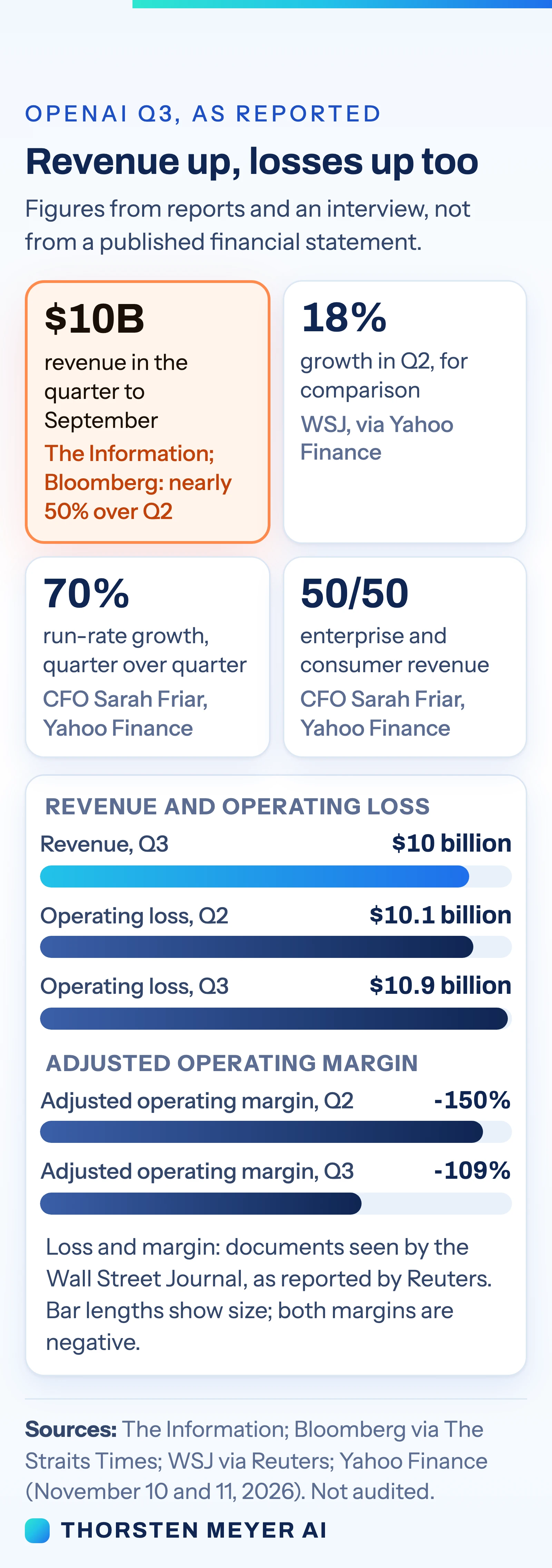
What the numbers do say: OpenAI’s growth has sped up. Yahoo Finance, citing the Wall Street Journal, says growth in the second quarter was 18%. Friar’s comments also connect the quarter to this week’s launches. She named enterprise products as a main driver and singled out the small business offering, the same market Business Hub is aimed at.
What the numbers do not say:
- They are not audited figures. They come from investor materials seen by reporters and from an interview, not from a published financial report.
- Run rate is not revenue. “Close to about 50 billion in ARR” extrapolates the pace at the end of the quarter. It is not money already earned.
- Revenue does not mean profit. On the WSJ figures, the operating loss in the quarter was larger than the revenue. Yahoo Finance noted that OpenAI’s latest numbers say nothing about how much it spends on computing power.
- Comparisons with rivals are tricky. Bloomberg notes that Anthropic reported third-quarter revenue of about $17 billion, but adds that OpenAI and Anthropic have historically calculated revenue differently. The two figures are not directly comparable.
For more on how the money behind the AI build-out is being raised, see our earlier look at OpenAI’s funding round.
What it means for businesses
- Check if you can claim your business. If you are eligible, claiming and verifying your profile is cheap insurance against ChatGPT describing you with outdated facts. Keep opening hours, services and prices consistent with your website and your Google listing.
- Treat product feeds as a storefront. If you sell online, inaccurate pricing or availability in a feed can now cost you mentions in AI answers.
- Measure before you pay. Mentions, views and clicks from Business Hub are a baseline. Look at those numbers before you buy sponsored placements. Insights are aggregated and only appear above thresholds, so small businesses may see little data at first.
- Watch the ads line. If competitors sponsor their Business Agents, the space for unpaid visibility may shrink. That is how search advertising developed. Whether AI answers follow the same path is still open.
- Travel and booking businesses: OpenAI now has its own team for booking agents. Partners like Booking.com and Expedia are inside ChatGPT, but the Odessia deal shows OpenAI also wants to build its own capabilities.
What it means for users
- A Business Agent speaks for the business. It is labeled and kept separate, but it is not a neutral adviser. Its instructions come from the company it represents.
- Look for the sponsored label. OpenAI says sponsored placements are labeled. Treat a sponsored agent the way you would treat a search ad.
- Your conversations stay private, OpenAI says. According to OpenAI, businesses do not receive users’ conversations or Business Agent chats, only aggregated insights above thresholds.
- Check the facts before you book. Even with verified profiles, an AI answer is not a contract. Confirm prices, availability and cancellation terms with the business itself.
What is not known
- How ChatGPT decides which businesses to mention, and whether claimed profiles or sponsored agents influence organic answers.
- Exactly how verification works. OpenAI only says the methods differ by business type and market.
- When Business Agents will reach businesses outside the US, and how sponsored agents are priced.
- What OpenAI paid for Odessia, and what it will build in travel.
- OpenAI’s audited revenue, its computing costs, and how its revenue definition differs from those of its rivals.
Sources
- OpenAI: “Introducing Businesses in ChatGPT”, November 10, 2026 (OpenAI news feed entry; the page itself was not machine-readable when we checked)
- OpenAI: “A milestone in expanding access to AI” (ChatGPT Ads), August 31, 2026 (OpenAI news feed entry)
- Reuters via CNA: “OpenAI lets businesses claim ChatGPT profiles, adds AI agents for US e-commerce firms”, November 10, 2026
- The Verge: “ChatGPT is getting verified AI ‘Business Agents'”, November 10, 2026
- TechCrunch: “OpenAI rolls out new business profiles, making ChatGPT just a little bit more like Google”, November 10, 2026
- PYMNTS: “OpenAI Gives Businesses New Tools to Reach ChatGPT Users”, November 10, 2026
- TechCrunch: “OpenAI acquires Odessia, travel startup created by Sonder founder”, November 10, 2026
- Skift: “OpenAI Acquires Odessia, the AI Travel Agent From Sonder’s Co-Founder”, November 10, 2026
- The Tribune: “OpenAI acquires AI travel startup Odessia; founder Francis Davidson to join team”, and Unite.AI on the same deal (quoting Davidson’s announcement)
- The Information: “OpenAI Revenue Jumps to $10 Billion in Third Quarter Amid Growing Losses”, November 10, 2026 (paywalled; headline only)
- Bloomberg via The Straits Times: “OpenAI Q3 revenue soars nearly 50% to US$10 billion”, November 11, 2026
- Reuters via CNA and The Hindu: “OpenAI posts steep losses even as quarterly revenue rises to $10 billion, WSJ reports”, November 10 and 11, 2026
- Yahoo Finance: “OpenAI CFO: Q3 was a ‘blockbuster quarter,’ revenue jumped 50%” (article and video interview transcript), November 10, 2026
Researched and drafted with AI assistance, including Anthropic’s Claude. Anthropic, a competitor of OpenAI, is mentioned in this article. Neither OpenAI, Anthropic, Odessia nor any company named here reviewed or sponsored this article, and it contains no affiliate links. Revenue figures are as reported by the named outlets; this is not investment advice. Statements as of November 11, 2026. Images: AI-generated illustration (Runware) and graphics by Thorsten Meyer AI; no real people or logos are shown.